Teruaki Sato’s card market is being asked to price possibility as much as production. The Hanshin Tigers hitter is coming off an NPB Triple Crown season in which he hit .306 with 39 home runs and 106 runs batted in, following a prior season with 40 home runs and 102 RBI. That two-season power output has put his cards in a different kind of spotlight: collectors are not simply looking back at a completed career, but trying to judge what could happen if he plays in Major League Baseball.
That distinction matters. A player’s move from Nippon Professional Baseball to MLB can create a fresh audience, more coverage and a much larger pool of prospective collectors. It does not, however, make an overseas transition automatic, nor does it turn every early card into a permanent premium. Sato has not yet played an MLB game, and his next club remains uncertain. The available prices therefore show interest and expectation, rather than a settled long-term market.
Recent reporting on Sato’s post-Triple Crown card attention similarly illustrates how quickly a major NPB season can turn a player’s cards into a wider collecting conversation. The key is separating the attributes that make individual cards scarce from the broader narrative that may be lifting the whole market.
Why Sato’s season has collectors watching
A Triple Crown is the achievement of leading a league in batting average, home runs and RBI. Each category describes a different element of offensive performance: batting average records hits per at-bat; home runs capture over-the-fence power; and RBI measure runs driven in. Winning all three makes for an unusually clean headline, even before considering Sato’s 39-homer, 106-RBI, .306 line.
For more context, explore GTA 6 Is Building Pedestrian Dialogue as a Core Part of Its Open World, Not Background Noise.
For cards, that headline arrives alongside a useful recent baseline. The previous season’s 40 home runs and 102 RBI mean the 2026 campaign was not presented as a single isolated power spike. That does not predict MLB performance, but it explains why collectors may view his current production as a trend rather than a one-year curiosity.
NPB-to-MLB movement also has a long and meaningful history. Masanori Murakami became the first Japanese-born player to reach MLB in 1964, pitching in relief for the San Francisco Giants for two seasons after two NPB seasons. He returned to NPB and pitched there for 16 years before retiring. Later players who made the move include Hideo Nomo, Ichiro Suzuki, Hideki Matsui, Masahiro Tanaka, Munetaka Murakami and Shohei Ohtani.
Those names help explain the attention, but they should not be used as a shortcut to a valuation. Every player arrives in different circumstances, with a different role, club, performance level, card checklist and supply profile. Comparisons can establish that there is collector interest in Japanese stars; they cannot establish that Sato’s cards will follow another player’s price path.
Related coverage includes Teruaki Sato Card Market Heats Up After Triple Crown Season in Japan.
The four benchmark Sato card sales
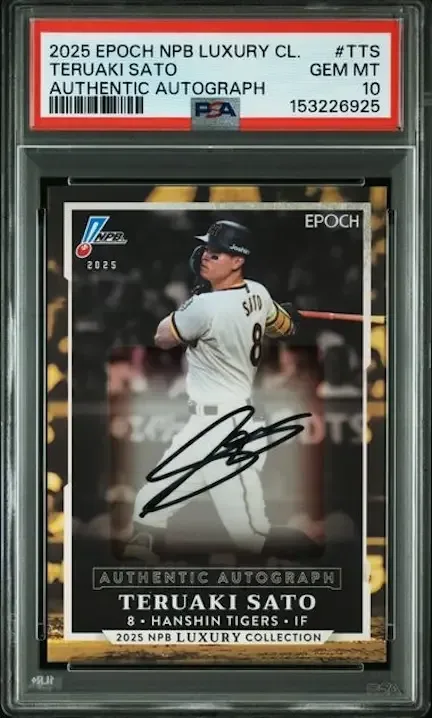
1. 2025 EPOCH Authentic Autograph /39, PSA 10 — $2,450
The highest reported sale among Sato cards is a 2025 EPOCH Authentic Autograph numbered to 39, graded PSA 10, which sold for $2,450 on August 19, 2026. Its appeal is easy to identify from the card description: it combines an autograph, a very limited serial number and a top grade.
“/39” means the card is one of 39 copies in that numbered run. Serial numbering is not a universal measure of desirability by itself, but it makes the supply constraint legible. An autograph adds another layer of differentiation from a standard printed card, while a PSA 10 denotes a card receiving the grading company’s highest numeric grade. For collectors, that makes this sale a benchmark for a particularly premium version of Sato rather than a benchmark for all of his cards.
It is also worth resisting a common mistake: a $2,450 sale does not mean every ungraded or lower-grade copy should be treated as close to that figure. Grade, card condition, the scarcity of the specific parallel and the autograph all matter at once.
2. 2019 Panini Stars & Stripes Autograph Patch /13 — $2,200
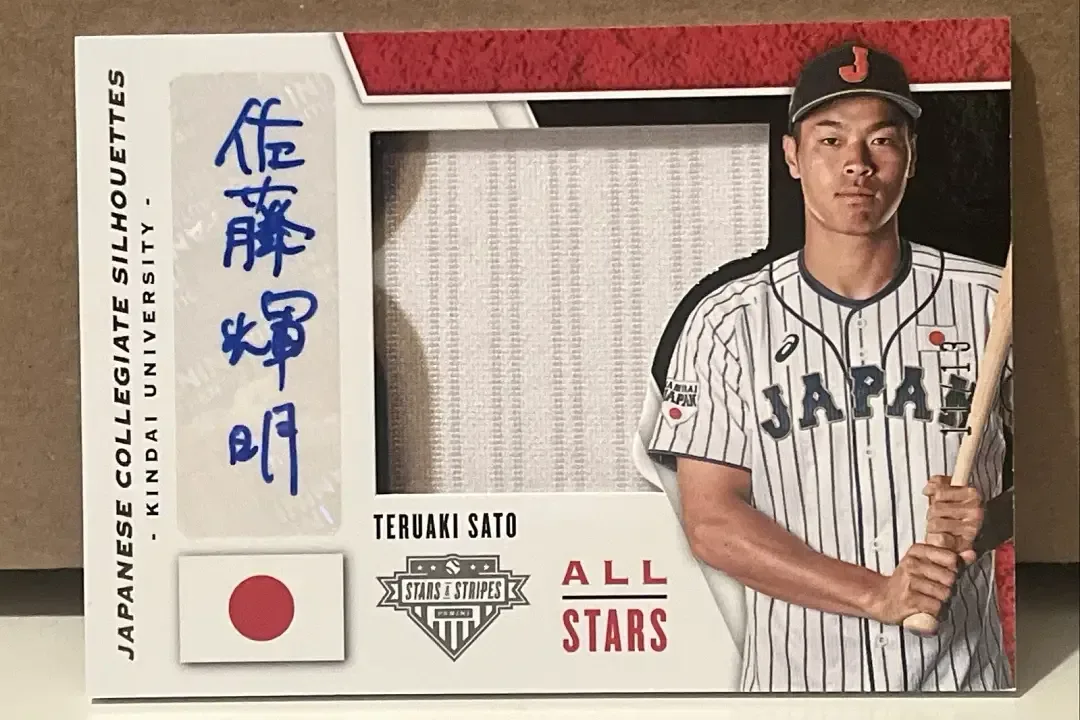
The second-highest reported sale is $2,200, recorded on July 8, 2026, for a 2019 Panini Stars & Stripes Autograph Patch numbered to 13. This card’s /13 serial number is much smaller than /39, and it pairs a signature with a patch element.
A patch card includes a piece of material as part of the design. Collectors often distinguish patch cards from ordinary memorabilia cards because the patch can make the card visually distinct, though the supplied sale information does not establish further details about the material or its provenance. The important point here is narrower: this is an autograph-and-patch card with only 13 numbered copies, and it traded near the top of Sato’s reported market.
The $250 difference between this sale and the PSA 10 EPOCH autograph is not a simple ranking of which card is “better.” The EPOCH card has a PSA 10 grade and is numbered to 39; the Panini card is numbered to 13 and has a patch. Different collector priorities can produce close results for cards with very different configurations.
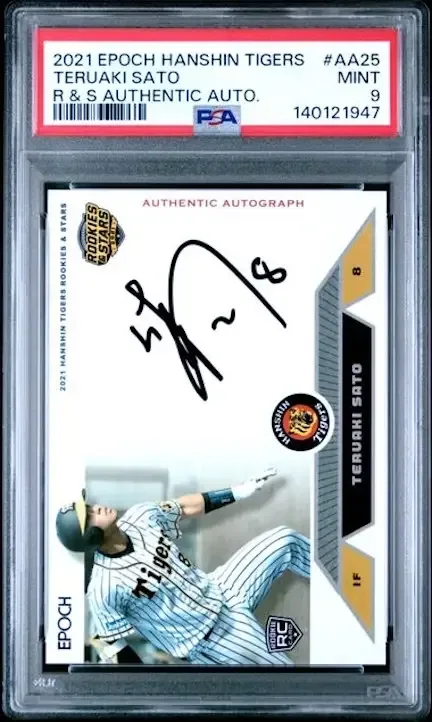
3. 2021 BBM Hanshin Tigers Rookies & Stars RC Auto /39, PSA 9 — $2,000
Third is a 2021 BBM Hanshin Tigers Rookies & Stars rookie-card autograph numbered to 39 and graded PSA 9. It sold for $2,000 on July 8, 2026. The “RC” designation identifies it as a rookie card, a category that frequently commands special attention because it is tied to the early stage of a player’s card career.
Here, the market is valuing several clear attributes: rookie-card status, a signed card, limited numbering and third-party grading. PSA 9 is a high grade, but it is not the same as PSA 10. That distinction is one reason collectors should not flatten prices into a single “Sato autograph” figure. A rookie autograph can carry a different collecting appeal from a later-year autograph, and a grade difference can matter significantly to buyers who focus on condition.
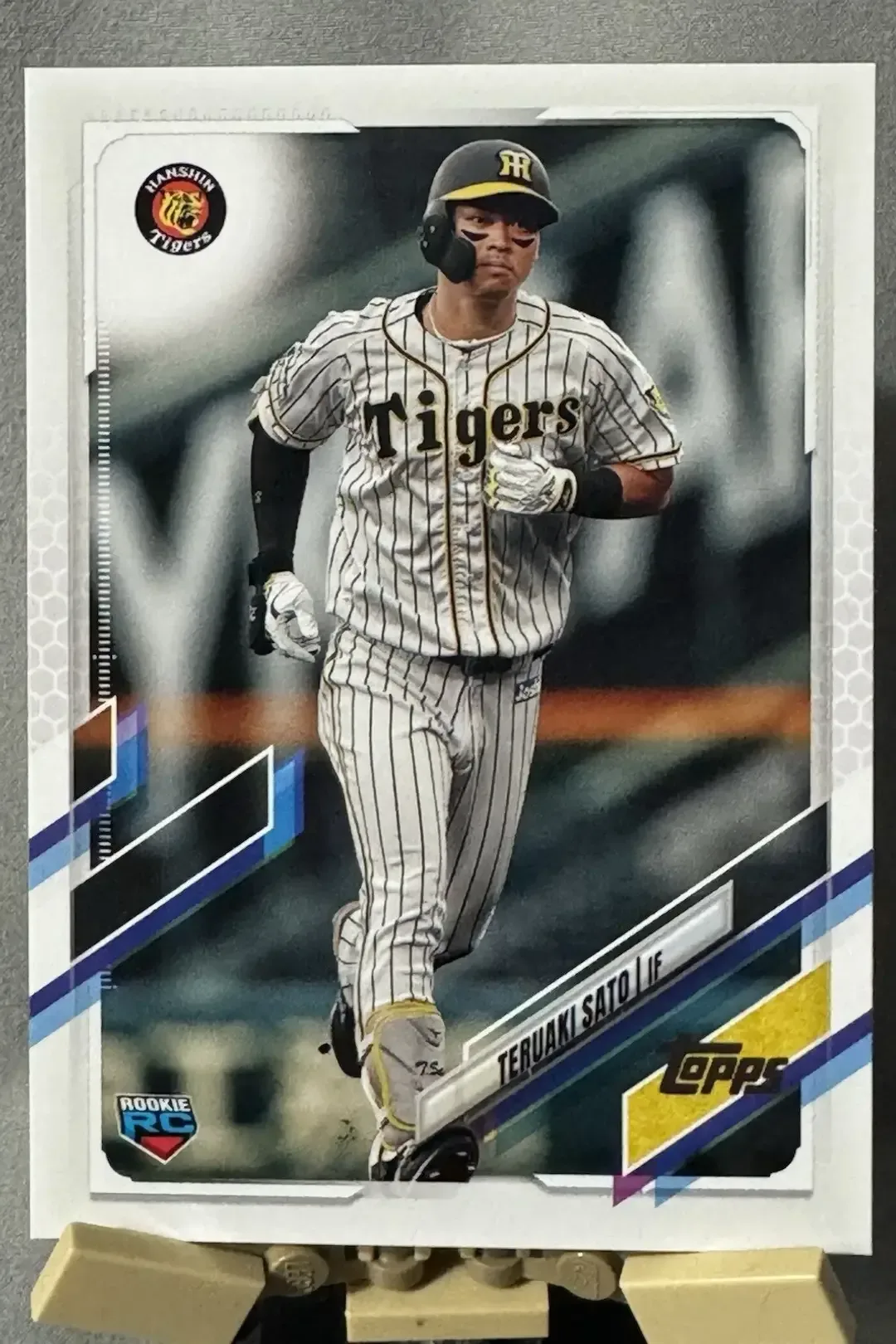
4. 2021 Topps NPB Hanshin Tigers #N16 — roughly $25
The fourth card is the accessible entry point: the 2021 Topps NPB Hanshin Tigers #N16 rookie card. It has been available at roughly $25, while the Topps Chrome version sits around $50 and the Topps Chrome Refractor around $150.
These three figures show how card treatments create tiers even around the same player and rookie-year theme. Topps Chrome is a separate card format from the standard Topps issue, and a Refractor is a parallel treatment within the Chrome line. The supplied market figures place the Chrome card above the standard version and the Refractor well above both. That does not establish that one is inherently the best choice; it establishes that buyers are paying differently for variations with different perceived scarcity and finish.
What the price gaps actually tell collectors
Sato’s reported market currently divides into two broad lanes. At the premium end are low-numbered signed cards, including cards with grades or patch elements, selling from $2,000 to $2,450 in the reported examples. At the entry end are recognizable 2021 Topps rookie cards at roughly $25 to $150 depending on version.
That spread is practical. A collector interested in the player but unwilling to commit four figures can identify a standard Topps rookie card as the lower-cost route. A collector seeking scarcity may be drawn to a numbered autograph or patch card, but should recognize that a small number of high-end sales is not the same thing as constant, deep demand. Limited cards can be hard to find when interest rises and can also be hard to resell quickly because there are fewer directly comparable transactions and fewer possible buyers.
Condition adds another layer. A third-party grade packages an opinion on a card’s condition into a numerical label, creating a readily understood difference between otherwise similar cards. The highest reported Sato sale was a PSA 10, while the $2,000 BBM rookie autograph was PSA 9. Raw, or ungraded, examples should not be assumed to match graded sales simply because their card name and serial number are similar.
The MLB question is the market’s central uncertainty
Sato is expected to seek his next team for the next MLB season, but neither his destination nor his MLB results are known. Speculation around possible large-market landing spots may make for exciting conversation, yet it is not a substitute for a signed destination or on-field performance. Geography, lineup fit, playing time, adjustment to a new league and team success could all change the attention surrounding a player, but none of those outcomes are established here.
There is a second stated risk: a possible MLB strike. If a labor stoppage occurred, it could reduce or delay the games and exposure that speculative buyers may be anticipating. Since Sato has not played an MLB game, much of the upside case depends on events that have not happened. A major postseason contribution for a club such as the Yankees would likely draw attention, but that is a hypothetical, not a current fact.
For collectors, the most useful approach is to be precise about what is being bought. A $25 base rookie is a different proposition from a $2,450 PSA 10 autograph /39. The former offers a lower-cost connection to Sato’s early card catalog; the latter is a scarce, graded premium card whose price is already reflecting substantial attention. Neither purchase removes the uncertainty around an MLB transition.
A measured way to follow the market
- Match the sale to the exact card. Compare serial number, autograph status, patch status, year, brand and grade rather than relying on the player name alone.
- Distinguish a sale from a listing. The reported figures are completed-sale benchmarks; an asking price is only a seller’s expectation.
- Do not treat one premium sale as a universal comp. The PSA 10 EPOCH /39, the /13 patch autograph and the PSA 9 BBM rookie autograph each have materially different traits.
- Keep the timeline in view. Sato’s recent NPB performance is established, but his MLB club and MLB performance are not.
- Collect within a defined budget. The 2021 Topps NPB rookie, Topps Chrome and Chrome Refractor give collectors visible lower-price reference points without equating them to scarce signed cards.
Sato’s market has a clear early shape: high-end scarcity is already producing four-figure transactions, while his 2021 Topps rookie issues provide a more approachable route into the player. His Triple Crown season and consecutive 100-RBI power campaigns supply the sporting case for the interest. The eventual answer to the larger card-market question, though, depends on the next phase of his career rather than the excitement already attached to it.