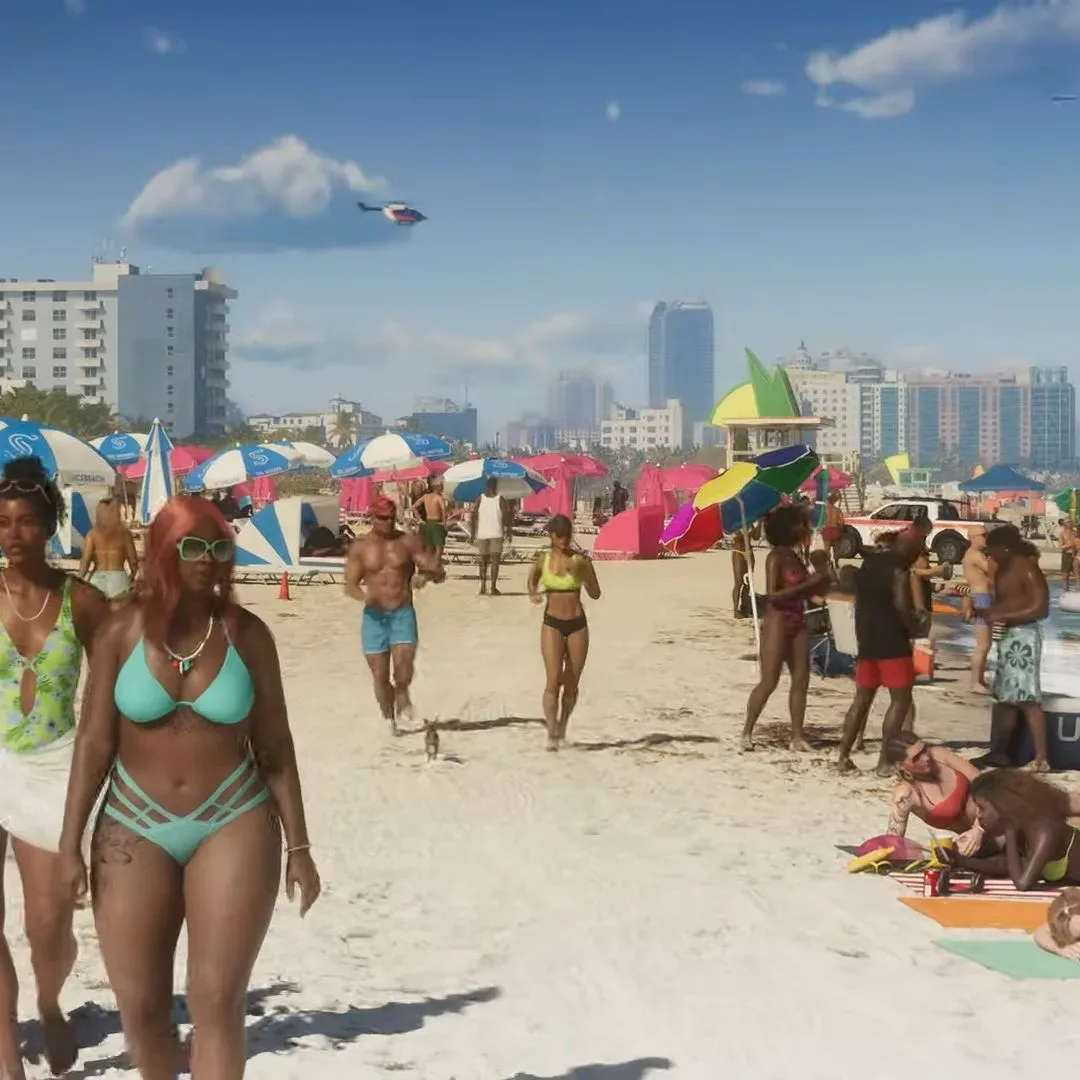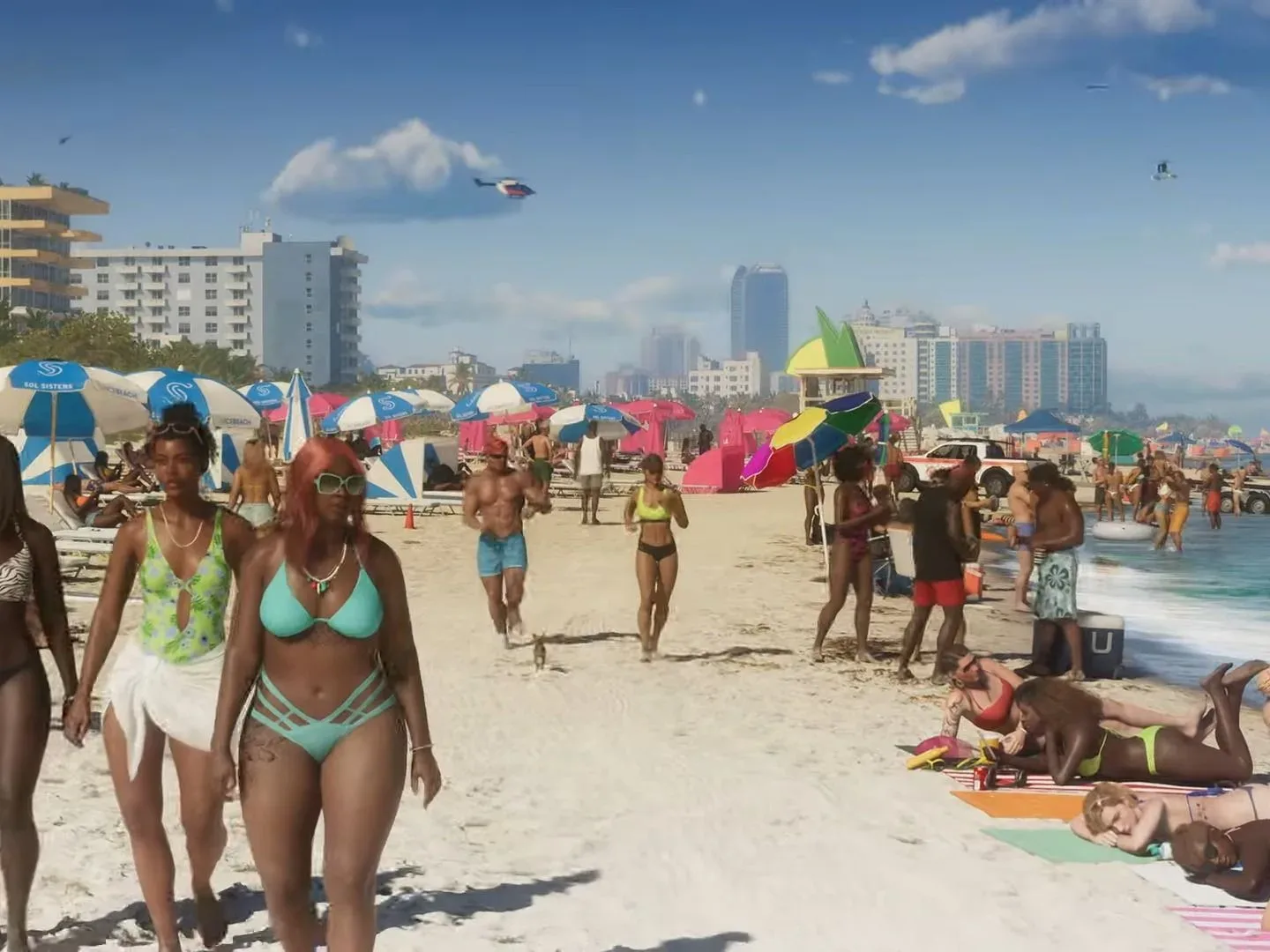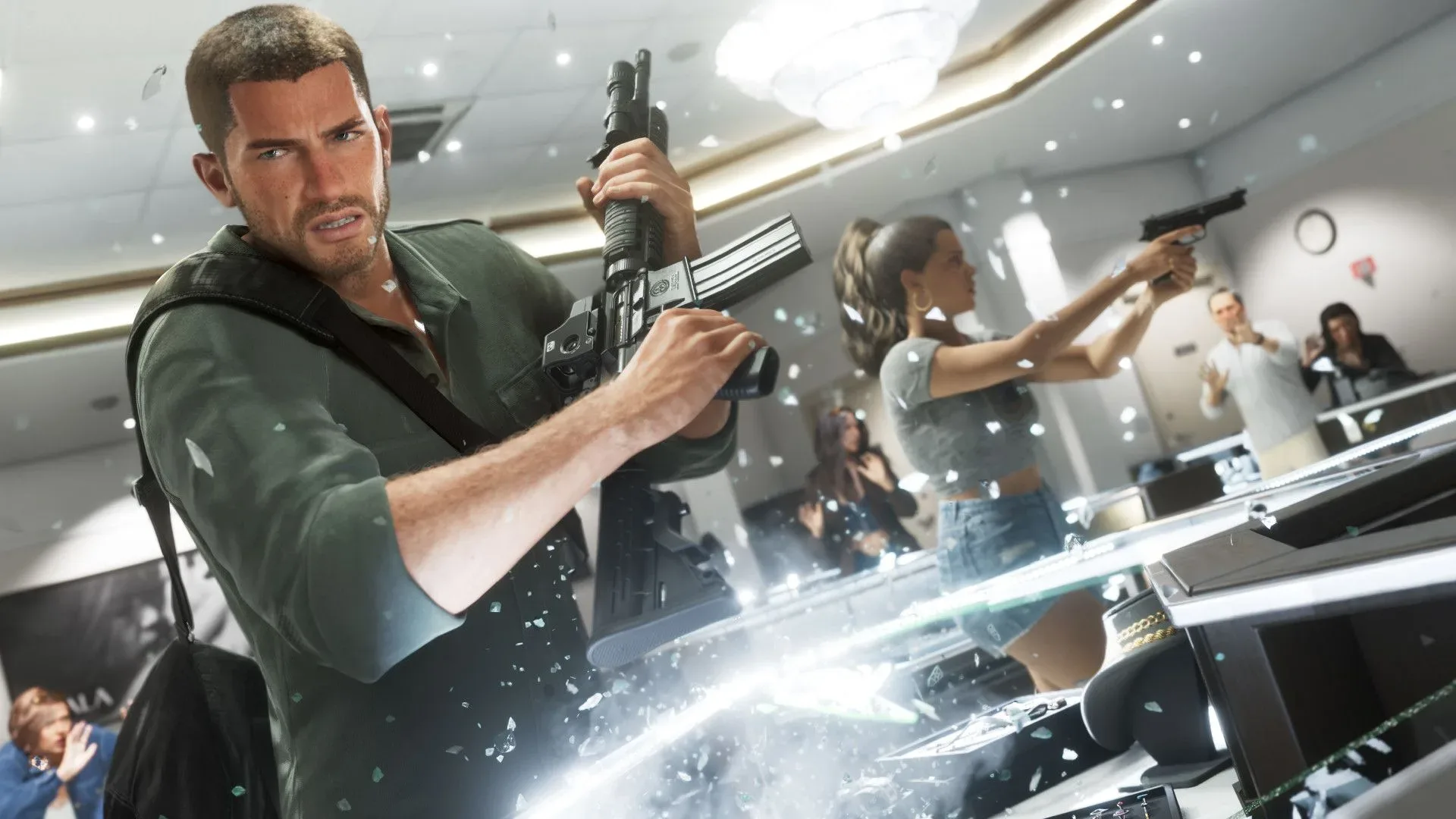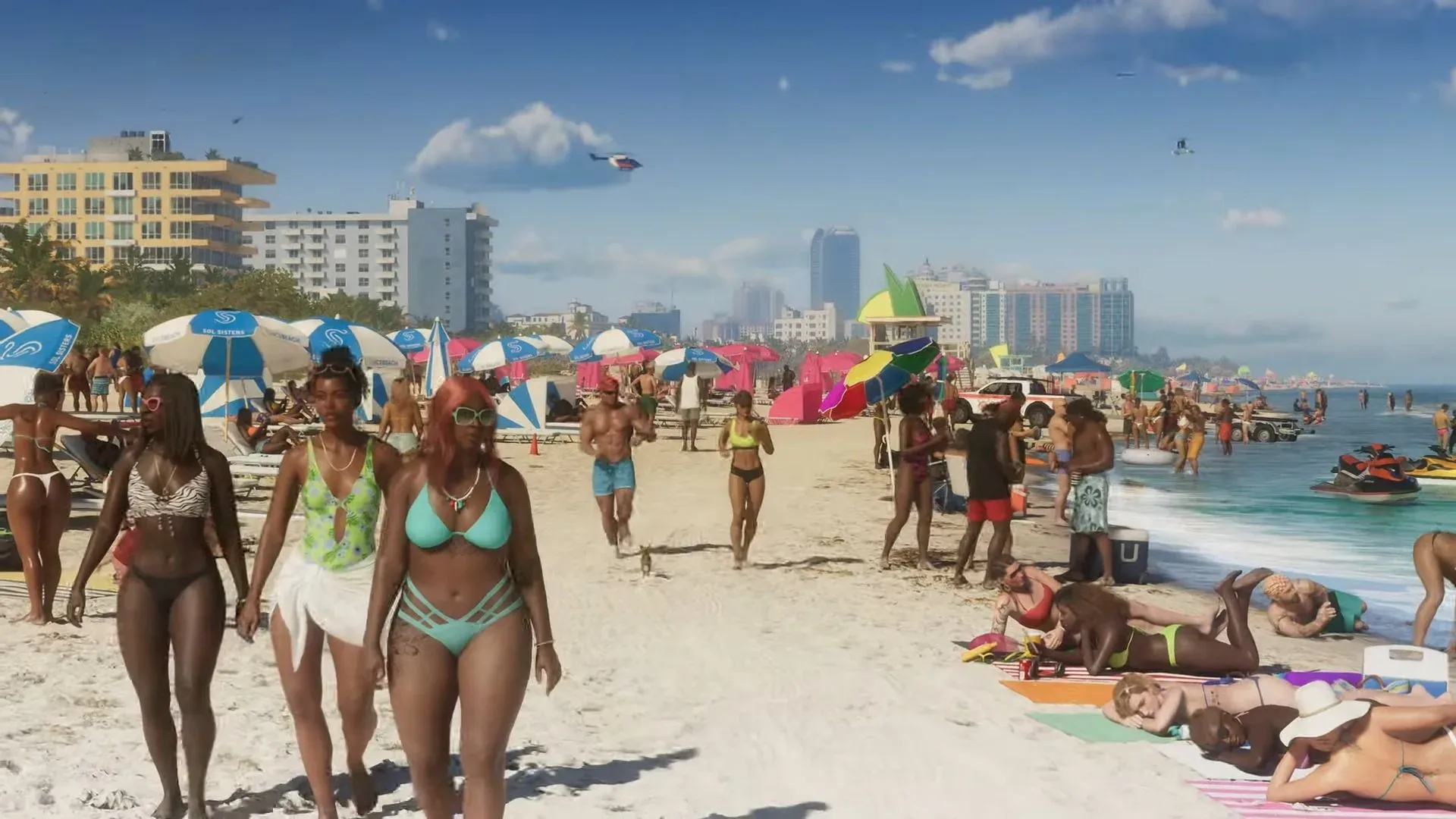
Grand Theft Auto 6’s city is being written down to the level of the people players may only hear for a few seconds while passing them on the street. Rockstar says it has a dedicated team for pedestrian dialogue, supported by advertising and comedy writers working across Los Angeles, New York and London.
That may sound like an extravagant investment in ambient chatter, but the creative leads describing the work frame it very differently. In their view, the passing conversations, fake advertisements and jokes encountered around the city are not disposable decoration around the missions. They are part of the simulation of place: the material that helps a busy street feel like somewhere with its own culture, tensions and oddities rather than a level built solely for the player.
Rockstar senior vice president of narrative Rupert Humphries described an “amazing team of writers and creatives” assigned to the background material that makes the world feel alive. More specifically, he identified a pedestrian-dialogue team in Los Angeles, plus advertising and comedy writers spread across Los Angeles, New York and London.
“None of us see it as background,” Humphries said of the work, describing it as part of the game’s larger tapestry.
A dedicated job for the voices at the edge of the screen
In game-development terms, pedestrian dialogue is the spoken material associated with non-player characters, or NPCs, moving through the world outside of scripted story scenes. It can include fragments of conversations, reactions to nearby events, one-sided comments and other bits of overheard speech. The supplied details do not specify how GTA 6 will trigger, vary or record this dialogue, so it would be premature to infer particular systems or quantities. What is clear is that Rockstar has assigned writers specifically to it.
That organizational choice matters because ambient writing has different demands from mission writing. A mission scene can establish who is speaking, why the player is there and what information must be delivered. Street-level dialogue has to do its work quickly. A listener may catch only a line while running past. Another player may stop, observe and expect the exchange to withstand closer attention. The text needs to sound plausible in fragments while still rewarding curiosity.
James Horton, Rockstar’s open-world writing director, directly described those two conditions. The city’s writing should, he said, wash over a player moving through a crowded street and hearing pieces of many conversations. Yet an individual exchange should remain convincing when a player chooses to focus on it.
That is a useful way to understand the intended experience. The objective is not simply to fill silence with more voices. It is to make the city readable at two speeds:
Related coverage includes GTA 6 Builds Dedicated Writing Teams for Pedestrians, Ads and Comedy.
- At movement speed: dialogue contributes tone, rhythm and the impression of density without demanding that the player stop.
- At observation speed: a player who lingers should find speech that feels intentional rather than like an obviously repeated sound effect.
Horton’s point is especially relevant to an open-world game, where players determine the camera, pace and route. One person may race through an area toward an objective; another may wander and listen. A line that is acceptable only as indistinct noise can undermine the illusion for the second player. Conversely, dialogue written as if every line will receive full attention can become too prominent or artificial for the first. Writing for both uses is a narrow target.
Why advertising and comedy belong in the same world-building plan
Humphries also singled out teams focused on advertising and comedy. Those areas fit the series’ longstanding interest in presenting a satirical version of contemporary public life, but the important news here is the level of staffing Rockstar says it has devoted to them for GTA 6.
In-world advertising refers to material presented as though it belongs to the fictional setting: promotional copy, slogans and other media that characters in that world might encounter. It can establish what a city sells, fears, celebrates or mocks. Comedy writing, meanwhile, can shape the cadence of that material and of the public conversations around it. Humphries said the group shares an interest in having fun with the absurdities of people, media and advertising.
That emphasis carries a practical benefit for a giant setting. Missions generally tell players what is important to the plot. Ambient media can suggest what is important to everyone else. An advertisement, stray remark or joke can make a location feel socially specific without stopping the game for an explanation. It is compact storytelling, and it is also difficult storytelling: it must communicate character while sounding like it belongs in the world rather than like an author stepping outside it to explain a theme.
The arrangement across three cities also suggests a deliberate attempt to draw on writers with differing perspectives and backgrounds, though Rockstar has not outlined the exact process through which those teams collaborate or how dialogue is selected for use. Humphries stressed the variety of backgrounds within the broader group. That diversity is relevant to a project seeking the feel of a crowded public space, where a city should not sound as though it is being voiced by a single narrowly defined viewpoint.
“No background” is a design philosophy, not a promise of endless simulation
Horton went further than calling these details important. He argued that GTA 6 has, in a sense, no true background. What counts as foreground or background changes with the player’s attention. If someone decides that a random pedestrian is worth watching, that character becomes the focus of that moment.
It is a compelling description of open-world design because it recognizes a basic fact about player behavior: creators cannot fully decide what will matter. A main character may be central to a scripted narrative, but a player can become interested in a passerby, storefront, radio segment or odd interaction that the critical path barely acknowledges.
Horton said Rockstar’s ambition is that no person encountered feels like an “extra,” and that each character should register as the main character of their own story. This should be read as an artistic standard for how the world is presented, rather than a technical claim that every NPC has a fully authored life story. The information available does not detail character simulation, routines, branching interactions or individual narrative depth. It does show that Rockstar wants even incidental characters to be treated as meaningful components of the city’s texture.
That distinction is important. Marketing language around huge open worlds can easily be taken as a promise of unlimited bespoke content. The more grounded takeaway is still significant: Rockstar says it is resourcing the writing of incidental encounters rather than treating them as a late-stage layer of generic ambience.
The production challenge behind small moments
“There are no shortcuts” was Horton’s description of building a world at this scale. His explanation focused on giving the appropriate people the resources to create something broad and varied, but also believable under close scrutiny.
For writing, this means the small moments cannot simply be assumed to take care of themselves once the major story is finished. A street conversation has to be conceived, written, placed and integrated into a larger tonal picture. Advertising and comedy need to feel connected to the setting without becoming identical. Even before considering performance or implementation, the creative challenge is one of volume without monotony.
A believable crowd does not necessarily mean every voice must explain the game’s world. In fact, many of the most effective ambient details will likely be incomplete: the snatch of a disagreement, a strange claim, a sales pitch or a passing observation. Horton’s description of players hearing “snatches” of many conversations points toward this fragmented quality. The player supplies the rest of the context, just as they would while walking through a real busy street.
There is also a tonal balance to maintain. GTA’s satire is broad by design, but a city made entirely of punchlines risks sounding staged. Humphries’ comments indicate that comedy is part of a wider blend that includes pedestrian speech and in-world advertising, not necessarily the only purpose of either. The goal appears to be a place that can be ridiculous while remaining internally convincing.
What players can reasonably take from this
The immediate implication is that wandering may be treated as more than downtime between missions. Players who listen closely could find texture in the streets, while players focused on driving or objectives should still absorb a general sense of activity. That is the dual-purpose standard Horton described: the material needs to work when it is barely noticed and when it is examined.
It also provides a clearer explanation of why the writing side of an open-world production can extend beyond story missions and named protagonists. The narrative department’s remit, as described here, reaches into the city’s ordinary voices and its fictional media. Rockstar is treating the setting itself as something that must communicate continuously.
There is still plenty that has not been established. Rockstar has not, in the material provided, revealed how much pedestrian dialogue there is, whether conversations respond dynamically to player actions, how often lines repeat, or what platforms will receive the game. It has also not supplied examples of the finished writing. Those are meaningful unknowns, and the quality of the final result will depend on execution rather than staffing alone.
Still, the creative rationale is unusually explicit. GTA 6’s writers are being asked to make a world that holds together whether it is seen in a blur or inspected at street level. For players, that means the casual voice from the sidewalk may be designed not as filler, but as one more invitation to pay attention. For broader GTA 6 context, including questions around the hardware landscape, see our look at PS5 Pro supply pressure and GTA 6 demand.