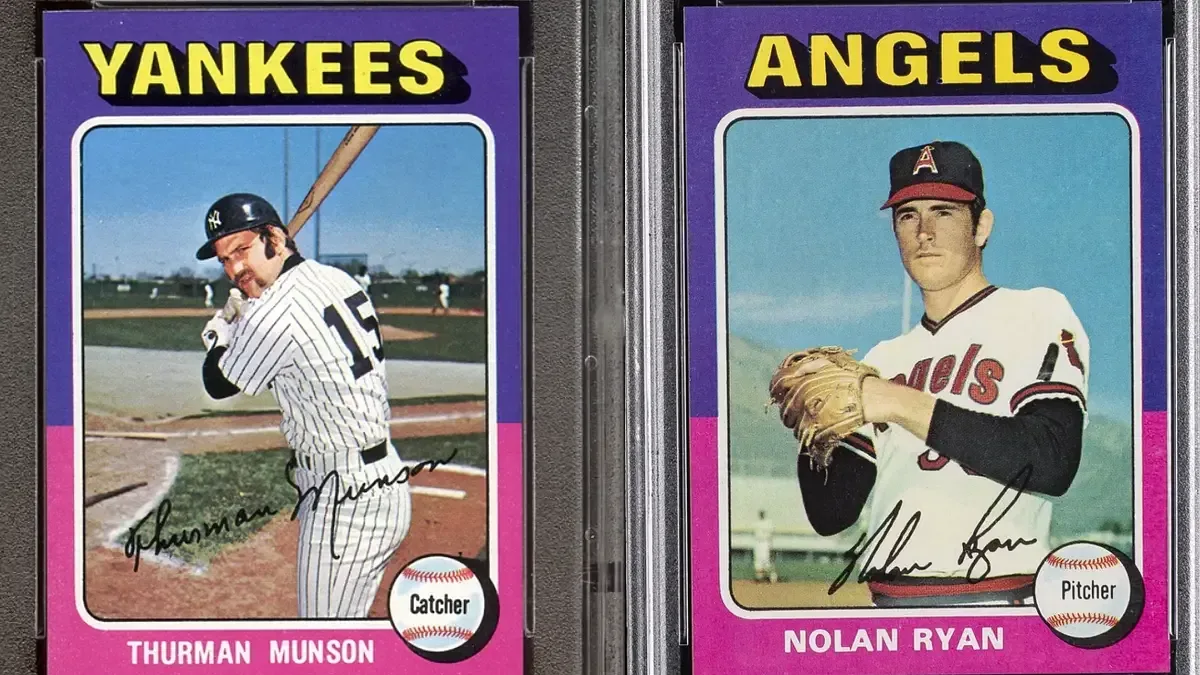
The 1968 Topps baseball release is a vintage set with the aesthetic confidence of a choice nobody talked the designer out of. Its speckled brown frame has been likened to burlap and period kitchen wallpaper, and it is unlike the comparatively restrained Topps designs that came immediately before it. Yet collectors keep coming back to the 598-card issue for much more than the border.
It is a set packed with consequential players, from established legends Mickey Mantle, Hank Aaron, Roberto Clemente and Willie Mays to emerging stars Johnny Bench, Tom Seaver and Nolan Ryan. It also has an unusually complicated collecting story. The regular Topps cards sit beside Milton Bradley Win-A-Card versions, a tiny 3-D test issue, and a 33-card game subset. For a collector, that means “1968 Topps” can describe a main set, a variation hunt, a scarce experiment, or all of the above.
At the center is Nolan Ryan/Jerry Koosman #177, a shared rookie card whose top-grade auction result reached $600,000 in 2020. But the full set rewards a more nuanced look at condition, player legacy, printing variations and the difference between a headline sale and an attainable example.
Why the 1968 design uses older photographs
The familiar-looking images were not merely a nostalgic art decision. During a dispute between Topps and the Major League Baseball Players Association, players were told not to pose for new photos while the sides worked toward an agreement. Topps consequently returned to its existing photo archive for images used in the 1968 issue.
That background makes the set a physical record of a business constraint as well as a baseball season. A card’s photograph may reflect an earlier moment than the year on its front, an important detail for collectors who enjoy the visual history of the hobby instead of treating cards solely as player checklists.
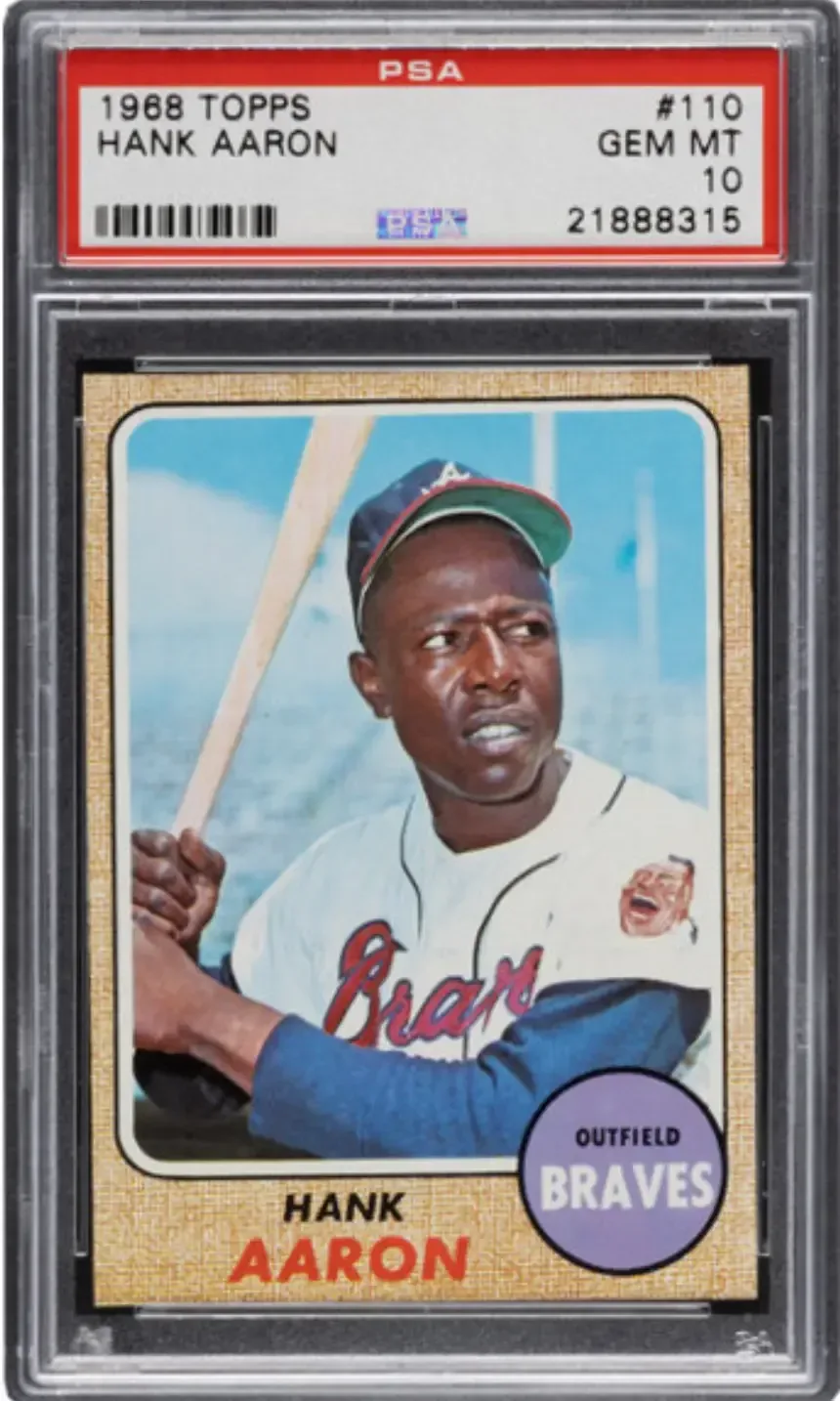
The brown borders have another practical implication: condition can be unforgiving. Edge and corner wear become especially visible against a dark, busy surround. Hank Aaron #110 illustrates the point. Only five copies have received a PSA 10 grade, with chipping noted as a major obstacle. A PSA 10 sold for $174,000 in 2023, while an earlier PSA 10 sale in 2017 was $10,600. Those two results are a sharp reminder that individual sales—even for the same numerical grade—are not a universal price guide.
PSA, or Professional Sports Authenticator, assigns grades on a 1-to-10 scale to cards it evaluates. A PSA 10 is a top grade; a PSA 7 is a materially different condition tier, not simply a lightly discounted 10. Reported PSA 7 values for the featured cards offer a useful mid-grade reference point, but collectors should still distinguish an estimated value from a completed sale of a specific copy. Centering, surface wear, print defects, eye appeal and buyer competition can all change the outcome.
The six cards that lead the conversation
1. Nolan Ryan / Jerry Koosman rookie card #177
The defining card of the set is the Nolan Ryan and Jerry Koosman rookie card. Ryan’s long career—spanning 1966 to 1993—ended with 5,714 strikeouts and seven no-hitters, explaining why his rookie is routinely treated as one of the signature baseball cards of the 1960s. A lone PSA 10 copy sold for $600,000 in 2020. The reported PSA 7 value is $6,100, while a PSA 3 is listed at $1,227; 21,151 examples appear in the cited PSA population.
The shared format is central to the card’s character. Multi-player rookie cards were common in the 1960s, and Koosman was no afterthought at the time: he won 19 games as a 1968 rookie and made the All-Star team. Ryan, 21 in 1968, had logged only three major-league innings before the season. He went 6-9 with a 3.09 ERA and struck out 133 in 134 innings, showing the electric strikeout ability that later defined his career while still experiencing control issues.
Variation collectors have an added challenge. Four versions are associated with the Ryan rookie: the standard Topps card, a Milton Bradley version, the Canadian O-Pee-Chee version, and the scarcer Venezuela Topps version. Together they are often called the “Nolan Ryan Four Horsemen.” The regular Topps card may be the starting point, but the broader chase is about identifying exactly which issue is being offered rather than assuming every #177 is equivalent.
2. Mickey Mantle #280
Mickey Mantle #280 is his final Topps card from an active playing career. Although Mantle appeared on a 1969 Topps card, he attended spring training and then retired before the 1969 season. That distinction gives the 1968 card a special place: it is the final cardboard snapshot tied to his on-field career.
Mantle was 36 in his final 1968 season and hit .237 with 18 home runs, but he drew 106 walks and posted a .385 on-base percentage. His performance supplies useful context for the card. It is not positioned around a final burst of traditional batting-average numbers; it marks the end of a career in which his ability to get on base remained formidable.
A PSA 10, with 11 such examples in the cited population, sold for $510,000 in 2023. The reported PSA 7 value is $1,214 and the PSA 3 figure is $330, with a total PSA population of 18,921. For collectors priced out of the elite-grade example, the lower-condition tiers underline an important feature of established vintage icons: the historical significance can remain accessible even where mint-condition scarcity drives the spectacular headlines.
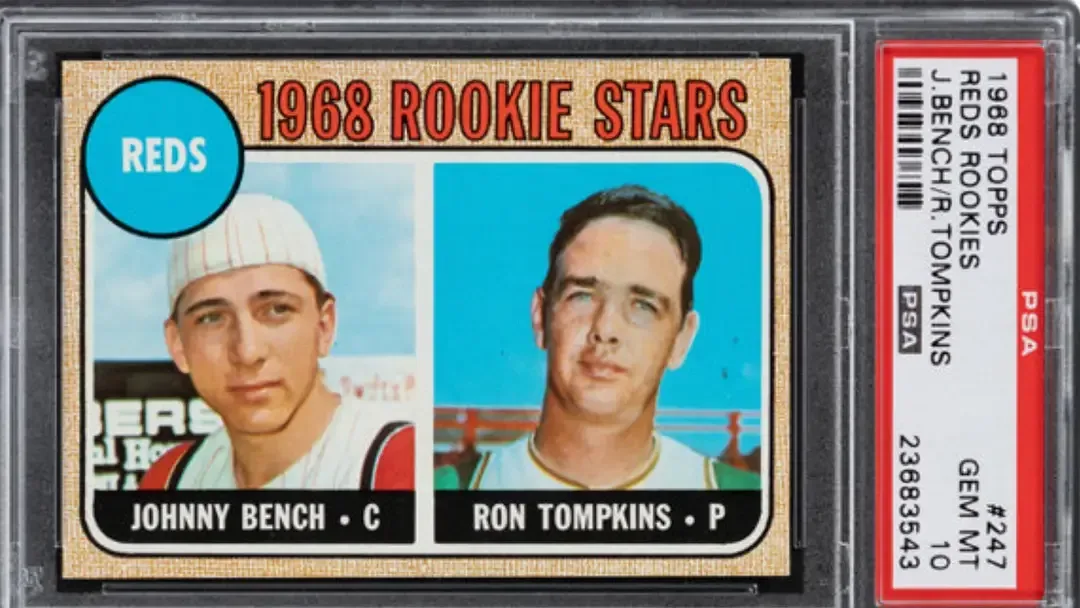
3. Johnny Bench rookie card #247
Johnny Bench shares #247 with Reds pitcher Ron Tompkins. Tompkins finished with a 0-2 major-league record, but Bench’s legacy transformed the card into a major 1960s rookie. At age 20 in 1968, Bench hit .275 with 82 RBI, made the All-Star team, won a Gold Glove and took National League Rookie of the Year honors. He won his first MVP two seasons later.
The reported PSA 7 value is $735 and PSA 3 value is $156, while the PSA population is listed at 16,116. Its top-end benchmark is a PSA 10 sale of $108,000 in 2021. The card is a strong example of why collectors should inspect shared rookie cards carefully: the second player is part of the original artifact and checklist, even if one future Hall of Famer is the obvious driver of demand.
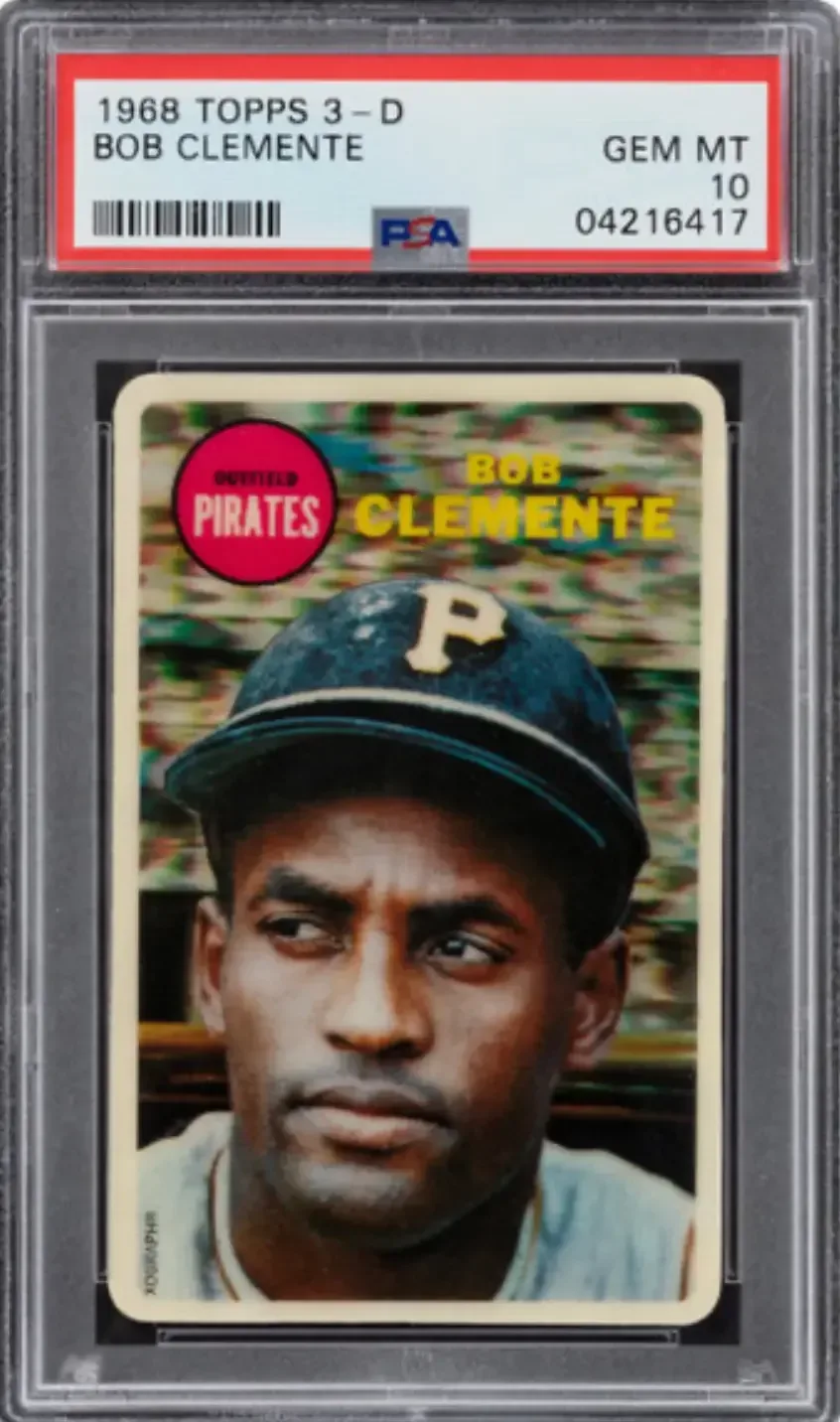
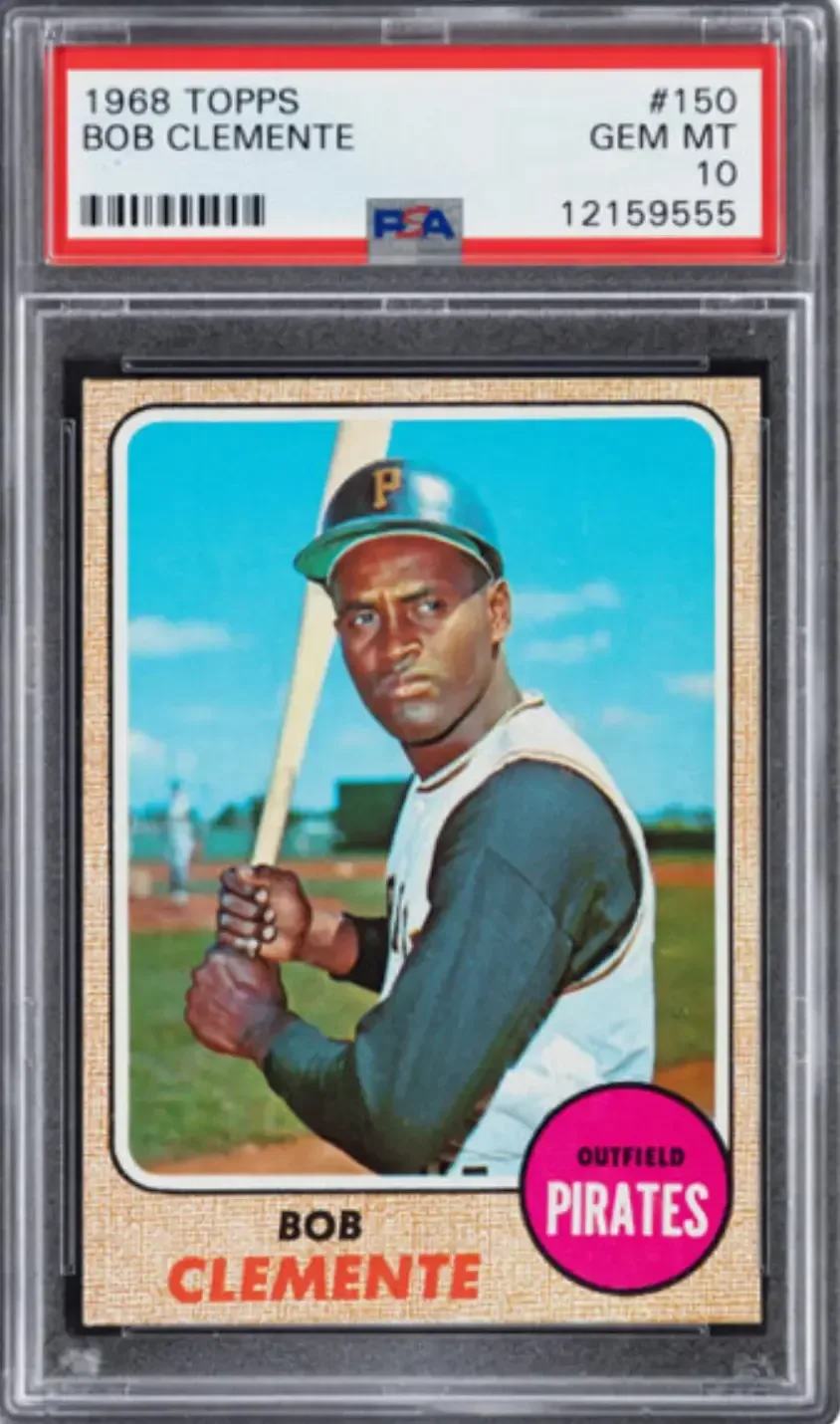
4. Roberto Clemente #150
Roberto Clemente #150 has a small but meaningful naming wrinkle: Topps used “Bob” despite Clemente’s dislike of the nickname. The card’s portrait and its wording therefore carry different kinds of historical information, and the mismatch is worth knowing before describing it or listing it for sale.
Clemente entered 1968 after batting .357 in 1967. In the pitching-dominated 1968 season, he batted .291 with 18 home runs and an .838 OPS. OPS, on-base plus slugging, combines a player’s ability to reach base with his power production; the number adds context that batting average alone cannot provide.
A PSA 10 copy, one of five at that grade, sold for $50,400 in 2021. The reported values are $520 for PSA 7 and $70 for PSA 3, with a PSA population of 6,467. Clemente also appears in an entirely different corner of 1968 Topps history: he is the most valuable player in the scarce 12-card 3-D test set. A PSA 10 3-D Clemente, one of six graded at that level, sold for $162,000 in 2022.
5. Hank Aaron #110
Hank Aaron #110 delivers the challenge of the brown-bordered design in its most punishing form. High-grade copies are exceptionally difficult because the dark edges readily show chipping. That is why five PSA 10s loom so large in discussions of the card, rather than merely serving as a footnote.
Aaron was 34 in 1968 and still among baseball’s best hitters, finishing with a .287 average, 29 home runs, 86 RBI and 28 stolen bases. He was five years away from surpassing Babe Ruth’s career home-run record. The reported PSA 7 value is $360, and PSA 3 is $73, across a cited PSA population of 7,001. This is a card where a buyer should give the physical border as much attention as the front image: a numerical grade explains part of condition, while a clear scan helps reveal how the specific copy presents.
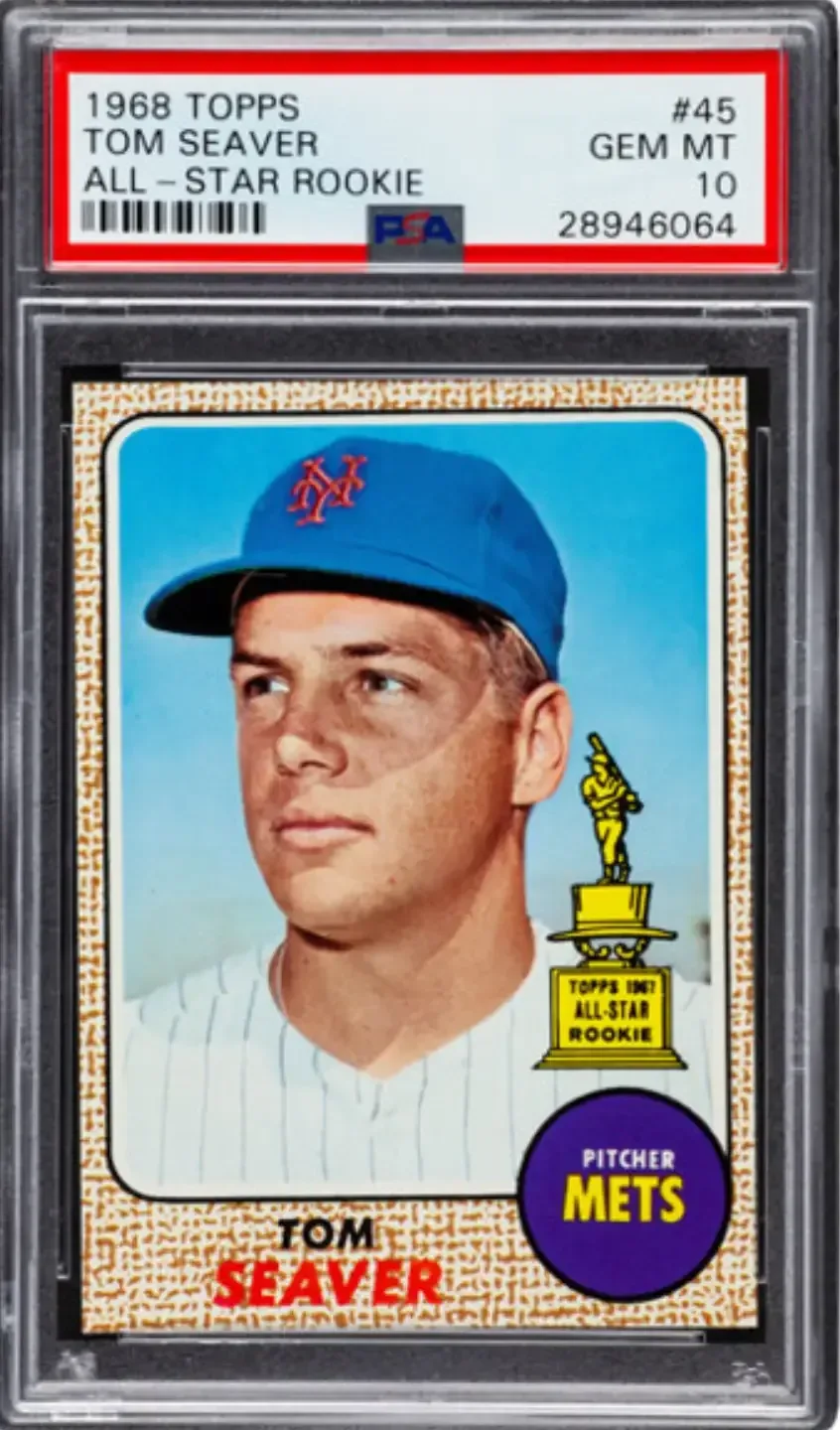
6. Tom Seaver #45
Tom Seaver #45 is his second-year card but his first standalone Topps issue. His 1967 rookie is more expensive, including a recent PSA 3 sale of $1,100, making the 1968 card a potentially more approachable way to collect “Tom Terrific” in the main set.
Seaver had already won National League Rookie of the Year in 1967. In 1968 he went 16-12 with a 2.20 ERA and earned the first of 12 All-Star selections. ERA, or earned run average, measures earned runs allowed per nine innings; the 2.20 figure shows just how effective he was in that season.
The cited PSA 7 value is $350, versus $45 for PSA 3, and the PSA population is 9,344. A PSA 10 sale reached $22,800 in 2018. Seaver #45 also exists as a Milton Bradley Win-A-Card version, so it can lead naturally from a player collection into a broader 1968 variation project.
Milton Bradley, 3-D cards and a game hidden in the set
The 1968 release is not limited to conventional pack cards. Some cards were distributed via Milton Bradley’s Win-A-Card board game. Their backs are brighter yellow than standard examples, and certain copies can show traces of white borders from 1967 Topps football cards because the products shared printing sheets. Those traits are tangible identification clues, not decorative trivia.
Topps also produced an exceptionally scarce 12-card 3-D test set. Each card was covered by plastic intended to create a three-dimensional effect. It was an experiment rather than a normal extension of the 598-card base set, and surviving cards are correspondingly rare and expensive. Collectors should be precise when comparing a 3-D card to the standard issue: they are related 1968 Topps products, but they do not share the same scarcity, construction or market category.
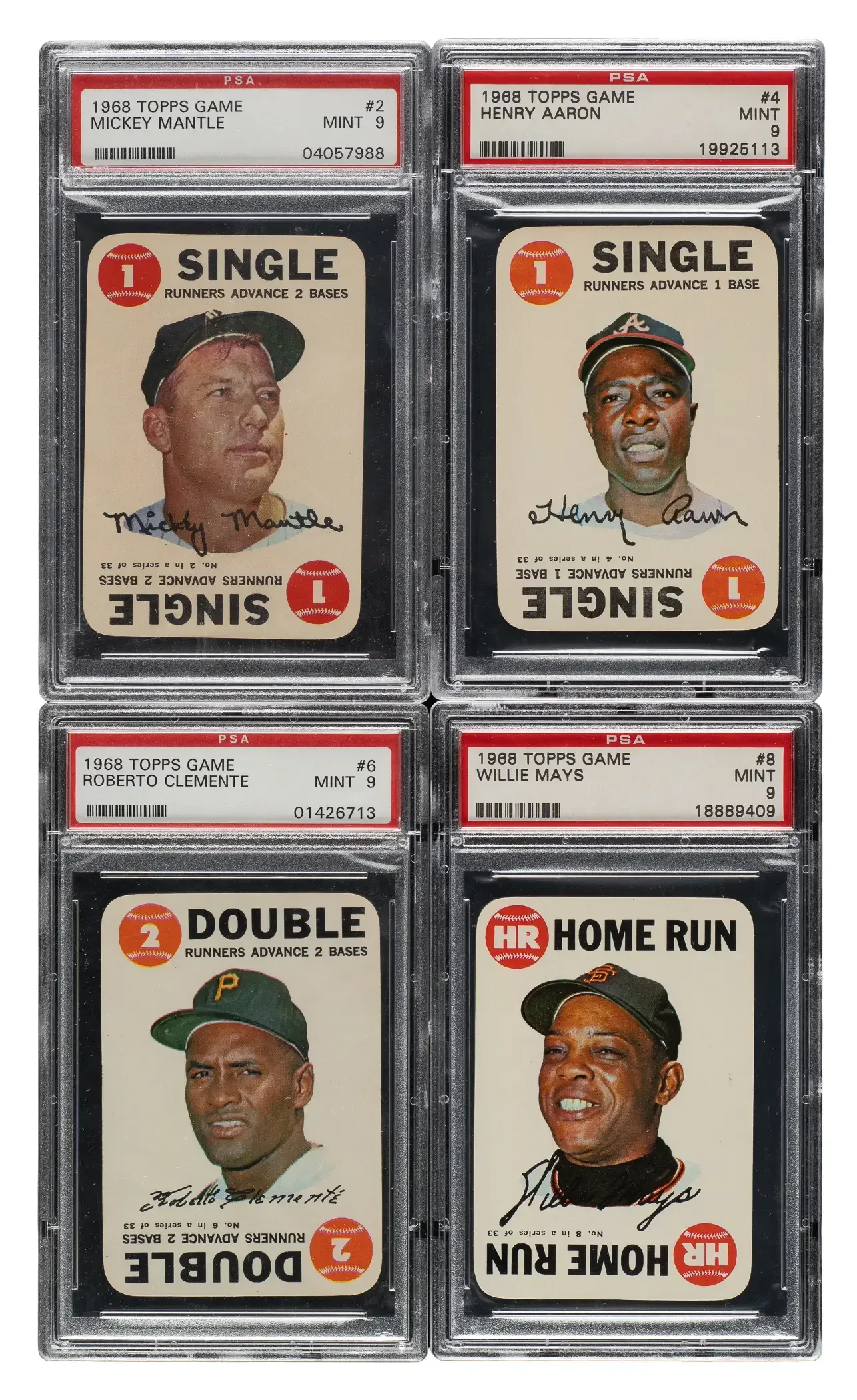
Then there is the 1968 Topps Game subset. Its 33 cards represented game outcomes such as singles and home runs, taking inspiration from Topps’ 1951 Red Back and Blue Back sets. The subset was included in third-series packs and sold as complete boxed sets. It was an early trading-card-game-style concept, though it never caught on in the same way as the core baseball release. A complete PSA-graded 33-card set sold for $5,781 in April.
That game subset is a useful bridge for hobbyists whose interests cross formats. The desire to preserve physical cards, packaging variations and play-oriented designs continues well beyond vintage baseball; even current conversations around physical releases recognize that discs and collectible formats still have dedicated audiences, as seen in the discussion around physical PS5 game demand.
Other major names in the 1968 checklist
The six headliners do not exhaust the set’s appeal. Willie Mays #50 has a reported PSA 7 value of $350; its PSA 10 record is $81,000, and 13 copies have received that grade. The three-player Super Stars card—Harmon Killebrew, Willie Mays and Mickey Mantle, #490—is listed at $550 in PSA 7.
- Pete Rose #230: reported PSA 7 value of $273.
- Rod Carew #80: reported PSA 7 value of $229.
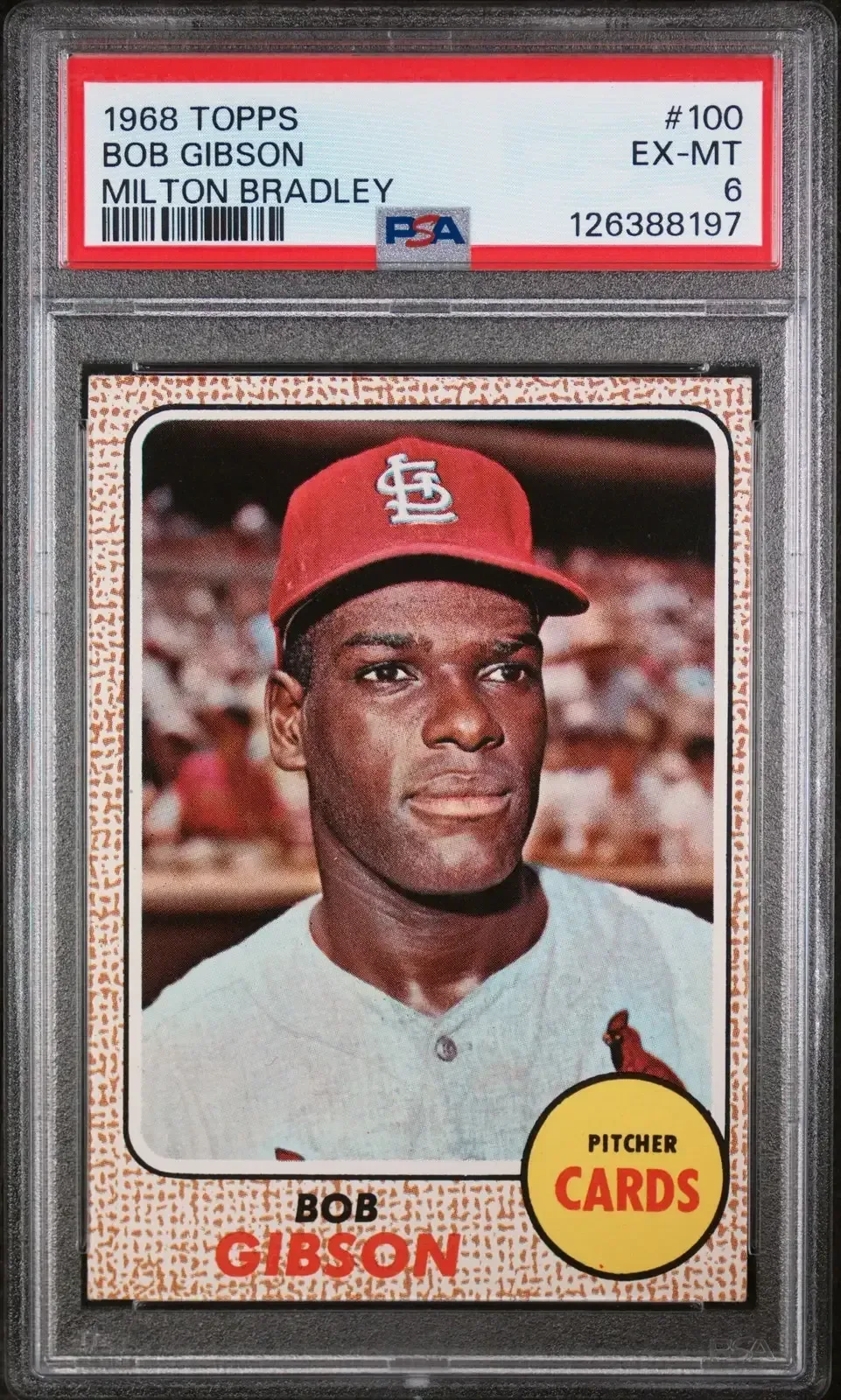
- Bob Gibson #100: reported PSA 7 value of $209.
- Ernie Banks #355: reported PSA 7 value of $135.
For someone building the set rather than pursuing only its most expensive pieces, these cards make a strong case for collecting with a defined condition strategy. Decide whether the goal is complete low-grade ownership, a visually consistent mid-grade run, individual player cards, or a variation-focused project. A collector attempting to buy mint examples indiscriminately is entering a much narrower, more competitive part of the market—particularly when brittle-looking borders, centering and surface preservation separate ordinary survivors from elite-grade cards.
That is the enduring appeal of 1968 Topps. It is not one chase but several: a star-heavy 598-card set, a landmark Nolan Ryan rookie, Mantle’s active-career finale, the shared rookie-card era, board-game variations, a 3-D oddity and a compact baseball game built into the product. Its visual design is unmistakable. Its collecting paths are even more varied.