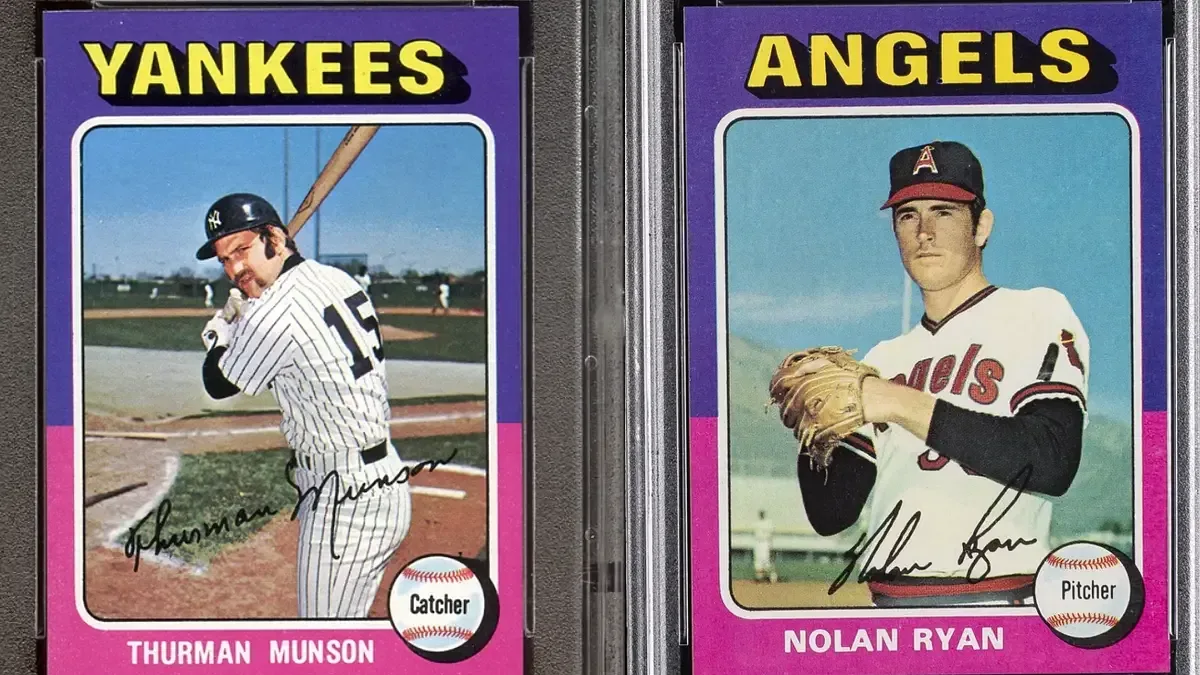
The 1975 Topps Baseball set is one of those rare vintage releases whose personality is obvious from across the room. The 660-card checklist arrived after several comparatively restrained Topps designs, then detonated into a carnival of two-color frames. Green meets purple. Brown meets orange. Tan meets light blue. Some pairings flatter the uniform in the photo; others seem to have been chosen by a color wheel with a mischievous sense of humor.
That visual chaos is not a flaw to be corrected. It is the point. Alongside the familiar player photography, 1975 Topps has 18 border-color combinations, creating a set in which adjacent cards can feel like they came from entirely different design teams. Add frequent centering trouble, occasional miscuts, and a full Mini parallel-sized issue, and collectors get a vintage challenge with a look that cannot be mistaken for any other year.
The set is also loaded with baseball history. Its best cards connect to a 1975 season that included the rise of free agency, Frank Robinson becoming Major League Baseball’s first Black manager, and Nolan Ryan matching Sandy Koufax’s then-record with a fourth no-hitter. The same year saw Bob Watson score MLB’s one-millionth run, just four seconds before Dave Concepción scored in a separate game.
For modern collectors, the lesson is familiar across hobby categories: distinctive presentation and hard-to-find condition can turn an ordinary base card into a formidable chase. That same collector instinct extends well beyond cardboard, including display pieces such as LEGO’s Link and Epona set. With 1975 Topps, however, the central appeal is a superb convergence of stars, rookies, career milestones, and unapologetically seventies design.
Why grade matters so much for 1975 Topps
The big auction figures attached to this set need context. A sharp, well-centered card at PSA 10 is not simply a slightly nicer version of a lower-grade copy. For many 1975 Topps subjects, it is a drastically scarcer object. The broad colored borders make centering imperfections especially conspicuous, while production quirks mean cards with clean edges, strong corners, and favorable registration are difficult to locate.
Prices below are reported sales and recent PSA 7 comparisons, not guarantees of what any copy will sell for. Eye appeal, centering, grade, timing, and buyer demand all matter. Population totals are likewise snapshots rather than permanent scarcity measurements. Still, the figures show why the highest-grade copies of this eccentric set attract such intense attention.
7. Pete Rose, #320
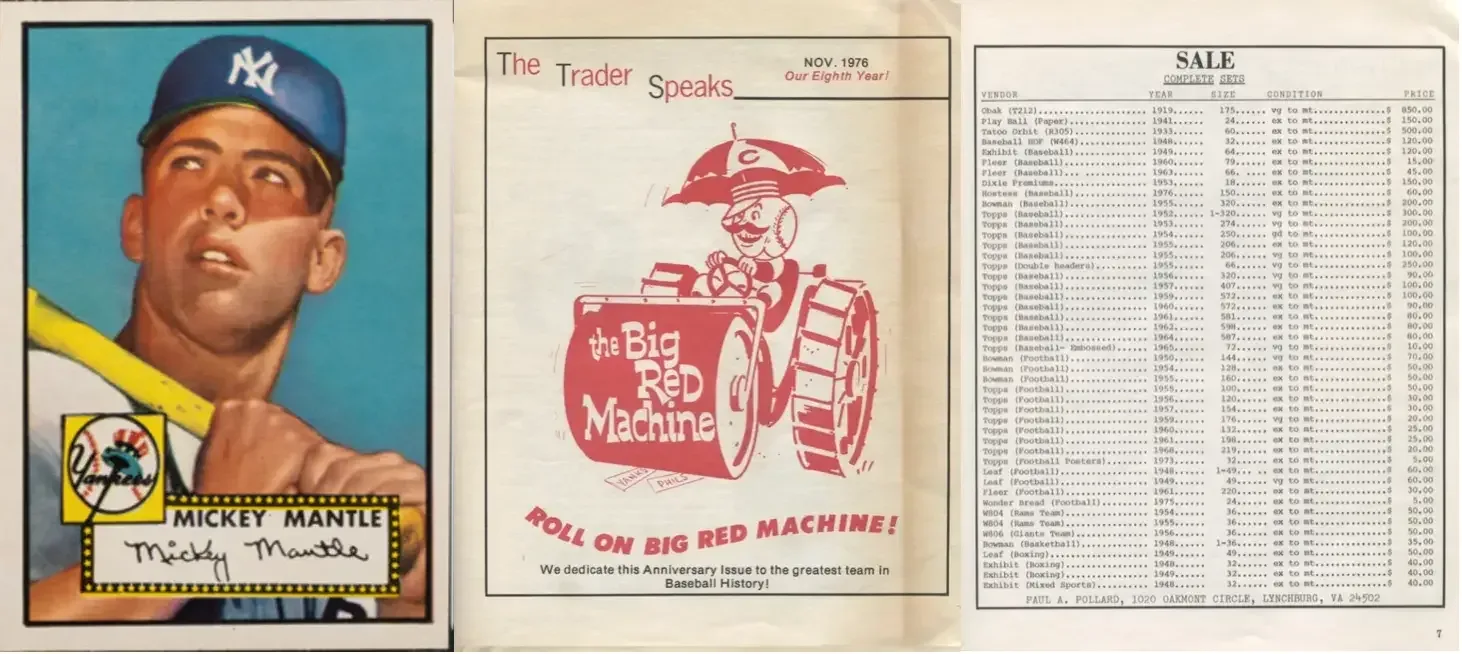
Pete Rose’s card has the fortunate kind of color coordination that collectors hope for in this set: its red-and-yellow treatment works naturally with Cincinnati’s uniform. A red star on the front denotes his 1974 All-Star status, adding another visual detail to an already memorable card.
Rose was at the center of the Big Red Machine’s 1975 championship run. He moved to third base to clear an outfield opportunity for George Foster, led the National League in both hits and doubles, and batted .370 while earning World Series MVP honors in a seven-game clash with Boston. A PSA 10, with a population of 26, sold for $19,200 on March 23, 2024. A more recent PSA 7 sale was $80, while the total PSA population was listed at 8,711.
Related coverage includes The 7 Most Iconic and Valuable 1975 Topps Baseball Cards Still Driving the Hobby.
6. Thurman Munson, #20
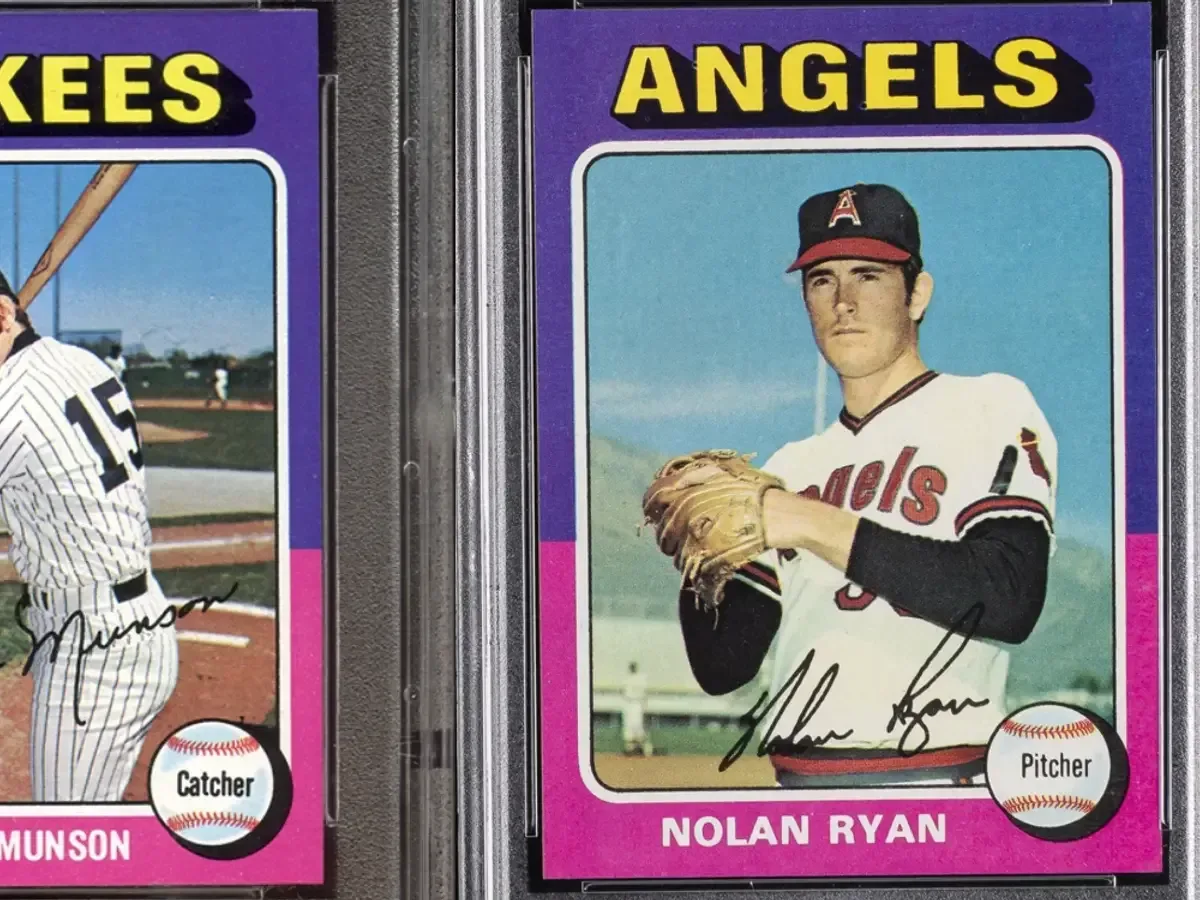
Pink and purple are not the obvious colors for a Yankees catcher, yet the #20 Thurman Munson has become one of the set’s most delightfully odd successes. Its unlikely palette helps it stand apart from more conventional Munson issues and captures the unpredictable charm that makes 1975 Topps so collectable.
Munson hit .318 with 102 RBIs in 1975, made his fourth All-Star team, and earned his third Gold Glove. His place as the Yankees’ on-field leader was firmly established in this period, before his formal naming as team captain the following season. Condition sensitivity is dramatic: only 168 PSA 9s and four PSA 10s were reported. One of those PSA 10s sold for $164,700 on December 19, 2025. The reported PSA 7 comparison was $104, and total PSA population stood at 4,359.
5. Bob Gibson, #150
Bob Gibson’s 1975 Topps card carries the special appeal of a final-season issue for a towering Hall of Fame career. The red-and-yellow border happens to complement the Cardinals colors exceptionally well, making the card a visual standout as well as a career-bookend collectible.
Gibson was 40 in his final season and struggled, but 1975 was still a moment for St. Louis to recognize 17 years of greatness. The Cardinals held Bob Gibson Day on September 1, and he concluded the campaign second only to Walter Johnson among major-league pitchers in career strikeouts. A PSA 10, population three, sold for $47,580 on May 16, 2026. A PSA 7 recently sold for $118, and the reported overall PSA population was 2,906.
4. Robin Yount rookie card, #223
Robin Yount’s rookie card is important partly because it belongs solely to him. Shared rookie cards were common in the era, including Jim Rice and Gary Carter cards elsewhere in this same set. Yount instead received a mainstream rookie card all to himself, a decision that looks better with every milestone of his later career.
At 19, Yount played 147 games as Milwaukee’s rookie shortstop in 1975 and hit .267. He would spend 20 seasons with the Brewers, collect more than 3,000 hits, and win two MVP awards. His #223 remains his only mainstream rookie card. A PSA 10 with a population of six sold for $152,500 on January 31, 2026; a PSA 7 comparison was $180. Total PSA population was reported at 22,696, illustrating how a plentiful card can still become exceptionally difficult at the peak grade.
3. Hank Aaron, #660
Card #660 has built-in significance simply by occupying the final slot in the standard set, but Hank Aaron’s presence makes the placement feel especially appropriate. This card depicts Aaron after his late-1974 move from Atlanta to Milwaukee, with the image airbrushed into Brewers colors.
In 1975, Aaron returned to Milwaukee, where he served as a designated hitter as knee issues accumulated. On May 1, he surpassed Babe Ruth’s career RBI record, a year after passing Ruth’s home-run mark with number 715. The checklist creates a neat Aaron bookend: card #1 is a 1974 Highlights/Record Breaker card celebrating that historic homer, while #660 is his regular base card. The lone PSA 10 reported sold for $152,500 on January 31, 2026. A PSA 7 was reported at $219, and the total PSA population was 2,019.
2. Nolan Ryan, #500
Nolan Ryan’s purple-and-pink #500 may be the loudest great-player pairing in a loud set. It is also one of his most vivid standard-issue cards, an especially fitting presentation for a pitcher whose career mythology is built around overwhelming speed, strikeouts, and historic no-hitters.
On June 1, 1975, Ryan no-hit Baltimore for the fourth time in his career. That tied Koufax’s record and made Ryan the first pitcher to throw a no-hitter in three straight seasons. He also reached 100 career wins during the year. The set includes a separate 1974 Highlights card recognizing his third consecutive 300-strikeout season. A PSA 10, population three, last reported at $38,240 in a sale dated August 21, 2015. The PSA 7 comparison was $399, with 7,833 cards in the total PSA population.
1. George Brett rookie card, #228
George Brett’s #228 is the defining rookie card of 1975 Topps and, for many collectors, one of the instantly recognizable rookie cards of the entire 1970s. The green-and-purple border is bold without swallowing the image, and the card’s fame has made that unlikely color combination inseparable from Brett’s early career.
Brett’s first full major-league season was a breakout: he hit .308 and led the American League in hits and triples. His later résumé includes an AL MVP, three AL batting titles, 13 All-Star selections, a World Series title with Kansas City, and first-ballot Hall of Fame induction. A PSA 10 with a reported population of 11 sold for $186,000 on February 26, 2021. A PSA 7 recently sold for $440, while the total PSA population was 20,256.
More 1975 Topps cards worth knowing
The seven cards above lead the conversation, but the checklist has no shortage of alternatives for collectors who prefer stars, rookie combinations, or pure border-color spectacle.
- Jim Rice Rookie Outfielders, #616: recent PSA 7 price of $80.
- Johnny Bench, #260: recent PSA 7 price of $79.
- Reggie Jackson, #300: recent PSA 7 price of $76.
- Mike Schmidt, #70: recent PSA 7 price of $60.
- Gary Carter Rookie Catchers, #620: recent PSA 7 price of $60.
Whether someone is chasing Brett’s landmark rookie, Aaron’s set-ending base card, Ryan’s fluorescent masterpiece, or a favorite Hall of Famer in a more attainable grade, 1975 Topps rewards close attention. Its imperfections are part of the assignment, its palette remains unforgettable, and its major cards preserve a remarkably rich slice of baseball history.