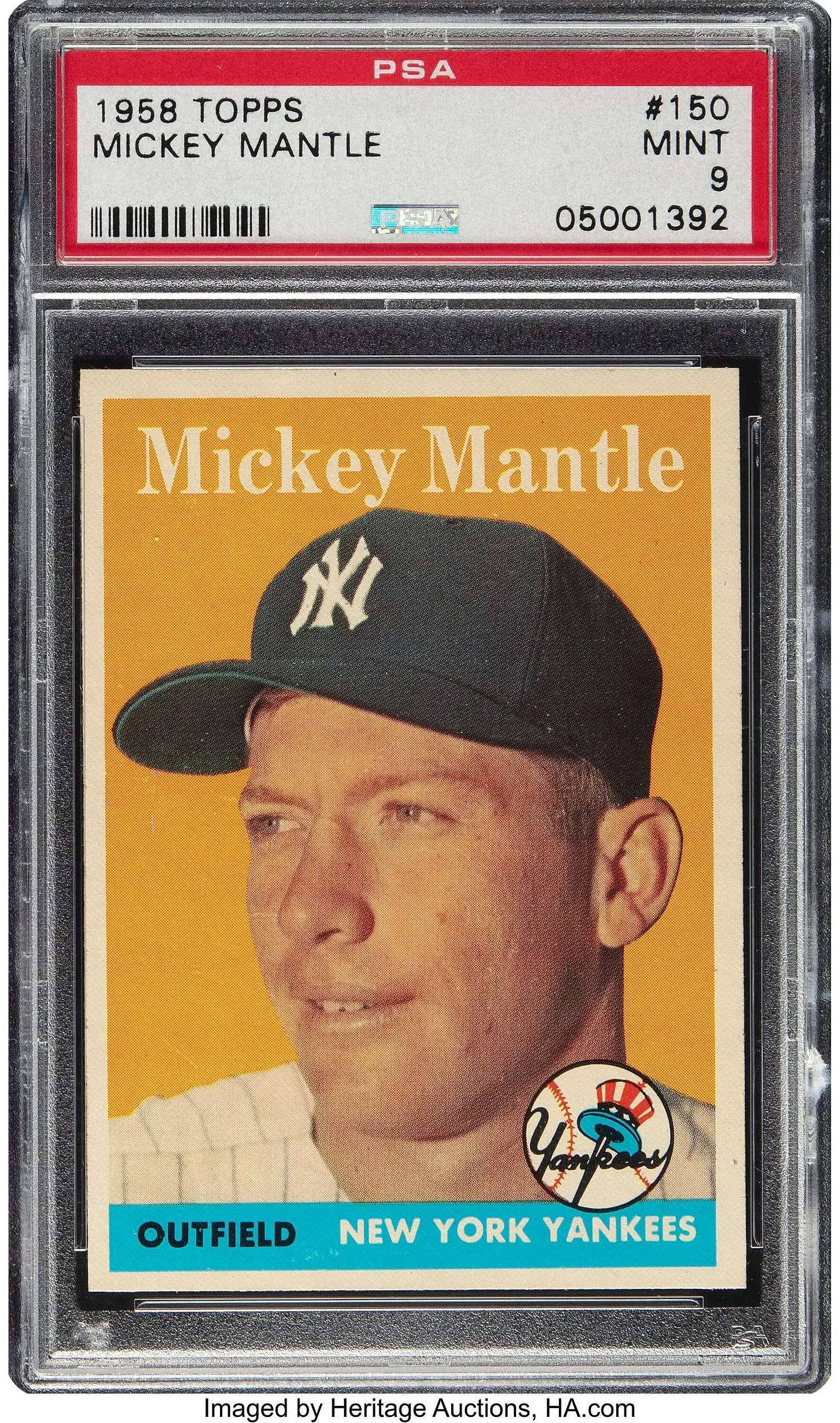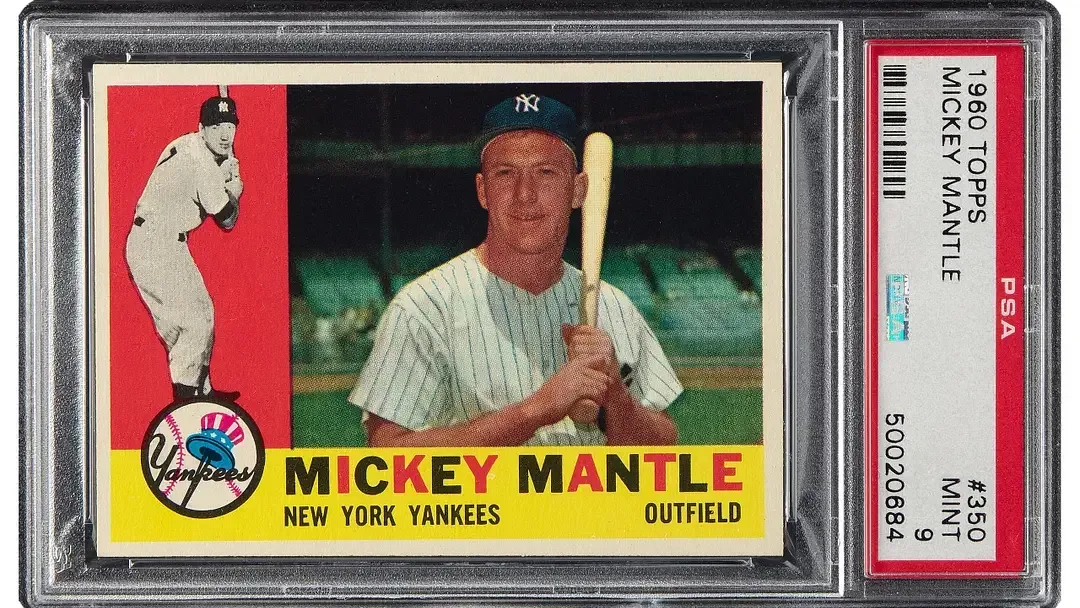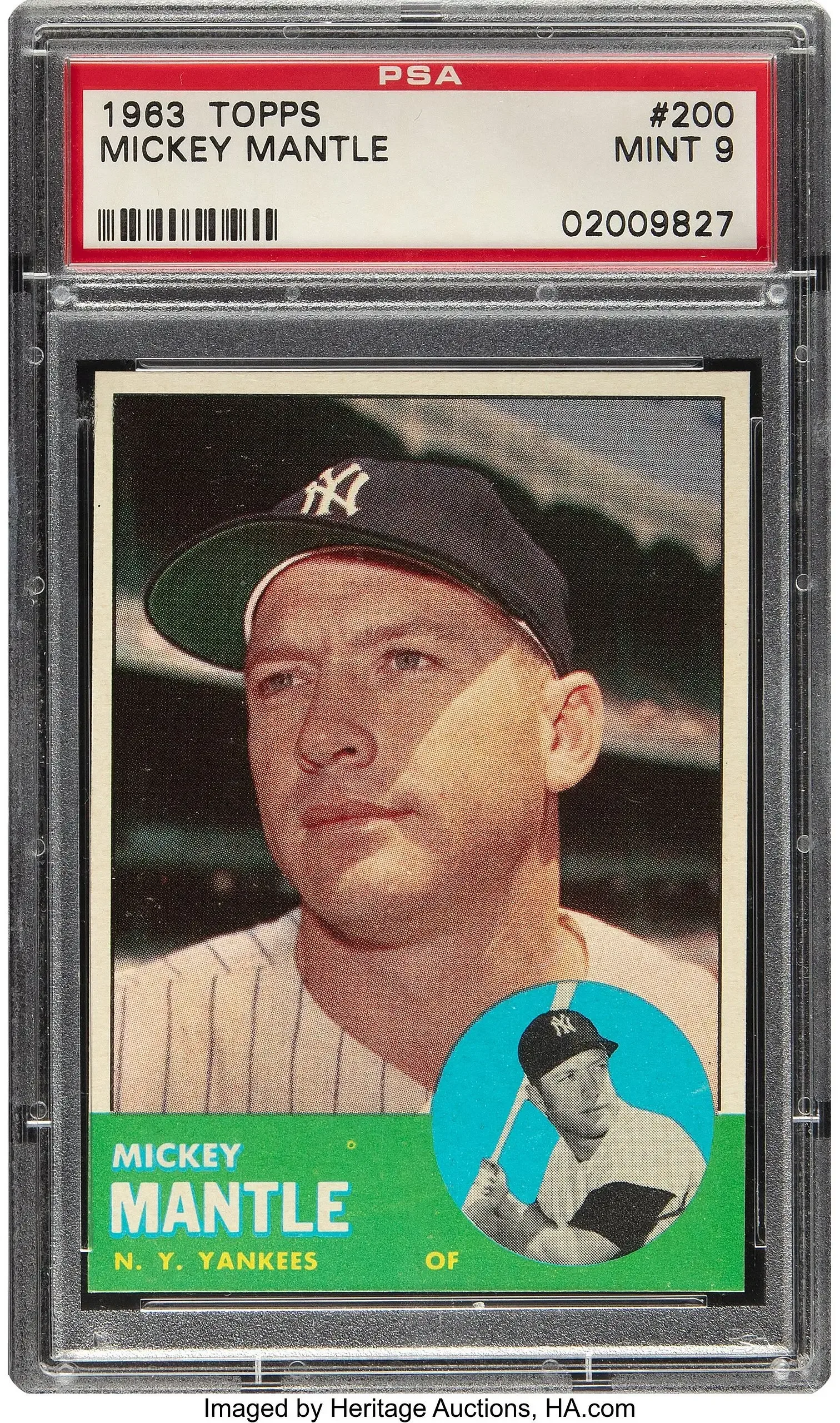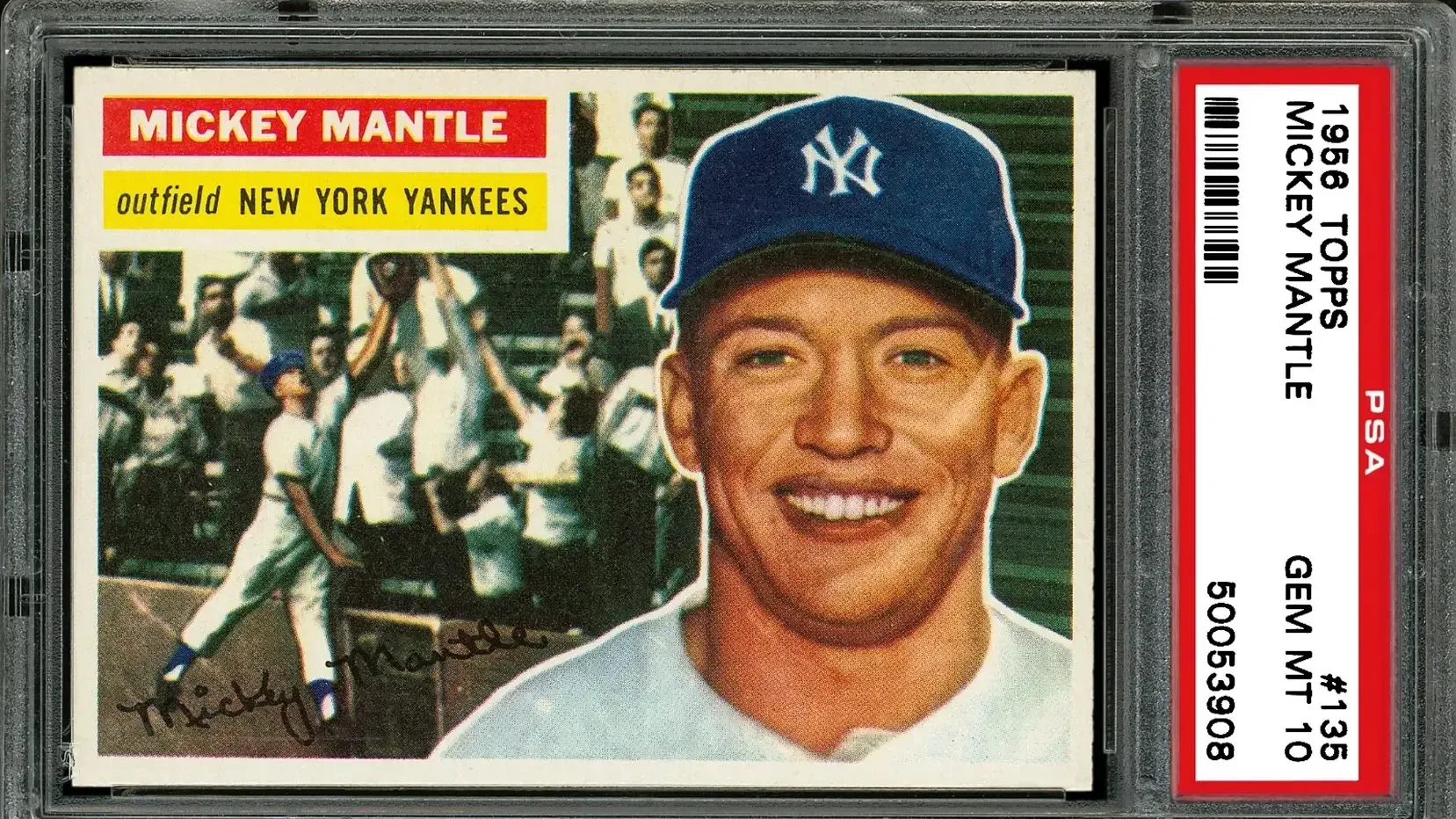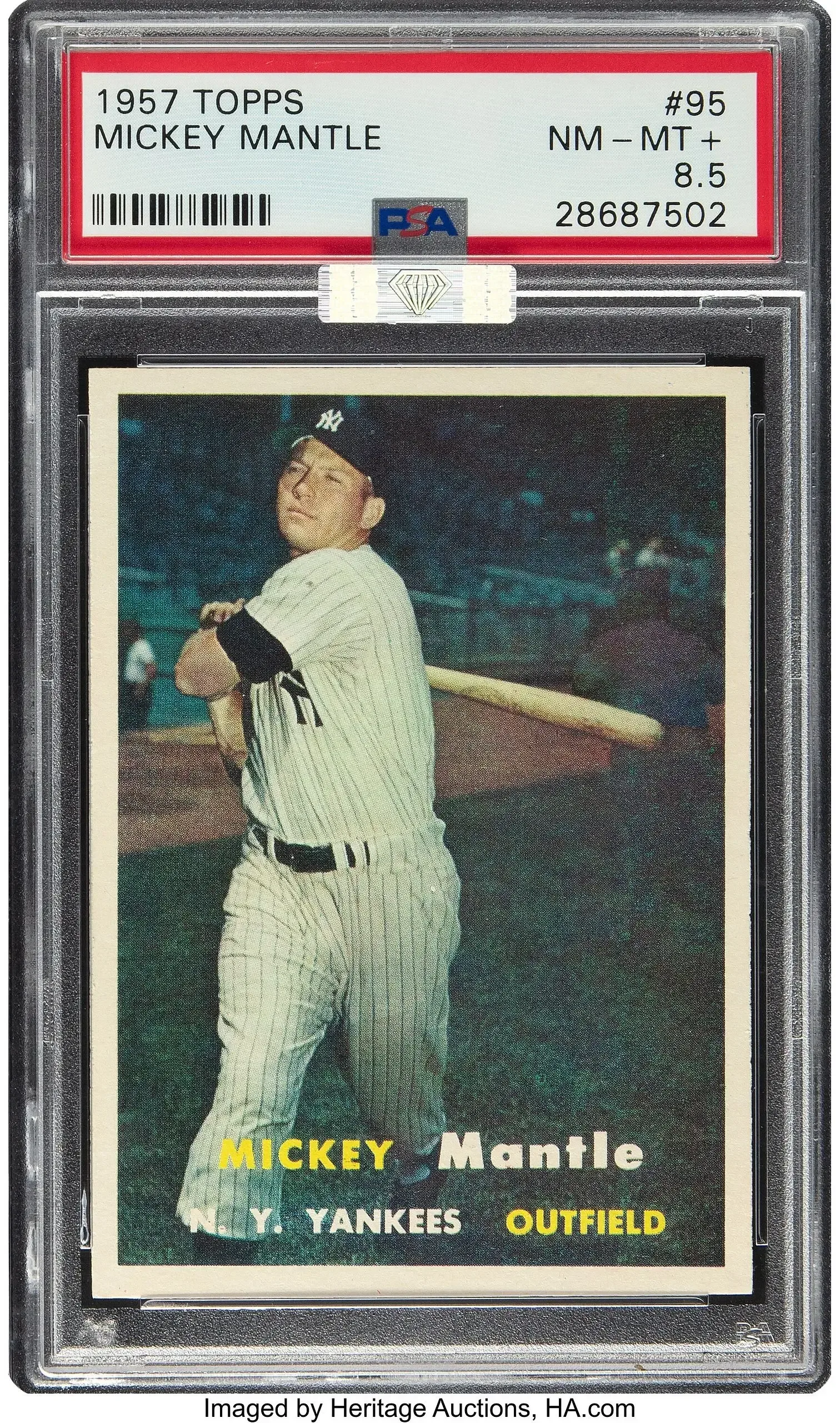
Four high-grade Mickey Mantle Topps cards from 1957, 1958, 1960 and 1963 are scheduled for auction, placing some unusually useful reference points in front of vintage baseball-card collectors. The group includes a 1957 Topps #95 graded PSA 8.5, plus PSA 9 copies of 1958 Topps #150, 1960 Topps #350 and 1963 Topps #200.
The individual cards matter, of course. Mantle remains one of the defining names in postwar baseball collecting, and each of these issues has its own visual identity and collector appeal. But the larger significance is the chance to establish fresh comps—recent comparable sales—for grades that do not trade especially often. In a market where condition can radically change value, a result from several years ago can be informative without being a perfect substitute for a present-day sale.
The auction is expected to close during the last week of October 2026. Bids mentioned below are snapshots rather than final prices; auction totals can change materially before the closing date, especially when high-end vintage cards attract late bidding.
Why grade and population matter here
PSA grades cards on a 1-to-10 scale. A PSA 9 is generally described as Mint, while an 8.5 sits just below that level. The half-grade on the 1957 card should not be treated as a trivial distinction. At this price level, collectors often focus intensely on centering, corners, edges, surface presentation and the details that separate one numerical grade from the next.
Population figures add another layer. A PSA population is the number of examples that PSA has graded at a stated grade, not a direct census of every copy that exists. Nor does it tell collectors how many of those cards are actively available. Still, it is a practical measure of certified scarcity at a given grade—and a helpful reminder that a card can be common in lower-grade form while remaining extremely difficult to find near the top of the grading scale.
That distinction is particularly relevant with Mantle. The appeal combines a player with enduring collector demand, vintage Topps issues and condition scarcity. Jason Simonds, a consignment director involved with the sale, characterized high-grade vintage demand as strong and pointed to limited new supply of mint-condition Mantle cards entering the grading ecosystem. That is a market view, not a guarantee of any particular result, but the four lots offer concrete tests of where bidders currently place value.
1957 Topps #95: the 8.5 with a busy auction history
The 1957 Topps Mickey Mantle #95 is the one non-PSA-9 card in the group, but it is far from an ordinary example. PSA’s reported population includes 10 cards graded 8.5, 22 graded 9 and one graded 10. That places this copy in a narrow band of high-grade survivors even though a handful of higher-graded examples exist.
The 1957 design is notably spare: Mantle’s left-handed swing carries the card, with relatively little visual clutter beyond the player identification and team. For collectors who prioritize photography over ornate graphics, it is easy to see why this issue holds a distinct place in the Mantle run.
Related coverage includes Four High-Grade Mickey Mantle Cards Head to Auction With Fresh Market Comps in Focus.
This specific PSA-certified copy has an unusually traceable sale trail. It brought $39,900 in May 2021, then $35,100 in November 2021, before selling for $66,000 in June 2022. That June result stands as the reported high sale for a 1957 Mantle at this grade. The variations show why a single historical number should not be mistaken for a fixed value: even the same card can produce different outcomes depending on timing, bidder participation and the auction setting.
For the broader grade, a PSA 8.5 example sold for $46,800 in March 2024 and another realized $40,800 in April 2025. Those figures create a more recent context than the exact card’s 2022 result, but they are still not interchangeable with the current lot. Eye appeal, certification history and buyer confidence can all matter within the same assigned grade.
1958 Topps #150: a PSA 9 where none grade higher
The 1958 Topps Mantle #150 is a PSA 9, and PSA reports 28 cards at that grade with none higher. That “none higher” designation is a major part of the card’s appeal. It does not mean every PSA 9 looks identical, nor does it establish a mandatory price floor, but it confirms that the offered grade is the top of PSA’s recorded scale for this issue.
The particular card in this auction last sold in November 2016 for $21,226. That long gap underscores the difference between a card’s prior personal sale and current market evidence. A more useful recent grade-level comparison came in January 2024, when a PSA 9 1958 Mantle sold for $80,533. The auction bid had already reached $82,000 at the time of the reported snapshot, putting it above that 2024 comp before the sale had concluded.
The highest reported sale for a 1958 Topps Mantle PSA 9 is $92,146 from May 2022. Whether the current card approaches, passes or finishes below that mark will be more than a headline statistic. It will help collectors assess the distance between a past peak and live demand for a top-population vintage Mantle today.
1960 Topps #350: scarce at the grade, but the current bid trails prior sales
The 1960 Topps #350 shows Mantle in a horizontal format, with a bat-on-the-shoulder pose and a period-specific design that makes it immediately different from the 1957 issue. It is offered at PSA 9, a grade PSA has assigned to 31 copies. There are no PSA 10s reported for the card.
Its recent sales evidence is less straightforward than a simple upward line. A PSA 9 sold for $64,103 in February 2022, which remains the reported high sale. Another sold for $60,000 in July 2023. The current auction bid was $52,000 at the reported point in the sale.
That gap should be read carefully. It does not establish that demand has fallen, because bidding was not finished. Nor does the absence of a sale for a period of time automatically make a later card more valuable. What it does create is a useful question for watchers: will final bidding return the 1960 issue to its prior range, exceed it, or identify a new market level?
This is the practical value of a comp. It is an evidence point, not a prediction engine. Collectors weighing a future purchase can compare the final price against the 2022 and 2023 results while accounting for the particular card, the time between sales and the auction’s final terms.
1963 Topps #200: more PSA 9s, still little current evidence
The 1963 Topps #200 is also PSA 9. Its reported PSA population of 40 at that grade is larger than the populations noted for the other cards in this group. Two examples grade higher at PSA 10. On a purely numerical basis, that gives collectors more high-grade certified supply to consider than with the 1958 or 1960 cards.
More supply does not equal weak demand, especially for a central vintage player such as Mantle. It simply changes the scarcity conversation. A buyer deciding between four high-grade Mantles may give different weight to top-pop status, visual design, grade and availability. The 1963’s population is one factor in that choice rather than a complete valuation answer.
The last reported PSA 9 sale occurred in May 2024. Its all-time reported high is $90,000, while the current auction stood at $26,000 when the bid was recorded. With time left before closing, that number is a starting point rather than a valuation verdict. The final result will supply the first more-current public comparison for a grade that had not traded recently.
What collectors can take from the four-lot group
These lots are a reminder to separate three ideas that are often blended together: a player’s popularity, a card’s grade rarity and a card’s actual transaction history. Mantle’s stature gives all four cards broad interest. The PSA grades and population reports clarify how difficult comparable certified copies may be to find. Recorded sales, meanwhile, show what buyers have actually paid at particular moments.
None of those pieces alone settles fair value. A population report cannot establish demand. A record price cannot promise a repeat. And an early auction bid cannot be treated as a final comp. Used together, however, they provide a more disciplined framework than treating every Mantle card—or every PSA 9—as equivalent.
For collectors who are not bidding, the closing prices may still be valuable market information. The 1957 will test an 8.5 with both a thin population and a documented sales history. The 1958 offers a top-pop PSA 9 already beyond one recent comparison at the reported bidding stage. The 1960 has prior six-figure-adjacent context to measure against, while the 1963 could clarify demand for a high-grade issue with a larger population but no fresh sale since May 2024.
Sports collecting also moves alongside the wider sports-media calendar; for readers following another major league, our guide to watching the 2026–27 NHL season without cable covers the broadcast-plan details to check before subscribing.