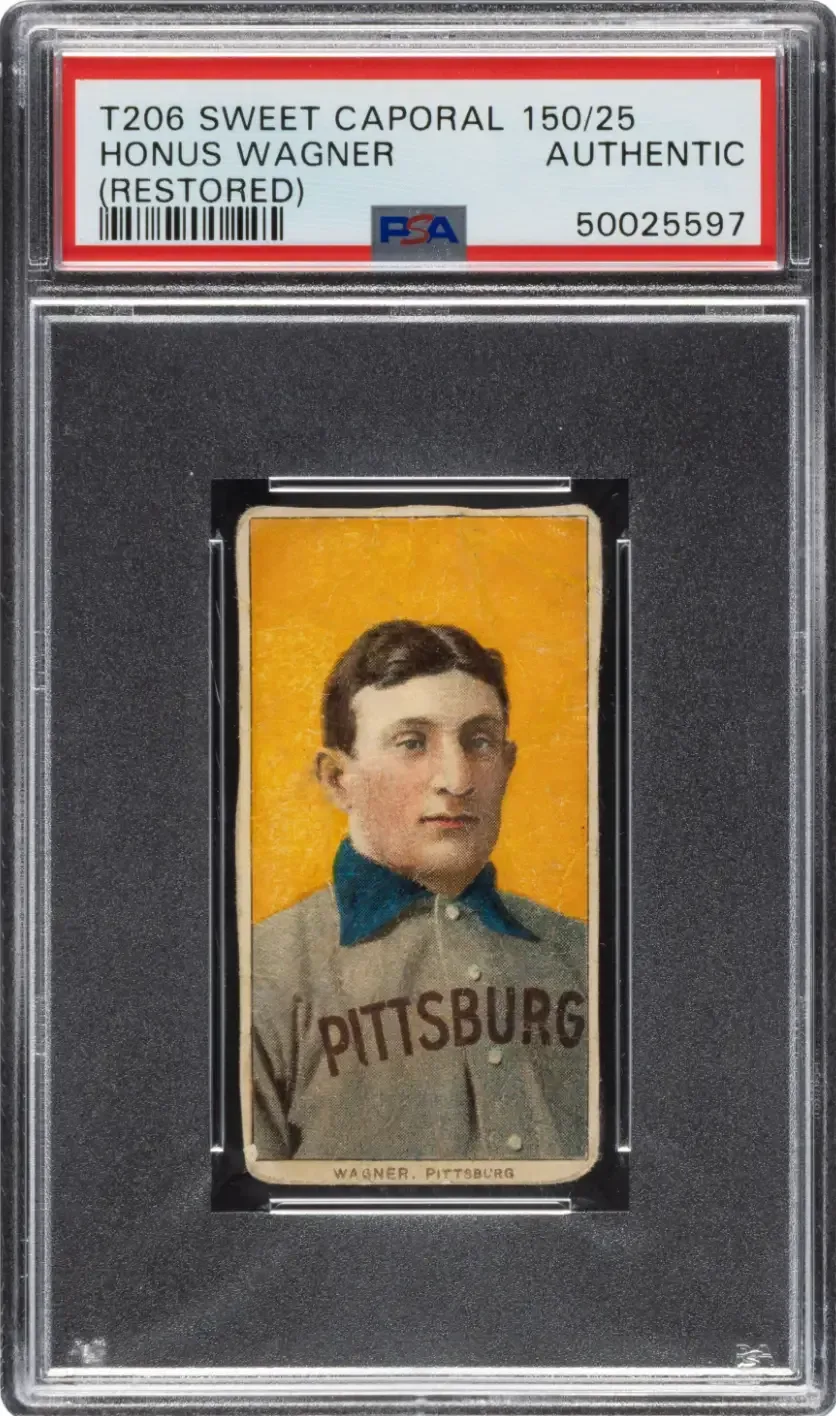
A restored 1909 T206 Sweet Caporal Honus Wagner has reached a current bid of $1.025 million in an October auction, with more than 11 days remaining at the time the figure was recorded. That alone would be major vintage-card news. But this particular Wagner is not simply another appearance of the hobby’s most mythologized baseball card: it is a well-traveled restored example whose prior auction history gives collectors an unusually clear way to consider a difficult question.
What is the market willing to pay for a card when its visual and structural condition has been improved, but its original state has been altered?
The question is bigger than one orange-background portrait of one all-time great. Restoration disclosures, authentication labels, grading terminology, the card’s individual sales record and the difference between scarcity and condition all shape the answer. The current bid does not settle the issue, particularly before the auction closes. It does, however, show that a restored Wagner can still command seven-figure attention.
That is the gravitational pull of the T206 Honus Wagner: even its difficult copies are not ordinary collectibles. They are artifacts at the intersection of baseball history, early tobacco-card production, card-condition ethics and the very modern reality of public auction records.
For more context, explore Buying a Cheap Android Phone? These Specs Matter More Than a Fancy Frame.
Why the T206 Honus Wagner remains the hobby’s defining card
The 1909 T206 Sweet Caporal Honus Wagner depicts the Pittsburgh shortstop in a collared uniform against a bold orange field. Wagner’s on-field standing is a central part of the card’s enduring significance. He began his professional career with the Louisville Colonels in 1897. In his first season with Pittsburgh in 1900, he batted .381 and earned the first of eight batting titles. He ultimately retired with a .328 lifetime average, won a World Series and became a founding member of the Baseball Hall of Fame in Cooperstown.
That résumé matters, but it is not enough on its own to explain why the card occupies such a singular place. Its scarcity is tied to the long-circulated account that Wagner objected to his likeness being used to promote Sweet Caporal cigarettes and that production stopped after the company complied. The result was a card with limited survival and an enormous mythology built around it.
In practical collecting terms, scarcity is not the same as condition. A card can be scarce because few exist, while still being heavily worn, trimmed, repaired or otherwise altered. The T206 Wagner is compelling precisely because its scarcity makes even compromised examples consequential. Each one can become a market event, and each example’s specific physical history can materially change the conversation.
Related coverage includes Restored T206 Honus Wagner Bid Reaches $1.025 Million.
For collectors who want a concise snapshot of the current bidding story, related auction-market coverage reflects how closely the hobby is watching this restored copy.
This is not the card’s first major sale
The present Wagner has appeared at auction multiple times, making its trail unusually important. Sales tied to its PSA serial number show three earlier results:
- $1,102,806 in November 2021.
- $1,968,000 in September 2023.
- $1,980,000 roughly a year and a half later.
Those figures make the current $1.025 million bid more nuanced than a simple “Wagner clears $1 million” milestone. It is already an extraordinary bid, but it remains below the card’s two most recent reported sale prices while the auction is still underway. It would be a mistake to characterize the unfinished sale as a final valuation, or to assume it will finish above or below any previous number. Bidding can change substantially near an auction’s close.
Still, the history establishes a useful baseline. This is demonstrably a million-dollar restored Wagner in the market’s eyes. The open question is where it ultimately lands now, and what that result says about the premium or discount buyers attach to the specific restoration and the card’s current presentation.
Restoration, conservation and why the terms matter
“Restored” can sound straightforward, but it is a broad label. The work performed on a vintage card can vary enormously based on its original damage and the methods used to address it. Listed examples of card work include edge or corner reinforcement, trimming, color retouching, adding ink where paper loss occurred, and flattening bends with heat. Even simple flattening has a spectrum, from deliberately controlled treatment to the old collector habit of pressing a card between heavy books.
These actions are not interchangeable. Trimming means material has been removed from a card’s edges, changing its dimensions or edge profile. Color retouching means ink or pigment has been added to lessen visible wear or restore parts of an image or border. Paper loss describes missing portions of the card’s stock; adding material or ink to disguise that loss changes what a viewer sees. Reinforcement can strengthen vulnerable corners or edges, but it also introduces material or intervention beyond the card’s original manufacture.
Conservation is often used for treatment intended to stabilize an item or mitigate damage while retaining as much original material as possible. Restoration generally points more directly to efforts that improve or rebuild appearance. In reality, the boundary can be subjective. One collector may see a treatment as responsible preservation of a fragile survivor. Another may view the same work as an unacceptable alteration that compromises originality.
That subjectivity does not mean the distinction is meaningless. Rather, it explains why disclosure is so important. A buyer needs to know what has been done, because the market can assign dramatically different values to a worn-but-unaltered card and a more attractive card whose appearance has been enhanced.
How the Wagner compares with other high-end examples
The restored Wagner is arriving in a market where other T206 Wagner results have recently set much higher benchmarks. A 1909 Piedmont Cigarettes Wagner sold for $5.856 million in August 2026 and carried an SGC Authentic designation with trimming noted. Separately, a PSA 1 example sold for $5.124 million in February 2026.
Those sales make an important point: elite demand for the Wagner is not limited to pristine cards. A PSA 1 is a very low numerical grade, signaling substantial wear, yet the February result shows that rarity, authenticity and a card’s individual characteristics can outweigh the pursuit of high technical condition. The Piedmont example also demonstrates that a noted alteration does not automatically prevent a multimillion-dollar result.
But those figures should not be treated as direct price guides for the current card. A designation such as SGC Authentic communicates something different from a numbered PSA grade. A notation for trimming is not a complete description of every form of restoration. Different backs, individual provenance, eye appeal, physical integrity and the amount and kind of disclosed work all can influence bidders. Put simply: “a Wagner with an issue” is not a standardized asset class.
The comparison does, however, frame the current sale clearly. At $1.025 million with bidding still open, this restored example is participating in the same rarefied conversation while also testing where buyers draw their lines between originality, appearance and historical importance.
What collectors can take from the bidding
The practical lesson is not that restoration is always acceptable or always disqualifying. It is that collectors should resist treating a single word on a listing as a full condition report. “Restored,” “authentic” and a numerical grade all provide useful starting points, but none should replace understanding the actual card and its documented treatment.
Questions worth asking before valuing an altered vintage card
- What work was performed? Edge work, trimming, recoloring and paper-loss repair can affect desirability differently.
- Is the work disclosed clearly? The ability to evaluate a card depends on buyers knowing what changed.
- What remains original? Original stock, borders, image area and surface condition are central to how collectors judge integrity.
- Does the item have a traceable sales history? This Wagner’s prior auction results offer context that many vintage cards lack.
- What are the appropriate comparisons? Compare cards with similar designation, condition issues and restoration history rather than relying only on a famous-card headline price.
- Is the sale complete? A current bid is a snapshot, not a final result.
For buyers outside the seven-figure tier, the same discipline applies. Restoration can be especially tempting when a card looks sharper than its original condition might suggest. That does not make it inherently undesirable. It means the buyer should make a deliberate decision about whether they value the treatment, accept it at the asking price and understand how another future buyer may view it.
A market test with no simple verdict
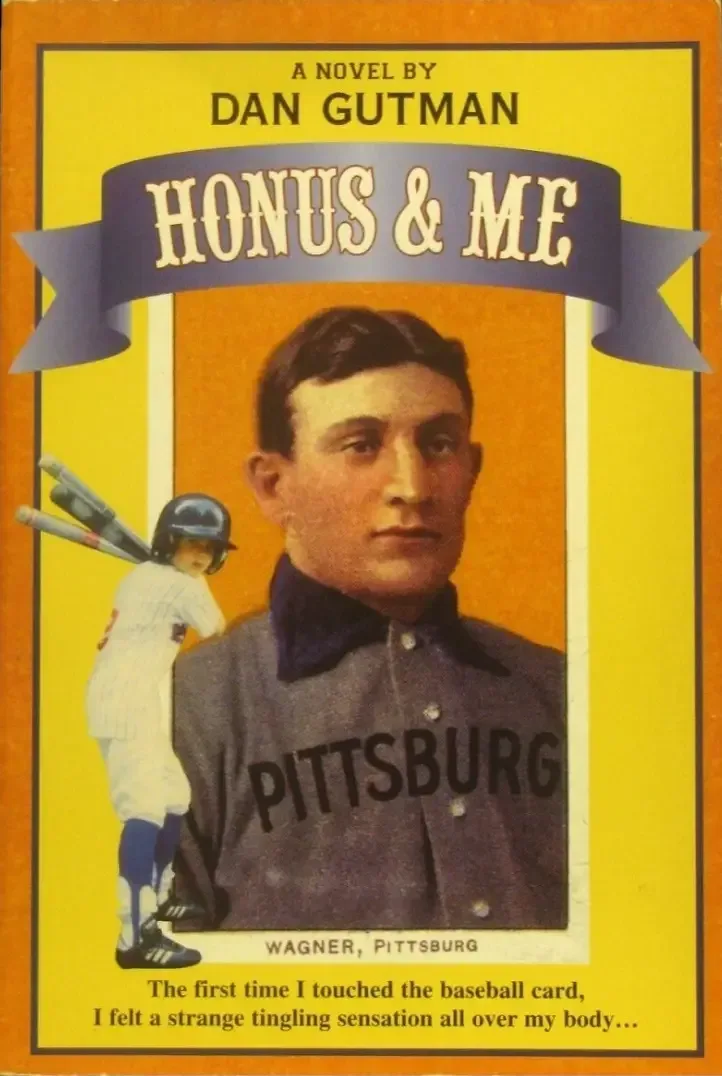
The T206 Wagner has always carried stories larger than its cardboard dimensions: an elite player, an early cigarette-card issue, a scarcity legend and generations of collectors treating it as a pinnacle. Its continued appeal also extends beyond auction catalogues; Dan Gutman’s 1997 book Honus & Me helped introduce the card to younger readers through fiction, reinforcing its place in popular collecting imagination.
This restored copy adds another chapter to that legacy. Its multiple prior sales show continuing demand, while the current bid confirms that restoration has not removed it from the highest level of the hobby. At the same time, the gap between its bid and recent multimillion-dollar Wagner sales underscores that the market does not value every example identically.
The final hammer price will be closely watched, but the more durable takeaway is already visible. In vintage cards, restoration is not a footnote. It is part of the object’s identity, part of its pricing logic and part of the trust relationship between seller and collector. With a card as scarce and culturally loaded as a T206 Honus Wagner, that distinction can be worth millions.