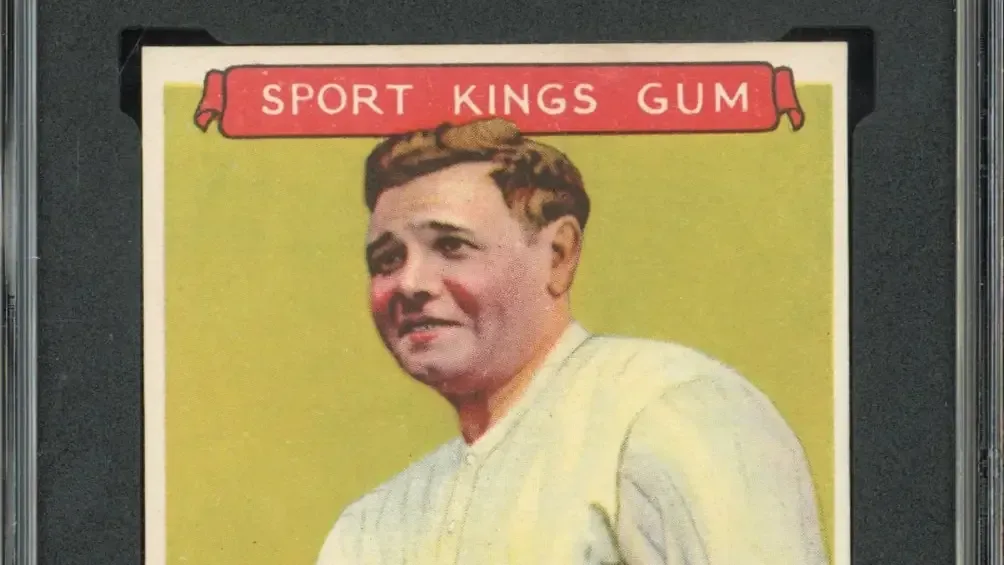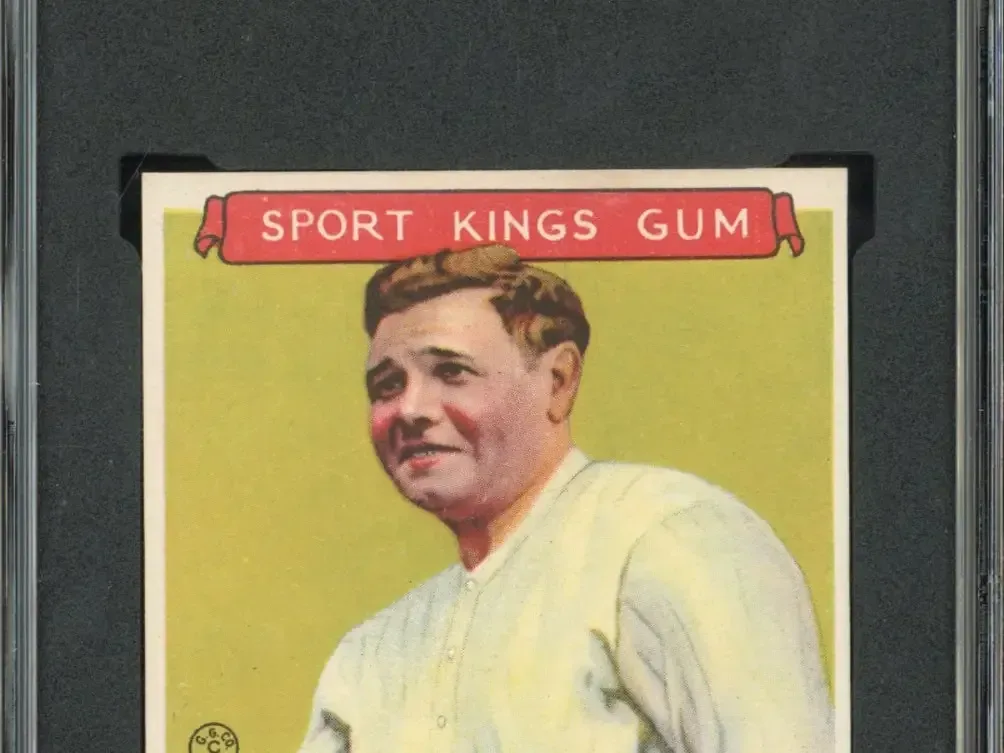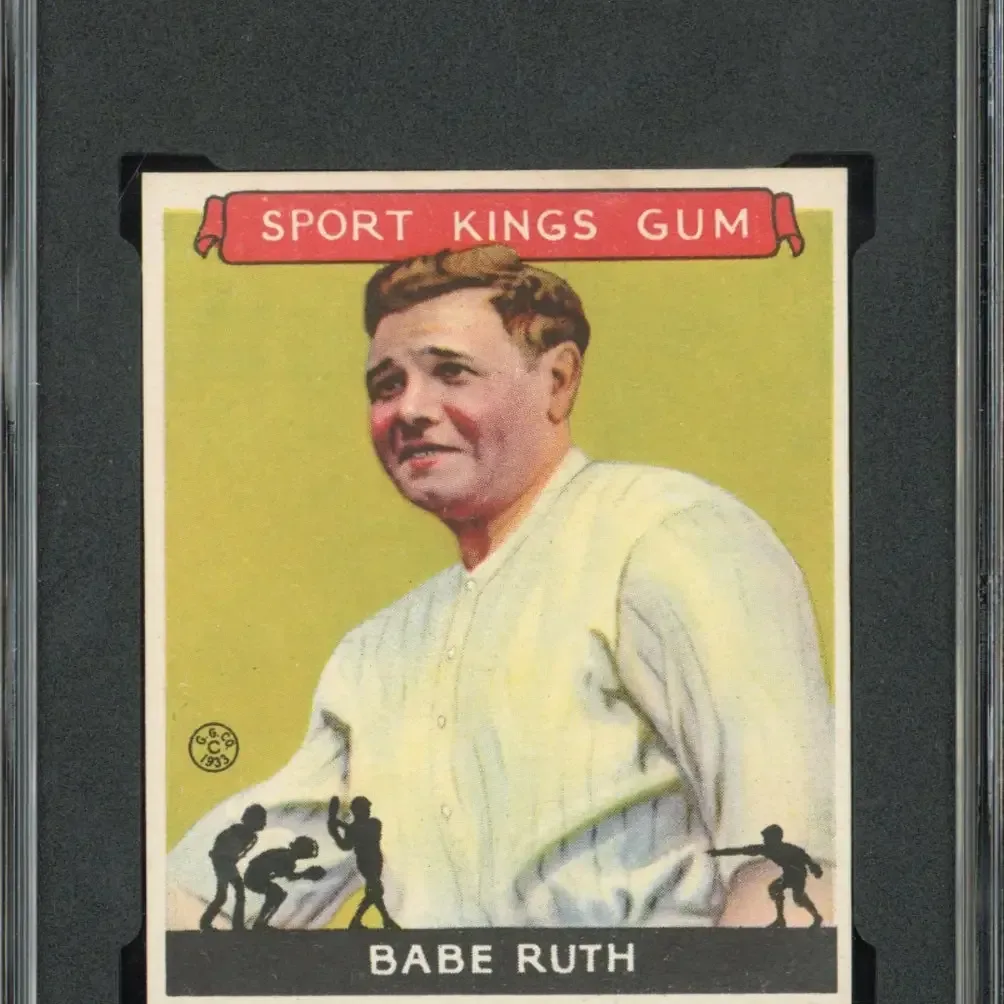
A 1933 Sport Kings Gum #2 Babe Ruth graded SGC 9 is the centerpiece of a 3,100-lot Fall Auction running through October 22. It is described as the only example of that card at the SGC 9 grade, a distinction that immediately explains why it sits at the front of a catalog full of famous names, difficult issues and high-grade vintage material.
The sale’s appeal is not limited to one Ruth card, though. Its baseball offerings range from pre-war issues to 1970s Topps, with Mickey Mantle, Willie Mays, Ty Cobb, Jackie Robinson and George Brett among the headliners. Football and hockey are represented as well, including cards of Bart Starr, Tom Brady, Walter Payton and Wayne Gretzky. Two major registry-ranked collections—the 1909-11 T206 Polar Bear Back near-complete set and a 1962 Topps Football collection—give set collectors a second reason to study the auction beyond individual star cards.
The Ruth card and what the grade signals
Sports-card grading is a third-party assessment of a card’s condition, generally expressed on a numerical scale. The grade does not erase the need to inspect the specific item, but it gives collectors a common reference point when comparing cards. In this case, the designation is particularly important because the Ruth is identified as the only 1933 Sport Kings Gum #2 example graded SGC 9.
That wording matters. It is a population statement tied to the named grading company and grade, not a claim that no other 1933 Sport Kings Ruth cards exist or that no finer example could ever emerge. Still, it makes the card a notably unusual offering: collectors are weighing an iconic player, a specific 1933 issue and an elite assigned grade all at once.
Another Ruth appears in the auction in a different vintage format: a 1933 Goudey #149 graded PSA 5.5. Placing those two Ruth cards in the same event offers a useful reminder that a player name alone does not define a collectible. Brand, card number, year, grading service and condition are all part of the item being offered. The 1933 Sport Kings Gum and 1933 Goudey cards are distinct pieces, rather than interchangeable versions of a single Ruth collectible.
Mantle, Mays, Cobb and Robinson form a deep baseball lineup
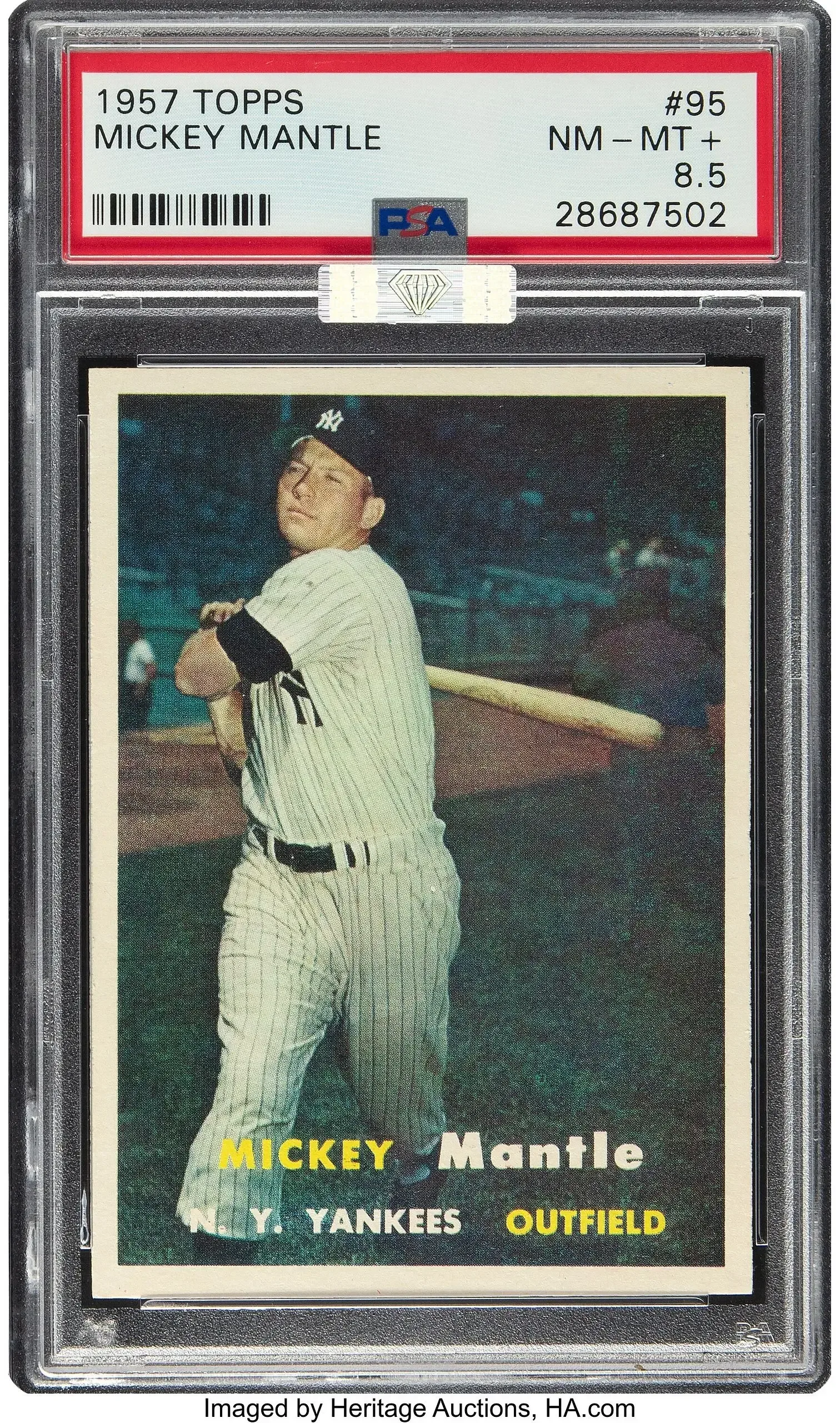
Mickey Mantle is represented by a 1961 Topps All Star #578 graded PSA 10 and a 1952 Topps #311 graded MBA 2.5 GOOD+. The contrast is useful for collectors reading the catalog. One is a perfect numerical grade from PSA; the other carries a lower condition assessment from MBA, whose label also uses the descriptive term GOOD+. Neither label alone answers every question about desirability, but each identifies the condition opinion attached to that particular card.
The auction also includes two unusual Mantle paper collectibles: a pair of 1958 Mantle Haggar Slacks card/pamphlet pieces with the original string hang tag, described as possibly the only known example, and a 1960s Mickey Mantle “best wishes” card. The “possibly” is worth retaining. It signals a seller’s stated belief about known survival, rather than a definitive census of every example in private hands.
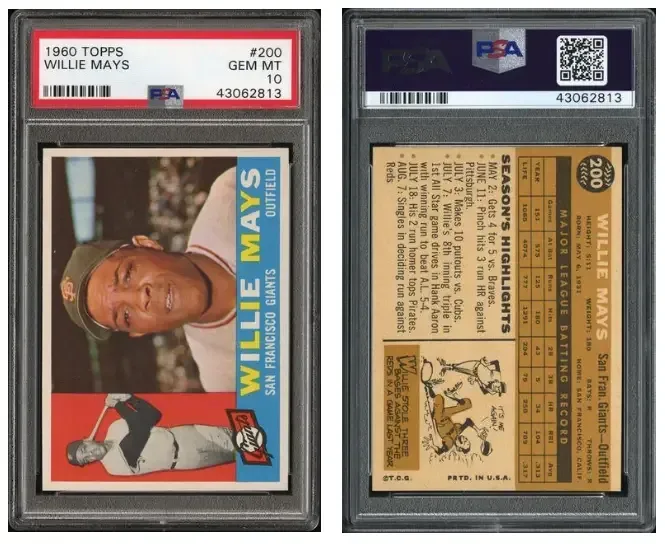
Willie Mays appears in two prominent lots: a 1952 Topps #261 graded SGC 8 with an MBA Silver Diamond, and a 1954 Bowman #89 graded PSA 9. The Silver Diamond is an MBA designation included with the Mays listing, while the SGC 8 remains the stated numerical grade for the card. Buyers evaluating a card that has more than one authentication or review-related notation should keep each designation separate instead of treating them as one combined grade.
Related coverage includes Babe Ruth SGC 9 and Elite Vintage Sets Lead Mile High Fall Auction.
Further baseball highlights include a 1909 E92 Croft’s Candy Ty Cobb graded PSA 1.5 FAIR, a 1948 Leaf #79 Jackie Robinson graded MBA 4, and a 1975 Topps Mini #228 George Brett graded MBA 10. Those listings cover a broad range of grades and eras, but the practical commonality is that every lot needs to be considered on its own stated details. A low-grade early Cobb can be a fundamentally different collecting proposition from a top-grade Brett mini, even if both are major names.
The T206 Polar Bear Back collection is offered two ways
One of the auction’s most consequential structural choices involves the 1909-11 T206 Polar Bear Back near-complete set. The collection is ranked first on the PSA Set Registry with a 5.643 GPA, and it will be offered both as an entire collection and as individual lots.
Set Registry rankings organize registered collections around graded examples, while GPA means grade point average. Here, the 5.643 figure is the collection’s reported PSA Set Registry GPA. It should not be read as the grade of any one card. The appeal lies partly in the group’s focused construction: these are T206 cards with Polar Bear backs, rather than a general assortment of T206 fronts or a handful of unrelated tobacco-era cards.
The collection’s individual highlights include Ray Demmitt graded PSA 6 and Bill O’Hara graded PSA 4. Other listed Polar Bear-back keys are Ty Cobb Portrait-Red (PSA 5), Ty Cobb Bat Off Shoulder (PSA 5), Walter Johnson Hands At Chest (PSA 6), Christy Mathewson Dark Cap (PSA 5), Tris Speaker (PSA 5), Cy Young Clev. Glove Shows (PSA 6), and Home Run Baker (PSA 7).
For a buyer pursuing the full offering, the attraction is the opportunity to acquire a near-complete, registry-leading collection as a unified project. For a buyer targeting single cards, the separate-lot format provides a path to specific players and back variations without taking on the entire collection. The availability of both formats creates distinct decisions, so interested bidders should establish early whether they are pursuing a particular card or the broader set build.
1962 Topps Football brings another registry leader
The 1962 Topps Football collection is reported as the number-one All-Time PSA Set Registry collection, with a 9.36 GPA. Its listed high-grade cards include Johnny Unitas (PSA 8.5), Lenny Moore (PSA 9), Mike Ditka (PSA 8), Jim Brown (PSA 8), Ernie Davis (PSA 8.5), Bart Starr (PSA 9), Paul Hornung (PSA 9) and Fran Tarkenton (PSA 9).
That concentration of upper-grade cards makes the group meaningful as a collection rather than simply a sequence of player names. The reported GPA indicates that the full registry entry is consistently strong, while the named cards illustrate the level of key-player representation inside it. The sale separately includes a 1957 Topps #119 Bart Starr graded MBA 9, allowing Starr-focused collectors to compare a single-card opportunity with the role his PSA 9 card plays within the 1962 set collection.
Football card collectors following current player-driven markets may find it useful to separate veteran and vintage set considerations from short-term performance narratives. Joking Joystick’s look at what Week 4 can mean for NFL card collectors explores that more contemporary side of the hobby. The 1962 collection, by contrast, is presented here as a high-grade historical set and a registry-ranked object.
Non-baseball lots widen the auction’s audience
Outside baseball, the catalog lists a 2000 Playoff Contenders #144 Tom Brady AU graded Beckett 8.5 with a 10 Auto. The two numbers refer to different things: the Beckett 8.5 is the stated grade for the card, while the 10 Auto is the stated assessment for the autograph. Keeping the card grade and autograph grade separate is essential whenever a label reports both.
A 1976 Topps #148 Walter Payton autograph is encapsulated with PSA/DNA 6 and Auto 9. Again, the listing presents separate evaluations for the item and signature. The group also includes a 1979 O-Pee-Chee #18 Wayne Gretzky graded MBA 8 and the aforementioned 1957 Topps Bart Starr graded MBA 9.
These lots make the sale broader than a conventional vintage-baseball event, but they do not reduce the need for discipline. Different graders appear across the catalog—SGC, PSA, MBA, Beckett and PSA/DNA—and their labels should be recorded accurately rather than casually flattened into a single universal scale. A PSA 9, an MBA 9 and an SGC 9 are each stated assessments from different companies; the listing’s exact service and designation are part of the lot description.
How to approach a large, mixed-grader auction catalog
A catalog with 3,100 lots can reward a focused plan. The strongest practical starting point is to identify the precise object of interest: player, set, year, card number, grade and, where relevant, back variation or autograph notation. That avoids confusion between similarly named cards such as the two 1933 Ruth offerings or the several Mantle items.
- Read the grade exactly as listed. Note the grading company, numerical grade and any separate autograph grade or designation.
- Distinguish a collection average from an individual-card grade. The 5.643 and 9.36 GPAs describe the reported registry collections, not every card within them.
- Separate certainty from qualification. “Only” at a specific grade is a strong population claim; “possibly the only known” remains a qualified assertion.
- Decide between set-building and player collecting. The T206 Polar Bear group’s whole-collection and individual-lot options create materially different targets.
- Review lot descriptions before bidding. Names and grades are a starting framework, not a replacement for studying the exact item being sold.
The auction’s central story is therefore depth as much as star power. The SGC 9 Sport Kings Ruth is the signature lot, but the T206 Polar Bear Back near-complete set, the top-ranked 1962 Topps Football collection, the high-grade Mantle and Mays cards, and cross-sport signed and graded offerings give collectors several distinct routes into the event before bidding closes October 22.