Five landmark vintage baseball cards set new public-sale highs on October 23, spanning issues from 1933 through 1958 and grades from SGC 3 to PSA 9. The results were not confined to one company, one condition tier or even one collecting rationale. They included a near-top-condition Mickey Mantle, a relatively low-number-graded but exceptionally scarce Satchel Paige rookie, an iconic Babe Ruth playing-era issue, a high-grade Jackie Robinson co-rookie and a prized Sandy Koufax rookie.
That range matters. Vintage cards are often reduced to a player name and a number on a grading label, but these sales show why the real picture is more complicated. Population, scarcity at a particular grade, a card’s place in a player’s career, set design and the card’s visual presentation can all inform a collector’s decision. A record for one exact card-and-grade combination is not automatically a baseline for every copy of that card, nor for every vintage card bearing the same player. It is, however, a concrete public data point for a particular piece of hobby history.
A quick guide to the terminology
PSA and SGC are third-party grading companies. A numerical grade is intended to communicate a card’s condition, while the encapsulated holder also identifies the item. A PSA 9 and SGC 3 should not be read as simple interchangeable points on the same market ruler: collectors consider the exact card, the grader, scarcity and the individual copy.
Population, frequently shortened to “pop,” refers here to the number of copies a grading company has assigned that precise grade. It can provide useful context, but it is not a total print-run figure and does not account for ungraded copies. A low population may indicate that a particular grade is hard to find, yet demand and the card’s importance still determine whether buyers pursue it aggressively.
For more context, explore RBX’s Amended Spotify Lawsuit Over Alleged Botting Is Rejected Again.
Eye appeal is the collector shorthand for how a card presents visually. Centering, color, print quality and the general look of the front can affect appeal independently of the assigned number. This does not override a grade; it explains why two examples with the same label may not attract the same attention.
Finally, a playing-era card is a card issued during the athlete’s active career. For collectors, that direct connection to a player’s own era can add a distinct layer of appeal.
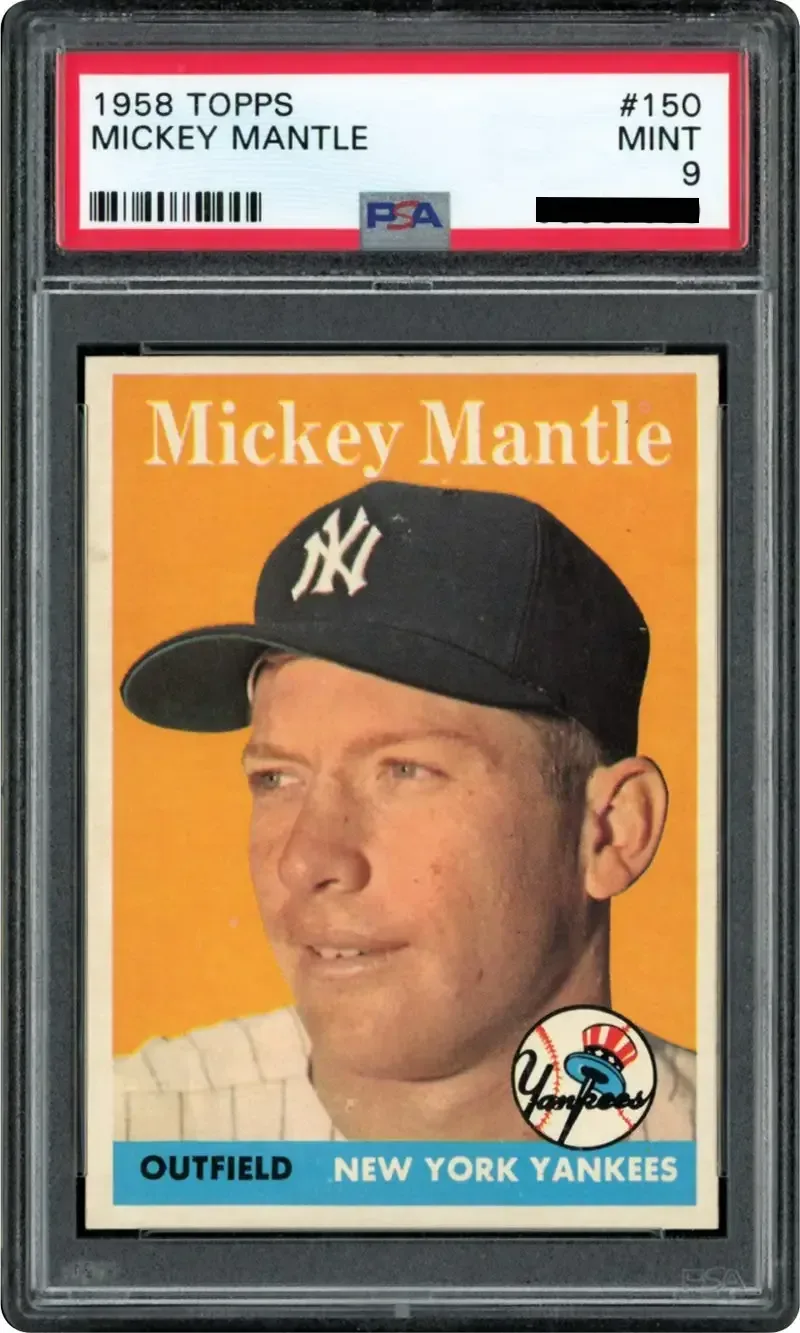
1958 Topps Mickey Mantle #150 PSA 9: $189,100
A 1958 Topps Mickey Mantle #150 in PSA 9 established a new high of $189,100. Its prior public sale was $80,530 on January 26, 2024, putting the new result $108,570 higher, or 134.81% above that earlier price.
The PSA 9 population is 28, and no PSA 10 example exists. That leaves PSA 9 as the highest available grade for collectors seeking the cleanest certified version of this specific Mantle. In a vintage market where the very best known condition can become its own category, the absence of a higher-graded alternative is significant context for the result.
The card also comes from a visually recognizable Topps release, known for its multicolored backgrounds. The 1958 Topps set holds a place in the evolution of card-set construction because it introduced All-Star cards as a subset. A subset is a themed group within a broader release, rather than the standard run of player cards. The format is familiar now, but that early use gives the set an additional historical hook beyond its Mantle connection.
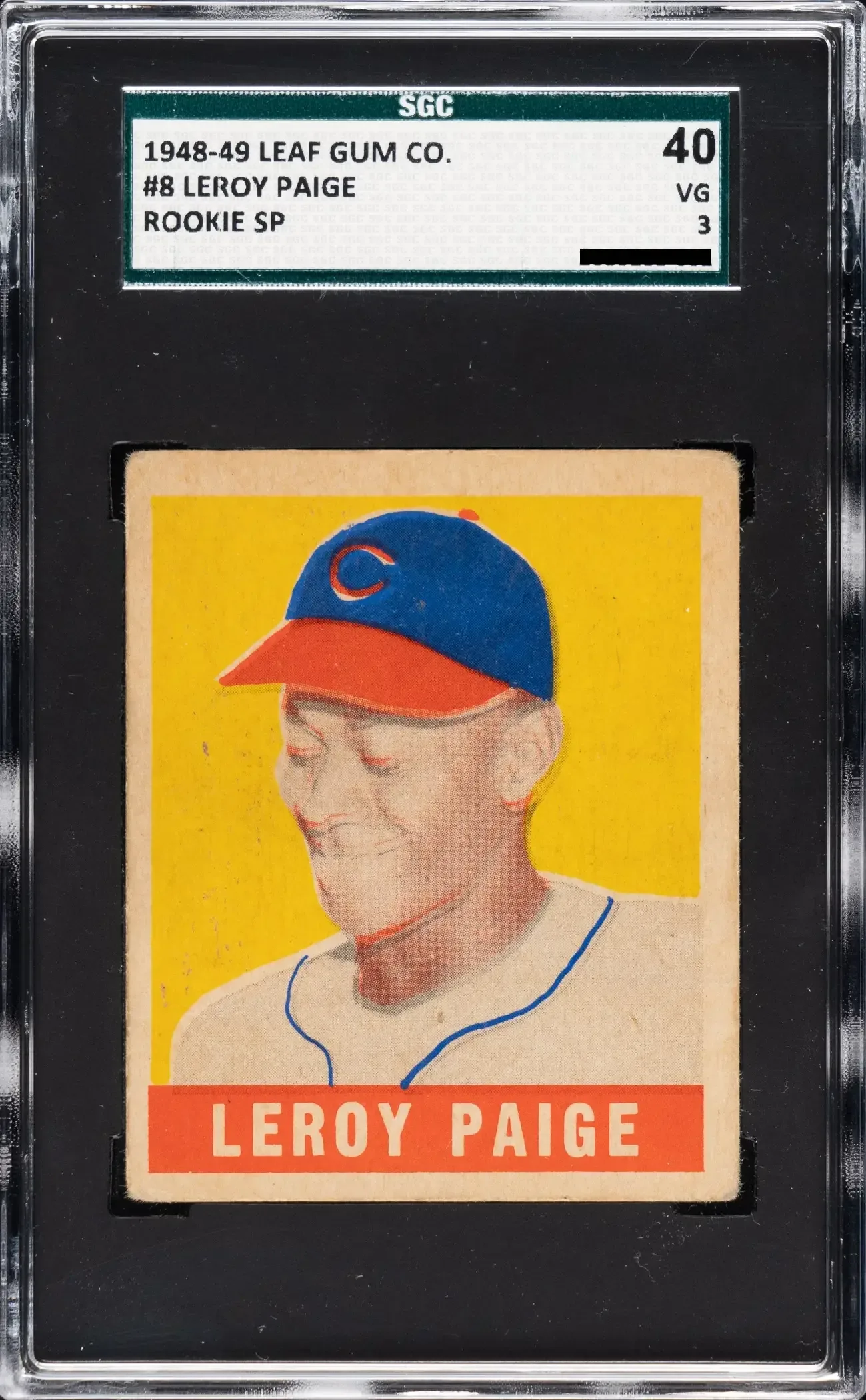
1948 Leaf Leroy “Satchel” Paige #8 SGC 3: $120,000
The week’s sharpest percentage move belonged to the 1948 Leaf Leroy “Satchel” Paige #8 in SGC 3. It sold for $120,000, surpassing its last public sale of $36,000 on March 22, 2024. The $84,000 difference represents a 233.33% increase.
On the surface, an SGC 3 might appear far removed from the Mantle’s PSA 9. The Paige result is a reminder that grade alone does not establish importance. Only nine copies sit in the SGC 3 population, and the card has recorded 11 public sales in total. Limited public appearances can make every new auction result especially notable, while also making it unwise to treat a single sale as a complete map of the market.
This #8 is regarded as Paige’s rookie card and is consistently his highest-selling card. It uses his birth name, Leroy, and was issued in the same year he made his MLB debut. Paige remains the oldest player to debut in Major League Baseball, doing so at age 42. Those details make the card more than a condition census entry: it is a major collectible tied to an extraordinary career and a pivotal moment in the player’s professional story.
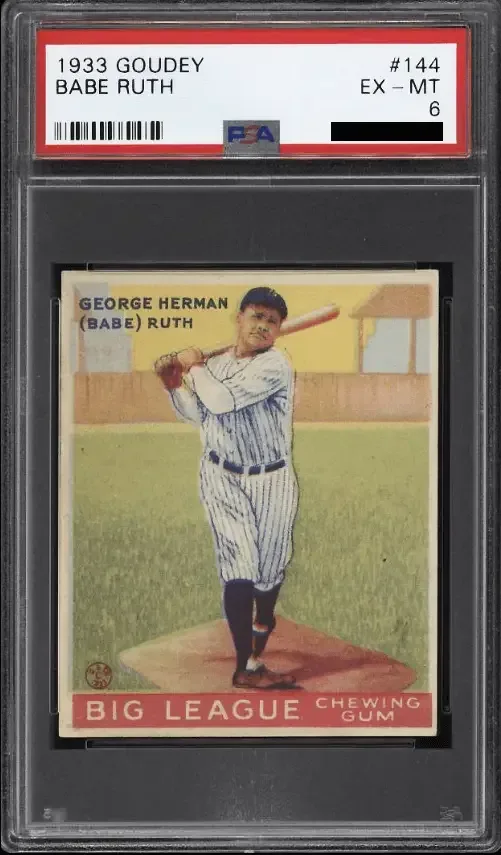
1933 Goudey Babe Ruth #144 PSA 6: $112,850
A 1933 Goudey Babe Ruth #144 graded PSA 6 brought $112,850, a new public high. The card had most recently sold publicly for $96,000 on June 19, 2026, making the latest price $16,850 higher, a 17.55% rise in a little over four months.
PSA’s population information adds nuance. There are 71 PSA 6 copies, with 80 graded higher. That means it is not the top condition available, but it occupies a grade that still carries substantial appeal for a foundational Ruth issue. The premium comes from the full package: Ruth, the vintage Goudey brand, the card’s visual identity and its status as a playing-era example.
Ruth appears four times in the 1933 Goudey set: #53, #144, #149 and #181. Card #144 was double-printed, meaning it was produced at twice the quantity of other cards in the release. Increased production has not removed its desirability. That is a useful collecting distinction: availability is one part of scarcity, but historical stature and sustained demand can keep a card highly sought after even when it was printed more often than neighboring cards.
The set is also an important design landmark. Goudey moved away from the black-and-white photography common on earlier baseball cards with a colorful presentation whose influence remains visible in later card designs.
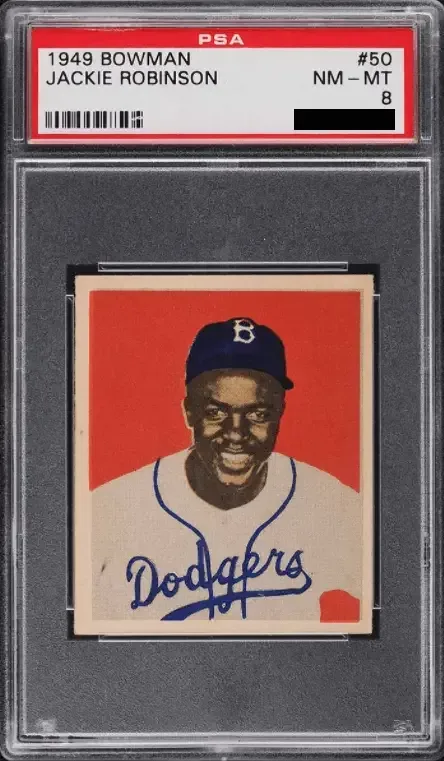
1949 Bowman Jackie Robinson #50 PSA 8: $85,400
The 1949 Bowman Jackie Robinson #50 in PSA 8 sold for $85,400, eclipsing its December 19, 2025 public sale of $37,820. That is a $47,580 increase, or 125.81%, in just under a year.
The PSA 8 population is 115, and only 20 copies have graded higher. While 115 may sound substantial compared with the Paige figure, the more relevant question for a high-end buyer is often how many examples sit above the offered grade. Here, the limited number of higher-graded cards places PSA 8 among the stronger certified options for the issue.
Collectors regard the 1949 Bowman as a co-rookie for Robinson because the 1948 Leaf set was distributed in March 1949. The designation captures a common vintage-card reality: “rookie card” can be a collecting consensus shaped by release and distribution history, rather than a perfectly tidy calendar label.
The card also connects to Robinson’s historic 1949 season, when he won the National League MVP. Its record price therefore reflects the appeal of a high-grade card associated with one of baseball’s most consequential players and a season of particular significance in his career.
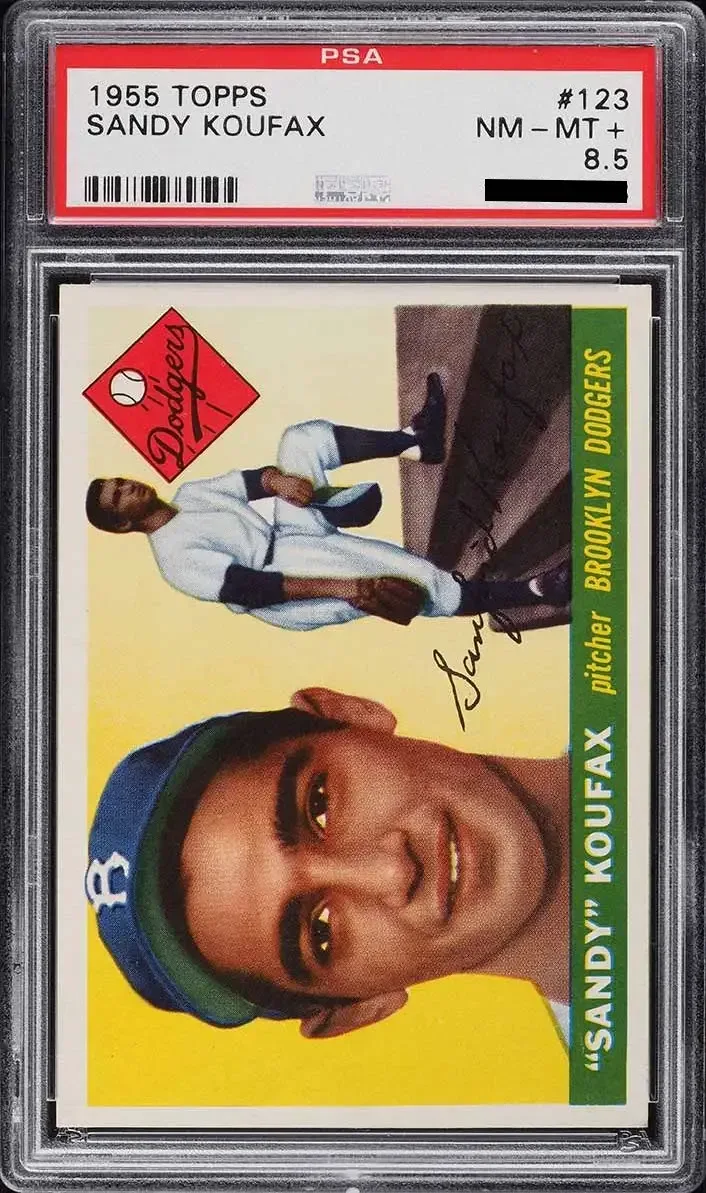
1955 Topps Sandy Koufax #123 PSA 8.5: $170,800
The 1955 Topps Sandy Koufax #123 in PSA 8.5 sold for $170,800, setting another all-time public high. Its previous public sale, on December 4, 2022, was $102,000. The new result is $68,800 higher, an increase of 67.45% in just under four years.
Only 17 copies have received the PSA 8.5 grade. The number is a useful measure of the exact version that sold, particularly because half-grade examples can occupy a distinct niche for collectors aiming beyond whole-number grades without reaching the highest available tier.
Koufax’s #123 is considered his rookie card and one of the defining cards in the 1955 Topps set. Its rookie class also includes Harmon Killebrew and Roberto Clemente, giving the release depth far beyond a single headline name. The 1955 flagship design was the first to use a horizontal format throughout the entire set, another characteristic that has helped it remain a frequent reference point for modern Topps designs.
What these results do—and do not—say
Together, the five sales total $678,150. Mantle and Koufax produced the two largest individual prices, but Paige’s sale posted the largest percentage increase from its prior public result. Ruth’s PSA 6 shows that a card does not need to be the top-graded known copy to set a record, while Robinson’s PSA 8 demonstrates the premium collectors may place on a card with comparatively few higher-graded examples.
The practical takeaway for collectors is to read record-price headlines precisely. Verify the player, year, card number, grading company and grade before using a comparable sale. Then consider population data, prior sale timing and the card’s individual visual appeal. A record attached to a PSA 9 Mantle is evidence about that PSA 9 Mantle; it is not automatically a value for an ungraded copy, a different grade or even another card from the same set.
These five results nevertheless make a strong case for the continued depth of vintage baseball demand. The common thread is not simply fame. Each card combines a recognizable player with a particular collecting story: top available PSA condition for Mantle, the scarce and career-defining Paige rookie, Ruth’s colorful playing-era Goudey, Robinson’s co-rookie status and Koufax’s iconic horizontal rookie. When those factors align, the number on the label is only the beginning of the conversation.