Some vintage card sets are important because they are scarce. Others are important because one rookie card has become a hobby monument. The 1956 Topps Baseball set takes a more complete route: it looks spectacular, carries a formidable lineup of stars, offers a substantial 340-card project, and still gives collectors enough variation to turn one checklist into several different missions.
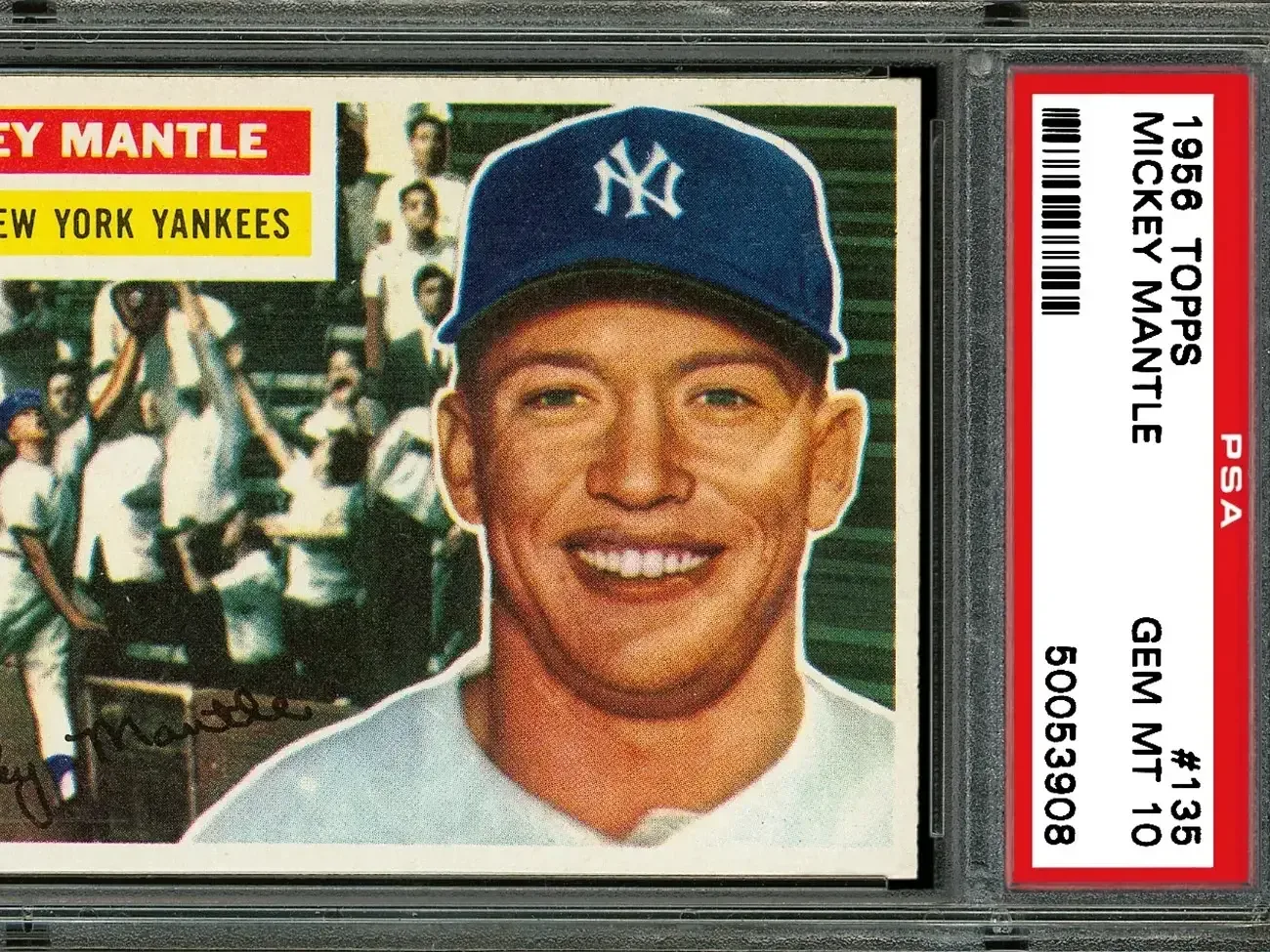
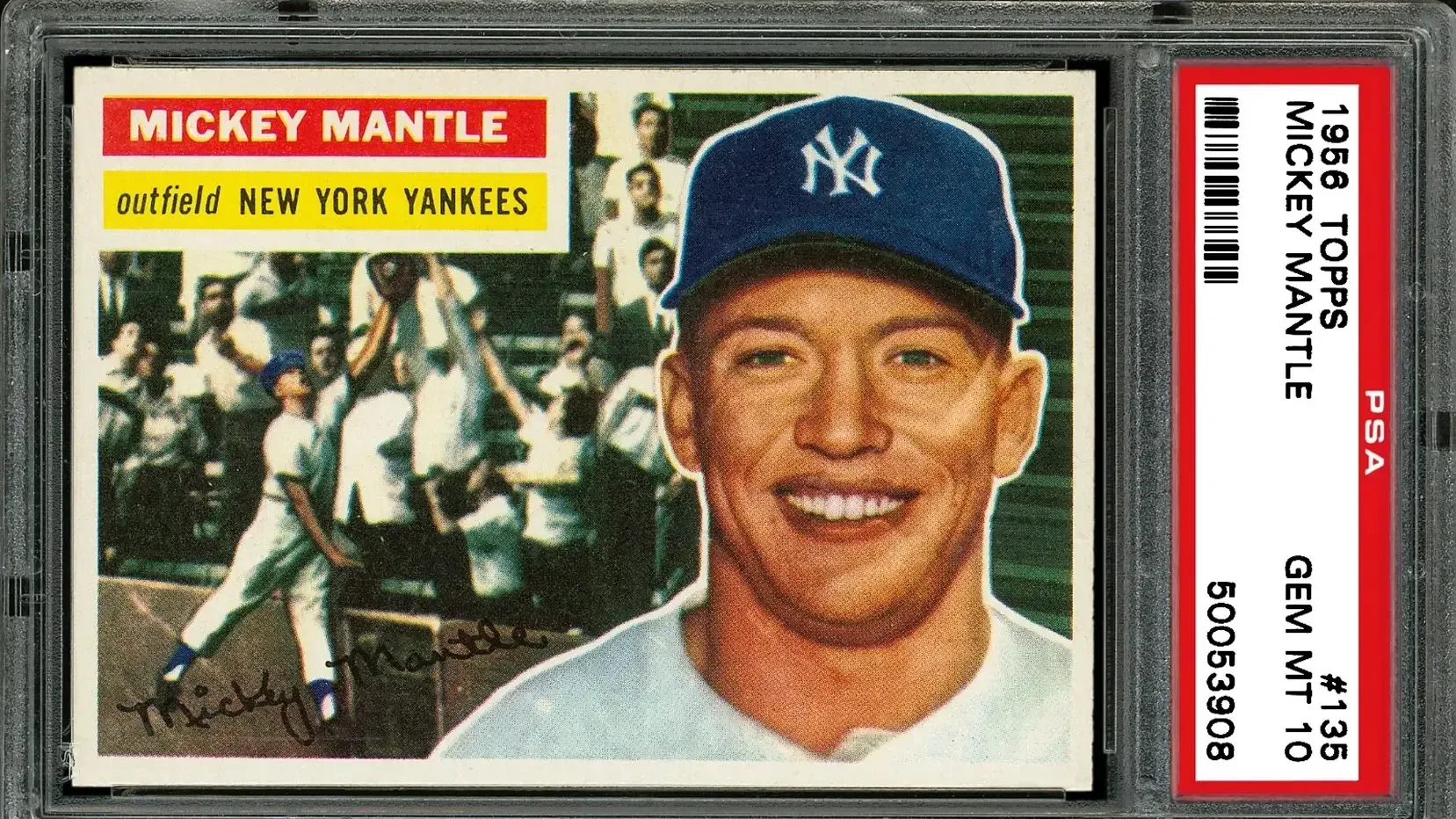
Its front design is the obvious draw. A color portrait is paired with an illustrated in-game scene, framed by clean white borders and strong color. The result gives each card both a player-identification image and a small piece of baseball drama. It is a format that makes even a collector who is not chasing a registry leaderboard stop and look at the card rather than merely check another number off a list.
There is also no shortage of players worth stopping for. Mickey Mantle sits at the top, but the set includes Ted Williams, Jackie Robinson, Willie Mays, Hank Aaron and Al Kaline. Luis Aparicio supplies the principal rookie-card draw, while Sandy Koufax, Roberto Clemente and Harmon Killebrew appear in their second Topps season. It is a set built less around one isolated rookie chase than a roster-wide run of baseball history.
That combination explains why 1956 Topps remains a popular vintage target seven decades after its release. It has the visual appeal, the star power, the supply, and the complications—because naturally a hobby cannot let a beautiful checklist simply be beautiful and straightforward.
Mickey Mantle’s return is the headline
The key story behind the set is Mantle’s return to Topps. He appeared in the company’s 1952 and 1953 issues, then disappeared from its 1954 and 1955 releases while rival Bowman held an exclusive agreement. After Topps bought its competitor in January 1956, Mantle returned, along with Yankees pitcher Whitey Ford and Cleveland Indians pitcher Bob Feller.
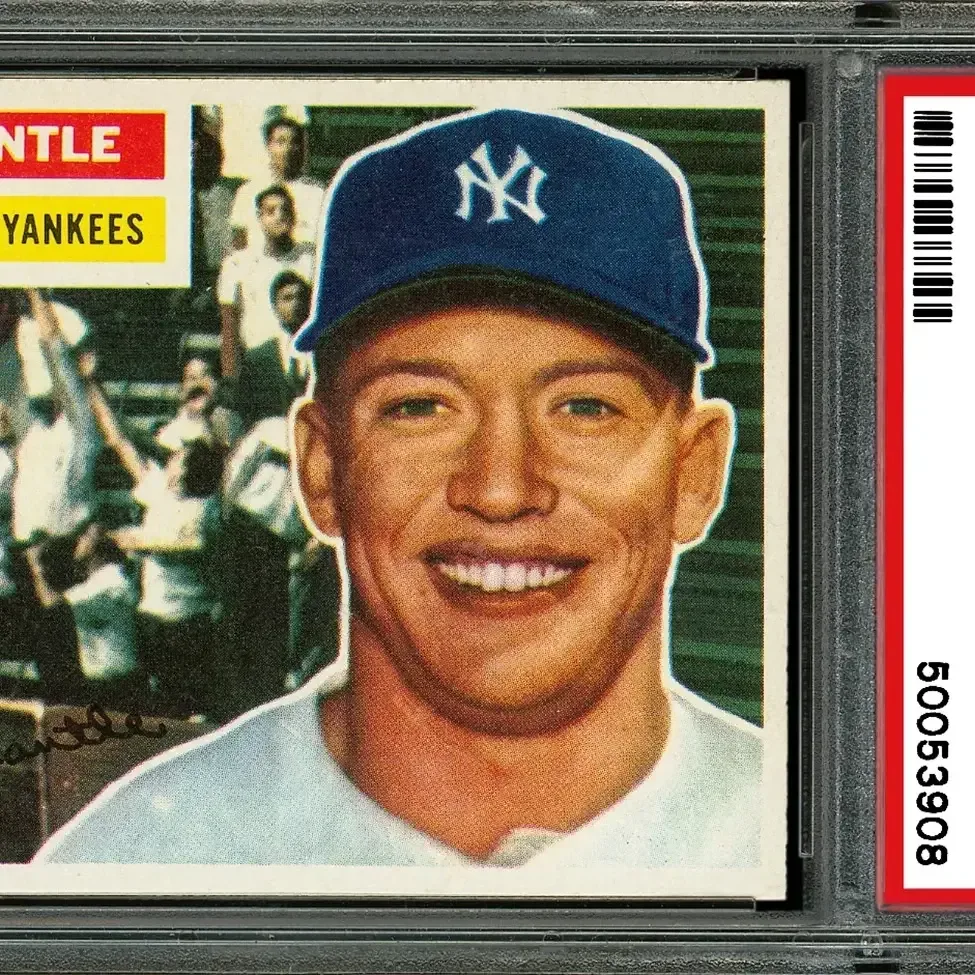
The timing could scarcely have been better for the card maker. Mantle won the Triple Crown in 1956, and his card became the only horizontal example in his Topps run. Its smiling portrait and background image of Mantle leaping at the wall have helped make it one of his most admired cards, generally spoken of alongside the 1952 and 1953 releases among his most coveted Topps issues.
That does not make the 1956 Mantle a substitute for the celebrated 1952 card. It is its own landmark: a highly visual card from his Triple Crown season, and a reminder that a card’s place in collecting culture can be shaped by composition and timing as much as first-year status.
The broader checklist matters just as much. A collector can build around Robinson’s #30, Williams’ #5, Mays, Aaron or Mantle #135 without treating the rest as anonymous cardboard. The action-and-portrait layout makes the common cards part of the aesthetic proposition. In a set build, that matters. A 340-card project becomes much easier to enjoy when the cards between the biggest names have genuine display appeal.
Why availability is part of the appeal, not a footnote
Vintage does not automatically mean rare, and 1956 Topps is a useful example. Topps increased production after 1955, leaving considerable surviving supply. By the end of January 2026, PSA had graded 391,296 cards from the 1956 issue, compared with 212,795 from the 1955 set.
Those figures do not reveal every raw card in collections, albums or boxes, and they should not be read as a census of all copies ever made. They do, however, show how much material has made its way into third-party holders. A population report is a grading company’s count of the cards it has graded, usually separated by card, variation and numerical grade. It is a valuable research tool, but it records submissions rather than a perfect supply total; resubmissions can complicate any simple interpretation.
For collectors, the practical implication is encouraging. The set is not only possible to assemble; it can be pursued in attractive condition. Nearly 80,000 1956 Topps cards have received PSA 8 or better, and 305 have reached PSA 10. White borders may help show corner and edge flaws, but they do not create the same unforgiving visual contrast as dark-border designs. The reported grade distribution has a notable concentration in the PSA 6 through PSA 8 range, a healthy outcome for cards of this age.
Grading is the assessment of a card’s condition by a third-party company, generally expressed on a numerical scale. A card encapsulated in a tamper-evident holder is commonly called a slab. High-grade availability should not be mistaken for a claim that top-grade cards are cheap: as condition rises, price differences can become steep, especially for stars and scarcer back varieties.
That creates multiple sensible ways into the set. A collector can buy raw cards for an album-style build, target mid-grade graded examples, focus on the visual stars, or chase the most demanding high-grade registry version. The sealed side is far less accommodating. Unopened wax packs and even wrappers are exceptionally difficult to locate, with no major finds reported to have supplied a deep pool of unopened material. In other words, singles are the sensible route; sealed material is the boss fight.
A set-builder’s game with a serious competitive mode
The appeal changes depending on the collector’s goal. For someone who wants a classic-looking run of cards, the broad supply and lack of a costly high-number series make the 1956 set comparatively approachable beside some earlier Topps issues. For someone competing in a registry, the very same availability invites escalation.
A set registry is a platform where collectors enter graded cards into a defined checklist and are ranked using the cards’ grades. The format turns condition into a score-driven collecting challenge. Completing a set in PSA 8 is one undertaking. Replacing cards with 8.5s and 9s to improve the weighted score is another entirely.
John Evanoff’s registry set illustrates the jump. His No. 3-ranked Current Finest 1956 Topps set has 236 PSA 9 cards, 29 PSA 8.5s and 77 PSA 8s, for a weighted GPA of 8.78. He has continued upgrading cards after initially assembling the set in five months during fall 2015. Among the specific hurdles is Red Schoendienst: only 17 gray-back copies have reached PSA 9, and that version has remained elusive in his pursuit.
The cost curve is real. Evanoff paid $29,000 for a PSA 9 Roy Campanella. Earlier acquisitions demonstrate how sharply top examples of major stars can change hands over time: he bought PSA 8.5 Jackie Robinson and Hank Aaron cards for $2,000 each, while comparable examples now sell in the five-figure range. These are individual sale-context examples, not a price guide or a promise of future value. Their useful lesson is simpler: collectors should decide their grade target before starting, because “I’ll just upgrade later” can turn into a second collection with a significantly different budget.
White backs and gray backs: the variation layer
For cards numbered 1 through 180, Topps used both white and gray cardboard backs. This is where a standard checklist gets more interesting. Numbers 1 through 100 more commonly appear with white backs, while gray backs are more common from 101 through 180. Neither color is universally the rarer version; the card number matters.
The population counts make that distinction clear. Ted Williams #5 has 5,319 graded white-back copies and 2,344 gray backs, making gray the less frequently graded variation in that case. Mantle #135 reverses the equation: 10,334 gray backs have been graded versus just 1,109 white backs. A 1956 Mantle white back in PSA 5 sold for $4,500 in October 2025, while a gray-back Mantle at the same grade sold for $2,800 in January 2026.
That is why a collector should not buy a card merely described as “1956 Topps Mantle” without checking its back if variation matters to the goal. The front image may be identical, but the back type can alter scarcity, registry requirements and pricing. It is also worth separating the terms carefully: a variation is not automatically an error, and a lower population count is not automatically a command to pay any premium asked. Condition, demand, card number and the specific player all remain part of the equation.
The set’s dimensions add one more historical marker. At 2 5/8 by 3 3/4 inches, 1956 Topps was the company’s final larger-format baseball release. The following year, Topps shifted to 2 1/2 by 3 1/2 inches, a size it has used ever since. That makes the 1956 cards feel distinct in hand and in storage planning, a small physical difference that reinforces their place at the end of one format era.
How to approach a 1956 Topps project
The strongest practical approach is to choose the collection’s rules before buying. The design makes it easy to get carried away, and the back variations make it easy to get carried away twice.
- Define the finish line: Decide whether the goal is one of each numbered card, both eligible back types, a star-card run, or a condition-ranked registry set.
- Set a grade lane: Mixing grades can be perfectly satisfying for a display set, but a target range helps prevent the expensive “upgrade loop.”
- Verify backs on #1–180: Especially on marquee cards, confirm whether the offered copy is white back or gray back and compare it with the version you actually want.
- Prioritize eye appeal: Centering, border wear, color and surface presentation can be meaningful to personal enjoyment even when two cards share the same numerical grade.
- Keep sealed expectations realistic: Individual raw and graded cards are widely available; unopened wax and wrappers are a different and much scarcer pursuit.
Collectors who enjoy comparing vintage and modern card-market questions may also find useful context in this look at classic-card reprints and price gaps. The products are different, but the central habit transfers: know exactly which version, condition and scarcity profile you are evaluating before treating a card name as a complete description.
1956 Topps endures because it offers a rare harmony of beauty and breadth. Mantle’s return and Triple Crown season give it a natural centerpiece. Robinson, Mays, Aaron, Williams and the rest give it uncommon depth. The large surviving supply lowers the barrier to a real set build, while condition competition and back varieties provide long-term difficulty for collectors who want it. It is a vintage checklist that can be a gorgeous binder project, a slabbed star collection, or an obsessive registry campaign—sometimes all three, if the collector’s wallet has agreed to a doubleheader.