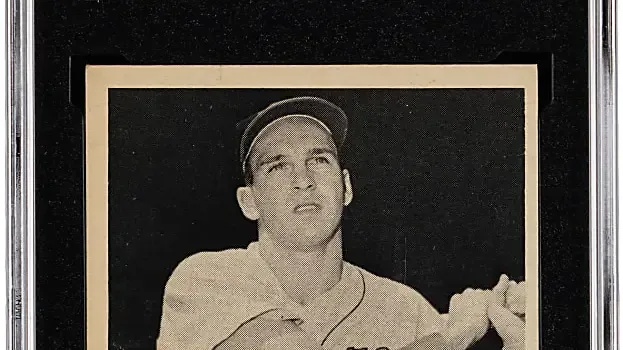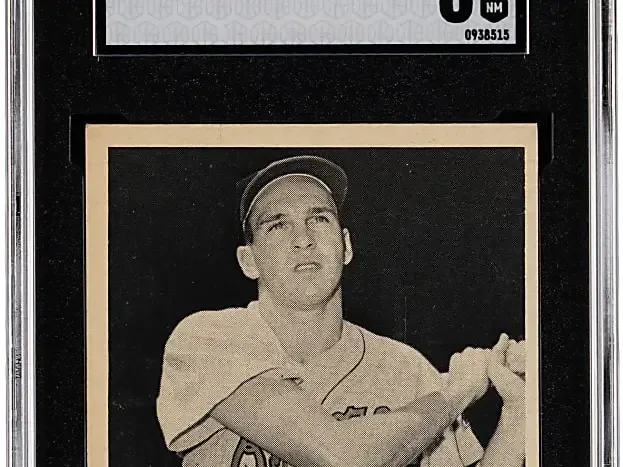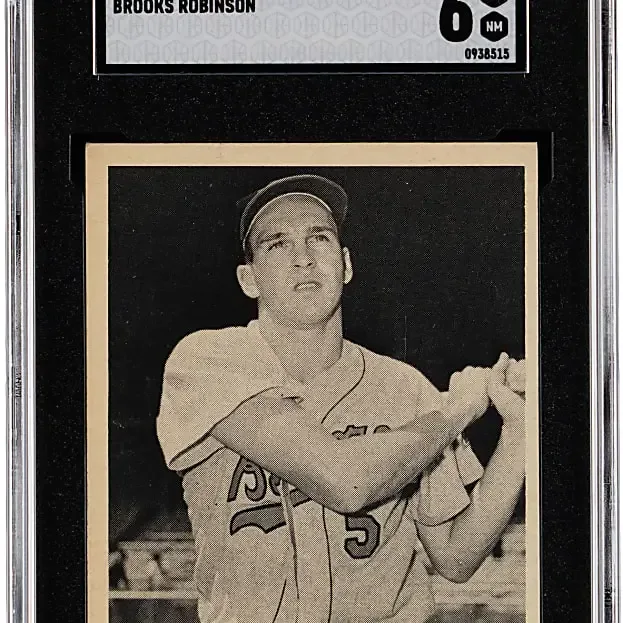
Brooks Robinson built a baseball legacy on reactions that appeared to defy the normal limits of a third baseman. The Baltimore Orioles icon won 16 consecutive Gold Gloves, an extraordinary run that helped make him one of the game’s defining defensive players. Now, an unusually scarce card tied to Robinson has made a different kind of history: a 1961 Topps Dice Game example has sold for $72,000, establishing a new high-water mark for the card.
The card, graded SGC EX/NM 6, was identified as the highest-graded known example of the Robinson issue. It led a summer auction filled with vintage baseball, basketball, unopened material, inserts, and memorabilia. For collectors, the result is a reminder that scarcity is not always about the most famous flagship rookie card. Sometimes the hobby’s biggest numbers come from an unusual side release with a tiny surviving population, a distinctive game-related format, and the right Hall of Famer at its center.
A $72,000 result for an uncommon Robinson card
The 1961 Topps Dice Game Brooks Robinson card belongs to a niche area of vintage collecting that can be easy to overlook beside standard yearly Topps sets. Dice Game cards were connected to a baseball game product rather than a conventional pack-issued card run, giving them a different collecting identity and, crucially, a different survival story. Material intended for play is often handled, lost, marked, or discarded. Finding a high-grade survivor decades later is an entirely separate challenge.
That combination of player, rarity, and condition helps explain why the SGC 6 reached $72,000. Robinson’s reputation is unusually durable: he is remembered not merely as a great Orioles player, but as the benchmark for defensive third basemen. His 16 straight Gold Gloves create an immediate statistical shorthand for his place in the sport. On a rare 1961 issue, the highest graded example brings that career prestige into contact with the collector preference for condition-ranked scarcity.
A record result should not be read as a universal price guide for every copy of the card. The grade matters, the designation as the top-graded example matters, and auction timing can matter. Still, the sale offers a clear indication of how strongly collectors can respond when an overlooked vintage issue has both a celebrated subject and an unusually compelling condition profile.
Two more card records underline the auction’s vintage focus
Robinson was not the only player to leave with a new auction benchmark. A newly discovered 1921 Tip Top Bread Baltimore Orioles Lefty Grove Pre-Rookie, graded SGC FAIR 1.5, brought $58,800. Its condition is modest by the numerical standards collectors often associate with major sales, but that is part of the lesson embedded in the result. Age, rarity, historical context, and discovery status can be just as central to a card’s appeal as a high technical grade.
The Grove card’s “pre-rookie” description positions it before the pitcher’s better-known major-league cardboard appearances. Grove became one of baseball’s all-time great pitchers, and a Baltimore Orioles card from 1921 reaches back into an earlier chapter of his career. For advanced collectors, cards that document a star before the standard rookie-card timeline can hold a special fascination, particularly when an example is newly found and enters the market with a major backstory.
A third record arrived through modern-era grading rarity. A 1969 Topps #321 Jim McAndrew in PSA 10 sold for $39,600. The card was the only example at that grade, making it a very different kind of chase from the Grove piece. Here, the key is not a century-old regional bread issue or a Hall of Fame pedigree, but the apparent singularity of a pristine specimen from a widely recognized late-1960s Topps set.
Together, the three record sales show several lanes within vintage collecting. Robinson represents a rare game-related issue and an all-time defensive legend. Grove represents early career history, regional scarcity, and a newly surfaced card. McAndrew represents an ultra-high-grade population outlier. None is interchangeable with the others, which is precisely why the trio makes for such an instructive snapshot of the market.
High-grade rookies, Jordan cards, and unopened wax also command attention
The broader list of sales did not lean on one sport, one decade, or one collecting philosophy. A 1967 Topps #581 Tom Seaver rookie card graded PSA 9 realized $31,200, demonstrating continued demand for high-grade examples of an established star’s key card. Seaver’s rookie is a recognizable cornerstone for vintage baseball collectors, and a PSA 9 is a condition-sensitive offering in a set that is now approaching six decades of age.
Unopened material also posted a substantial number. A complete 1982 Topps wax case, comprising 20 boxes with 36 packs in each box, sold for $20,400. Unopened wax occupies a special place in the hobby because collectors value both the physical object and the possibility inside it. The result does not reveal what individual cards may be present, nor does it turn every unopened product into a sure thing, but it does show demand for a fully intact vintage configuration.
Basketball appeared prominently in several forms. A 1984-85 Star Basketball #288 Michael Jordan 1985 Rookie-of-the-Year, graded BGS 7, sold for $18,600. A 1986-87 Fleer #57 Michael Jordan rookie in PSA 8 matched that $18,600 total. The shared figure is a neat illustration of how the hobby can value different Jordan collectibles: one tied to an early Star issue and award-season theme, the other to the defining mainstream Fleer rookie card.
Another basketball classic, a 1961-62 Fleer #8 Wilt Chamberlain rookie graded PSA 5, finished at $15,000. In baseball, a 2001 Bowman Chrome #340 Albert Pujols Autograph Rookie Refractor, numbered to 500 and graded SGC 8, also reached $15,600. Those results bridge generations: Chamberlain represents a foundational vintage basketball rookie, while the Pujols card reflects the autograph-and-serial-numbered framework that became a major part of modern sports-card collecting.
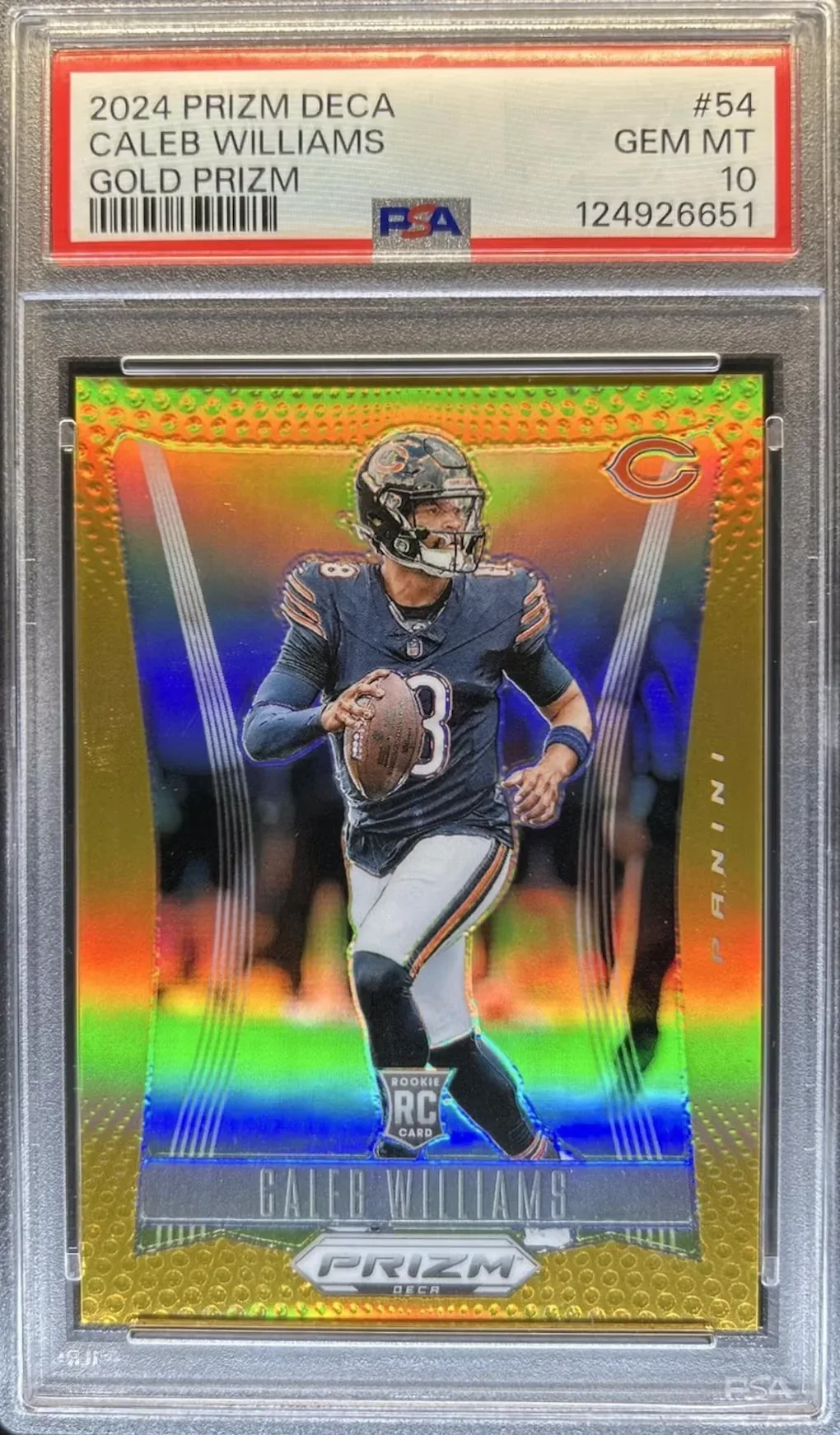
Collectors watching contemporary player demand can also compare these vintage and retired-star results with movement around active athletes, such as the recent surge in Caleb Williams card sales after Chicago’s 59-point Week 1 opener. The drivers are different—on-field momentum and present-day attention versus decades of legacy, rarity, and grading populations—but both demonstrate how quickly collector focus can concentrate around a compelling story.
Sets, panels, and large collections broaden the results
The auction also included examples where the attraction was breadth rather than a single famous card. A complete 300-card 1991 Fleer Pro-Visions Insert set sold for $19,200. A 1935 Goudey 4-In-1 uncut six-card panel, graded SGC Authentic and featuring 11 Hall of Famers including Babe Ruth, brought $15,000. An uncut panel is not simply a group of cards; it is a production-format artifact that presents vintage imagery in a way standard singles cannot.
A collection of more than 4,000 baseball inserts and parallels from the 1990s, described as being loaded with Hall of Famers and stars, realized $13,800. Meanwhile, a 1909-11 T206 White Border Ty Cobb Green Portrait graded PSA 3 sold for $13,200. The contrast is considerable: one lot is a massive accumulation from the insert-and-parallel boom, while the other is a singular tobacco-era card of one of baseball’s most enduring subjects. Both found substantial demand.
Memorabilia results add Ruth and Lakers championship history
Cards were the dominant attraction, but the memorabilia slate supplied two more notable figures. A Babe Ruth single-signed American Association baseball sold for $27,600. Ruth’s signature remains one of the most recognizable in sports memorabilia, and a single-signed baseball puts the focus squarely on the autograph rather than sharing the surface with a roster of additional names.
A 2009 Los Angeles Lakers NBA Championship 15K gold ring presented to assistant general manager Ronnie Lester brought $20,400. Championship rings have an appeal distinct from cards: they connect an object to a specific title-winning team and a specific recipient. The Lester ring adds an organizational-history angle to an item already tied to a major NBA championship.
What these sales say—and do not say—about collecting
The auction’s consignments director, Ron Oser, characterized the results as evidence of persistent demand for vintage cards and healthy activity across the hobby. The sale totals support the narrower observation that collectors competed vigorously for a varied group of items: rare game cards, pre-rookies, top-pop condition rarities, vintage rookies, unopened wax, complete insert sets, historic panels, autographs, and championship jewelry.
They do not guarantee that every vintage card, sealed box, or graded example will follow the same trajectory. Auction outcomes depend on the exact card, authentication and grading details, eye appeal, surviving population, provenance where applicable, bidder participation, and the particular moment an item reaches the market. But the $72,000 Robinson result is especially notable because it elevates a rare 1961 issue associated with one of baseball’s greatest fielders. For a player whose reputation was built on making difficult plays look routine, it is a decidedly uncommon addition to the record book.