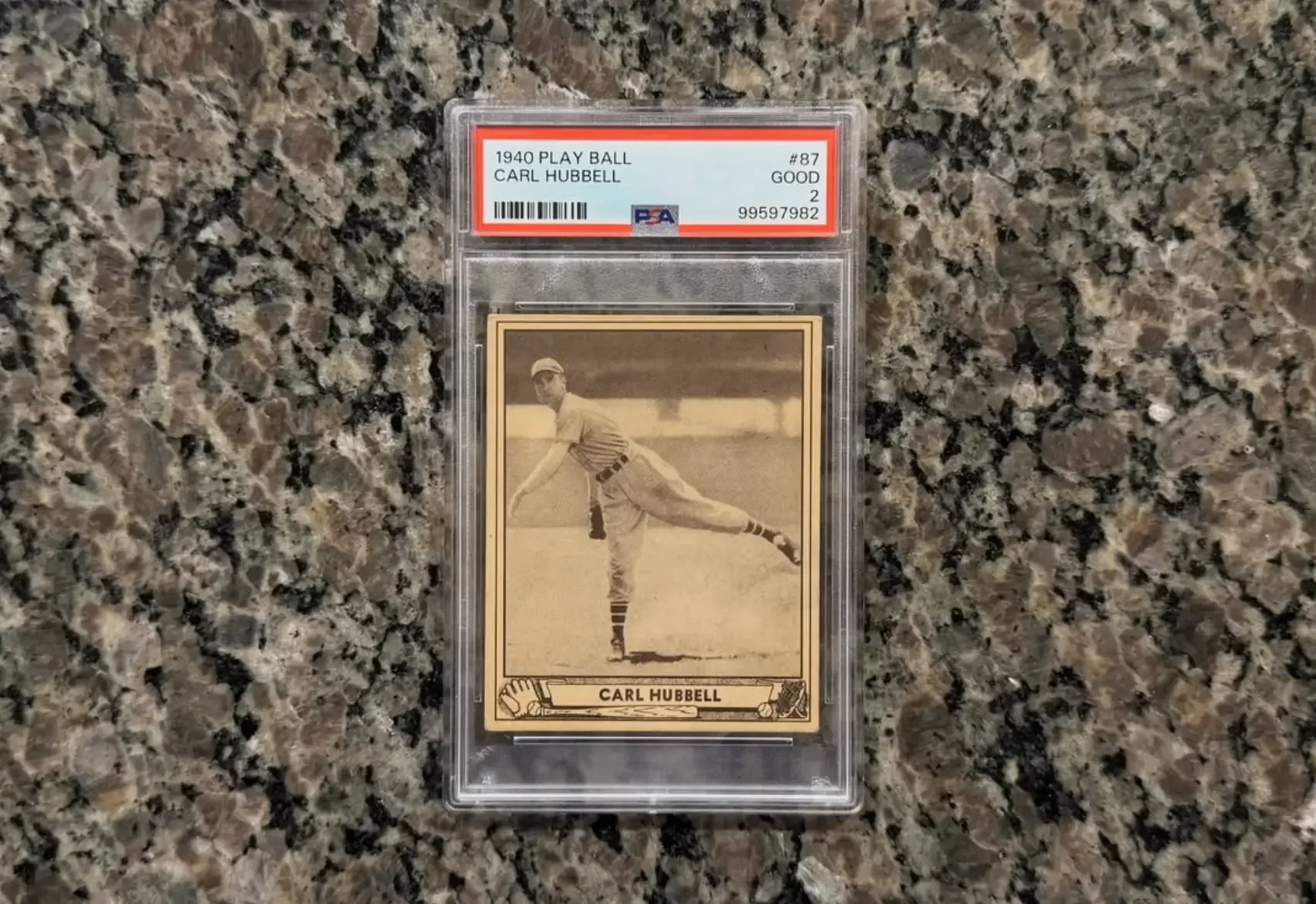
Carl Hubbell’s place in baseball lore can be condensed into an outrageous sequence at the Polo Grounds in 1934: Babe Ruth, Lou Gehrig, Jimmie Foxx, Al Simmons and Joe Cronin, struck out consecutively in the All-Star Game. It is the kind of lineup that sounds invented for a baseball game’s legends mode, except the source material is a real afternoon and Hubbell’s screwball was the deeply unfair special ability.
That moment is not the whole case for Hubbell. He won two MVP awards, made nine All-Star teams and won a 1933 World Series ring with the New York Giants. But it is an unusually useful lens for understanding why his prewar cards endure. The five cards below do not merely repeat a player portrait with new borders: together, they show Hubbell in different poses, products and collecting tiers, from a celebrated 1933 Goudey double appearance to a later color Play Ball issue.
For collectors, the key distinction is between a card’s visual or historical appeal and its market evidence. A public sale is an observed transaction for a particular graded copy on a particular date. A quoted estimate, by contrast, is an estimate—not a guarantee that another copy will sell there. That difference matters especially with high-grade vintage Hubbell cards, where the available sales can be old, thin or absent.
The baseball story behind the cardboard
The second MLB All-Star Game took place on Tuesday, July 10, 1934, at the Polo Grounds, with more than 48,000 fans in attendance. Hubbell represented the National League at his home park. The American League put immediate pressure on him: Detroit second baseman Charlie Gehringer singled and reached second on an errant throw, then Heinie Manush walked.
For more context, explore Adaptive Cruise Control Is Clever, Not Clairvoyant: The Radar-and-Camera Tech Behind the Gap.
With nobody out and runners aboard, Ruth stepped in. Hubbell struck him out looking on a screwball with a 1-2 count. Gehrig followed and worked the count full, but struck out swinging on another screwball. Foxx, coming off seasons of 58 and 48 home runs in 1932 and 1933, respectively, struck out on a 2-2 screwball.
Frankie Frisch then led off the National League half of the inning with a home run. When Hubbell returned for the second, he struck out Simmons swinging in four pitches, then struck out Cronin. Bill Dickey singled after Cronin, but Hubbell struck out the following hitter to end the inning. Through two innings, all six outs Hubbell recorded were strikeouts.
Why the five-player sequence matters: Ruth, Gehrig, Foxx, Simmons and Cronin form the famous consecutive run. The sixth strikeout is part of the remarkable two-inning stat line, but it is not part of that named five-man procession. Keeping those two facts separate makes the achievement clearer rather than smaller.
Related coverage includes Top 3 Carl Hubbell Cards That Still Define the Hall of Famer’s Hobby Legacy.
1933 Goudey #234: the red-background centerpiece
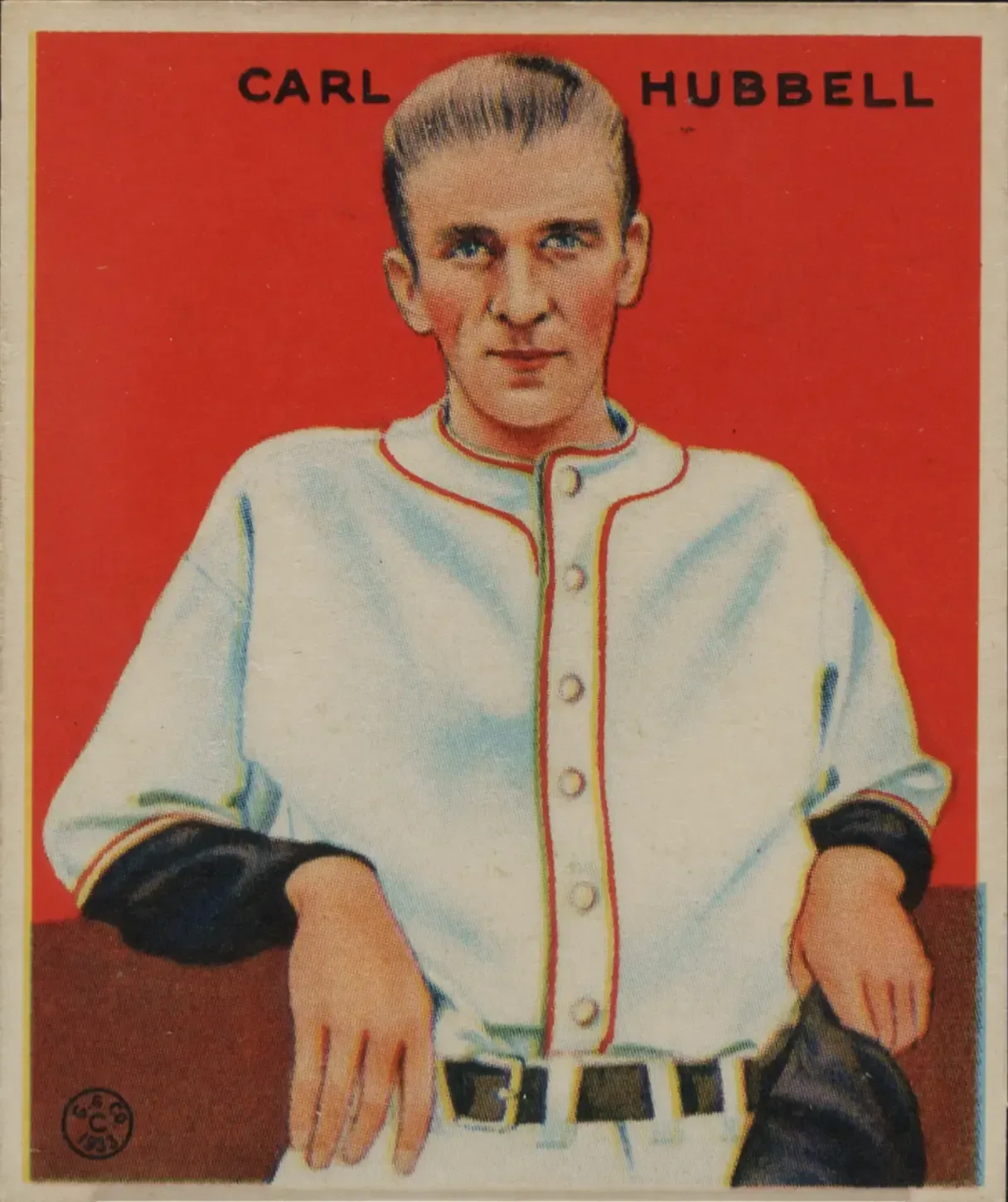
The most obvious starting point is 1933 Goudey #234. Hubbell appears hatless, arms at rest, against a red background. It is a calm, straightforward image, which is almost amusing given the pitcher’s association with the screwball and that All-Star Game demolition job. In the 1933 Goudey checklist, this card works as the poised counterpart to the more kinetic #230.
It also carries a particular wrinkle tied to its era. The 1933 Goudey set is described as a “living set,” meaning its copy can refer to events from the 1933 season despite being a 1933 release. Hubbell’s card references his 1933 MVP award and multiple World Series wins. For a collector, that makes the back more than boilerplate: it places the card in the middle of the season and success it is commemorating.
A PSA 9 copy last sold publicly in 2019 for $19,200. A PSA 10 exists without a known sale. An estimated PSA 9 value has been placed at $111,000, but the long gap since that recorded PSA 9 transaction is precisely why an estimate should not be treated as a fresh market comp.
Practical implication: #234 is the card for someone who wants the visual signature of Hubbell’s Goudey run. When comparing examples, do not assume that a numerical grade alone closes the conversation; the limited high-grade public-sale record makes individual card condition and the timing of any sale especially consequential.
1933 Goudey #230: Hubbell in motion
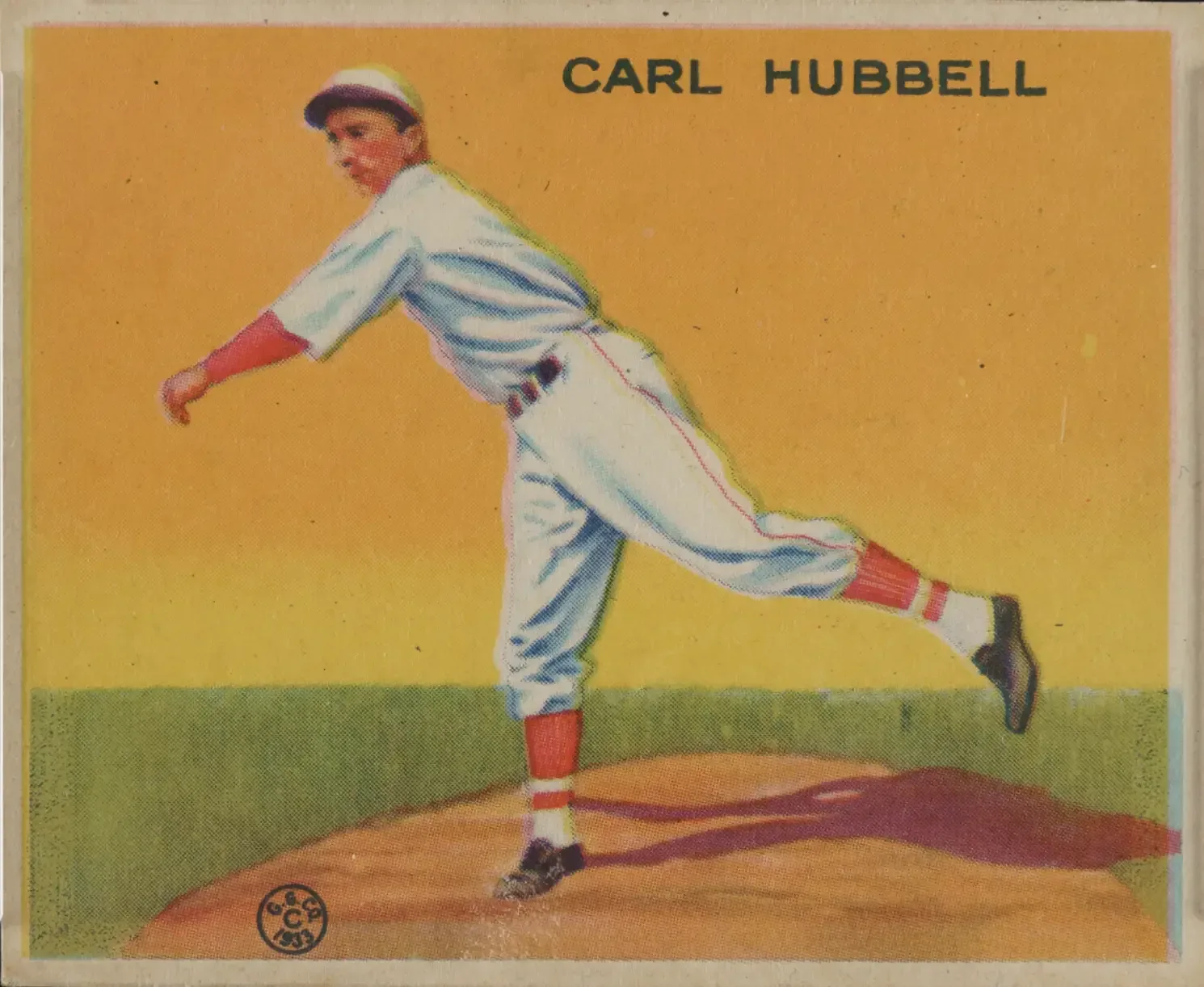
Goudey #230 delivers the other half of Hubbell’s 1933 double feature. Rather than the composed profile of #234, this card shows the left-hander in his delivery follow-through. It is the better match for collectors who want a card that conveys pitching movement, and it foreshadows the pose used again in the Play Ball issues.
The timing is meaningful. Hubbell’s 1933 MVP season and World Series performance elevated his profile, and the pair of Goudey cards gives modern collectors two genuinely different ways to represent that period. One card is an iconic portrait; the other is a baseball image first.
The most recent cited PSA 8 sale occurred in January 2024 at $10,028. Only two copies are graded higher, both PSA 9s, and neither has a public sale noted here. That does not establish a price for those higher-grade cards. It establishes scarcity at that grade and a lack of transparent recent transaction evidence.
Technical note: “Population report” refers to a grader’s tally of cards it has graded at each level. It can show that higher-graded examples exist, but it does not reveal what buyers will pay for every copy. A population count and a realized sale answer related, not identical, questions.
1933 Sports Kings Gum #42: a multisport detour
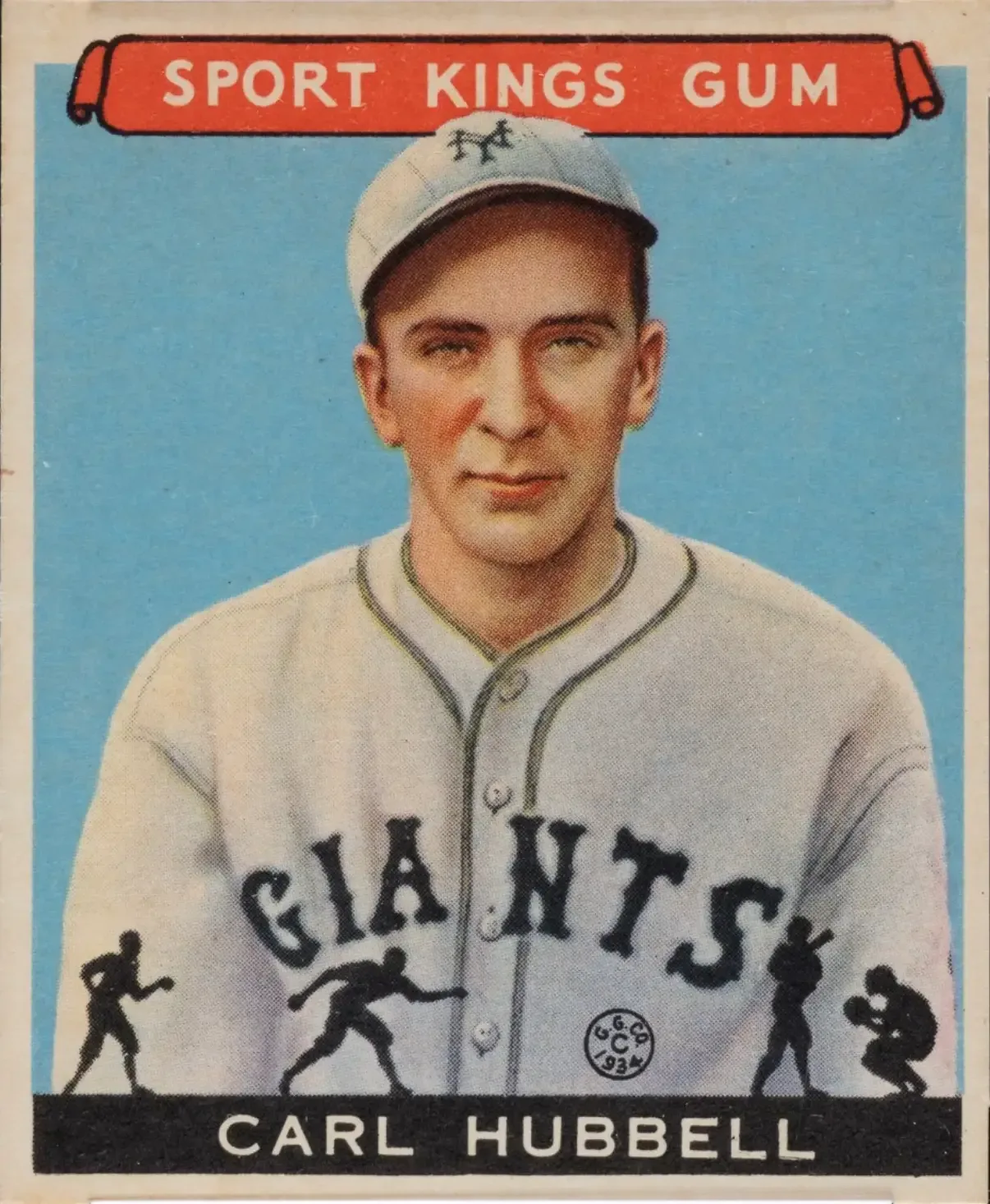
Hubbell’s 1933 Sports Kings Gum #42 is the outlier in this group because it belongs to a multisport release rather than an all-baseball checklist. Sports Kings included 48 subjects across baseball, football, basketball, wrestling and even dog sled racing. That broader setting gives Hubbell’s card a different appeal from the Goudey issues: it is a baseball Hall of Famer placed among a compact snapshot of sporting culture.
It is also the clearest reminder that a card’s grade can transform its price bracket. An SGC 1 sold in February 2026 for $299. The cited record was a PSA 5 at $699 in July 2023. An estimated PSA 9 value sits at $51,000. Those figures are not contradictory; they describe cards in dramatically different assessed conditions and, in the case of the estimate, an unconfirmed future price.
Technical note: PSA and SGC are third-party grading companies. Their labels communicate a numerical assessment of condition, but a PSA 5 and an SGC 1 are not interchangeable objects, and neither is comparable to a theoretical PSA 9 simply because all are the same card number.
For collectors focused on the subject rather than a single baseball set, #42 provides a distinct route into Hubbell. Its multisport identity is part of its appeal, not a side detail.
1935 Diamond Stars #39: an accessible visual change-up
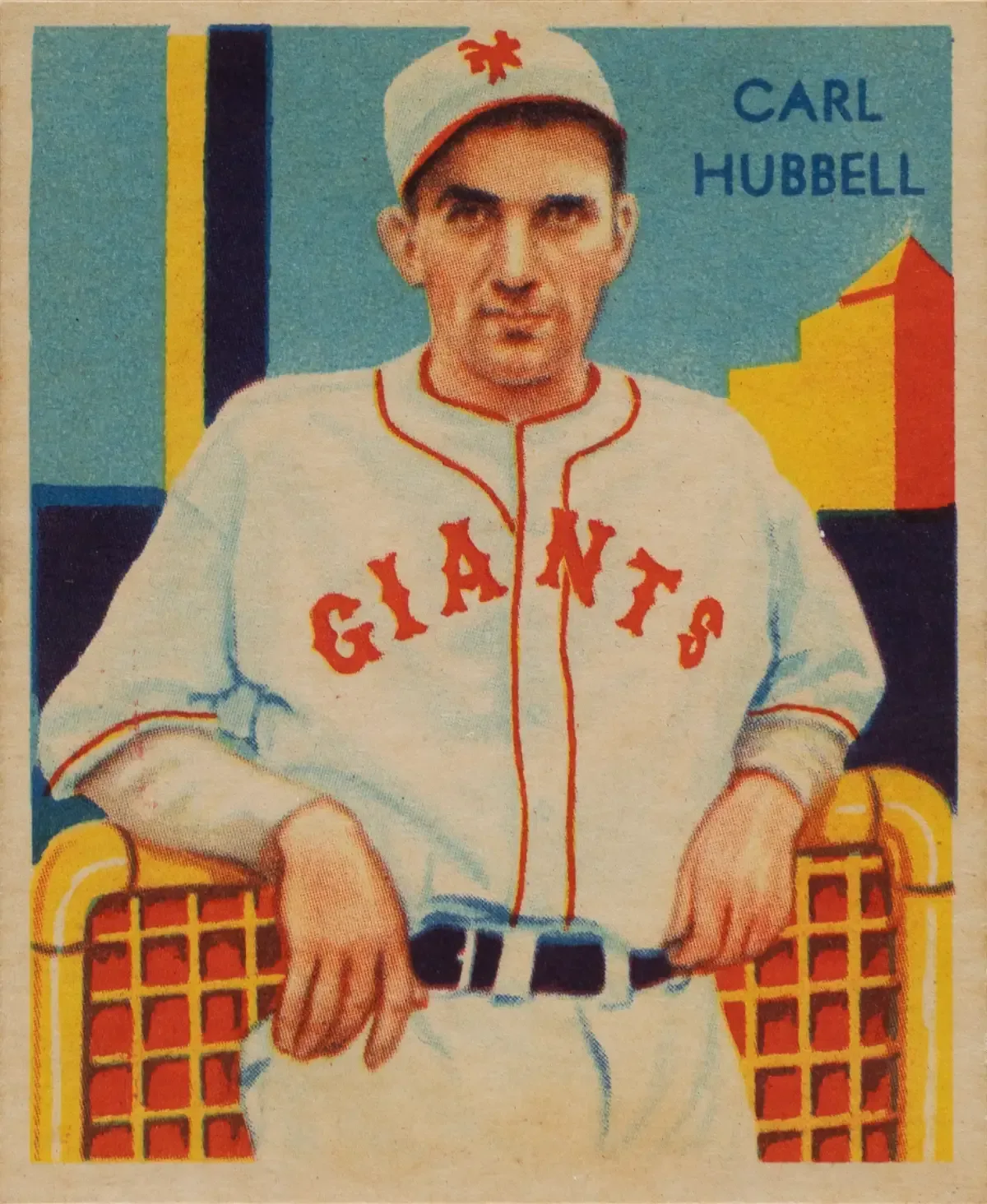
Diamond Stars #39 offers a more relaxed Hubbell. The card shows him leaning against ballpark fencing, arms up, wearing his New York Giants cap at an angle. The orange team name contrasts sharply with the blue background, producing a look unlike the red Goudey portrait or the action-focused #230.
The Diamond Stars run was printed from 1934 through 1936, while Hubbell’s card belongs to the 1935 set. That context matters for accurate checklist identification: “Diamond Stars” describes the broader run, but the Hubbell issue here is the 1935 entry.
A PSA 8.5 copy sold in December 2025 for $4,267. It is one concrete sale, not a universal quote for every 8.5, but it illustrates why this card can function as a different kind of Hubbell target. It retains the visual charm of mid-1930s card design while not requiring a collector to pursue one of the Goudey cards that define his biggest vintage-card pairing.
Collector fit: Choose Diamond Stars #39 when the priority is design variety and a casual ballpark pose. Choose the Goudeys when the priority is the seminal 1933 season and either portrait or delivery imagery.
1941 Play Ball #6: color returns to the follow-through
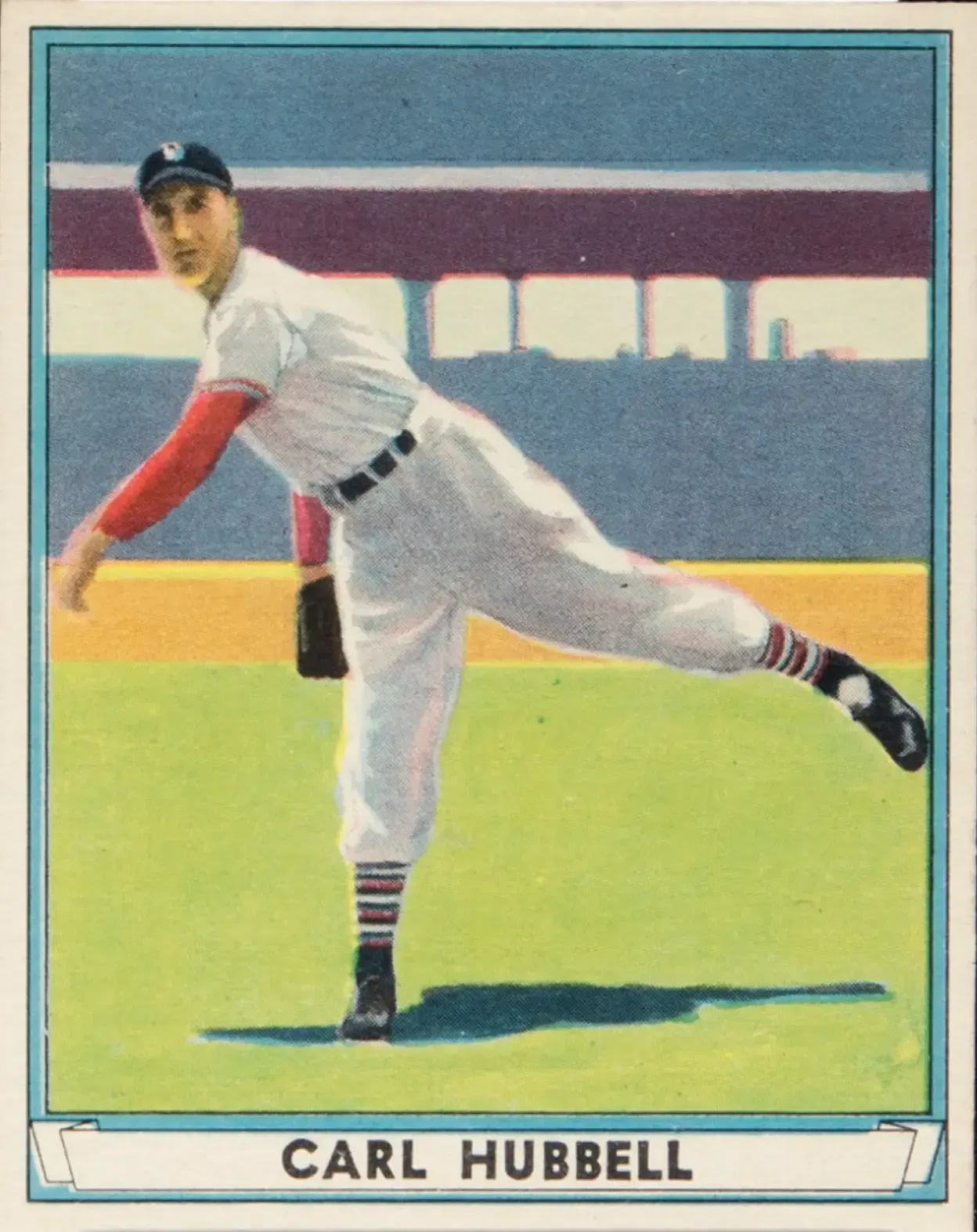
1941 Play Ball #6 circles back to Hubbell’s pitching image. It uses the same photograph seen in the 1940 Play Ball checklist, but in color. That continuity makes the 1941 card a useful choice for collectors who respond to the action image of Goudey #230 but want a later, color presentation instead.
Play Ball was positioned to stand alongside the prominent Goudey sets that came before it, and Hubbell’s 1941 appearance places him among many Hall of Fame inductees in the checklist. The card’s importance is therefore twofold: it preserves his follow-through, and it does so in a set with broad Hall of Fame depth.
A PSA 9 sold for $2,640 in May 2020. A current estimate has put the figure nearer $10,000. As with the other older top-grade transactions, collectors should recognize the distance between an historic sale and an estimated current value. The market may have changed, but an estimate is evidence of an opinion about the market, not proof of a completed sale.
How the five cards divide the Hubbell assignment
- 1933 Goudey #234: the quiet, red-background portrait and the most natural centerpiece for a 1933 Hubbell focus.
- 1933 Goudey #230: the action counterpart, centered on his follow-through.
- 1933 Sports Kings Gum #42: the cross-sport checklist choice, with a notably wide spread between low-grade sales and a high-grade estimate.
- 1935 Diamond Stars #39: the relaxed fencing pose and bold orange-and-blue design alternative.
- 1941 Play Ball #6: the later color version of the familiar follow-through image.
The appeal of a Hubbell collection is not limited to chasing the most expensive grade or trying to replay a single famous afternoon through cardboard. These five issues map a player’s visual identity across several major prewar styles: portraiture, pitching action, multisport presentation, candid-looking design and color photography.
Still, the All-Star Game sequence supplies the narrative current beneath all of them. Hubbell did more than survive a dangerous inning. With runners on first and second and no outs, he struck out Ruth, Gehrig and Foxx; he then opened the next inning by fanning Simmons and Cronin. That is why a collector can look at a modestly graded Sports Kings copy, a Goudey portrait, or the blue-and-orange Diamond Stars design and see more than a Giants pitcher. Each is a route to one of baseball’s most implausible true stories.