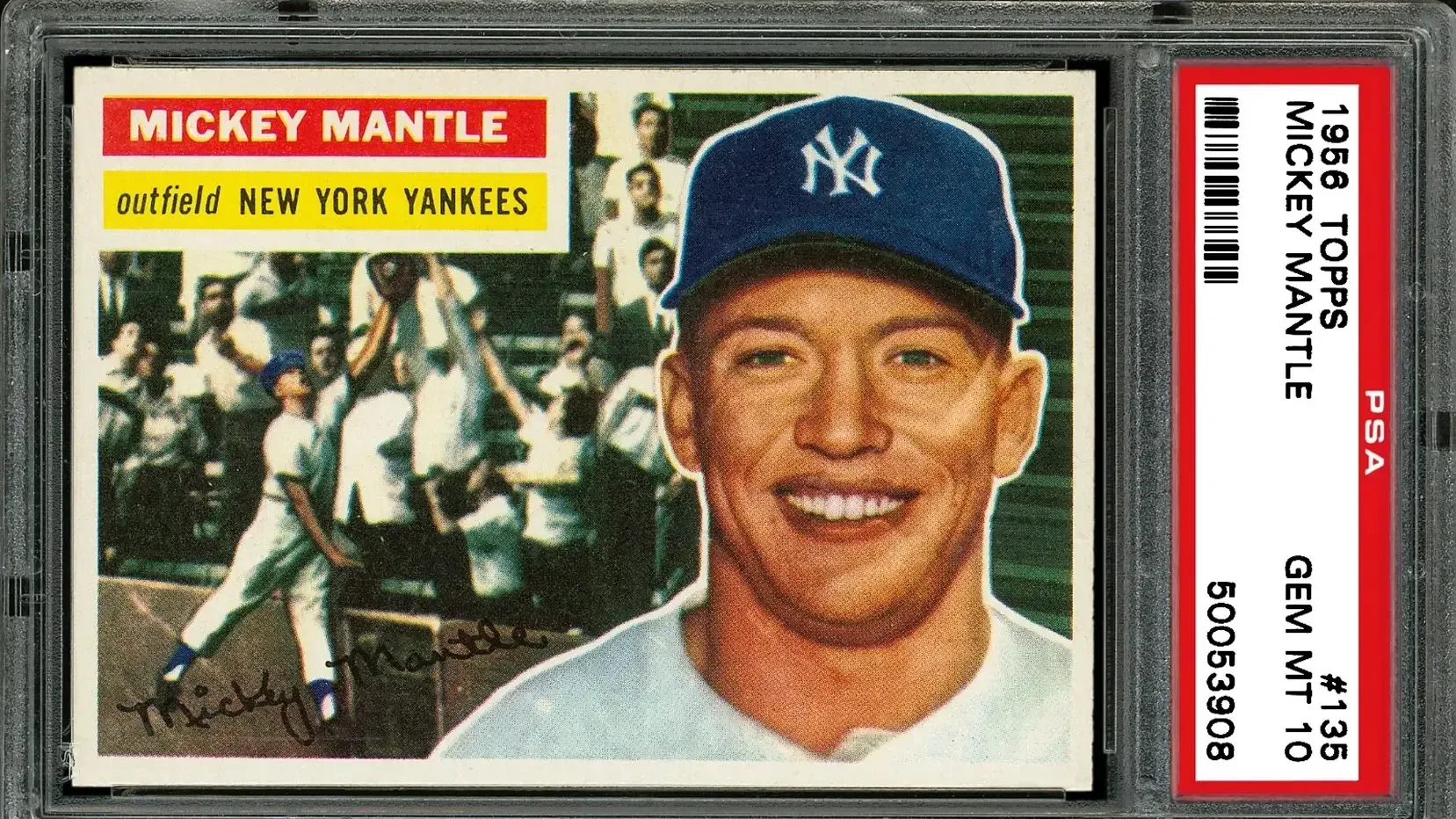
The 1960 Topps Baseball set has an unusually clear split between collecting for the card and collecting for the grade. Its horizontal design and deep group of recognizable players—including Mickey Mantle, Willie Mays, Willie McCovey, Hank Aaron and Roberto Clemente—give the set broad appeal before condition enters the equation. But the available sales and population figures for four examples show why the very best certified copies occupy a markedly different market from raw cards.
Willie Mays, Mickey Mantle, Luis Aparicio and Hoyt Wilhelm represent four distinct paths into the set. Mays and Mantle bring immediate star appeal. Aparicio and Wilhelm demonstrate that a lower-priced raw card can become a major item when an extremely scarce top-grade example appears. The common thread is not simply age or name recognition: it is the combination of an established 1960 issue, surviving condition and a very limited number of cards graded PSA 10.
What the grades mean in this comparison
A raw card is one that has not been assigned a numerical grade by a third-party grading company. Its price can vary substantially based on centering, corners, surface, print quality and other details a buyer sees in person or in photographs. A graded card has been authenticated and encapsulated with a stated grade, creating a more standardized condition label for buyers and sellers.
In the figures discussed here, PSA 8, PSA 9 and PSA 10 refer to progressively higher certified condition levels. A PSA 10 is the top numerical grade and, for vintage cards, it can be exceptionally difficult to obtain. That difficulty is central to the premium: the market is not valuing a PSA 10 as merely a slightly cleaner version of a raw copy. It is valuing a card that has cleared a demanding condition threshold and is scarce at that threshold.
For more context, explore Casey Bloys Sees HBO’s Identity Holding Firm as Paramount-Warner Bros. Plans Take Shape.
Population counts are also worth reading carefully. They describe the number of examples listed at particular grades in the reported data, not a guarantee that every card is available for sale, nor a complete measure of all copies that still exist. A card can be tightly held in a collection, and its next public result may arrive years after its previous one. As a result, a headline sale is a useful record of what one buyer paid for one specific card at one time—not a standing price quote for every comparable example.
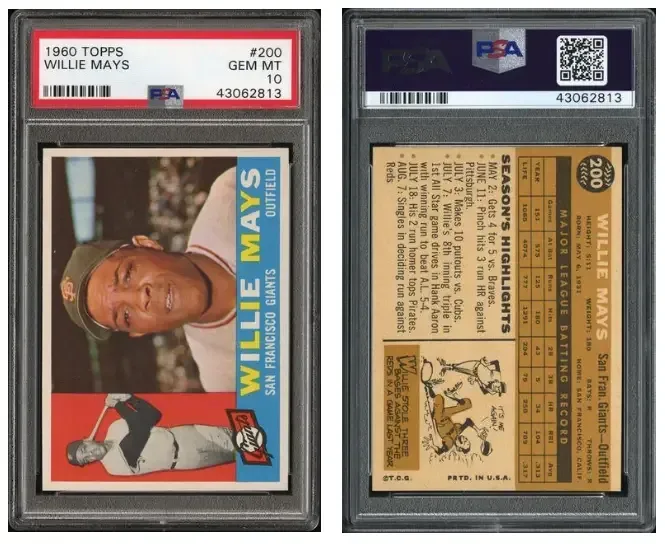
Willie Mays No. 200: star power with only three reported PSA 10s
The 1960 Topps Willie Mays, card No. 200, is a direct example of both sides of the condition divide. Raw copies generally trade in the $90 to $120 range. That is a meaningful price for an ungraded vintage card, but it is far removed from the top-grade market.
The reported graded population includes three PSA 10s, 28 PSA 9s and 332 PSA 8s. In other words, the count expands dramatically as the grade moves down from 10 to 9 and then to 8. That pattern helps explain why a perfect-grade Mays can draw a level of attention that cannot be inferred from the raw-card range alone.
A PSA 10 example recorded a public sale of $75,000 on July 17, 2019. The result underscores an important collecting distinction: Mays' historical draw is part of the appeal, but the small number of reported PSA 10s is what turns this particular condition tier into a scarcity-driven pursuit.
For collectors considering the card at less extreme grades, the PSA 8 and PSA 9 population figures provide useful context. There are still far fewer reported PSA 9s than PSA 8s, while the raw market offers another route for collectors who prioritize the card’s visual presentation and place in the set over a numerical label.
Mickey Mantle No. 563: the raw-price leader of this group
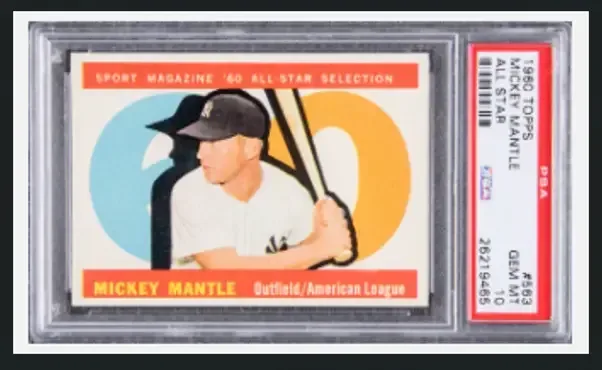
Mantle’s 1960 Topps card, No. 563, carries the strongest reported raw range among these four: roughly $275 to $350. That starting point reflects how much name recognition matters even without a grade. Yet the gap between a raw Mantle and the finest certified examples remains significant.
The reported figures list four PSA 10s, 74 PSA 9s and 564 PSA 8s. Mantle has one more reported PSA 10 than Mays, but the total remains remarkably small next to the PSA 8 population. The PSA 10 market is therefore narrow by definition, and a buyer seeking that exact grade is competing for an exceptionally limited class of card.
The highest reported public sale for a PSA 10 Mantle was $61,200 on March 8, 2021. It is notable that this recorded top price sits below the reported $75,000 Mays sale despite Mantle’s higher raw-card range. That is a reminder not to assume that a player’s raw-card price and a single top-grade auction record will move in lockstep. Timing, buyer participation, the particular copy offered and the number of interested bidders can all matter in individual public transactions.
For set builders, Mantle illustrates a practical choice. A raw copy may be the accessible way to add one of the set’s biggest names. A PSA 8 or 9 offers a certified alternative with a larger reported population than the 10. The PSA 10 is a different objective altogether: it is an elite-condition version with only four reported examples.
Luis Aparicio No. 240: a $5-to-$15 raw card with a singular top-grade example
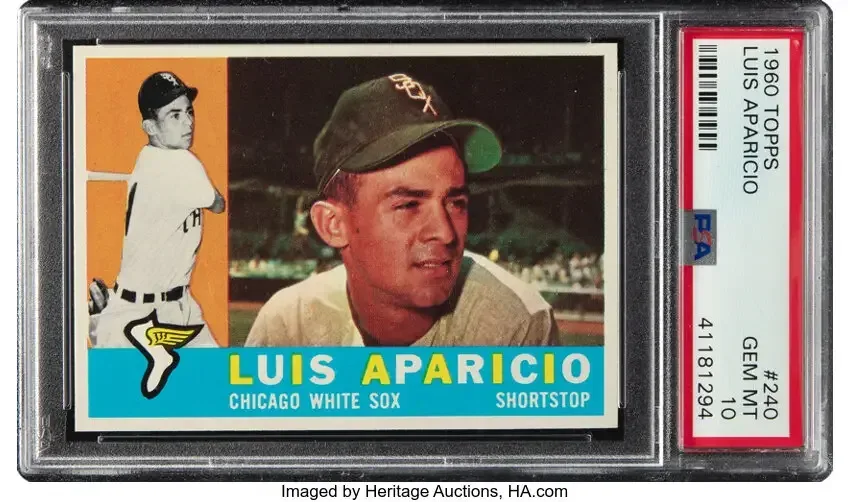
Luis Aparicio’s No. 240 may be the sharpest illustration of why raw price alone is an incomplete guide to a vintage card’s ceiling. Raw examples generally sell for just $5 to $15, a range that makes the card comparatively approachable within this four-card group.
At PSA 10, however, the reported population is one. Below it are 21 PSA 9s and 164 PSA 8s. The difference between one top-grade copy and 21 near-top examples makes the 10 an unusually specific opportunity. If the sole reported PSA 10 comes to market, collectors who want that designation do not have an equivalent substitute waiting in the wings.
A public sale dated May 16, 2026 recorded $31,720 for a PSA 10 Aparicio. The result should not be used to price raw copies or to presume a repeatable PSA 10 value; the raw range and the singular PSA 10 are plainly different products for different buyers. It does show how a low-dollar raw card can become a high-dollar certified rarity when condition scarcity is sufficiently severe.
Hoyt Wilhelm No. 359: another one-card PSA 10 tier
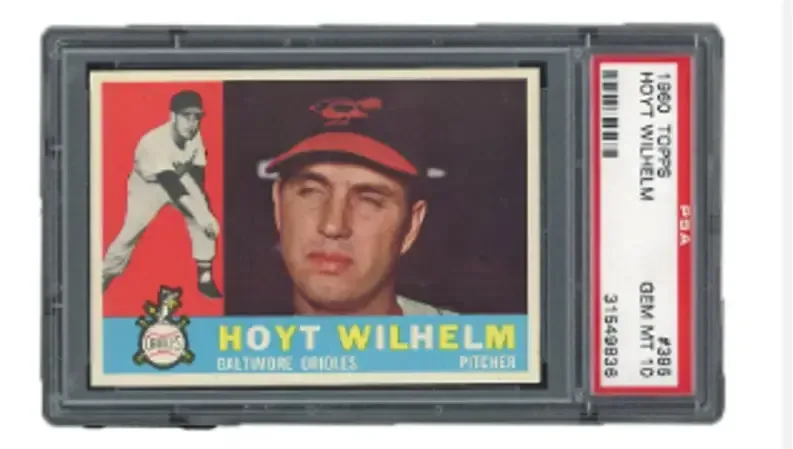
Hoyt Wilhelm’s 1960 Topps No. 359 follows a similarly dramatic profile. Raw examples generally sell for $5 to $10, the lowest reported range of the four cards. The reported population then rises from one PSA 10 to 18 PSA 9s and 199 PSA 8s.
That single PSA 10 was also reported with a $31,720 public sale on May 16, 2026. The matching date and amount attached to the Aparicio and Wilhelm results are details collectors should verify against the individual card and sale record before treating either figure as a comparable. In markets where a grade has a population of one, precision matters: card number, player, certification details and the exact item sold are more useful than a broad search term or an assumption based on another player’s result.
Even so, the larger market lesson remains clear. Wilhelm’s modest raw range does not limit the potential importance of an exceptional certified copy. A collector focused on condition rarity may value the lone PSA 10 very differently from a collector pursuing an affordable set card.
How to use these figures without over-reading them
The four cards show that grade scarcity can be a powerful pricing force, but collectors should separate several questions before making a purchase:
- What are you buying? A raw example, a PSA 8, a PSA 9 and a PSA 10 should be treated as separate market segments rather than interchangeable versions of the same item.
- How many examples exist at the desired grade? The reported PSA 10 counts range from one to four across these cards, while PSA 8 counts range from 164 to 564.
- How recent and comparable is the sale? A public record establishes that a sale occurred; it does not establish that another copy will sell for the same amount.
- Does the card itself suit your goal? Player importance, the horizontal 1960 Topps look and the satisfaction of building a coherent set can matter as much as the label on the holder.
The most revealing contrast is between accessible raw prices and the very limited PSA 10 populations. Mays and Mantle demonstrate how established superstar demand meets elite-condition scarcity. Aparicio and Wilhelm show that condition rarity can place less expensive raw cards into a much different bracket when a top-grade copy is effectively singular.
For buyers, the sensible takeaway is not that every high-grade vintage card will rise, or that a numerical grade automatically makes a card a sound purchase. It is that scarcity should be evaluated at the exact grade being considered. In 1960 Topps Baseball, that approach helps explain why the market can contain a $5 raw card and a five-figure PSA 10 version of that same card without either price contradicting the other.