The phrase “Junk Wax Era” can make 1980s baseball cards sound interchangeable: hugely produced, easy to find and therefore of little consequence. Recent sales of top-graded rookie cards tell a much more complicated story. For collectors pursuing a PSA 10—the top grade on the PSA scale—the market can attach extraordinary value to the tiny subset of surviving cards judged virtually flawless.
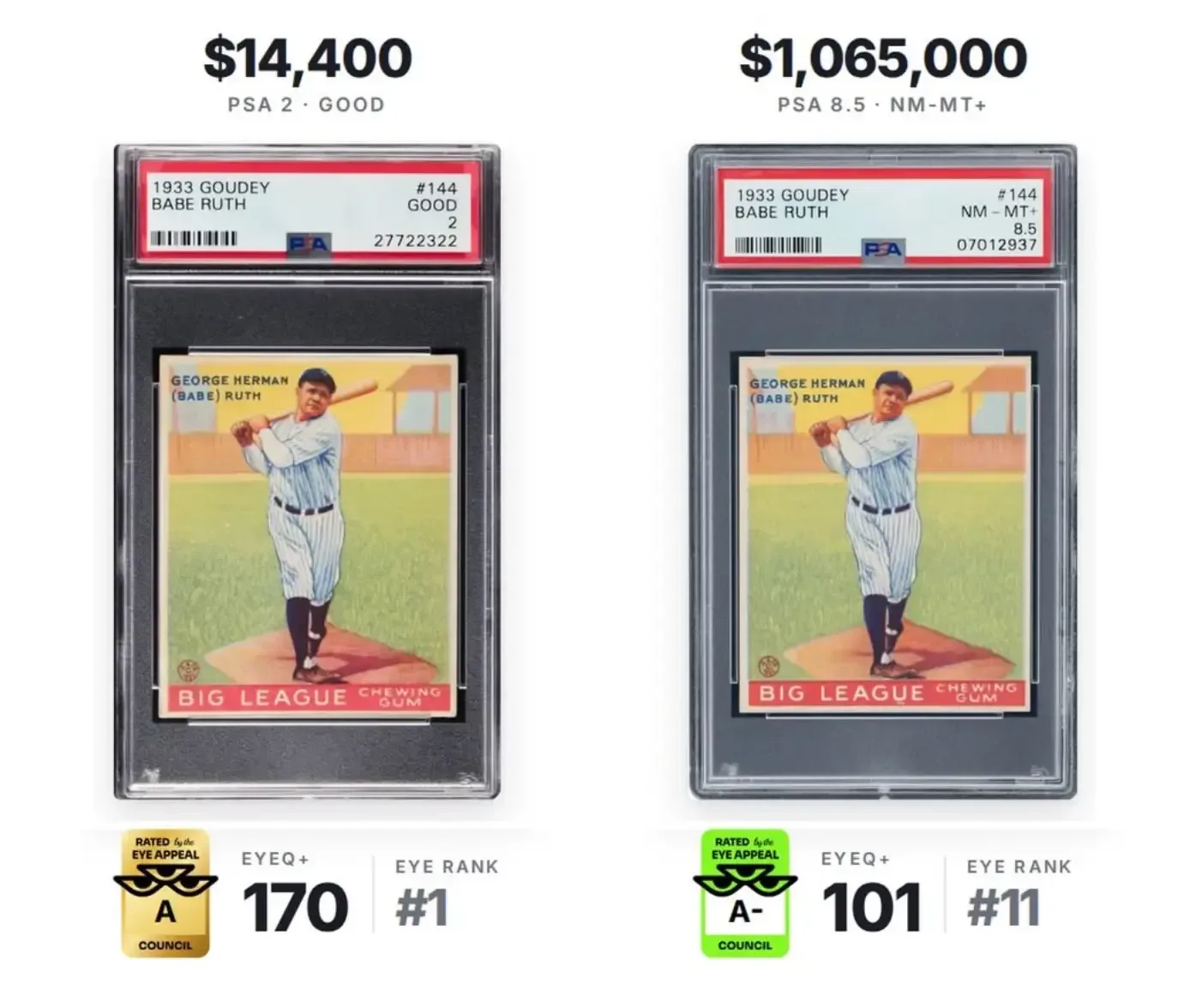
The clearest outlier is Rickey Henderson’s 1980 Topps #482 rookie card. A PSA 10 example sold for $268,400 in September, while a PSA 9 sold for $4,211 on November 1. That is not merely a difference in visual appeal to most casual observers; it is a dramatic premium assigned to a one-point distinction on a third-party grade.
The result puts a practical collector lesson into sharp focus. A card’s broad availability, the player’s accomplishments, the particular issue, nostalgia, and the number of known top-grade examples can all matter. None independently settles the price. In this corner of the hobby, condition rarity can be as decisive as a player’s legacy—and sometimes more so.
What a PSA 10 premium actually represents
A PSA 10 is a card graded Gem Mint by Professional Sports Authenticator. The grade is attached to the individual copy, not the card design or player. It means a collector shopping for a Henderson rookie is not simply buying “a 1980 Topps Henderson”; they may be competing for one of only 26 PSA 10s among 51,131 copies of that card PSA has graded.
A population report, often shortened to “pop report,” is the count of examples a grading company has recorded at each grade. It is useful for comparing graded scarcity, but it is not a census of every copy ever printed or every copy still in existence. The figures here describe cards submitted to PSA. Still, they give prospective buyers a concrete way to see why two cards that look nearly identical in a listing may occupy completely different price tiers.
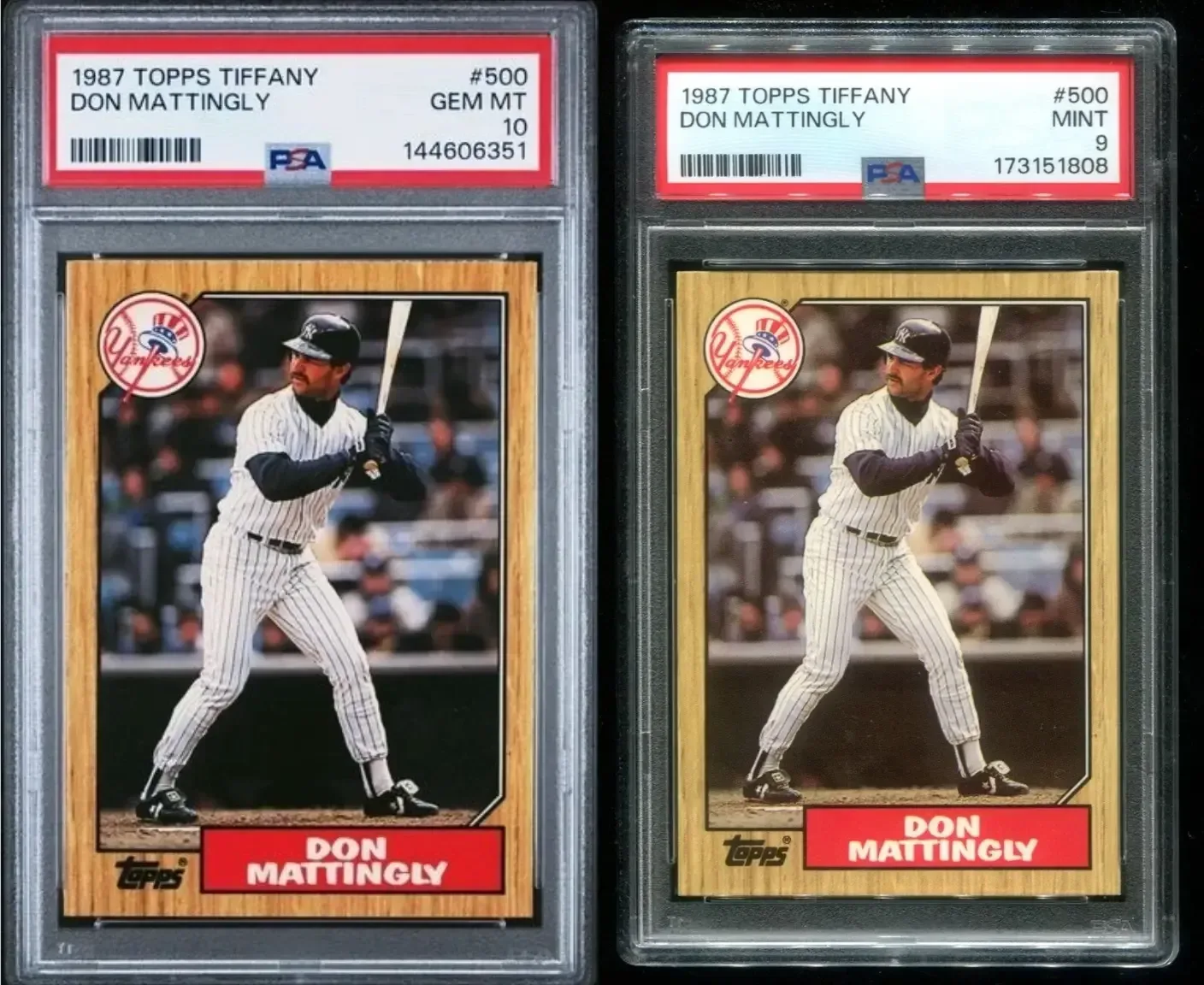
The grade gap shows up repeatedly. A 1987 Topps Tiffany Don Mattingly card in PSA 10 recently sold for $425, compared with $45 for a PSA 9. Harold Baines’ 1981 Topps #347 rookie recently sold for $5,988 in PSA 10, while recent PSA 9 and PSA 8 sales were $107 and $17.50, respectively. Greg Gagne’s 1984 Donruss #39 reached $1,350 in PSA 10; a PSA 9 recently sold for $28.
Those comparisons do not mean every 10 will always command the same type of multiple over a 9. They do show why a buyer should not infer a card’s value from the player name and year alone. The grade, grading population and exact version belong in the description every time.
Tier 1: six elite PSA 10 rookies
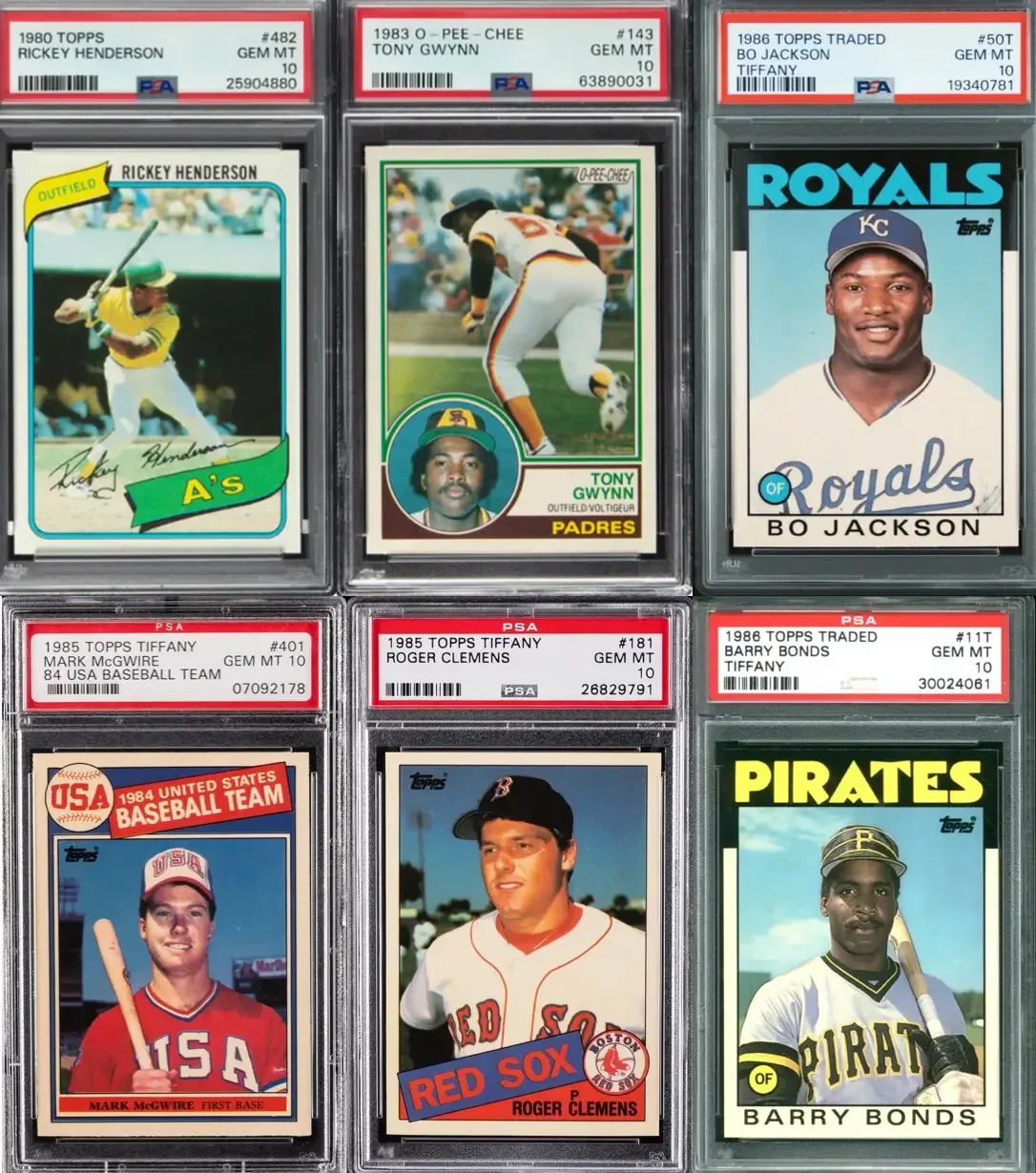
At the summit, Henderson is separated from an already expensive group. His $268,400 PSA 10 sale was far above a $28,300 PSA 10 sale in May 2020, illustrating how quickly high-end prices can change. The rest of the elite tier is anchored by scarce high-grade examples from special issues and less-common releases.
- Rickey Henderson, 1980 Topps #482: $268,400; 26 PSA 10s out of 51,131 graded.
- Tony Gwynn, 1983 O-Pee-Chee #143: $32,900; 37 PSA 10s out of 1,996 graded.
- Bo Jackson, 1986 Topps Traded Tiffany #50T: $28,600; 37 PSA 10s out of 1,231 graded.
- Mark McGwire, 1985 Topps Tiffany #401: $26,900; 35 PSA 10s out of 2,041 graded.
- Roger Clemens, 1985 Topps Tiffany #181: $22,600; 49 PSA 10s out of 1,955 graded.
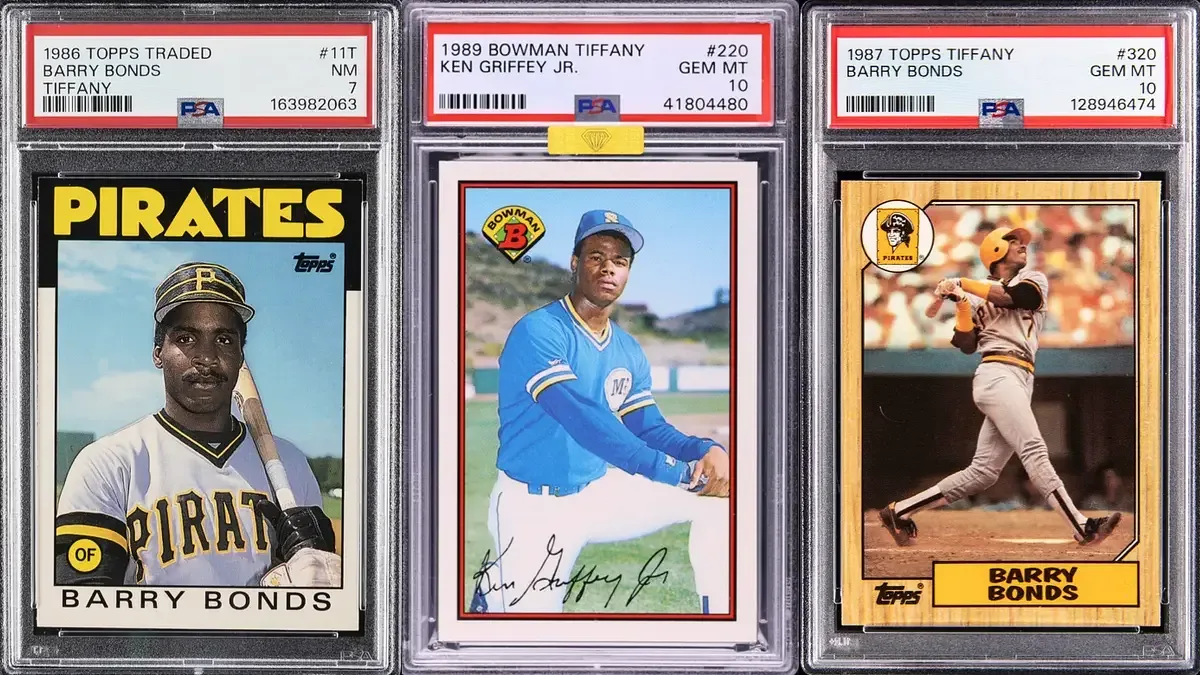
- Barry Bonds, 1986 Topps Traded Tiffany #11T: $19,800; 456 PSA 10s out of 2,907 graded.
The tier is also a caution against treating Hall of Fame status as a complete pricing guide. Four of the five players after Henderson in this group are not Baseball Hall of Famers. The sales indicate that collector demand, the card’s place in hobby memory, and the difficulty of attaining a top grade can outweigh a simple Hall-of-Fame versus non-Hall-of-Fame divide.
Tiffany is especially important throughout these rankings. A Tiffany version is a distinct Topps issue rather than just a label variation on the standard card. Its presence repeatedly corresponds with much smaller PSA populations than the better-known mainstream counterpart, creating a different scarcity profile for collectors.
Tier 2: famous names, less obvious cards
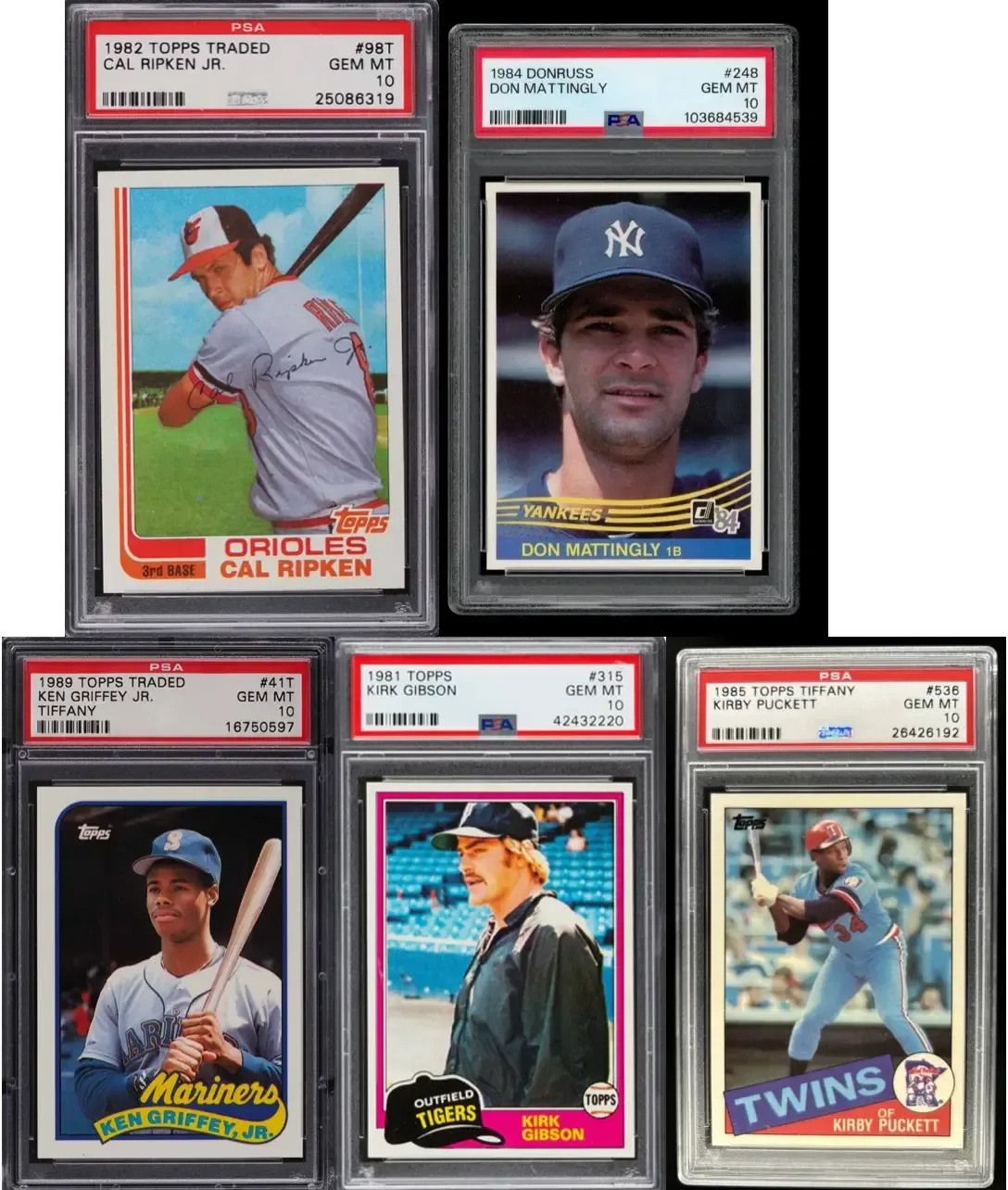
The premium tier contains several cards that show the difference between cultural fame and PSA 10 population. Don Mattingly’s 1984 Donruss #248, at $8,000 with 354 PSA 10s out of 15,952 graded, remains one of the decade’s defining rookie cards. Its status was cemented during the 1980s card boom, and its appeal has continued despite Mattingly not being in the Hall of Fame.
- Cal Ripken Jr., 1982 Topps Traded #98T: $8,433; 422 PSA 10s out of 19,365 graded.
- Don Mattingly, 1984 Donruss #248: $8,000; 354 PSA 10s out of 15,952 graded.
- Ken Griffey Jr., 1989 Topps Traded Tiffany #41T: $8,000; 346 PSA 10s out of 2,642 graded.
- Kirk Gibson, 1981 Topps #315: $7,655; 18 PSA 10s out of 3,064 graded.
- Kirby Puckett, 1985 Topps Tiffany #536: $7,500; 53 PSA 10s out of 1,259 graded.
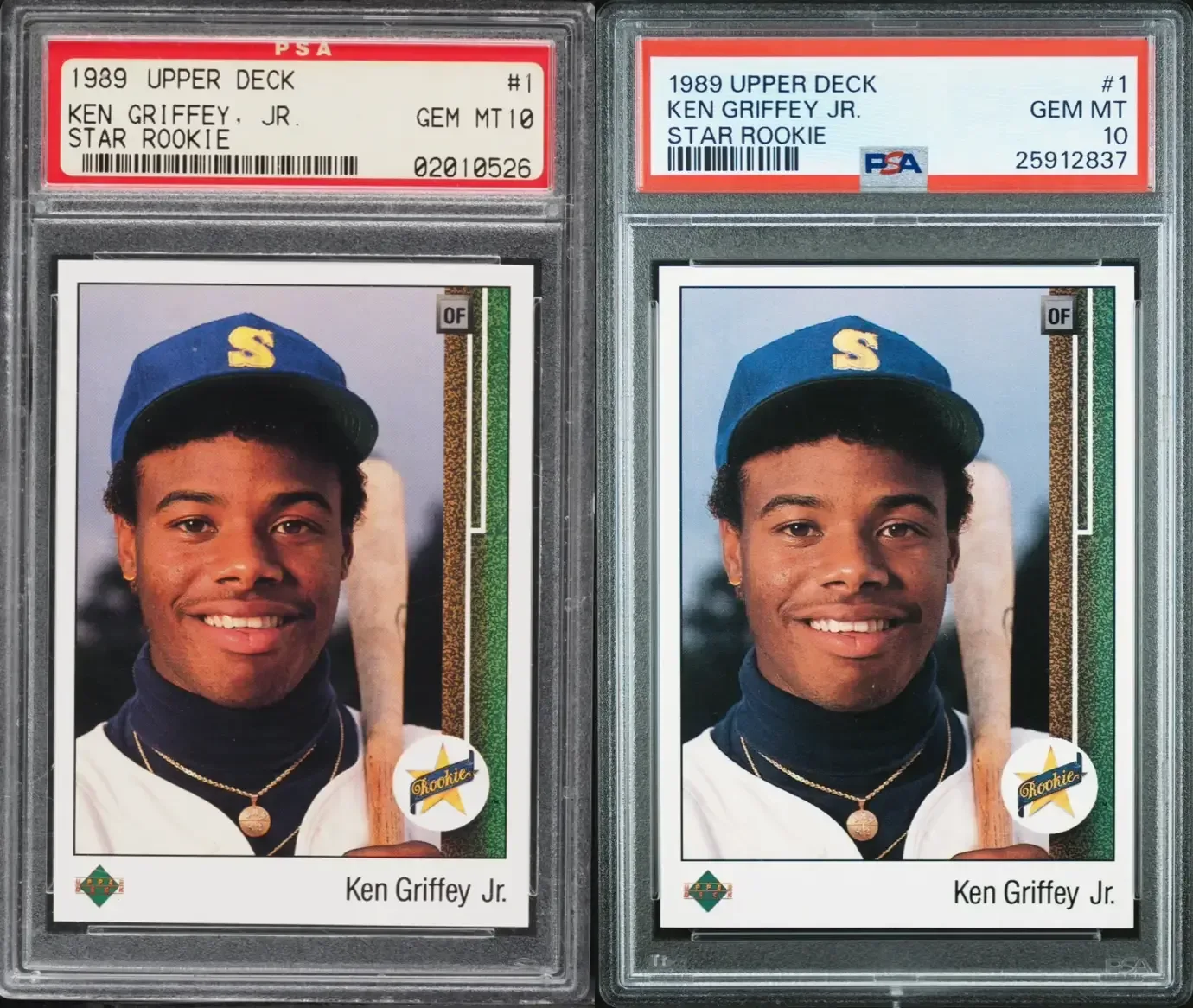
Ken Griffey Jr. offers the most useful comparison. The 1989 Upper Deck rookie is the more iconic Griffey card, but its PSA 10 population exceeds 4,250. A PSA 10 of that Upper Deck card last sold for $4,813. The Topps Traded Tiffany rookie, with only 346 PSA 10s recorded, last sold for $8,000. That does not diminish the Upper Deck card’s place in the hobby; it demonstrates that iconic status and top-grade scarcity are two separate forces.
Labels can become part of that condition conversation as well. Two PSA 10 copies of the 1989 Upper Deck Griffey sold for $4,440 with an older PSA label and $4,750 with a newer one. Some collectors perceive newer labels as preferable because they believe grading has become stricter over time. That is a market perception, not proof that every older and newer graded card differs in condition, but it is one more factor buyers may encounter.
Tier 3: accomplished players and set-builder demand
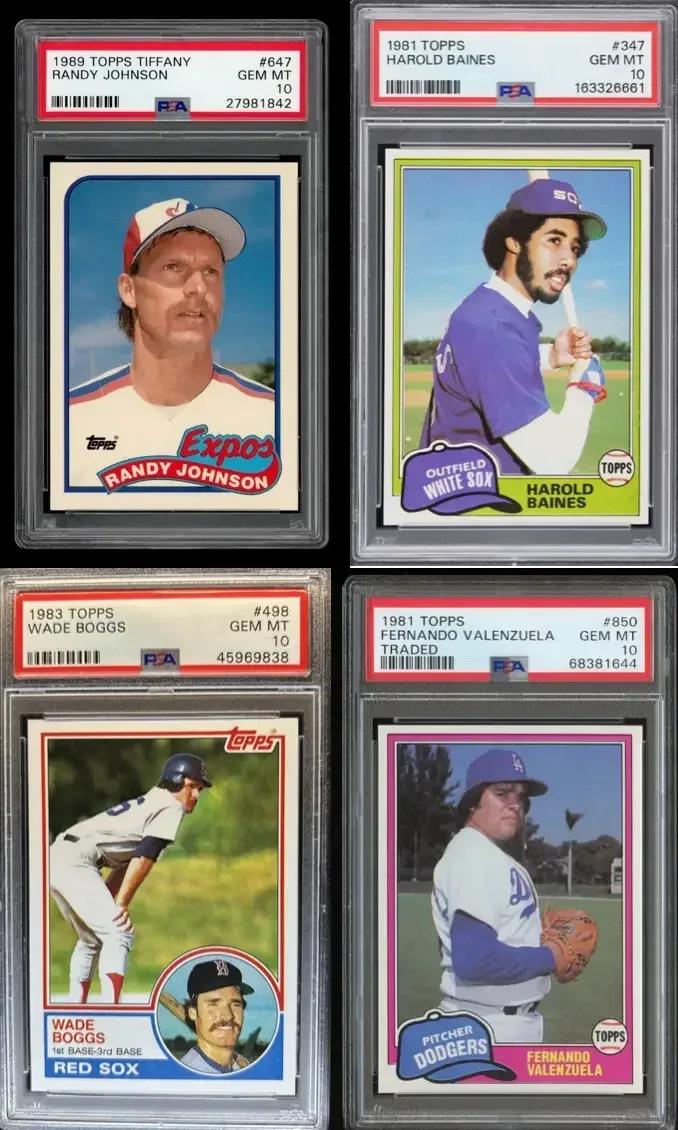
Randy Johnson and Wade Boggs were among their generation’s most accomplished players, yet their cards sit below the top two groups in this PSA 10-focused ranking. Meanwhile, Harold Baines and Fernando Valenzuela demonstrate how set collecting can support notable prices even where broad hobby attention is comparatively lower.
- Randy Johnson, 1989 Topps Tiffany #647: $6,000; 112 PSA 10s out of 1,359 graded.
- Harold Baines, 1981 Topps #347: $5,988; 47 PSA 10s out of 4,558 graded.
- Wade Boggs, 1983 Topps #498: $4,532; 417 PSA 10s out of 22,789 graded.
- Fernando Valenzuela, 1981 Topps Traded #850: $4,500; 22 PSA 10s out of 1,787 graded.
Set collectors seek to assemble every card in a defined release, while participants in the PSA Set Registry pursue graded sets and may compete to build the strongest possible registered collection. For either group, a low-population PSA 10 is not just a card of one player; it can be a hard-to-replace piece needed for a larger project. That helps explain why the market can value a pristine card far beyond less pristine copies of the same issue.
Tier 4 and 5: nostalgia and scarcity still have a price
The next two groups include Hall of Famers, memorable stars, and one striking set-collection outlier. Their results reinforce that the high-grade 1980s market is not limited to the decade’s universally biggest player names.
Tier 4: Valuable rookies
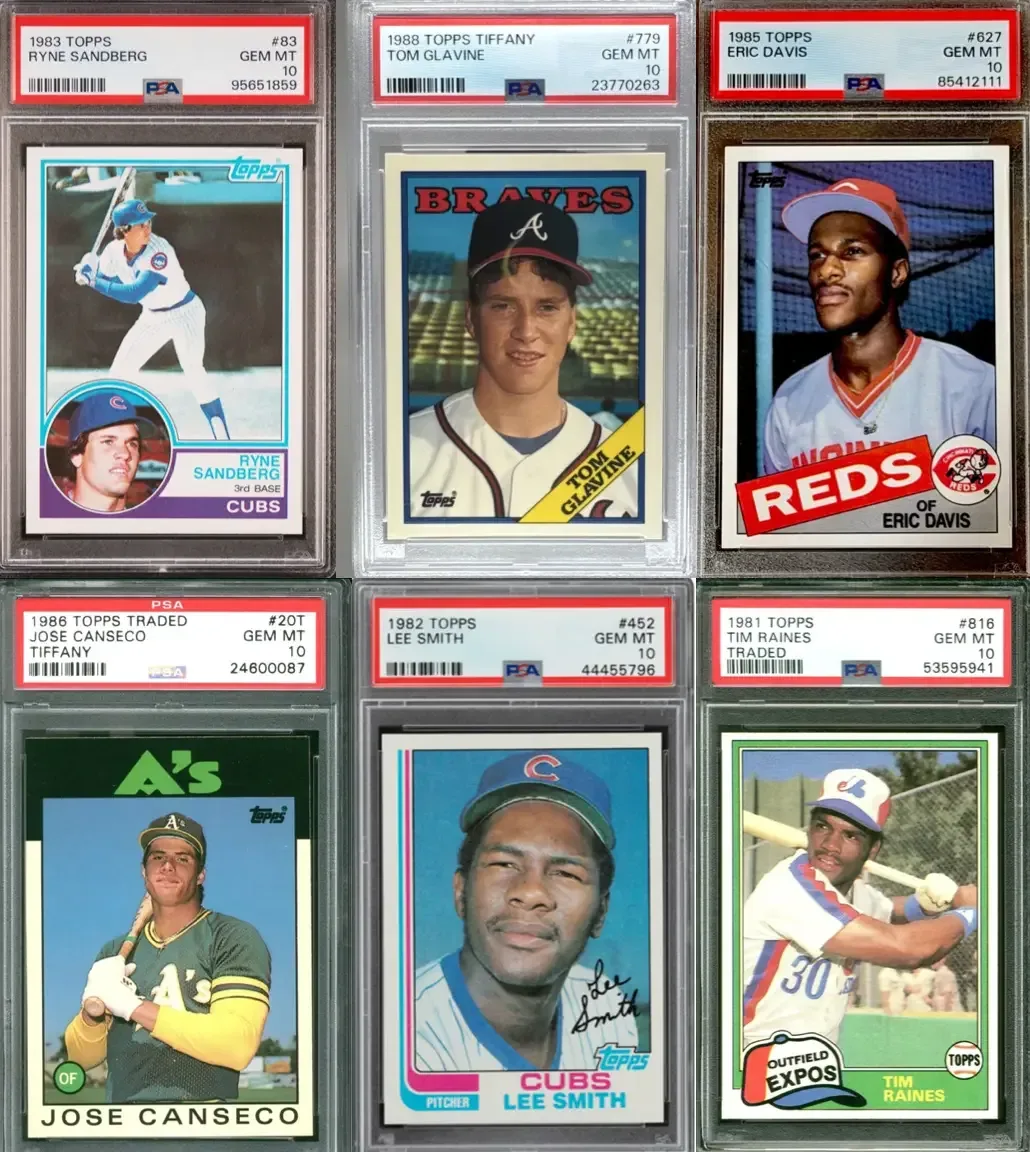
- Ryne Sandberg, 1983 Topps #83: $3,045; 826 PSA 10s out of 26,117 graded.
- Tom Glavine, 1988 Topps Tiffany #779: $3,001; 65 PSA 10s out of 1,065 graded.
- Eric Davis, 1985 Topps #627: $2,895; 57 PSA 10s out of 3,035 graded.
- Jose Canseco, 1986 Topps Traded Tiffany #20T: $2,275; 107 PSA 10s out of 1,234 graded.
- Lee Smith, 1982 Topps #452: $2,026; 64 PSA 10s out of 4,282 graded.
- Tim Raines, 1981 Topps Traded #816: $2,025; 174 PSA 10s out of 3,006 graded.
Canseco’s Topps Traded Tiffany rookie is a useful historical price marker: it sold for $81 in 2013 and is now listed at $2,275 for a PSA 10 sale. Eric Davis and Canseco were particularly coveted by young collectors in the mid-1980s. That formative demand can persist as nostalgia when those collectors have more spending power, while the small population of elite-condition copies limits supply at the grade being chased.
Tier 5: Under-the-radar, not undervalued in PSA 10
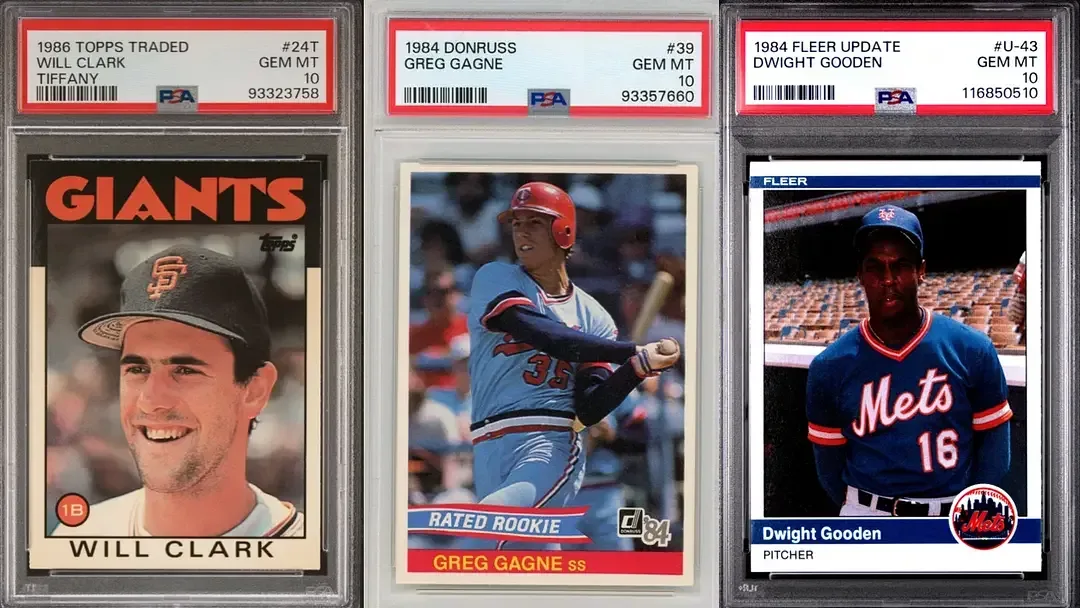
- Will Clark, 1986 Topps Traded Tiffany #24T: $1,700; 204 PSA 10s out of 858 graded.
- Greg Gagne, 1984 Donruss #39: $1,350; 15 PSA 10s out of 242 graded.
- Dwight Gooden, 1984 Fleer Update #U-43: $1,200; 225 PSA 10s out of 2,649 graded.
Clark and Gooden remain closely associated with the excitement surrounding young stars in the 1980s. Gagne is the clearest reminder that player résumé alone cannot predict an individual PSA 10 price: he never made an All-Star team, but only 15 PSA 10s are recorded among 242 graded examples of his Donruss rookie. For a collector who needs that card at the grade for a registry set, the supply constraint is plain.
How to read these numbers without oversimplifying them
Recent sales are snapshots, not guarantees. A listed sale establishes what a buyer paid for a particular card at a particular time; it does not promise the next copy will bring the same amount. The numbers are most helpful when used comparatively: evaluate the exact issue, card number, grade, PSA population, and the contrast with nearby grades.
The possibility of more technology-driven grading also creates an open question. Artificial intelligence could play a larger role in making card evaluation more objective. The broader cultural use of AI in entertainment remains a live issue, including situations such as AI-retouched voice work in games, but a card-grade application is its own technical and market question. If AI becomes more common in grading, collectors may reassess how they view grades assigned before that shift. Whether that affects confidence in older slabs or the premium attached to particular labels remains uncertain.
For now, the ranking’s strongest message is straightforward: 1980s production volume does not erase condition rarity. Plenty of collectors can locate a recognizable rookie from the era. Far fewer can locate the exact version they want, in PSA 10, with a population count that makes the card genuinely difficult to replace. That difference is where the surprisingly large prices begin.