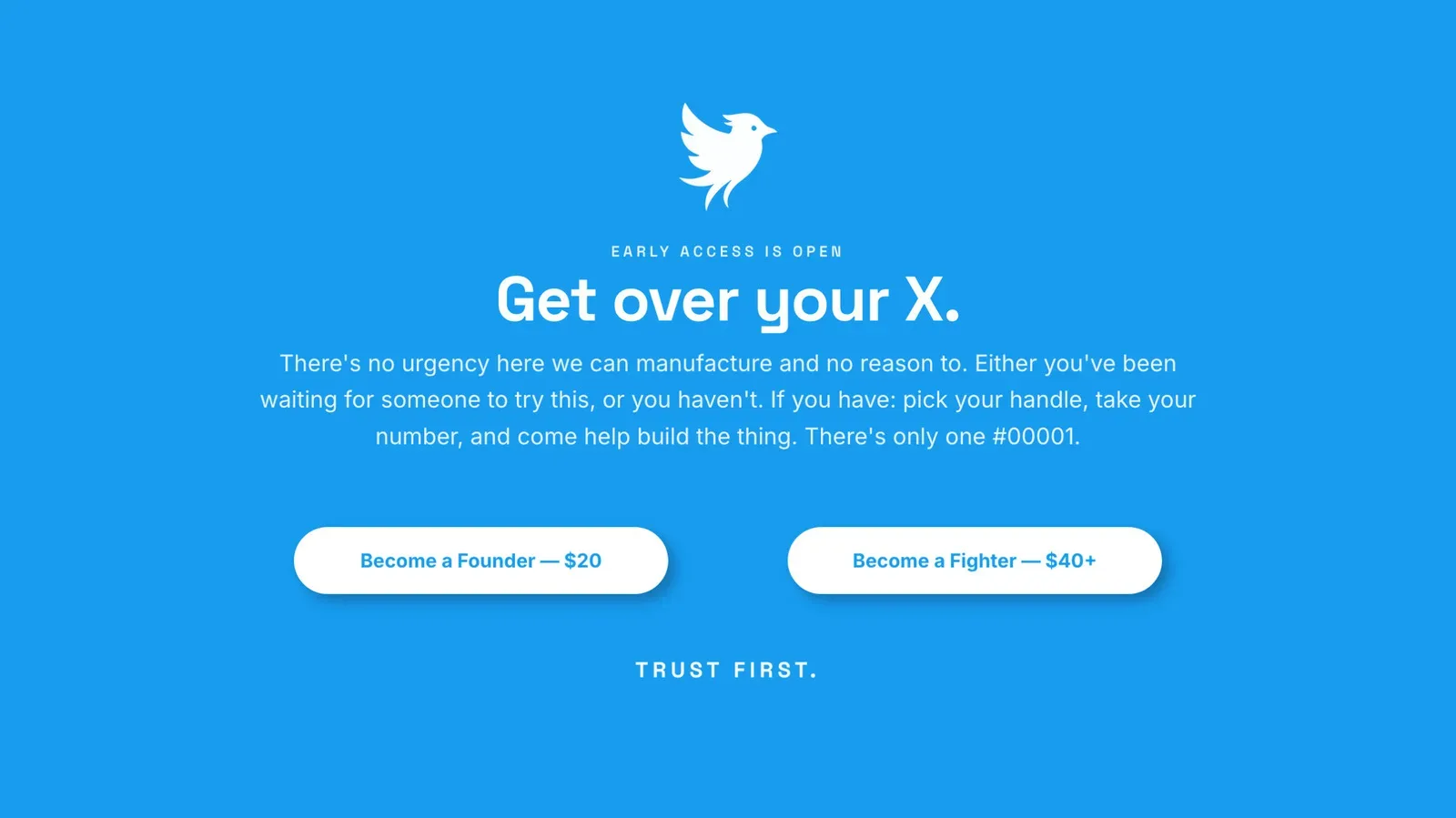
The internet’s long-running effort to treat old social-media terminology like a collectible console box that somehow survived a basement flood has reached another checkpoint. Operation Bluebird, the startup that had launched a forthcoming platform under the name Twitter.now, has rebranded the project as Tweet.app following an initial federal court ruling in its trademark dispute with X.
The decision is a split result rather than an all-access restoration of the platform’s former visual and verbal identity. US District Judge Colm Connolly determined that Operation Bluebird’s use of “Twitter” was likely to confuse consumers and infringe existing trademarks. That means the startup cannot continue using the original service name as it did with Twitter.now.
At the same time, the court indicated that X likely abandoned the word “tweet” and the familiar bird logo. For the purposes of the preliminary-injunction fight, those elements were treated differently from the Twitter name itself. Tweet.app says the court declined to block its use of the Tweet mark and the bird logo because the company is likely to establish that X abandoned both.
So, in gamer terms: the court did not hand Operation Bluebird the whole legacy skin bundle. It apparently left a couple of cosmetics unlocked while placing the most recognizable name behind a legal wall.
Twitter.now becomes Tweet.app
Operation Bluebird launched Twitter.now before the court had ruled on a request for a preliminary injunction tied to alleged trademark infringement. The preliminary ruling has now prompted the new identity: Tweet.app.
That distinction matters. A preliminary-injunction decision is not the same thing as the final outcome of the underlying lawsuit. It is an early judicial determination about whether certain conduct should be stopped while the case continues. Here, the ruling has already had a practical effect: the word Twitter is out, and Tweet.app is in.
The trademark case itself remains ongoing and is expected to proceed to trial. That leaves plenty of room for additional legal arguments, evidence, and a later ruling that could define the boundaries more fully. For now, users looking at the project’s public-facing branding should read Tweet.app as the active name, not as a declaration that every dispute surrounding the venture has been permanently settled.
The name “Twitter” may be too likely to cause consumer confusion, while “tweet” and the bird logo appear to occupy a different legal position in this early stage of the case.
It is an unusually literal demonstration of how a brand can be composed of separate parts with separate legal histories. In everyday conversation, a name, icon, product vocabulary, and user habits can feel inseparable. Trademark law does not always treat them as one indivisible object. A company may have strong rights in one identifier while rights in another identifier weaken, change hands, or are potentially abandoned through nonuse.
Why the ruling is a double-edged one
Operation Bluebird has reason to view the decision as both a limitation and an opening. Losing the ability to use Twitter removes the instantly recognizable label around which the earlier Twitter.now branding was built. The word carries years of public recognition and is still widely used as shorthand in casual conversation, even after the original platform’s own branding shifted to X.
But being allowed, at least at this stage, to use “tweet” and the bird logo gives the new project recognizable pieces of that older online language. Those are not minor artifacts. “Tweet” became a broadly understood term for a short public post, while the bird icon was among the most identifiable symbols in modern social-media design.
The caveat is crucial: the court’s view was expressed in connection with preliminary relief, and the litigation has not ended. “Likely abandoned” is not the same as an unconditional, irreversible final clearance. The project’s rebrand answers the court’s immediate finding on Twitter, but the continued case means its branding choices remain part of a live legal conflict.
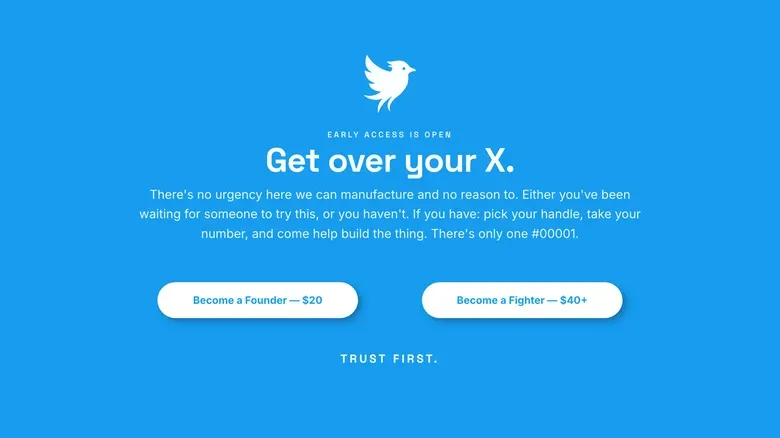
For would-be users, the plain-English version is simple: Tweet.app has a live website, but the service is not yet open as a finished public social platform. It is accepting people for a waitlist instead.
Waitlist numbers, handle reservations, and the Fighter tier
More than 172,000 people have reportedly signed up for the waitlist and requested a handle. The service charges $20 to reserve that handle. This is not the same as confirmation that those users are actively posting on a launched network; it reflects advance interest in the upcoming platform and its usernames.
Tweet.app also lists a Fighter tier for $40. The tier appears to include the benefits associated with a founder, including a founder number and badge. It also includes an exclusive slingshot badge aimed at supporters who want to signal something more combative than simple early adoption.
Badges, founding numbers, and reserved identities are familiar tools for building a sense of an early community. Gaming has its own versions: Kickstarter backer cosmetics, founder packs, pre-launch guild names, numbered hardware editions, and profile flourishes that say, “I was here before the servers filled up.” The appeal is not necessarily about functionality. It is about being recorded as part of a project’s opening chapter.
That mechanic may be especially potent for a platform designed around a word with years of cultural baggage. A reserved handle can feel like digital property, even though users should be careful to distinguish a platform-specific reservation from ownership of a general word, person, or identity. The $20 fee and $40 Fighter option are features of Tweet.app’s current waitlist setup, not a description of a broadly available finished service.
A social platform’s identity is more than its domain
The change from Twitter.now to Tweet.app shows how quickly a domain can become only one part of a much larger identity question. A platform needs a name that people can say, search, share, and associate with the service without mistaking it for another product. It also needs visual branding that can travel cleanly across apps, browser tabs, profile avatars, screenshots, and whatever strange meme format the internet invents next Tuesday.
That identity question reaches gaming communities, too. Social platforms remain important gathering spaces for launch chatter, patch reactions, fan art, mod discussions, speedrunning clips, and the kind of forensic speculation normally reserved for a blurry three-pixel screenshot. Communities tracking projects such as Fable’s hand-built NPC approach often depend on those fast-moving online conversations, regardless of which service ends up hosting them.
A revival-adjacent platform therefore has to do more than evoke an old logo or vocabulary. It has to persuade people that its network will become a place where their existing online habits can actually work: following friends, finding communities, sharing media, securing an account, and seeing worthwhile posts rather than an empty feed decorated with nostalgia.
What is established, and what remains unresolved
Several points are clear from the current situation:
- Operation Bluebird previously used the Twitter.now name for its planned social-media platform.
- The project has rebranded as Tweet.app after the preliminary ruling.
- The court found use of “Twitter” likely to cause consumer confusion and likely to infringe trademarks.
- The court also found that X likely abandoned “tweet” and the bird logo, allowing their use at this stage without an injunction.
- Tweet.app’s site is live, but the platform is presently taking waitlist applicants rather than operating as a fully launched public network.
- Reported waitlist interest has passed 172,000 handle requests, with a $20 reservation fee and a $40 Fighter tier.
- The trademark lawsuit is still active and expected to go to trial.
The unresolved portion is just as important. The eventual trial could clarify or alter the legal picture. There is also no completed-platform experience to assess from the information currently available: no basis to judge its feed, moderation, creator tools, mobile apps, technical reliability, or long-term community health. The site’s waitlist and paid reservation options show interest and a monetization structure, not proof that the network has cleared the difficult part of becoming a durable social destination.
For now, Tweet.app is a rebrand shaped directly by an early court decision. It cannot use the biggest legacy name it initially reached for, but it has retained potentially meaningful parts of the language and imagery associated with that era. Whether those pieces are enough to establish a new destination—and whether the case ultimately leaves them in place—remains a matter for the platform’s future and the court proceedings still ahead.