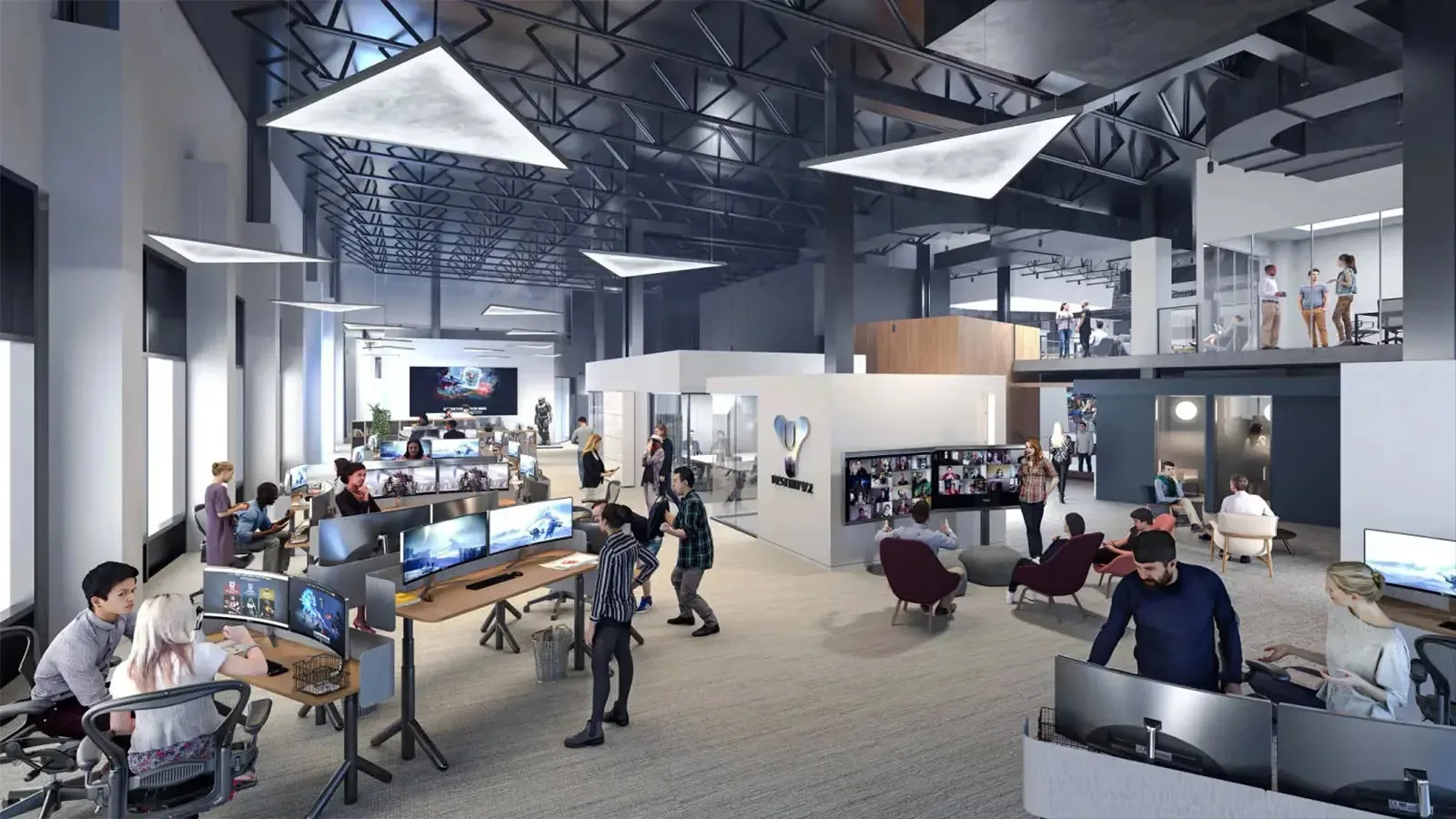
Bungie is exploring whether to sublease parts of its Bellevue, Washington campus, a significant shift for the PlayStation-owned developer after several years of layoffs and a move toward a digital-first working model. The studio confirmed that it intends to retain a physical presence in Bellevue, but the amount of space it requires has changed substantially since its pandemic-era expansion.
The developer’s statement frames the potential sublease as a workplace decision rather than a complete departure from its headquarters. Bungie said it has operated with a digital-first approach for several years and that remote collaboration has proven effective for its teams. In practical terms, the studio appears to be assessing what to do with facilities created for a much larger on-site operation.
“Bungie is exploring options to sublease its campus in Bellevue, Washington,” a spokesperson said. “The studio transitioned to a digital-first model several years ago, and this move reflects the team’s evolving workplace needs and the effectiveness of its remote collaboration.”
The wording matters: exploring options is not the same as announcing a completed lease agreement or a full relocation. What is clear is that Bungie’s Bellevue office will remain part of its operations even if portions of the campus are made available to other tenants.
A headquarters built for a larger multi-project future
Bungie expanded its Bellevue footprint in 2021, more than doubling its studio space during a period when Destiny 2 was enjoying strong momentum. The expansion was tied to plans for sustained support of the live-service shooter, more stories in the Destiny universe, and new intellectual property beyond it. It was also meant to house multiple development teams, a substantial commitment to a future in which Bungie would be both larger and more diversified.
The campus was reportedly designed around the specialized needs of game production as well as employee amenities. Its features include playtest spaces, a workout area, and a climbing wall. Marketing materials connected to the prospective sublease reportedly list more production-focused rooms too: motion-capture facilities, a streaming studio, audio and Foley rooms, capture capabilities, and editing suites.
Those are not generic office perks or interchangeable conference rooms. Motion capture, sound recording, video capture, and editing infrastructure can be central to the creation and promotion of modern games. Their presence underlines how the Bellevue expansion was intended to support a broad and technically demanding slate of work, rather than simply provide extra desks for a growing Destiny 2 team.
At the time, the logic of investing in that capacity was easier to see. Bungie had a major ongoing game, ambitions for projects outside its signature sci-fi universe, and the kind of pandemic-era growth that persuaded many technology and entertainment companies to plan for far larger headcounts. Workplace planning, however, often moves more slowly than the business conditions that shape it. A large purpose-built campus can remain in place long after a company’s staffing model and project portfolio have changed.
Related coverage includes Bungie Explores Subleasing Bellevue Campus Space After Years of Layoffs.
Layoffs have altered the size of the studio
The potential sublease follows substantial workforce reductions. Bungie’s headcount reportedly exceeded 1,500 people at its pandemic-era high. Layoff rounds in 2023, 2024, and 2026 cut at least 600 jobs in total, without counting normal departures or roles later moved elsewhere within PlayStation. Estimates have placed the remaining Bungie workforce nearer to 500 people, though the studio has not publicly confirmed a current employee total in this context.
That difference is crucial to understanding the real-estate question. A campus planned around a workforce of more than 1,500 people will have very different space demands from one serving a considerably smaller staff, especially when many employees can work remotely. Keeping every square foot of a specialized headquarters may not make operational or financial sense if utilization has fallen.
For workers, a statement about office space can also land heavily after repeated layoffs. Studios are made of people first, and facilities second. A building with recording rooms and motion-capture stages may symbolize a period of expansion, but it cannot offset the impact of teams losing colleagues or projects being reshaped. The proposed sublease is therefore a visible reminder of how much Bungie’s scale has changed in a relatively short period.
From acquisition optimism to a narrower slate
Sony acquired Bungie for $3.6 billion in early 2022. The deal positioned Bungie as an important part of PlayStation’s wider ambitions in live-service games, while Bungie continued operating with a degree of independence. The acquisition arrived after the Bellevue expansion had already been announced, but it reinforced the idea that the studio would play a larger strategic role inside PlayStation.
Several of the initiatives associated with Bungie’s expansion plans have since shifted. Reports have indicated that most of the studio’s non-Destiny projects were cancelled. One project, known as Gummy Bears and described as having a frog-like action concept, was reportedly moved within PlayStation rather than remaining at Bungie. Meanwhile, the future direction of Destiny 2 has been a subject of considerable uncertainty, with reports characterizing the game as being sunset while Bungie’s own long-term plans continue to evolve.
That leaves Marathon as Bungie’s most prominent announced project outside Destiny. The game is an extraction shooter based on the studio’s older Marathon name, and it carries enormous expectations precisely because the studio’s project slate is now more concentrated. Its commercial and creative prospects cannot be known in advance, and it would be premature to treat the game’s future as settled either way. But the stakes around it are plainly higher when fewer major initiatives remain publicly visible.
For broader industry context, the current push and pull between carefully authored development and large-scale production planning can be seen in Fable’s decision to build 1,000 NPCs by hand. Different studios face different challenges, but both stories point to the expensive, human-intensive choices behind contemporary game creation.
What “digital-first” can mean for game development
Digital-first does not mean a game studio no longer needs a physical workplace. Development still benefits from dedicated audio suites, equipment labs, secure build environments, playtesting rooms, face-to-face planning, and spaces where teams can solve difficult problems together. A Bellevue base can continue to offer all of that even if Bungie occupies less of its overall campus.
Instead, the term suggests that a physical desk is not the default measure of employment or collaboration. Teams may work remotely, meet at the office when a production task benefits from being together, and recruit from a broader geographic pool rather than requiring every employee to live within commuting distance of Seattle’s Eastside.
For a studio in the expensive Bellevue market, that flexibility has obvious appeal. It can potentially widen hiring options and reduce the pressure to assign permanent office capacity to every role. The trade-off is that game development becomes even more dependent on reliable remote systems, good communication, secure pipelines, and leadership capable of coordinating teams that are not all in the same room.
Bungie’s campus decision should not be treated as proof that remote work alone caused its present situation. The reported changes follow a combination of factors: a smaller staff, a revised project portfolio, major corporate expectations around live-service development, and the ordinary difficulty of forecasting long development cycles. But the company’s digital-first policy offers a straightforward explanation for why it may no longer need all the space it built up during an earlier growth phase.
What happens next
No timetable, amount of space, or prospective tenant has been publicly identified. A sublease process can involve multiple possibilities, including leasing individual floors or specialized sections, and not every exploration results in a finalized deal. Bungie has only confirmed that it is considering options and that Bellevue will remain its physical home in some capacity.
The immediate takeaway is less about a building than about scale. The 2021 expansion reflected confidence in a fast-growing studio supporting Destiny 2, expanding into new worlds, and maintaining several teams. The possible sublease reflects an organization now adapting to a much leaner workforce and a remote-friendly structure. Whether that smaller footprint becomes a stable foundation for Bungie’s next chapter will depend on the projects and people still working inside it, not merely on how much of the campus carries its name.