Grand Theft Auto 6 appears set to make getting away from the police more complicated than simply outrunning a patrol car. Footage and preview details point to a revised six-star Wanted Level meter whose stars communicate the state of an investigation, alongside a new Heat display that identifies the clues tying law enforcement to the player.
The important distinction is that a pursuit may no longer be the only danger. Police can investigate a crime without knowing the suspect, search while holding partial identifying information, or continue to retain evidence even after the player escapes immediate sight. That would make the space between committing a crime and being fully clear of it considerably more meaningful.
A related look at the potential shift describes why these systems could make each escape feel more personal here. The details seen so far suggest that the key question is not only “How many stars do I have?” but also “What does the police force actually know about me?”
Wanted stars appear to show police awareness, not just danger
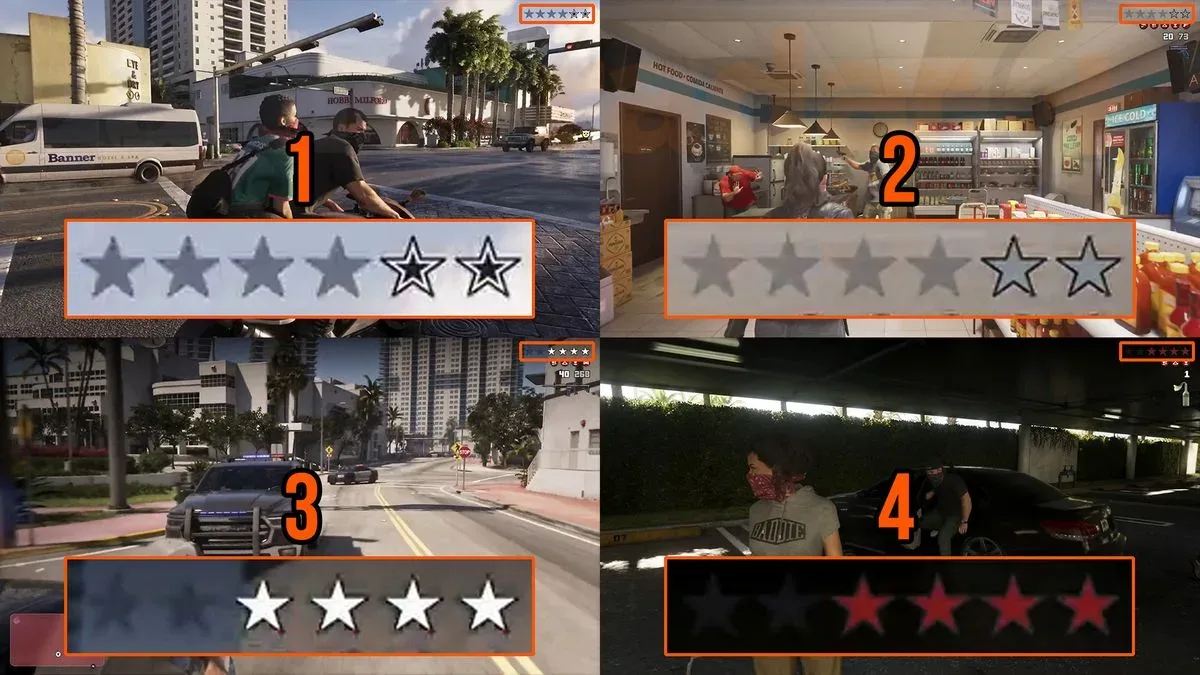
GTA 6’s meter has been shown with up to six stars. More notably, the stars seem to change colour and presentation depending on whether police are investigating, searching, chasing or trying to reconnect evidence to a suspect. That makes the display a status readout rather than a plain measure of force escalation.
For more context, explore Bloodborne’s The Hunter’s Dream PC Project Draws AI Backlash Despite Multiplayer Claims.
The precise meaning of each version has been inferred from the material available so far, so it should be treated as an informed interpretation rather than a complete official rulebook. Still, the four apparent states form a clear progression:
- Black-and-white stars: Police are investigating a crime, but do not appear to know who committed it. The safest response may be to avoid attention rather than initiate a dramatic escape.
- Gray stars: Police are investigating and have information that can identify or narrow down the suspect. The Heat icons beneath the Wanted meter indicate what information is in play.
- White stars: Police are actively pursuing the player and have visual contact.
- Red stars: The player has broken away from the immediate chase, but police still retain information that could lead them back to the suspect.
That last state could be the most significant change. In a conventional chase loop, leaving a search area is often the end of the encounter. Red stars suggest an escape can be provisional: police may no longer see the player, yet the player remains vulnerable until the identifying evidence has been dealt with.
Heat is the evidence tracker beneath the chase
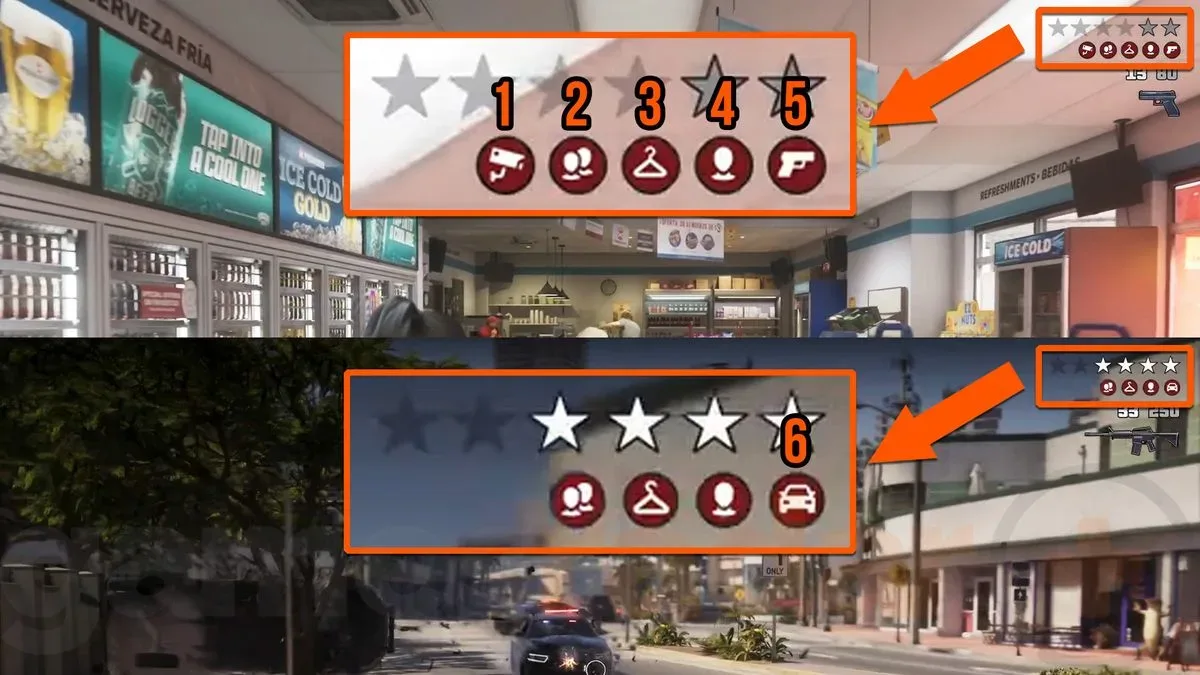
Heat appears as red icons in the upper-right portion of the interface. In this context, Heat means identifiable leads that police have gained through eyewitnesses or their own observations. It is not merely an abstract notoriety score. Each marker is meant to tell the player which detail is making them traceable.
Six Heat categories have been seen:
- Security camera footage
- Accomplice
- Clothing
- Face
- Weapon
- Vehicle
The system’s practical implication is easy to understand: accumulating more Heat markers should make it harder to disappear. A character connected to a visible face, distinctive clothing, a weapon, a vehicle, camera evidence and an associate has left multiple paths for an investigation to follow. Conversely, stripping away those links should reduce the police response even if the original crime cannot be undone.
In the footage discussed so far, leaving a car after a chase caused the Vehicle Heat marker to vanish immediately. That moment indicates that at least some Heat may be removed through straightforward actions rather than a lengthy cooldown. It also hints that a vehicle is not necessarily permanently “burned”; the immediate problem seems to be that the police can associate the suspect with it.
What each clue could mean in play
Some of the most useful tactics implied by the interface are preventative. A mask or face covering may limit Face Heat. Avoiding security cameras, or removing them where possible, could stop camera footage becoming part of the police record. Those are meaningful choices because they happen before a Wanted Level turns into a full chase.
Once Heat is active, the apparent countermeasures are more reactive. Changing clothes could remove Clothing Heat, concealing or ditching a weapon could address Weapon Heat, and exiting a known vehicle may clear Vehicle Heat. The available material supports those broad relationships, but it does not yet establish every condition, limitation or cost attached to them. Players should not assume, for example, that every outfit change will always erase every form of identification.
The Accomplice icon has its own wrinkle because GTA 6 follows Jason and Lucia. Splitting the two characters up appears to remove Accomplice Heat. However, this is not a loophole allowing one protagonist to abandon the other with no consequences: if either character is caught while separated, the result is still a Bust. The mechanic therefore appears to reward coordinated evasion rather than treating the second protagonist as disposable bait.
The minimap may become less reliable when the pressure rises
At higher Wanted Levels, red-and-blue flashing effects appear to obscure the minimap. If that behaviour remains in the final game, it will deliberately remove a familiar tactical advantage: using the map to track nearby police movement while plotting an escape route.
Instead, players may need to watch the road, scan their surroundings and choose quieter places to lie low. It is a subtle UI decision with a large effect on tone. A minimap normally turns a pursuit into a navigational puzzle. Hiding it turns the same moment into a more immediate awareness test, where the player must rely on what they can see rather than perfect local information.
That does not necessarily mean every high-star encounter will be harder in the same way. The six-star scale leaves room for different intensities of response, and the evidence system suggests that the nature of a crime matters alongside its severity. A low-level incident that leaves no usable identifying clues may be easier to outlast than a messier situation that provides police with a face, vehicle and weapon connection.
Why the two systems matter together
The best way to read the displayed systems is as two related layers. Wanted Level describes the police response at the moment: investigation, search, visual pursuit or post-escape attention. Heat describes the information sustaining that response. Stars show the pressure; Heat shows its cause.
This could make evasive play less binary. Rather than only driving until a meter disappears, a player may have to decide whether to stay unnoticed, break line of sight, change their visible identity, leave a traceable vehicle, hide a weapon or separate the two protagonists. Each choice is connected to information the game says the police possess.
It also gives Rockstar a clearer way to communicate why a player is still being hunted. If red stars remain after a pursuit, the Heat symbols can explain whether the unresolved problem is an eyewitness-recognized face, surveillance footage, an accomplice connection or something else. That feedback is useful because it turns a potentially opaque law-enforcement system into one the player can read and respond to.
What remains uncertain
Only a portion of the system has been shown. The available information does not confirm how long individual Heat markers persist, whether they can return after being removed, how witnesses create or strengthen evidence, or exactly how each of the six Wanted stars affects the scale of police response. It also does not establish whether all story missions and free-roam crimes use identical rules.
But the core direction is clear from what has been seen: GTA 6 appears to make evasion about managing evidence as much as surviving pursuit. The fastest car may still be useful, but it may not be enough if police know the driver’s face, clothes, weapon and vehicle. In Vice City, the cleanest escape may be the one that leaves the fewest clues behind.