Guy Nattiv’s The Liberation is built around a danger that does not arrive wearing a villain costume. It comes dressed as recognition. It knows how to ask an exhausted woman whether she is okay. It offers companionship, permission, a break from judgment and a vocabulary for pain. That makes the film’s portrait of cult recruitment especially unsettling: its central threat understands that warmth can be a weapon.
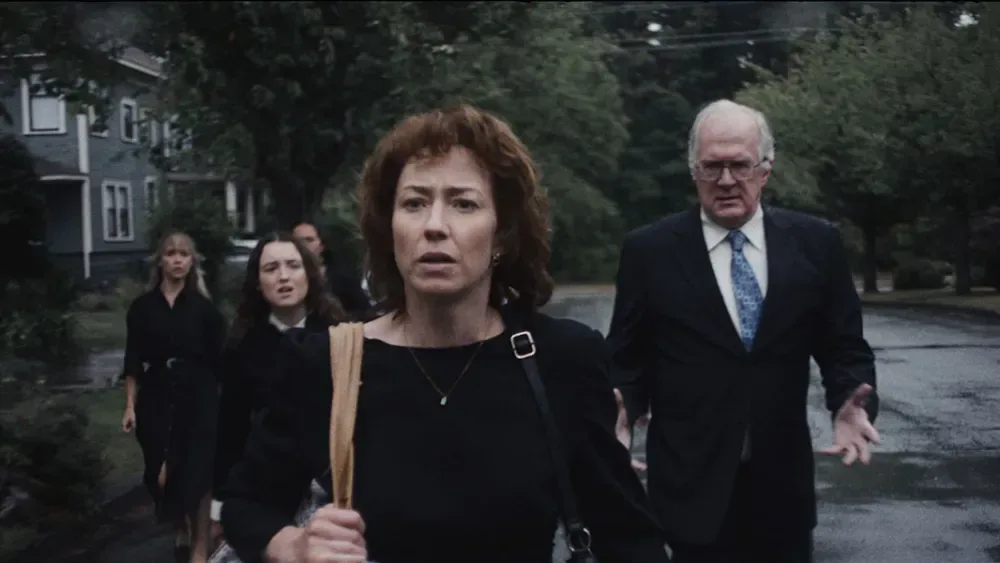
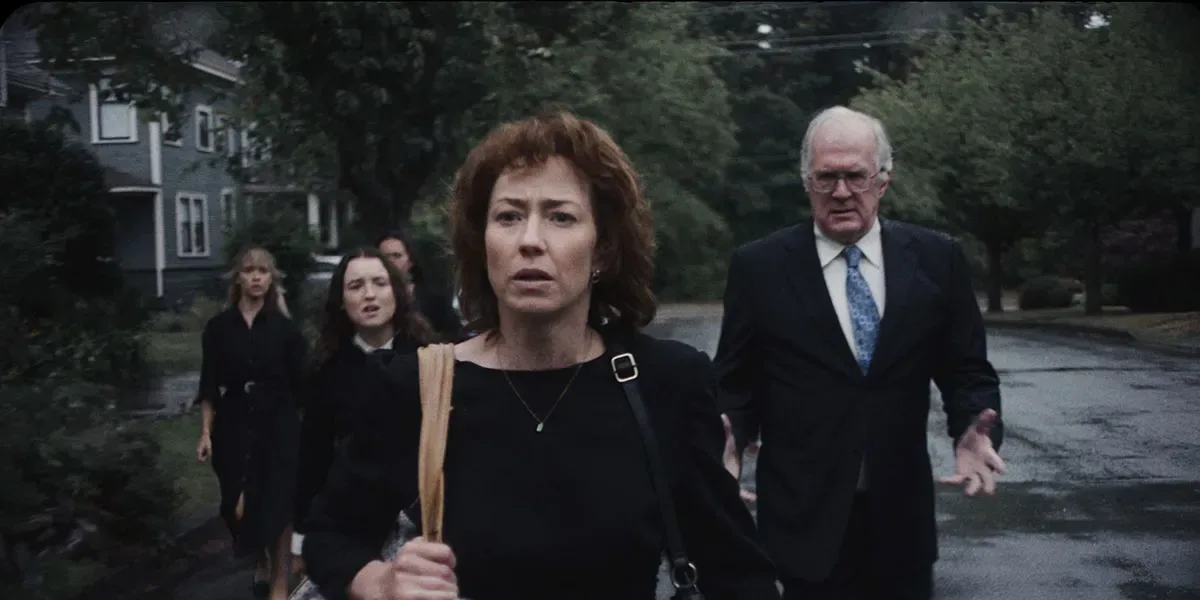
Set in early-1980s New Jersey, the 125-minute drama follows Rita Cooper, played by Carrie Coon with extraordinary control and force. Rita has the outward structure of an ordinary life: a bank job, a husband named Reuben, played by Tracy Letts, and two daughters, Ella and Jo, played by Bella Ramsey and Odessa Young. But routine has hardened into confinement. Rita is quietly depressed, burdened by the unprocessed legacy of surviving the Holocaust, and increasingly alienated from her own middle-aged body and the prospects she sees remaining before her.
That emotional terrain gives Coon room to create a character whose distress is rarely announced. Rita is not simply unhappy; she is practiced at moving through unhappiness. She works, mothers, manages, and keeps the pieces of herself that feel unwelcome tucked out of sight. In a film world often eager to make personal crisis loud and legible, The Liberation finds its ache in all the energy Rita spends making sure nobody has to notice.
A recruiter who offers understanding before control
Rita’s life shifts when Ricki, a mysterious young woman played by Lily James, enters her bank to deposit a large amount of money. Their encounter begins with a loaded observation about the weight Rita carries. Rita initially hears it as a familiar comment on aging and appearance. Ricki means something broader, and that distinction is the hook. She seems to see the exhaustion underneath the small talk.
James gives Ricki an unnerving poise. The character’s charm is not broad or theatrical; it comes through a confident smile, a sense of intimate knowledge, and an ability to frame escape as a basic human right. Her invitation is not only toward a commune in the woods. It is toward sunsets, self-reinvention and a circle of women who appear to understand the suffocating pressures Rita cannot explain at home.
The film’s sharpest idea is that Rita’s vulnerability is not foolishness. She is not lured because she lacks intelligence or because the story needs a simple victim. She is susceptible because she is lonely, because her history is heavy, and because a life of being needed by everyone else has left her hungry to be cared for without conditions. Ricki weaponizes precisely the language of no-judgment support and healing that ought to be meaningful.
That angle distinguishes The Liberation from the most familiar cult-story template. Instead of centering a charismatic male guru, Nattiv and co-writer Noa Berman Herzberg examine the coercive possibilities inside an apparently protective female space. The women-led dynamic makes the betrayal more intimate. It is not a story that dismisses the need for female solidarity; rather, it recognizes how devastating it can be when the promise of solidarity is used to isolate someone from the people who love her.
Carrie Coon plays Rita and the person Rita is remade into
The narrative moves across two timelines, edited by Sabine Hoffman and Yuval Orr with a steady sense of escalation. One thread shows the domestic Rita: uncertain, frayed and still trying to fulfill every expected role. The other finds her already inside Ricki’s orbit at the commune, where she has been renamed Naia. Her daughters Ella and Jo undertake a dangerous trip to bring their mother back.
Coon makes the two states recognizably connected while allowing each to carry a different physical and emotional grammar. The Rita at home appears hesitant and compressed, often dressed in muted floral clothing and continually negotiating her place in her own household. Naia, by contrast, looks calmer. The commune has given her apparent serenity, changed habits and a new identity. But the calm is also chillingly passive. It is the stillness of a person whose choices have been narrowed while being presented as liberation.
That is the performance’s accomplishment: Coon conveys the appeal of surrender without softening its cost. Her work does not ask viewers to pick between a “real” Rita and a false Naia. Both emerge from the same woman, and the second is made possible by needs the first had no safe place to articulate. The result is a much richer character study than a straightforward warning about manipulative groups.
Letts, Ramsey and Young give the home-life side of the story necessary weight. Reuben is Rita’s husband rather than a one-note explanation for her unhappiness, while Ella and Jo become active participants in the later rescue effort. The family’s response matters because Rita’s disappearance cannot be reduced to a mystery plot. It is a rupture with people who may not have fully understood her pain, but who still must reckon with what has happened to her.
Two timelines, one tightening trap
Nattiv, whose story draws in part from his grandmother as well as accounts from cult survivors, approaches Rita’s experience with patience. The film begins with the later situation already in view, then reveals the chain of events that brought her there. This structure lets ordinary interactions collect ominous meaning. A compliment, a promise of acceptance or a moment of relief can all become parts of Ricki’s machinery of control.
The flashbacks do not rush to explain Rita’s breakdown as one decisive event. Instead, the film tracks accumulated pressure: trauma that remains present despite the passing years, domestic monotony, guilt, dissatisfaction and the punishing social expectations directed at women who are no longer young. The Liberation is attentive to the way a person can become convinced that there is nothing else waiting for them, making even a destructive alternative feel like a door opening.
There is something especially bracing in how the screenplay treats therapeutic jargon. Phrases that can sound affirming in the abstract become frightening when stripped of genuine care and repeated as doctrine. Coon’s vulnerable delivery gives those moments their sting. The film is not mocking the desire to heal. It is showing how easily the language of healing can become a tool for demanding obedience.
For another recent example of a film willing to let a messy, psychologically complicated life resist neat packaging, see this look at The Idiot(s). Nattiv’s film works in a very different register, but both projects find drama in people whose interior contradictions cannot be tidied into an easy label.
An early-’80s world with texture, not costume-party gloss
Cinematographers Fabian Gamper and Tudor Vladimir Panduru give The Liberation a grainy, intimate visual texture. Their camera stays close to Rita, registering the minute changes in Coon’s face as her certainty and clarity are worn away. The early-1980s setting carries residue from the 1970s rather than shouting its period credentials. It has the muted, lived-in feeling of a world that existed before the characters entered it.
The production design and costumes follow the same philosophy. Rather than filling every frame with exaggerated patterns or instantly recognizable nostalgia props, the film builds a credible environment around its people. That restraint is important. Rita’s predicament should not feel safely sealed inside a retro aesthetic. The period is specific, but the pressures around identity, aging, bodily judgment and the commercialization of emotional wellness remain painfully familiar.
As the story reaches its final movement, the film pivots into a more immediate thriller mode. Jo, who is diabetic, is endangered at the commune, forcing Ella and Rita into a desperate struggle to protect her. The stakes become more overtly physical, but they remain tied to the film’s emotional core: liberation has been redefined as abandonment, and a mother who has been encouraged to discard her former self must face what that transformation endangers.
Why the thriller mechanics land
The late suspense works because The Liberation has earned it. The film has spent enough time showing why Rita went with Ricki, why the commune’s promises could briefly feel like rescue, and why getting free cannot be as simple as identifying a bad leader. By the time the danger tightens around Jo, the question is not merely whether someone can escape the woods. It is whether Rita can recover the agency that was taken from her in the name of giving it back.
Dascha Dauenhauer’s score supports that slow move from intimate unease to more urgent peril, while Hoffman and Orr keep the cross-cutting between eras clear. The filmmaking never loses sight of the person at the center of its plot. This is not a cult narrative that treats trauma as seasoning for a chase sequence. The thriller elements grow from a study of an unfulfilled woman whose need to be seen was exploited.
That focus makes The Liberation both harrowing and compassionate. Coon’s performance holds every contradiction at once: shame, longing, fury, relief, fear and the stubborn possibility of return. Nattiv’s film understands that manipulation rarely begins with an obvious command. Sometimes it starts with somebody seeming to notice the invisible burden you have been carrying alone.
Film details
- Title: The Liberation
- Director: Guy Nattiv
- Screenplay: Guy Nattiv and Noa Berman Herzberg
- Cast: Carrie Coon, Lily James, Bella Ramsey, Odessa Young and Tracy Letts
- Running time: 125 minutes
- Festival screening: Telluride Film Festival, September 4, 2026
The film was presented by Bleecker Street and produced by Sight Unseen Pictures, Scythia Films, New Native Pictures and Spooky Pictures. Its blend of close character observation and escalating danger makes it a notable festival title, particularly for viewers interested in dramas that find horror not in the supernatural, but in the seductive misuse of care.