There are two dependable ways a biopic can turn a famous artist into a museum exhibit. The first is to arrange the great achievements in neat chronological order, complete with reverent pauses whenever history is being made. The second is to make the subject so tortured, brilliant and isolated that everyone around them exists solely to validate the legend. The Idiot(s) appears determined to avoid both traps. Its Fyodor Dostoevsky is not presented as an untouchable sage in a portrait-frame beard. He is a celebrated author, certainly, but also a reckless gambler, an exhausting husband, a proud nationalist, a drunken catastrophe and a man capable of reducing a room to either helpless laughter or unbearable discomfort.
That unruly approach is the key to the film’s appeal. Directed by Małgorzata Szumowska and Michał Englert, The Idiot(s) narrows its attention to a turbulent period in Dostoevsky’s life rather than attempting to summarize every chapter of his legacy. The 120-minute Poland-Germany production follows the writer during a German honeymoon with his younger wife, Anna, while financial pressure and a looming manuscript turn daily life into an increasingly bizarre survival exercise. Dostoevsky is trying to complete The Idiot; the process is anything but a tidy portrait of inspiration striking a genius at his desk.
A literary giant, stripped of the marble pedestal
Johnny Flynn plays Dostoevsky as a gifted man who repeatedly makes himself impossible to defend. The fame attached to Crime and Punishment accompanies him, but it does not grant him poise, stability or a reliable ability to deliver work. Instead, the film reportedly leans into the physical indignities of his life: drink, sickness, vomit, begging, roulette and the kind of desperate behavior that turns humiliation into a recurring comic language.
That does not mean the filmmakers simply want to sneer at him. The sharper idea is that artistic importance and personal ugliness can occupy the same space without being smoothed into a comforting moral lesson. Dostoevsky’s failures are not a loophole that excuses his work, nor is his work a magic certificate that erases the damage he causes. The Idiot(s) lets both realities remain present. It treats the author as someone who can be obnoxious, ridiculous and painfully needy while still possessing a storyteller’s ability to expose the cruelties and absurdities surrounding him.
There is a useful contrast here with the collector impulse to treat a renowned name as a perfect object, sealed safely behind glass. As explored in The Collector’s Five Stages of Buying One Small Thing, attachment to an object can quickly become a strange emotional journey. The movie applies something similar to cultural reputation: remove the protective case, and the supposedly pristine icon becomes a complicated, sometimes grotesque human being.
Anna is not a supporting character in her own life
The biggest reason the premise does not collapse into a one-man spectacle is Aimee Lou Wood’s Anna. The film is built as a two-hander, and its perspective appears to give Anna at least equal dramatic importance. She is not merely the patient spouse standing near the great man while he wrecks the furniture and waits for posterity. She negotiates, secures food, keeps the couple moving and assumes practical burdens that Fyodor either cannot or will not handle.
Wood’s performance is described as warm, intelligent and forceful without making Anna feel saintly. Her love is real, but the story does not hide how much labor it costs her. The relationship becomes more layered as the couple face pregnancy, the birth of a child and later tragedy. Anna’s continued devotion could have read as baffling if the screenplay treated Fyodor as only a monster. Instead, the film apparently identifies the difficult, unsettling pull that can exist between two people: she recognizes his cruelty and instability, yet also sees a disarming authenticity and artistic intensity in him.
That choice makes the title’s plural parenthesis feel purposeful. Fyodor may be the famous idiot, but the film is interested in the system of devotion, delusion, sacrifice and trust that forms around him. Anna is the person transcribing his work, finding ways to keep him afloat and refusing to let the promise of the unfinished novel disappear. If The Idiot is ultimately the masterpiece on the horizon, The Idiot(s) gives its creation an unsentimental co-authorial context: it takes Anna’s persistence as seriously as Fyodor’s tortured talent.
Period drama with mud on its boots
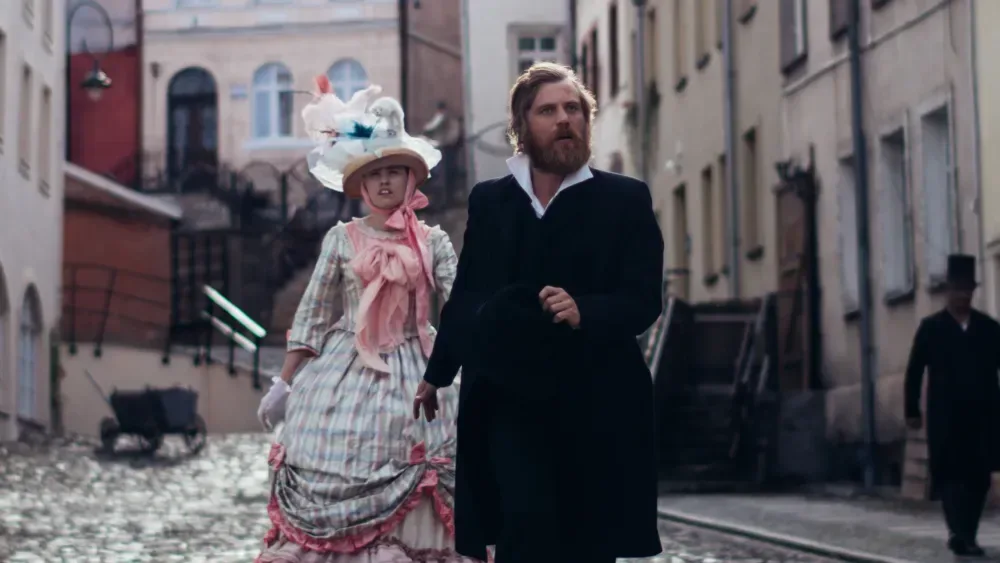
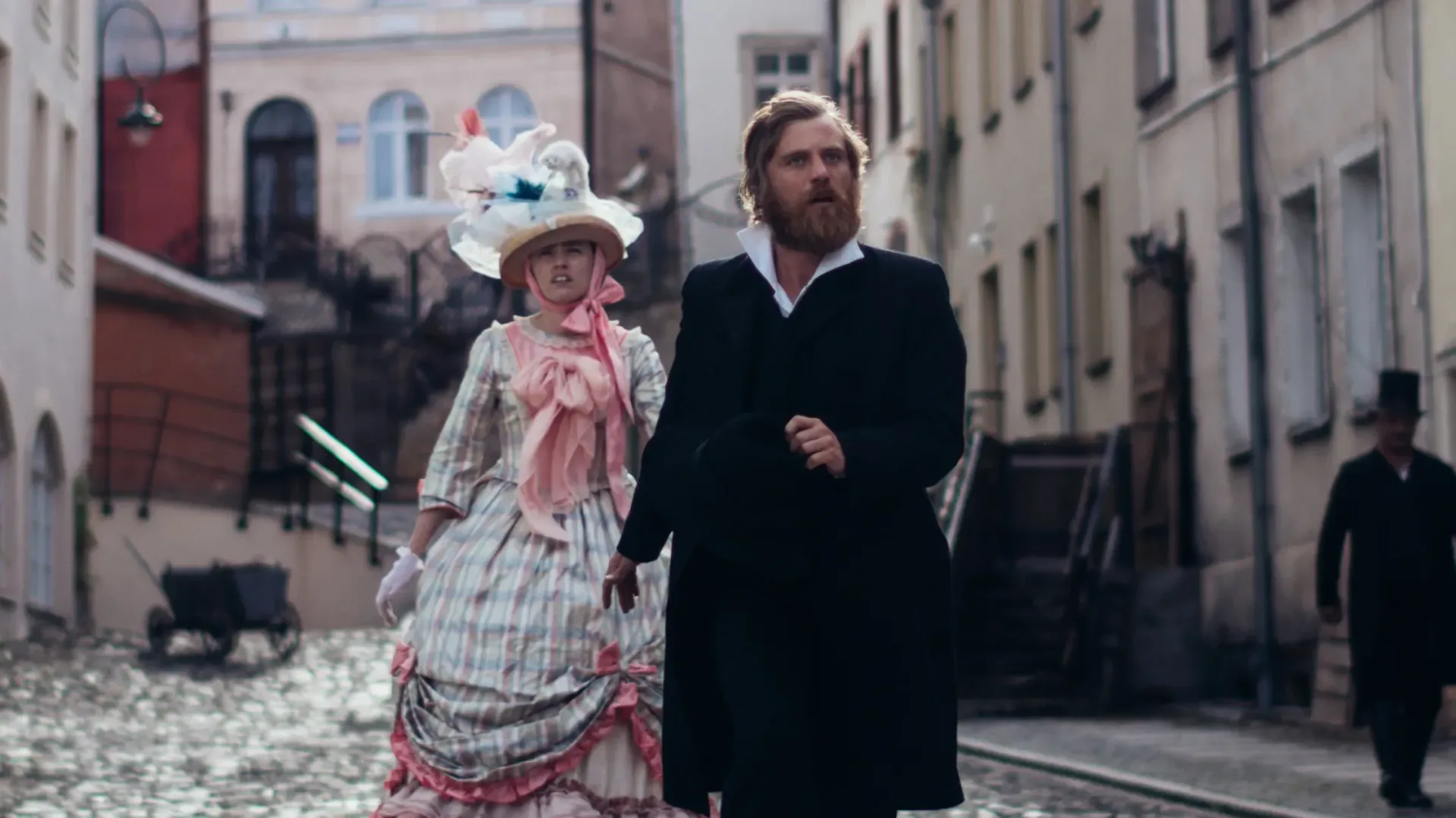
Costume dramas can sometimes make hardship look suspiciously well laundered. Szumowska and Englert seem to favor the opposite texture. The film sets palatial wealth against grimier rooms where Anna and Fyodor are forced to live, creating a blunt visual and social divide. Aristocrats hover around the story as outsized figures of decadence, filtered through Fyodor’s contempt for the Western European society he considers pompous and morally rotten.
Vicky Krieps plays one particularly vicious member of that privileged world. Christian Friedel appears as Ivan Turgeniev, Dostoevsky’s fellow Russian writer and a figure Fyodor resents partly because Turgeniev has adapted himself to Western comforts. The film even finds room for an impromptu dance contest between the two writers, a scene that signals how little interest this production has in conventional literary-biopic decorum.
The rowdiness extends to a duel, a suicide, an imagined decapitation aimed at misogyny and assorted bodily-function jokes. Those ingredients could sound like a checklist of deliberate provocation, but the reported tone is not random chaos for its own sake. The grime and broadness puncture the false elegance often imposed on the 19th century. These people wore formal clothes, perhaps, but they still worried about debt, food, sex, status, work, humiliation and the exhausting consequences of loving someone who keeps choosing the worst possible option.
In that respect, the movie’s social encounters play almost like a hostile form of couch multiplayer: everyone enters the room with their own objective, nobody agrees on the rules and one impulsive participant can wreck the entire evening. That is a less orderly version of the dynamic in The Unwritten Rules of Couch Multiplayer, Now Written Down. Dostoevsky, unsurprisingly, sounds like the player who insists the game is unfair moments before betting the last coins on one more round.
Comedy, discomfort and a modern musical wink
Flynn’s performance appears to live at the unstable boundary between farce and pain. When Fyodor crawls and pleads for forgiveness or gambling money, the material is designed to provoke a laugh that catches in the throat. The joke is never entirely separate from the desperation. That cringing tension is a useful fit for a man whose self-destruction is obvious to everyone except, frequently, himself.
Yet the film also reserves room for his command as a writer. In one key social setting, he is asked to entertain wealthy people with a salacious story. Rather than simply play along, he tells an account shaped by class and suffering, captivating the audience while quietly exposing its moral distance from the lives being discussed. It is a compact expression of the film’s central contradiction: the man can be deeply embarrassing, while the artist can still understand something piercing about humiliation and inequality.
The playful sensibility is further underlined by the use of A-ha’s “Take on Me” in a stripped-back form without its familiar electronic drive. The anachronism is not presented as an attempt to modernize the era into something it was not. It works more like a mischievous reminder that historical figures are not automatically solemn just because they lived long ago. The film’s costumes and careful production design may establish the period, but its absurdism prevents the past from becoming a waxworks display.
What to know about The Idiot(s)
- Directors: Małgorzata Szumowska and Michał Englert
- Screenplay: Szumowska, Englert, Kasper Bajon and Brid Arnstein
- Cast: Johnny Flynn, Aimee Lou Wood, Christian Friedel and Vicky Krieps
- Languages: English, German and French dialogue
- Running time: 120 minutes
- Story basis: Andrew D. Kaufman’s book The Gambler Wife: A True Story of Love, Risk and the Woman Who Saved Dostoyevsky
- Festival context: The film is listed for the Telluride and Toronto film festivals.
The Idiot(s) looks most compelling when viewed not as a corrective that asks audiences to discard Dostoevsky, and not as a tribute demanding that they worship him, but as a thorny story about the people behind supposedly fixed cultural monuments. Flynn gets to make the author foolish, undignified and vividly mortal. Wood ensures that Anna is not lost in the blast radius. Together, those choices give this literary period piece a volatile contemporary energy: a masterwork may be forming, but nobody involved gets to stay clean while it happens.