Mike Leigh’s films are often built from the tiniest social collisions: an ill-timed remark, a family ritual, a silence that lasts a beat too long, or the way an ordinary conversation gradually exposes an old resentment. Tender Loving Care, his new 107-minute drama, has plenty of those recognizably Leigh-like pleasures. Its people can be funny, awkward, guarded, blunt and unexpectedly affectionate within a single exchange. Its performers give the impression of lives continuing beyond the frame.
Yet the film’s observation is more persuasive than its overall design. Tender Loving Care brings together several subjects with obvious emotional and political weight: an overstretched social-care system, foster children, isolation, romantic disappointment, parental decline, dementia and the obligations friends owe one another. It is never short of material. The issue is that the connections between those strands can feel demonstrative rather than deeply discovered. The movie repeatedly asks what care means, but it does not always let its central character become as complicated, startling or exposed as that question requires.
That leaves this as an intermittently affecting Mike Leigh picture with vivid scenes and a very capable cast, but one whose strongest individual observations do not entirely grow into a fully satisfying drama.
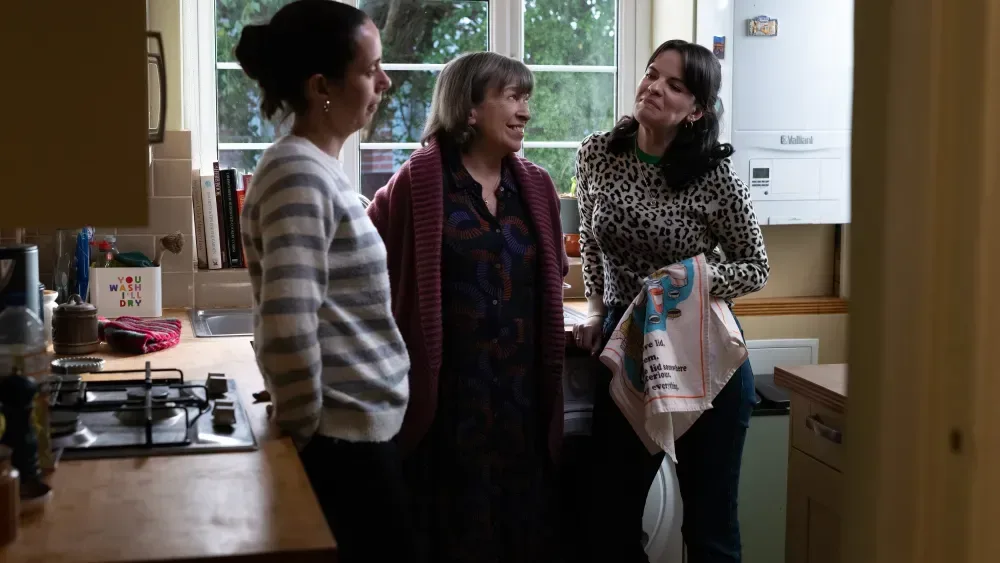
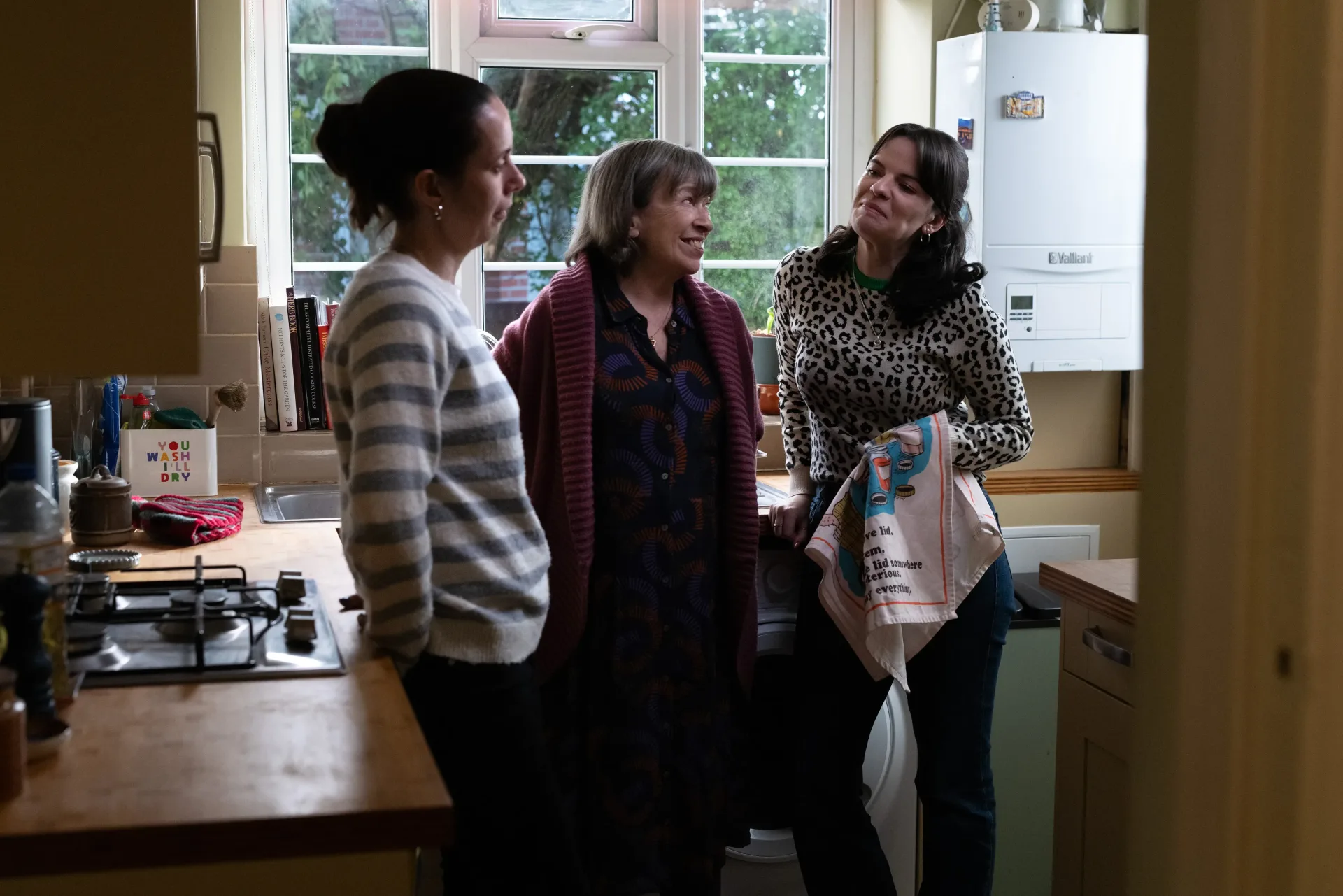
Amy and Rosie at work, then back at the flat
Kate O’Flynn plays Amy, a 37-year-old social worker with a brisk exterior and an underlying warmth. She is trying to reach foster teenagers who have learned not to trust the adults assigned to help them. Amy’s work is framed by a sector facing funding cuts and institutional retreat, a setting that matters not merely as background but as a pressure on every interaction. Good intentions are present; time, resources and confidence are much harder to find.
Amy has also returned to the apartment of her longtime friend Rosie, played by Alice Bailey Johnson. Amy had spent five years living with a man, only for that relationship to end when he went back to his wife in Glasgow. Now Amy and Rosie are once again sharing domestic space, bottles of white wine, gossip and nights of dancing. Their rapport makes immediate sense. They have history, they know how to irritate each other, and their affection is genuine even when their conversation is sharp.
Leigh is especially good at making this friendship feel lived-in without turning it into a glossy “best friends forever” construction. Rosie can be more cutting and more surface-minded than Amy; Amy’s careful, encouraging manner may conceal needs that she cannot readily name. The two women offer each other comfort, but the film keeps returning to a harder possibility: mutual support is not necessarily the same thing as self-knowledge.
That distinction should be the engine of the drama. Amy and Rosie have both been disappointed by men, and Rosie’s hopes are bruised further when a firefighter who has asked her to a fancy dinner fails to show up. The movie understands the disappointment and indignity of that experience. But it is less revealing about the two friends’ desires beyond the fact of romantic bad luck. Their loneliness becomes a condition the story identifies rather than an emotional terrain it fully explores.
Care as a private promise and a public failure
The title carries multiple meanings. It describes the labor Amy and Rosie perform for vulnerable people, the closeness that sustains their friendship, the protective love Amy receives from her parents and the support that people need when aging or illness strips away their independence. At its best, the film uses that repetition to show how care changes from setting to setting. A service can be a bureaucratic obligation. A parent’s concern can be loving yet smothering. Friendship can be lifesaving while still avoiding the truth.
The film also gives Amy a case that brings its institutional questions into sharp focus. A distressed young mother has had all three of her children removed by the state. She fears that anything she says to Amy will be converted into evidence against her. That fear gives the encounter real stakes. The woman’s pain is not abstract, and the scene has a force that the film’s broader social commentary sometimes lacks.
It also raises an important ambiguity: what can an individual social worker actually promise when the larger system holds the power? Tender Loving Care does not appear interested in providing an easy answer, which is sensible. But it can leave the film’s own perspective on that clash between compassion and authority somewhat unresolved. The encounter is powerful because it is rooted in a person’s urgent fear; the surrounding argument feels less complete.
For another film that finds messy vitality in a biographical subject rather than reducing its figure to a lesson, see The Idiot(s) Makes a Messy Dostoevsky Biopic Feel Surprisingly Alive.
Paul Jesson gives the film its deepest wound
The most moving thread involves Amy’s parents. Marion Bailey plays Amy’s mother with a chatty, steady devotion that feels both comforting and faintly overprotective. Amy is their only child, and the parental instinct to keep treating her gently has not faded with adulthood. There is humor in their conventional domestic manner, but no cruelty in it.
Paul Jesson, as Amy’s father, gives the film’s most piercing performance. He initially seems like an elderly relative defined by reserve: a decent man, a little gruff around the edges, capable of a joke, and never prone to making himself the center of the room. The gradual arrival of dementia changes that balance. Leigh does not turn the condition into a string of manipulative showcase scenes. Its force comes from accumulation and recognition—the sense that a familiar person can become harder to reach while still physically present.
A detail involving swans becomes one of the story’s signs that his mind is slipping into a different pattern. It is not presented as a grand metaphor so much as a troubling alteration in everyday conversation. Jesson makes the transformation painful precisely because the earlier portrait is so ordinary and humane. The role clarifies what the title can mean when it is stripped of policy language: care becomes the difficult work of staying with someone through a change that no one can fix.
The film begins with Rosie speaking to an elderly homeless man experiencing dementia in a hospital. He then disappears from the system, before returning later. The parallel to Amy’s father is easy to see. One man has a family network; the other is vulnerable to vanishing through institutional gaps. It is a meaningful contrast, and a sobering one. Still, the structure makes its point so visibly that the final effect can feel more like a diagram of social failure than a revelation emerging naturally from the characters.
Fine acting, incomplete interior lives
O’Flynn has the presence to carry Amy. Her performance captures someone who can project reassurance while carrying her own uncertainty quietly. Johnson is an agile counterweight, ensuring Rosie is not simply the caustic friend who exists to puncture Amy’s niceness. Bailey brings warmth and texture to Amy’s mother, while Jesson gives the family scenes their most durable emotional charge.
That level of performance is why the film’s limitations register. The actors create the sense of people worth following, especially Amy and Rosie, but the screenplay does not always press far enough into their separate inner lives. Amy’s breakup, her work and her parents’ decline should create an unusually volatile period in which she must decide what she wants from love, responsibility and herself. Instead, the film sometimes steps back from that personal drama to emphasize the wider social picture.
There is no problem with a movie wanting to address austerity, homelessness or the fragility of care services. Indeed, those subjects are central to the stakes of Amy’s work. The more compelling choice would be to let the societal pressures complicate her desires rather than stand beside them as a thematic framework. The difference is crucial. A social diagnosis can be correct and still remain emotionally distant; a character’s specific grief or hunger can make that same diagnosis unforgettable.
Leigh has made films where a large group of people, with all their competing hurts and defenses, eventually forms an overwhelming emotional whole. Secrets & Lies from 1996, Topsy-Turvy from 1999 and Another Year from 2010 remain prominent examples of that ability to turn social behavior into something both comic and bruising. Tender Loving Care contains echoes of the qualities that make those films memorable: the sharp everyday dialogue, the ensemble feeling and the refusal to treat people as merely noble or vile.
But this film feels more dispersed. Its concerns are valid, its scenes are often engaging and its best performance is quietly devastating. The total shape remains less potent than the ingredients. Viewers drawn to stories about how people keep one another afloat may still find much to admire, particularly in the friendship at the center and in the scenes of Amy’s father’s decline. They may also leave wanting the film to trust those people’s private mysteries more fully.
Festival details and credits
Tender Loving Care was screened at the Telluride Film Festival on September 4, 2026. It has an R rating and runs 107 minutes. Mike Leigh wrote and directed the film. Lucy Bristow served as cinematographer, and Gary Yershon composed the music.
Alongside O’Flynn, Johnson, Bailey and Jesson, the cast includes Brid Brennan, Peter Wright and Alan Williams. Georgina Lowe produced the film. Its production partners include Thin Man, Desmar, Merino Films, Ventureland and Creativity Media, with Bleecker Street handling the release.
The movie’s concern with shared responsibility may also resonate with the strange, small negotiations people recognize from group play—though obviously in far lighter form—explored in The Unwritten Rules of Couch Multiplayer, Now Written Down. In Leigh’s drama, however, the consequences of failing to show up are not an abandoned controller or a lost round. They are loneliness, weakened trust and the terrifying possibility that somebody who needs help will simply be missed.