Lionel Messi’s 2026 Panini Prizm Choice Prizms Nebula /1, graded BGS 9, was the week’s biggest reported sports-card sale at $1.25 million. The private transaction, dated October 9, put a current-era, one-of-one soccer card ahead of four remarkably different collecting propositions: a limited Stephen Curry Prizm parallel, a signed Babe Ruth issue, a high-grade Jackie Robinson rookie-era card, and an 1890–92 Cy Young studio cabinet.
That variety is the real story behind the five sales. The list does not point to one uniform definition of scarcity or desirability. Instead, each item has a distinct case: an explicitly serial-numbered modern one-of-one; a Gold parallel limited to 10 copies; a card carrying an exceptionally unusual player autograph; a condition-sensitive vintage issue with a small top-grade population; and a singular 19th-century photographic artifact. The five reported results total $4,188,702.20, though collectors should remember that auction results and reported private sales are not identical kinds of market evidence.
For readers following modern sports-card movement, the result also sits alongside the broader rookie-card conversation in football. Joking Joystick’s 2026 NFL rookie card watch tracks a very different portion of the hobby, but the same core questions recur: exact card identity, supply, grade, provenance and the circumstances of a sale all matter.
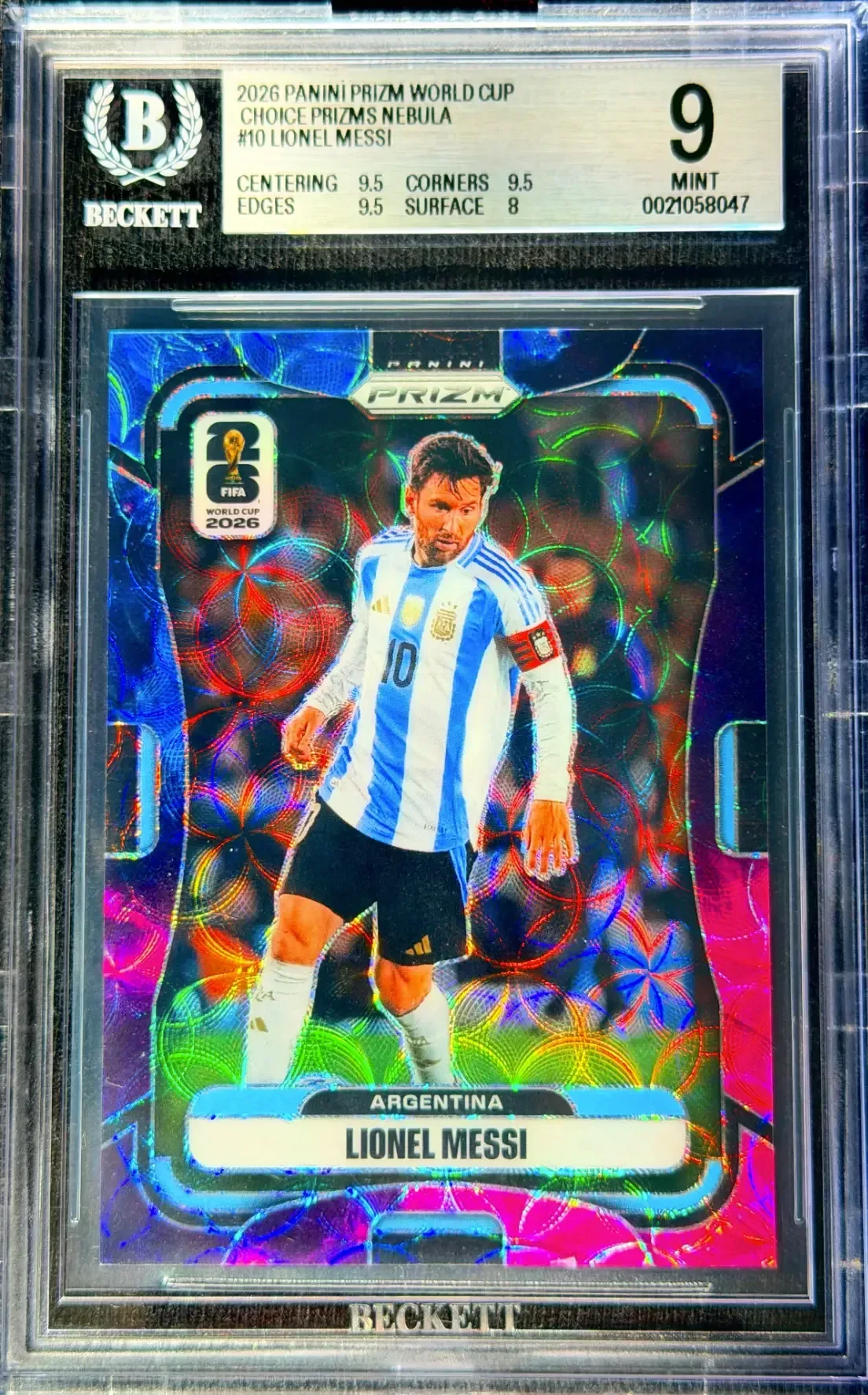
1. 2026 Panini Prizm Choice Prizms Nebula /1 Lionel Messi BGS 9 — $1,250,000
The headline sale was a 2026 Panini Prizm Choice Prizms Nebula Lionel Messi numbered /1. In straightforward terms, “/1” denotes that the card is identified as the sole copy in that parallel. It sold privately for $1.25 million on October 9 and is housed in a BGS 9 holder.
Modern one-of-one cards can appear deceptively simple on a checklist: a player, a branded set, a parallel name and a serial number. But their appeal depends heavily on the exact combination. Here, the selling point is not merely Messi’s presence or the Prizm name. It is the particular Nebula parallel, its declared single-copy status, and the BGS 9 grade attached to this individual card.
A grade of 9 is a third-party assessment of the card’s condition, not a declaration that every copy of the card type would carry the same value. With a one-of-one, there is no direct same-parallel population of comparable serial-numbered siblings. That means buyers and observers must be precise about what the result establishes: it is a reported price for this Messi Nebula BGS 9, on this date, in a private sale. It should not be treated as an automatic price guide for every Messi card, every Prizm Choice card, or even every future modern soccer one-of-one.
Still, it is a substantial data point. The sale placed Messi at the top of a week otherwise crowded with historically important baseball material and a key early Prizm Curry parallel.
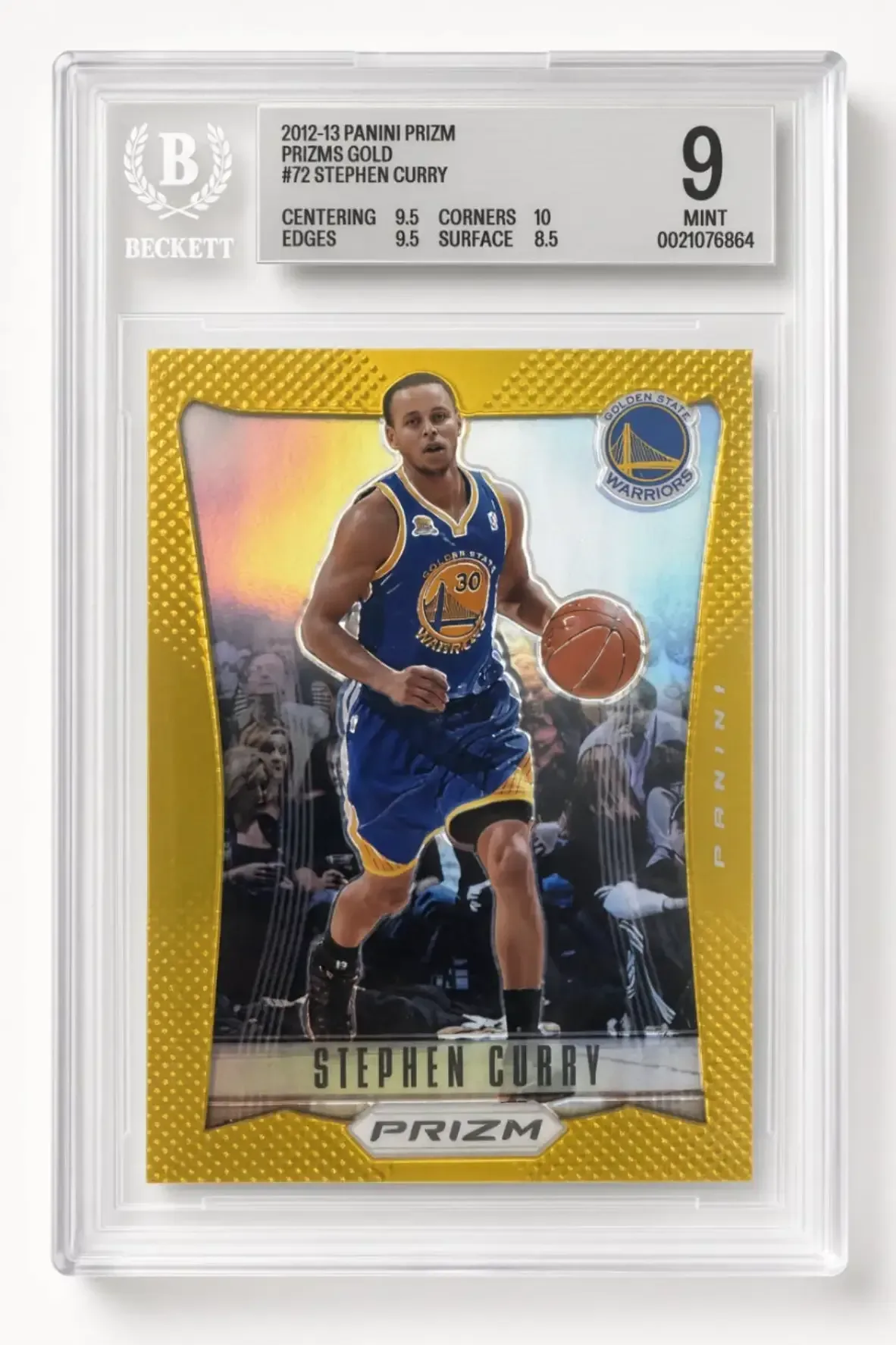
2. 2012–13 Panini Prizm Stephen Curry Gold /10 BGS 9 — $1,017,202.20
Second place went to a 2012–13 Panini Prizm Stephen Curry Gold /10 graded BGS 9, reported sold privately for $1,017,202.20. The “Gold /10” designation means the parallel is limited to 10 numbered copies, a scarce but fundamentally different proposition from the Messi card’s one-copy Nebula designation.
Related coverage includes Messi Nebula 1/1 Leads Week’s $1M Sports Card Sales.
Its year matters within the information available: 2012–13 is identified as Prizm’s first year, giving the card an additional collecting hook beyond Curry and the Gold parallel. Set chronology often becomes part of an item’s appeal. A first-year product can acquire special significance among collectors because it anchors the beginning of a recognizable brand line. That does not remove the need to evaluate the exact card, grade and transaction, but it helps explain why the card is treated differently than a generic later-year parallel.
The prior comparison cited for this card is a PSA 9 sale in 2023 at $114,000. That comparison needs careful handling. It is not a like-for-like repeat sale: the newer reported result is for a BGS 9, while the earlier figure involved a PSA 9. Grading companies use their own standards and labels, so the two holders are not interchangeable simply because both display a numerical 9. The result does show a sharp contrast between the two reported figures, but it cannot isolate a single cause for the difference.
The private sale was reported as verified through evidence of a completed wire transfer and supporting direct messages from the seller and buyer. That is useful disclosure, particularly because private deals do not generate the same public bidding trail as an auction. At the same time, a collector building a comp sheet should label it accurately as a reported, privately completed transaction rather than blending it uncritically with hammer-price records.
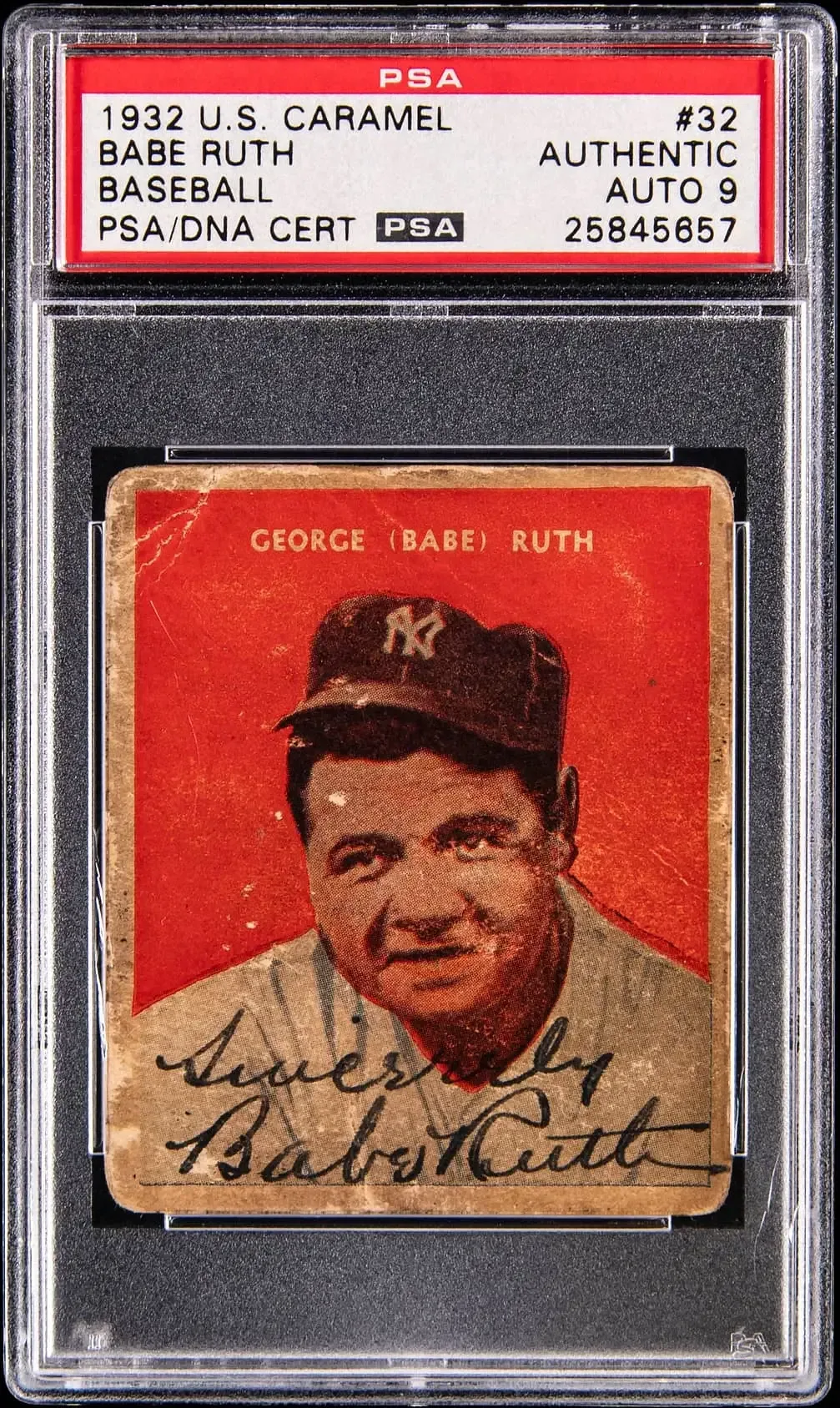
3. 1932 U.S. Caramel Babe Ruth #32, PSA Authentic/Auto 9 — $976,000
A signed 1932 U.S. Caramel Babe Ruth #32 took third at $976,000 in an October 10 auction. The holder designation, PSA Authentic/Auto 9, conveys two separate ideas. “Authentic” refers to the card’s authenticity designation, while “Auto 9” identifies the autograph’s grade. It should not be casually read as a conventional PSA 9 card grade.
The card’s special claim is unusually narrow and powerful: it is described as the only known signed U.S. Caramel Babe Ruth card, and as the only known signed U.S. Caramel card of any player. If those descriptions hold, its value case is based on more than Ruth’s enduring prominence. It occupies a one-of-one space created by the surviving signed example, combining a famous player, a 1932 issue and a signature on a card from that set.
This is a useful reminder that “one-of-one” is not always printed on a modern serial number. The Messi Nebula is a manufacturer-designated /1. The Ruth is treated as unique because no other signed U.S. Caramel example is known. Those are different forms of rarity. The former comes from production designation; the latter rests on known surviving examples and authentication. Both can command enormous attention, but collectors should avoid treating their scarcity claims as mechanically equivalent.
The $976,000 result finished just below the seven-figure mark. More importantly, it shows how an autograph can transform the way a vintage card is evaluated. Condition remains relevant, but the autograph’s authenticity, grade and apparent singularity become central to the card’s identity.
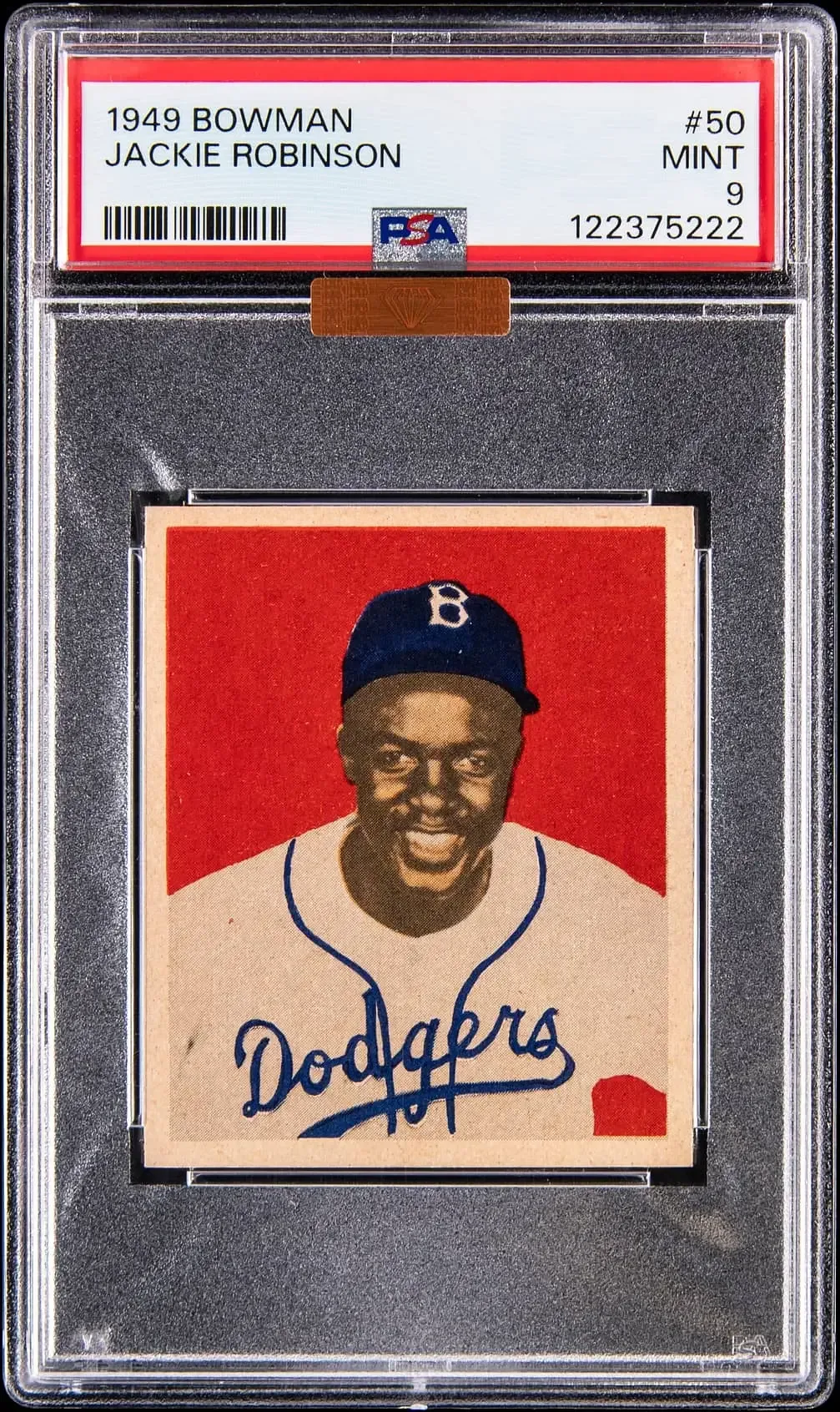
4. 1949 Bowman Jackie Robinson #50 PSA 9 — $518,500
A 1949 Bowman Jackie Robinson #50 in a PSA 9 holder sold for $518,500 at auction on October 10. This sale is the clearest example on the list of the premium attached to condition scarcity in a vintage card.
The PSA 9 population is listed at 13, with no PSA 10 copies. Separately, there is said to be one SGC 10, described as the only gem-grade example. “Population” or “pop” refers to the count of examples a grading company has recorded at a specified grade. It is an important research tool, but it is not a complete census of every card in existence. It tracks cards submitted to that company and recorded in its system; raw copies and cards graded elsewhere are outside a single company’s population count.
That distinction matters here. Saying there are 13 PSA 9s accurately describes the reported PSA population, while the mention of an SGC 10 demonstrates why a collector must note the grading company alongside the number. A 9 or 10 is not free-floating information. The label, the service and the exact grade category are all part of the card’s market identity.
Robinson’s 1949 Bowman #50 is therefore being evaluated through a particularly demanding lens: historical significance, a recognized vintage issue and a high condition grade in a field where the cited PSA population has no 10s. The result does not require an unsupported claim about what every Robinson card is worth. It shows the premium the market assigned to this specific PSA 9 example at this auction.
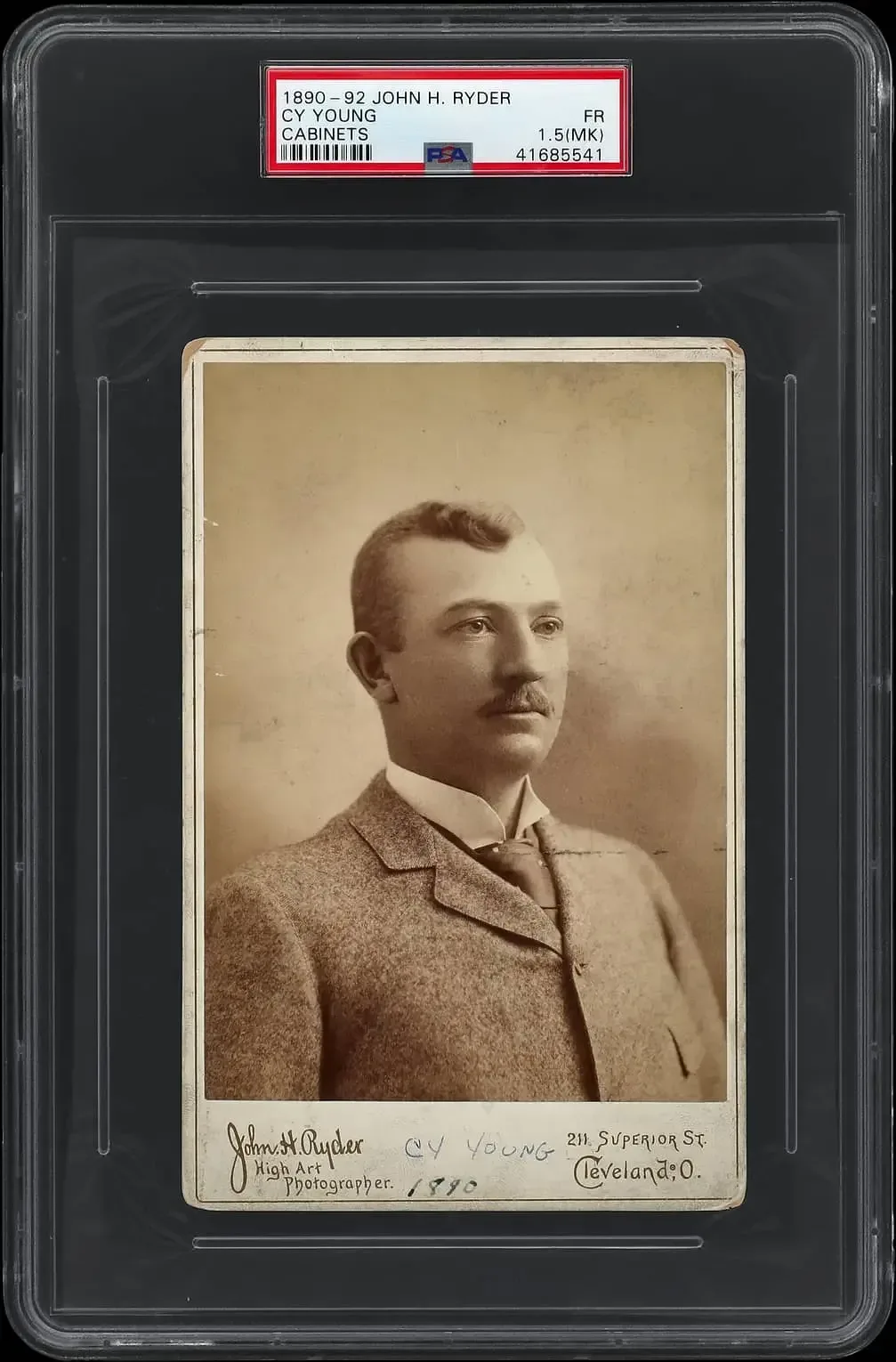
5. 1890–92 John H. Ryder Studio Cabinet Cy Young PSA 1.5 — $427,000
Rounding out the five is an 1890–92 John H. Ryder Studio Cabinet Cy Young graded PSA 1.5, which sold for $427,000 on October 10. Calling it a card is convenient, but its format is notably different from the later trading cards elsewhere in the ranking. It is a studio cabinet, a photographic collectible whose historical identity and apparent uniqueness loom far larger than the low numerical condition grade.
It is described as a true one-of-one, with the uniqueness claim characterized as irrefutable. Unlike a current card with a printed serial number, this sort of uniqueness is tied to the survival and identification of a historical artifact. The item’s status makes it a poor candidate for ordinary grade-based comparisons. A PSA 1.5 might sound modest next to PSA 9, BGS 9 or an autograph graded 9, but those labels measure different attributes across dramatically different formats and eras.
The cabinet had previously sold for $500,200 in June 2024. At $427,000, the October 2026 result is $73,200 lower than that cited prior sale. Two sale points do not create a broad trend, particularly for an artifact presented as unique. With no interchangeable second copy, a subsequent result may reflect the specific buyer pool, auction setting, timing or other circumstances that cannot be inferred from the numbers alone. What can be said is simple: the piece returned to public auction and changed hands at a lower reported price than its 2024 result.
What this week’s five sales actually show
The ranking is a compact lesson in why headline price alone is inadequate for collecting analysis. Messi’s $1.25 million result came from a modern BGS 9 one-of-one private sale. Curry’s seven-figure deal concerns a /10 Gold parallel from Prizm’s first year and was also private. Ruth’s auction result centers on an authenticated, highly graded autograph with a singular known-example claim. Robinson’s result highlights high-grade scarcity within a vintage issue. Cy Young’s cabinet is a unique photographic piece whose historic importance outstrips any attempt to compare its 1.5 directly with a modern mint-condition grade.
- Record the exact card: year, brand, subset or parallel, card number, serial number and player all matter.
- Read every part of the holder: card grade, authentication designation and autograph grade can refer to different things.
- Separate auction sales from private reports: both may be meaningful, but their documentation and visibility differ.
- Use population data carefully: a grading-company count is not necessarily the full surviving population.
- Do not force unlike-for-like comparisons: BGS 9, PSA 9, PSA Authentic/Auto 9 and PSA 1.5 describe different cards and, in some cases, different grading frameworks.
The week’s order is clear: Messi first, Curry second, Ruth third, Robinson fourth and Cy Young fifth. The more useful takeaway is that the hobby’s highest reported sales are being driven by several routes to significance at once—modern serial-numbered scarcity, early-product status, vintage condition rarity, authenticated signatures and historically singular artifacts.