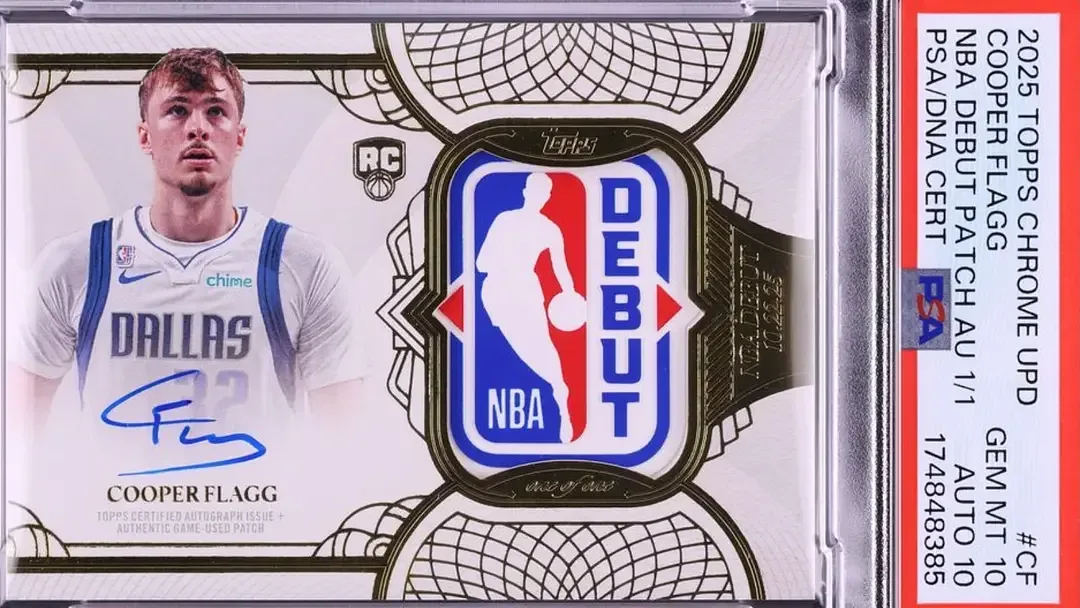
The sports-card market produced an eye-catching concentration of major results on September 25 and 26, 2026, led by a 2025 Topps Chrome Update Cooper Flagg NBA Debut Patch Auto 1/1 that sold for $8,040,000. The card carries PSA 10 and Autograph 10 grades, and its result alone accounts for nearly half of the reported value across six notable sales.
That six-card group totaled $17,917,700. Even removing an additional Shohei Ohtani card presented as a bonus entry, the five primary sales reached $17,107,700. The list brings together three current NBA rookie patch-autograph one-of-ones, two Ohtani cards from very different eras and formats, and a signed 1933 Babe Ruth issue. It is a useful snapshot of what the high end of the hobby is rewarding: singular cards, athlete signatures, memorabilia connections, condition, and—in one case—an unredeemed claim to a card rather than the physical card itself.
The six reported sales
- 2025 Topps Chrome Update NBA Debut Patch Auto 1/1 Cooper Flagg, PSA 10 / Auto 10 — $8,040,000, September 25 through Fanatics Premier Auction.
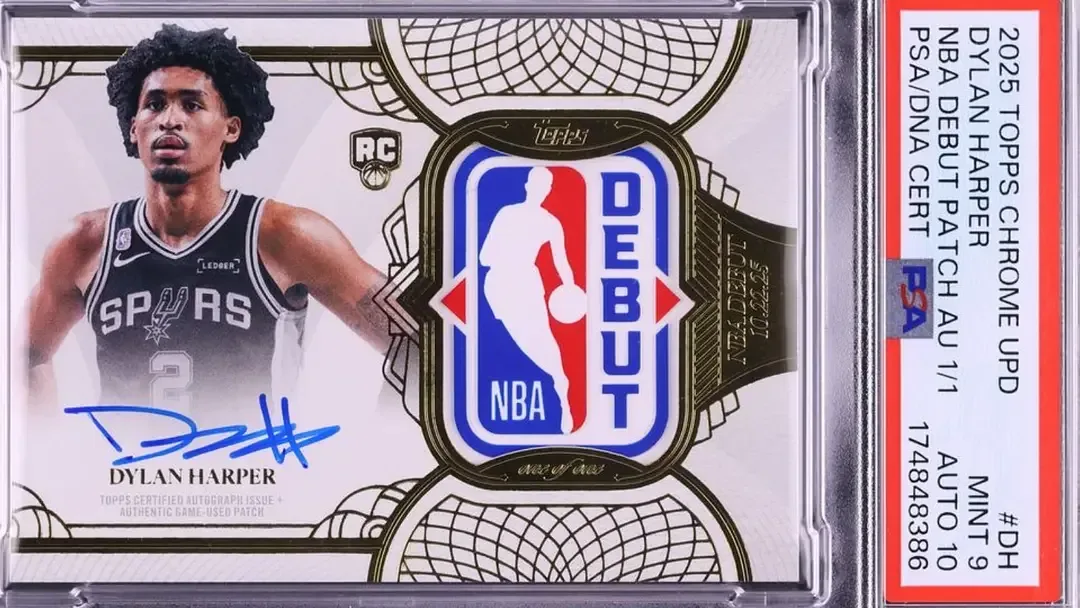
- 2025 Topps Chrome Update Dylan Harper NBA Debut Patch Auto 1/1, PSA 9 / Auto 10 — $2,880,000, September 25 through Fanatics Premier Auction.
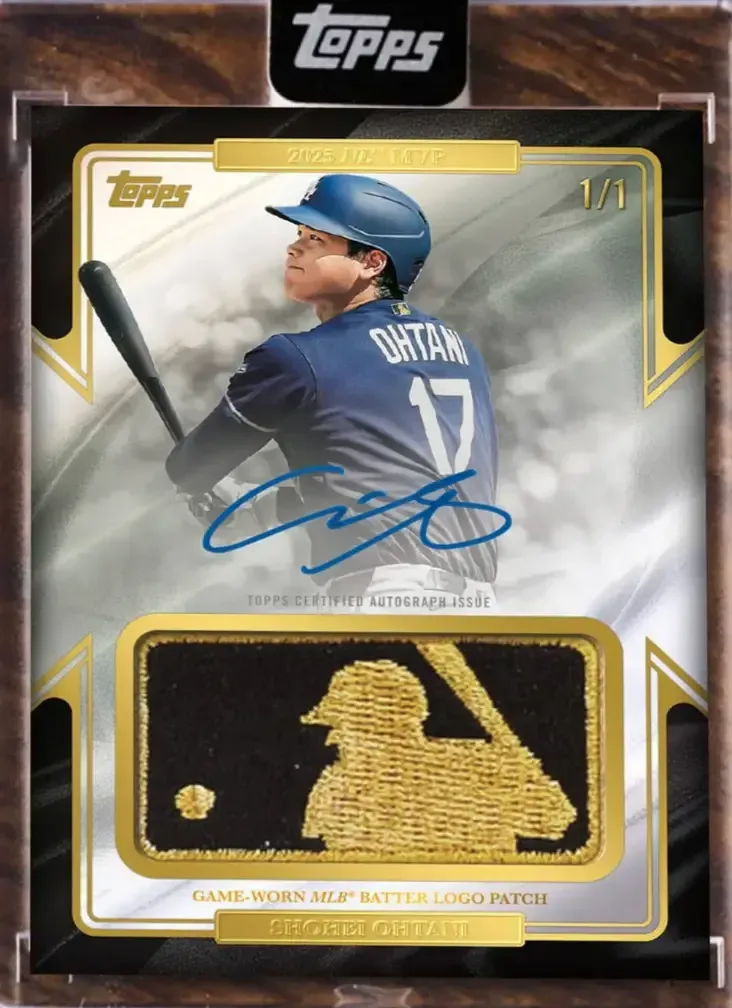
- 2026 Topps Chrome Gold MLB Logoman Auto 1/1 Shohei Ohtani, an unused redemption card — $2,848,700, September 26 through Goldin Auctions.
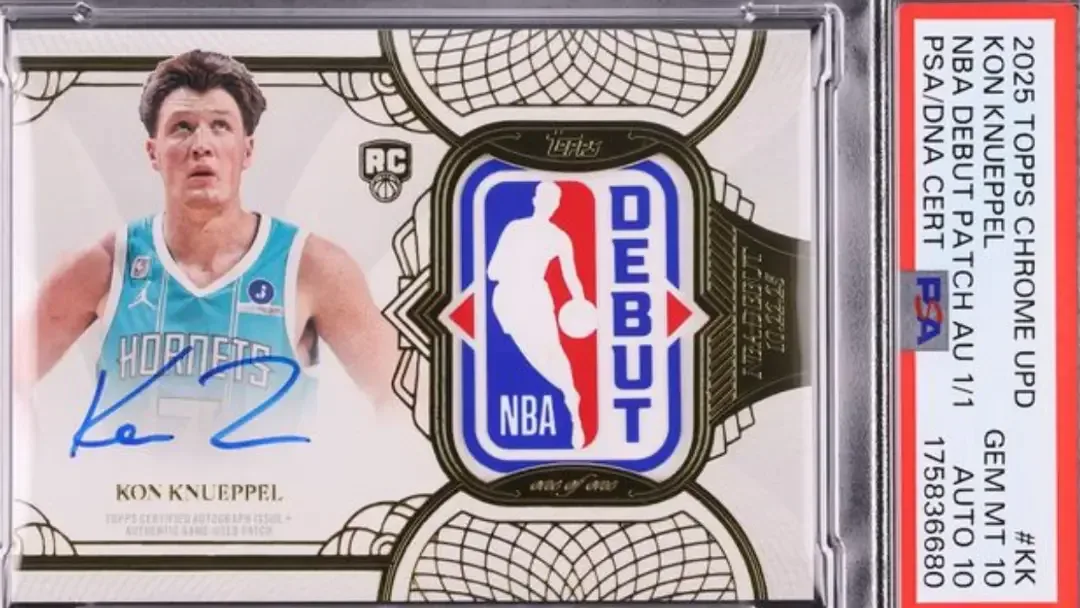
- 2025 Topps Chrome Update Kon Knueppel NBA Debut Patch Auto 1/1, PSA 10 / Auto 10 — $2,340,000, September 25 through Fanatics Premier Auction.
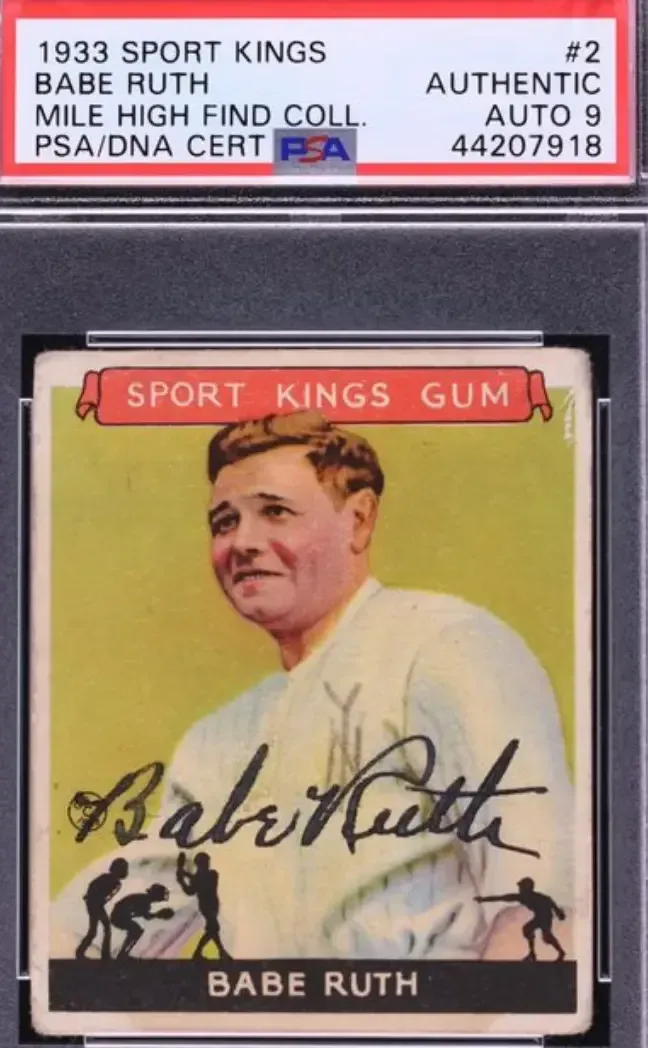
- 1933 Sport Kings Babe Ruth #2 Auto, PSA Authentic / Auto 9 — $999,000, September 25 through Fanatics Premier Auction.
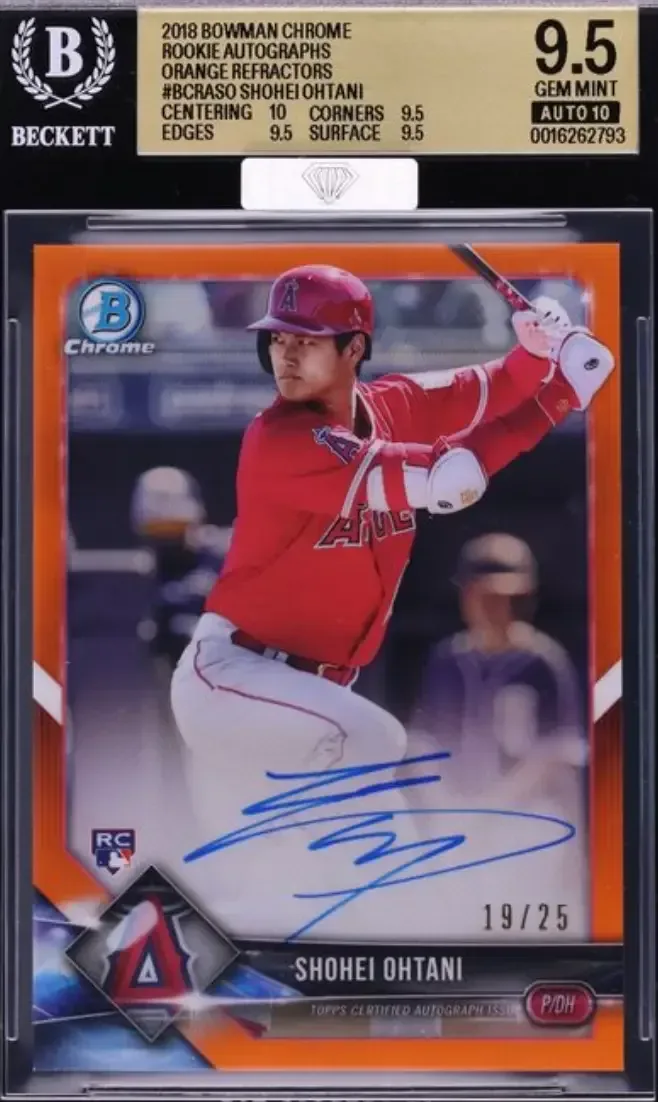
- 2018 Bowman Chrome Orange Refractor Auto /25 Shohei Ohtani, BGS 9.5 / Auto 10 — $810,000, September 25 through Fanatics Premier Auction.
The first five entries form the principal group, while the 2018 Ohtani Orange Refractor was included as an extra sale. The distinction matters when discussing the headline total: “more than $15 million for five cards” is accurate for the primary five, but the full set of reported transactions approaches $18 million.
Why the Flagg card stands apart
Flagg’s result dwarfs the other individual sales. At $8.04 million, it exceeded the combined prices of the Harper, Ohtani Logoman and Knueppel cards, which together reached $8,068,700, by only $28,700. That is an unusually sharp illustration of how the marketplace can value a particular combination of player, rookie status, card format and scarcity.
The card is a 1/1, meaning it is designated as the sole copy of that specific version. In modern card collecting, that label is central: there may be other Flagg cards, including other autographs, parallels or memorabilia cards, but no second card carrying this exact one-of-one configuration. Its NBA Debut Patch designation also ties the card’s memorabilia component to Flagg’s first NBA game. The supplied sale details identify it as a patch-auto card, so it pairs that game-worn patch element with a signed card.
PSA’s 10 grade for the card and 10 grade for the autograph add another pair of distinctions. In plain terms, the numerical card grade refers to the condition assessment assigned by the grading company, while the autograph grade assesses the signature. Grades do not create rarity, and a grade does not change the player or the patch’s event association. They can, however, give buyers a standardized description of condition when bidding on a card at this scale.
The $8.04 million result is reported as the fifth-highest sports-card sale of all time. That ranking places the transaction in territory typically reserved for the hobby’s largest landmark sales, while also making it a major modern-card result rather than solely a vintage one.
NBA debut patches account for three enormous prices
Flagg was not alone. The same 2025 Topps Chrome Update NBA Debut Patch Auto format produced $2.88 million for Dylan Harper and $2.34 million for Kon Knueppel. Together, the three NBA rookie cards generated $13.26 million, roughly 74% of the six-card total.
Related coverage includes Cooper Flagg’s $8.04M Debut Patch Headlines $17M Week in Card Sales.
Harper’s one-of-one received PSA 9 for the card and Autograph 10 for the signature. The reported description identifies the patch on the right side as one Harper wore in his first NBA game. Knueppel’s card received PSA 10 / Auto 10. All three are therefore closely related as a category—rookie-era, signed, one-of-one cards with NBA debut-worn patch material—while retaining their own player identities and grading outcomes.
It is important not to flatten those distinctions. A one-of-one patch autograph is a highly specific collectible object, but it is not a universal price guide for every rookie card, every autograph, or every patch card. The three sales show demand for these exact flagship-level cards, not a guaranteed value for adjacent products. For collectors, that is the practical lesson beneath the giant totals: the attributes supporting a headline auction result must be identified precisely before using it as a comparison.
A quick glossary for the patch-auto shorthand
- Patch auto: A card that combines a piece of memorabilia material, such as a jersey patch, with an autograph.
- NBA Debut Patch: In these reported examples, a patch worn by the player during his first NBA game.
- 1/1: A one-of-one card, identified as the only copy of that exact version.
- PSA 10 / Auto 10: Separate top grades for the card’s condition and the autograph. Harper’s card, by contrast, was PSA 9 / Auto 10.
- Refractor: A parallel treatment used on cards such as Ohtani’s 2018 Bowman Chrome Orange Refractor; the supplied information identifies that Orange version as numbered to 25.
Ohtani’s two-card presence spans a physical card and a redemption
Shohei Ohtani appears twice, but the two results represent very different kinds of modern-card desirability. The highest was a 2026 Topps Chrome Gold MLB Logoman Auto 1/1, sold as an unused redemption card for $2,848,700. A redemption is a card or code that entitles its holder to claim a promised item. Here, the auctioned item was the unused redemption itself, a distinction prospective buyers and collectors should read carefully in any comparable listing.
The eventual card is described as featuring a Gold MLB Logoman and recognizing Ohtani’s 2025 National League MVP award in gold. Topps states that Gold MLB patches can be worn by players who have earned major awards including MVP, Cy Young or Rookie of the Year. The one-of-one designation, autograph and award-linked Logoman form the core of the card’s appeal as described, though the reported sale concerns the unredeemed claim.
The other Ohtani entry was far more established as a physical issue: a 2018 Bowman Chrome Orange Refractor Auto /25, graded BGS 9.5 with an Autograph 10. It sold for $810,000. The “/25” means the Orange Refractor version was limited to 25 copies, a low serial number but fundamentally different from a 1/1.
A useful nearby comparison exists within Ohtani’s own Bowman Chrome autograph run. A Blue Refractor numbered to 150 sold for $390,400 on September 19, 2026. That does not establish a simple multiplier for every color parallel—the colors, print runs, grades and individual cards differ—but it gives collectors a concrete example of why serial-numbered scarcity is only one piece of a card’s auction profile. The Orange card’s /25 print run, BGS 9.5 grade and Autograph 10 all belong in any careful comparison.
For more baseball-focused context around current-market players, see four pitcher cards to watch as the 2026 MLB postseason nears.
Ruth supplies the vintage counterpoint
The most historical item in the group is the 1933 Sport Kings Babe Ruth #2 Auto, which sold for $999,000. It is authenticated by PSA, with the autograph graded 9. At 93 years old as described in the sale details, it offers a contrast to the NBA rookie cards and recent Ohtani releases: the value proposition is not a modern debut-patch format or a current award inscription. It is a signed relic from a 1933 issue featuring one of baseball’s defining figures.
Its placement beside the 2025 and 2026 cards is a reminder that “high-end sports cards” is not one uniform market. Vintage signed material and modern ultra-limited cards can share an auction list while drawing interest for different reasons. The Ruth card sold for less than $1 million; that should not be misread as making it less historically important than the newer issues. It simply reflects the reported outcome for this particular authenticated, signed example in this particular sale.
What collectors should take from a $17.9 million cluster
The headline is spectacular, but its most useful takeaway is specificity. The NBA cards were not ordinary rookies; they were debut-patch autograph one-of-ones. Ohtani’s top result was an unused redemption for a one-of-one, award-associated Logoman autograph, while the other was a limited Orange Refractor autograph with named grades. Ruth’s card was a vintage signed Sport Kings issue authenticated by PSA.
That makes broad statements such as “rookie cards are worth millions” or “Ohtani cards doubled” poor reading of the data. The transactions are evidence of strong bidding for six unusually distinctive cards. They are not evidence that every card connected to these players, sets, manufacturers or parallel colors will behave the same way.
For collectors watching auctions, the checklist is straightforward: verify whether the listing is a physical card or a redemption; distinguish a serial-numbered parallel from a true one-of-one; read card and autograph grades separately; and identify exactly what makes memorabilia special, such as a player’s NBA debut. Those details are not fine print at this level. They are the product.
In this case, the result is clear. Flagg’s $8.04 million card commands the spotlight, but the broader story is the unusually dense mix of modern basketball one-of-ones, Ohtani scarcity and a signed Ruth artifact. Six cards, two days, and nearly $18 million in reported sales make for a remarkable high-end moment in sports collecting.