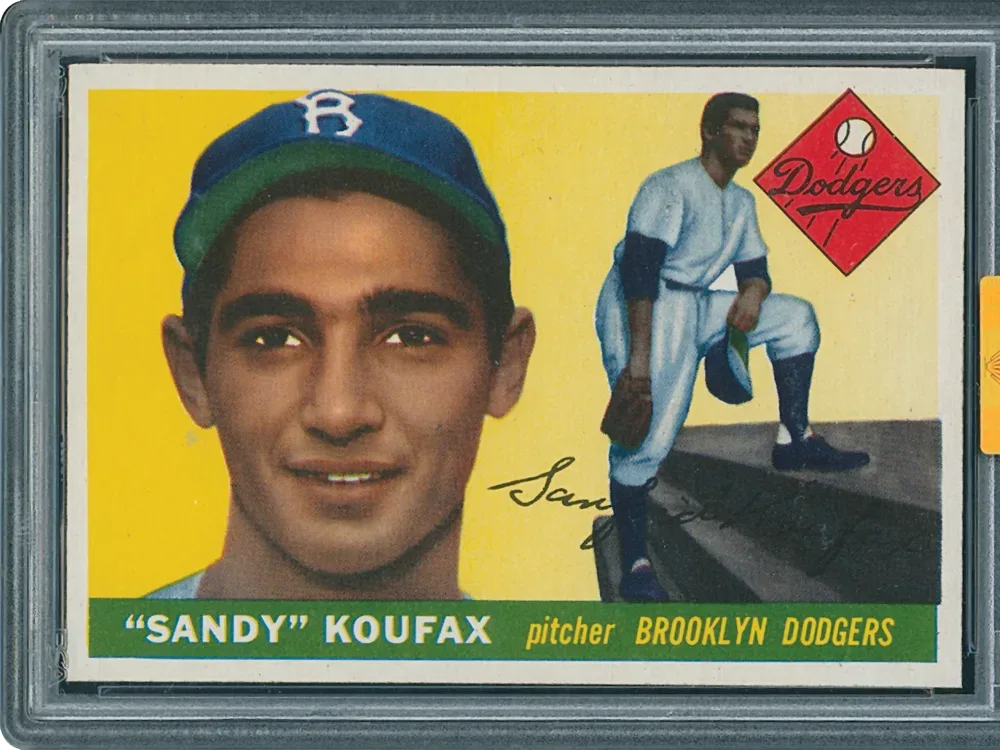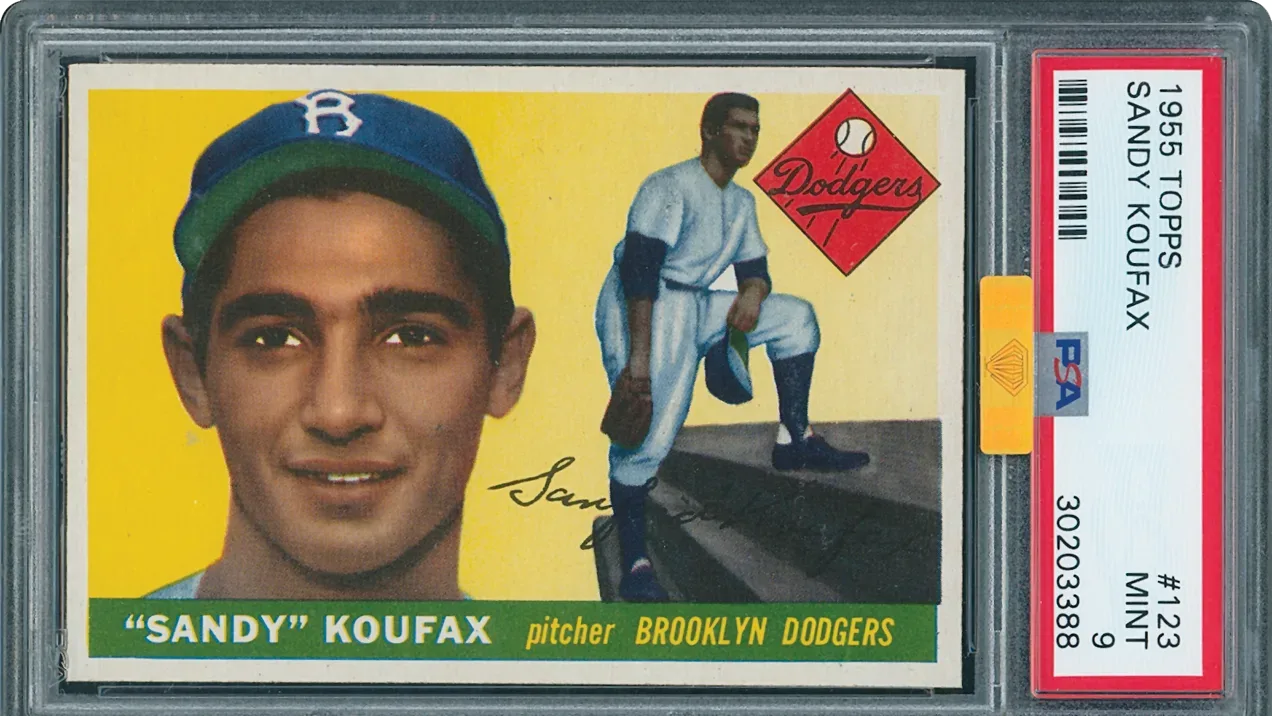
A 1955 Topps Sandy Koufax rookie card graded PSA 9 has sold for $604,736, establishing a new public-sale record for the card. The result was the leading lot in a summer rarities auction that generated more than $7.5 million in total sales.
The price overtakes the prior public record of $396,000, set in 2022. For collectors, the gap between those two figures is as striking as the card itself: it is a clear reminder that elite-condition examples of foundational postwar baseball cards can occupy an entirely different market tier from more commonly encountered copies.
The record-setting Koufax result arrived in an auction full of vintage baseball material, from 19th-century tobacco issues to postwar rookie cards and unopened product. Several lots set category records of their own, while a signed Michael Jordan rookie card and a sealed Chicago Bulls team bag showed that the strongest bidding was not limited to baseball.
Why the Koufax card carries such weight
Koufax’s on-field standing is central to the appeal. The Hall of Fame left-hander delivered a 4-3 record, a 0.95 ERA and 61 strikeouts across 57 innings in eight World Series appearances. Those postseason numbers offer an especially compact case for his reputation: an ERA, or earned run average, measures earned runs allowed per nine innings, so a 0.95 mark across that many World Series innings is exceptional.
For more context, explore Control Resonant FBC Terminal Answers: Every Reply Gives the Same Reward.
His 1955 Topps card is also his rookie card, the first mainstream issue associated with a player’s major-league career and a designation that commonly gives a card added collector significance. The $604,736 example received a PSA 9 grade. PSA grades cards on a 10-point scale; a 9 is generally described as mint, while a 10 represents gem-mint condition. That distinction is not cosmetic in an auction catalog. Centering, corners, edges, surface quality and print presentation can all separate an excellent vintage card from one that buyers regard as elite.
Importantly, the result is a record for a public sale. That wording matters because it identifies the comparison being made: published sales in an open auction environment, rather than an undisclosed private transaction. It does not mean every Koufax rookie sells anywhere near this figure. It demonstrates the premium commanded by this specific, high-grade copy in a competitive sale.
A sale defined by grade, scarcity and baseball history
The auction’s other baseball results help illustrate how those variables interact. A 1971 Topps #630 Roberto Clemente graded PSA 9 realized $170,579, a record for that card. A 1923 W515-1 #47 Babe Ruth, hand-cut and graded PSA 10, brought $137,582. A blank-back 1916 M101-4 Sporting News #87 Joe Jackson in PSA 7 sold for $134,579.
“Blank-back” describes a card with no printing on its reverse, a production variation that can have major importance to specialists. The hand-cut Ruth likewise belongs to a format where the physical presentation of the individual item matters greatly. These lots are not directly interchangeable with a standard, factory-cut Topps card, but they make the broader point: age alone does not set value. Card issue, player, configuration, condition and buyer demand all work together.
Other high-profile vintage baseball lots included a 1938 Goudey Heads Up #274 Joe DiMaggio in PSA 8 at $108,665; a 1939 Play Ball #92 Ted Williams rookie in SGC 8.5 at $68,256; and a 1934 Goudey #1 Jimmie Foxx in PSA 8 at $39,832. SGC is another third-party grading company, and its numerical scale serves a similar basic purpose: providing an independent assessment of a card’s condition.
The auction also reached further back. An 1888 N28 Allen & Ginter Cap Anson, PSA 8, realized $53,479. An 1888 N162 Goodwin Champions Beecher card graded SGC 1 sold for $19,031, while a 1933 Goudey #160 Lou Gehrig in SGC 3 brought $20,011. The grades on the Beecher and Gehrig cards are a useful corrective to the idea that only near-perfect specimens attract major bids. For genuinely old and difficult material, historical rarity and survival can remain compelling even when condition is modest.
Postwar icons supplied depth beyond Koufax
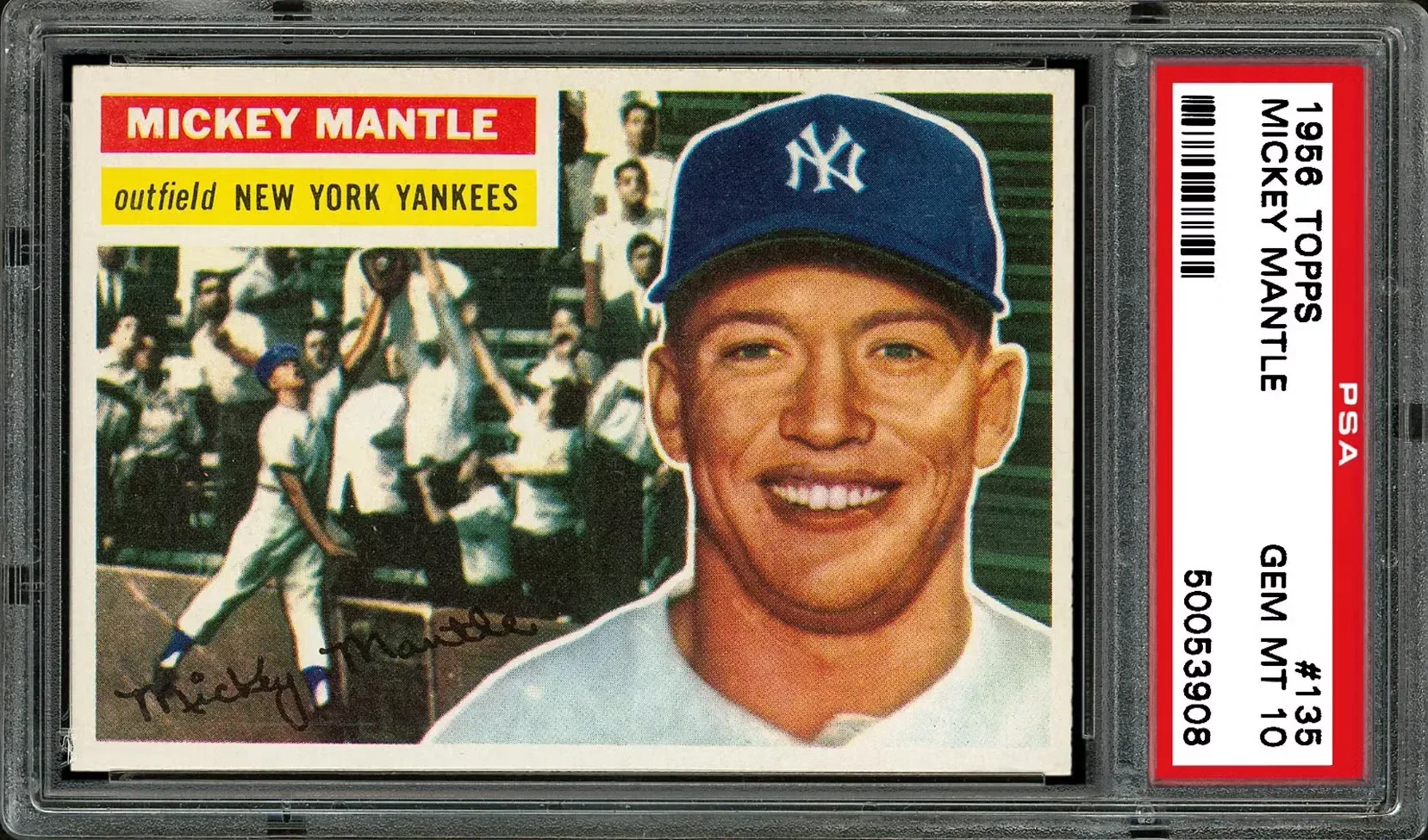
The postwar selection was equally loaded with major names. A 1951 Bowman #253 Mickey Mantle graded PSA 7 sold for $125,794, and a 1951 Bowman #305 Willie Mays rookie, also PSA 7, reached $105,888. A 1954 Topps #128 Hank Aaron rookie in PSA 8 realized $66,496.
A 1950 Bowman #22 Jackie Robinson in PSA 8 set a record at $68,256. The same release produced two further record prices: a PSA 9 Bob Feller at $20,188 and a PSA 9 Ralph Kiner at $24,427. These figures reinforce a practical reality for vintage-card collectors: the set and player matter, but high-grade condition can create substantial separation within a single year’s release.
Further results included a 1959 Topps #10 Mantle in PSA 8.5 at $56,153; a 1963 Topps #390 Aaron in PSA 9 at $37,027; a 1964 Topps #440 Clemente in PSA 9 at $31,613; and a 1954 Topps #201 Al Kaline rookie in PSA 8.5 at $21,494.
The 1970s cards were no afterthought. A 1975 Topps Mini #223 Robin Yount rookie sold for $43,998, while a 1972 Topps #695 Rod Carew realized $22,054. A 1972 Topps #447 Willie Stargell set a record at $15,035. The word “Mini” identifies the smaller-format Topps issue, an attribute that distinguishes the Yount from the standard-size version collectors may know best.
Memorabilia and sealed product broadened the auction
Cards were only part of the sale. A 1916 Ferguson Bakery group containing 95 of the 97 felt pennants from the set sold for $46,198. The Joe Jackson and Honus Wagner pennants were consigned separately; the Jackson pennant achieved $14,682. A nearly complete set can have its own appeal, because it gives a collector broad representation of an issue while leaving the missing pieces clearly defined.
A BBCE-authenticated 1959 Fleer Ted Williams baseball wax box sold for $39,907. BBCE authentication concerns the evaluation of unopened material. With vintage sealed product, the package is itself the collectible, so confidence about its status is fundamental to buyer interest.
Basketball supplied two more headline results. A signed 1986 Fleer #57 Michael Jordan rookie, graded PSA 5 with a 7 autograph grade, sold for $146,579. The separate grades identify two different assessments: one for the card’s physical condition and one for the signature. Meanwhile, a factory-sealed 1984 Star Chicago Bulls team bag from Jordan’s rookie season reached a record $134,579.
What the results do—and do not—say for collectors
The Koufax record is significant evidence of demand for a premier example of an iconic card, but it is not a universal price guide. A sale at this level reflects the specific card, its PSA 9 grade, its rookie status and competitive bidding in that auction. Collectors assessing another Koufax rookie should avoid treating the headline as a shortcut around condition, authentication, centering and the particulars of the individual copy.
The wider slate of results supports the same measured reading. Record prices appeared at many grades and across many eras, from 1888 cards to 1980s basketball. The common thread is not simply fame. It is the combination of a recognized collectible, a documented format or variation, condition information and enough buyer interest to establish a result.
For the hobby, the $604,736 Koufax is the defining number. For anyone studying the sale, the more useful lesson is the range beneath it: vintage collecting remains highly granular, and careful attention to issue, grade and item type is essential before one record-setting card becomes a benchmark in a collector’s mind.