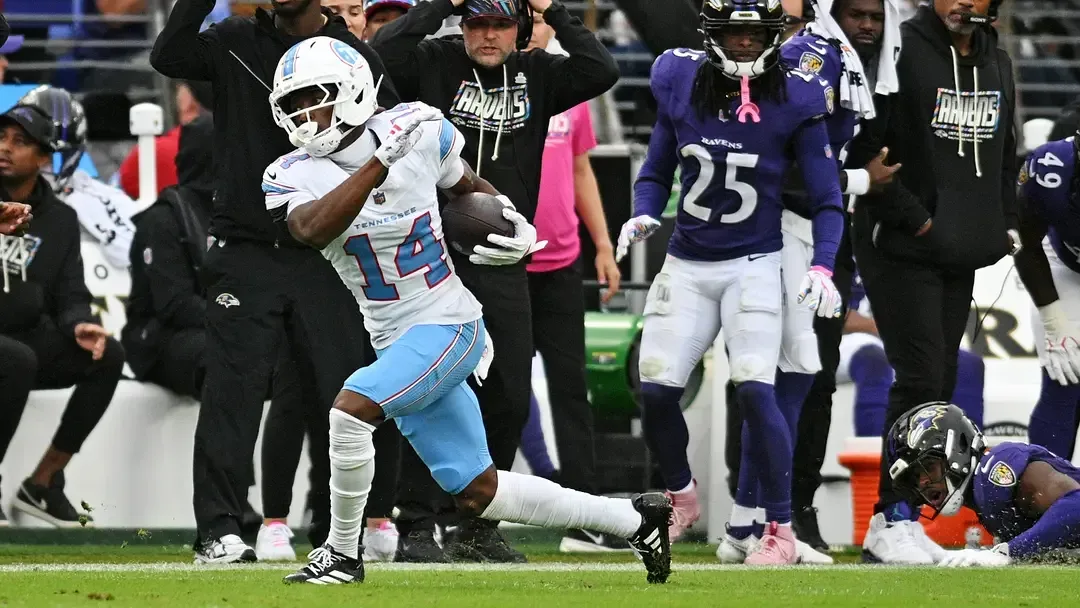
NFL rookie-card interest can change in a single Sunday, but Week 4 offered a more selective lesson: opportunity matters as much as a highlight. Tennessee Titans wide receiver Carnell Tate delivered the clearest movement among the leading names, catching nine of 12 targets for 145 yards against Baltimore. That performance moved him from No. 7 to No. 4 in this week’s rookie-card watch.
The result was important not merely because of the yardage. Tate has drawn 21 targets over his past two games, a workload that begins to establish a repeatable reason for collectors to pay attention. On a Titans offense described as one of the league’s weakest, that does not erase team-context risk. It does, however, give Tate a more useful individual case: he is becoming a visible offensive focal point rather than relying on one isolated big play.
Elsewhere, the upper end of the board is stable. Raiders quarterback Fernando Mendoza remains No. 1, Cardinals running back Jeremiyah Love stays No. 2, and Saints wide receiver Jordyn Tyson holds No. 3 despite a season debut that remains weeks away. The watch list also reflects the complicated reality of buying rookie cards early: availability, playing time, injury uncertainty, team performance and the timing of new products can all matter at once.
Week 4 rookie card watch: the top 20
Tier 1: established hobby attention
- Fernando Mendoza, QB, Raiders — unchanged at No. 1
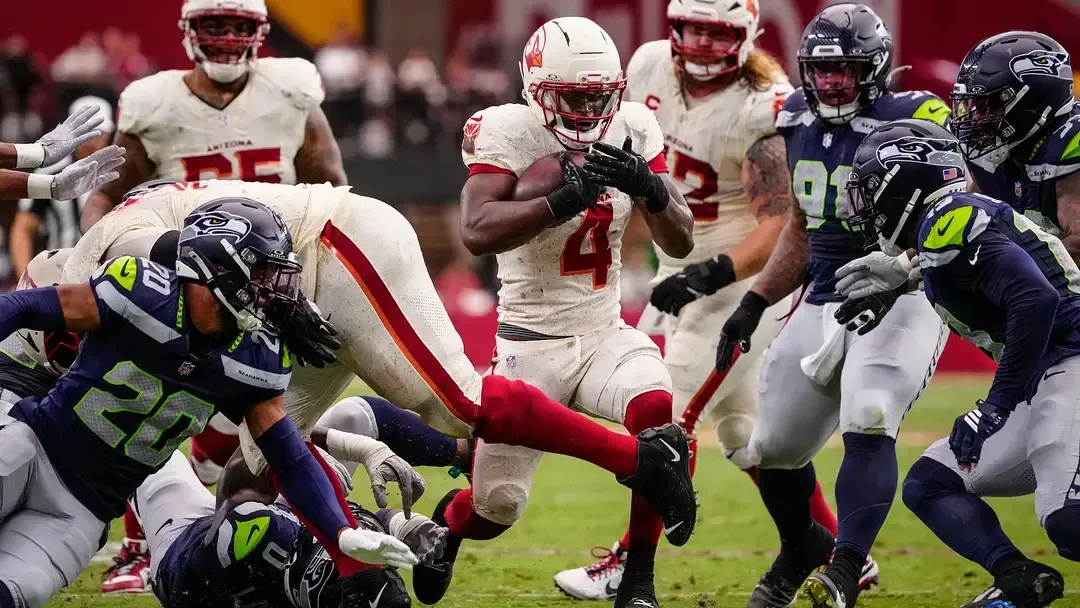
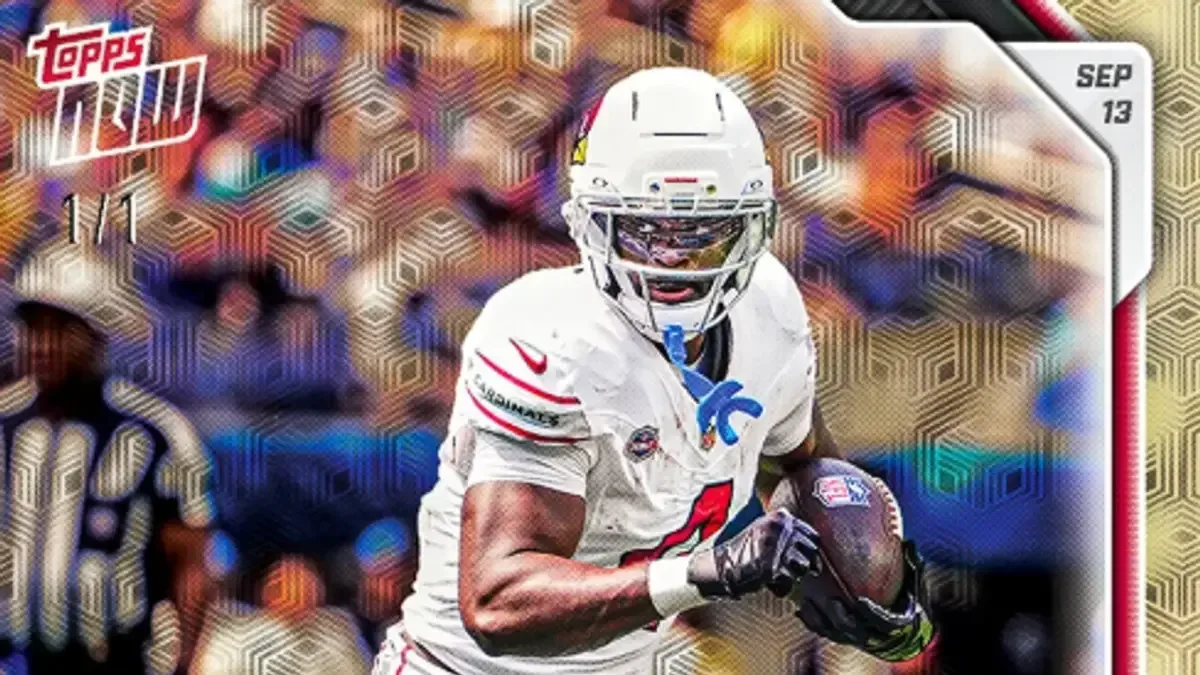
- Jeremiyah Love, RB, Cardinals — unchanged at No. 2
- Jordyn Tyson, WR, Saints — unchanged at No. 3
- Carnell Tate, WR, Titans — up from No. 7
Tier 2: the players seeking a clearer break
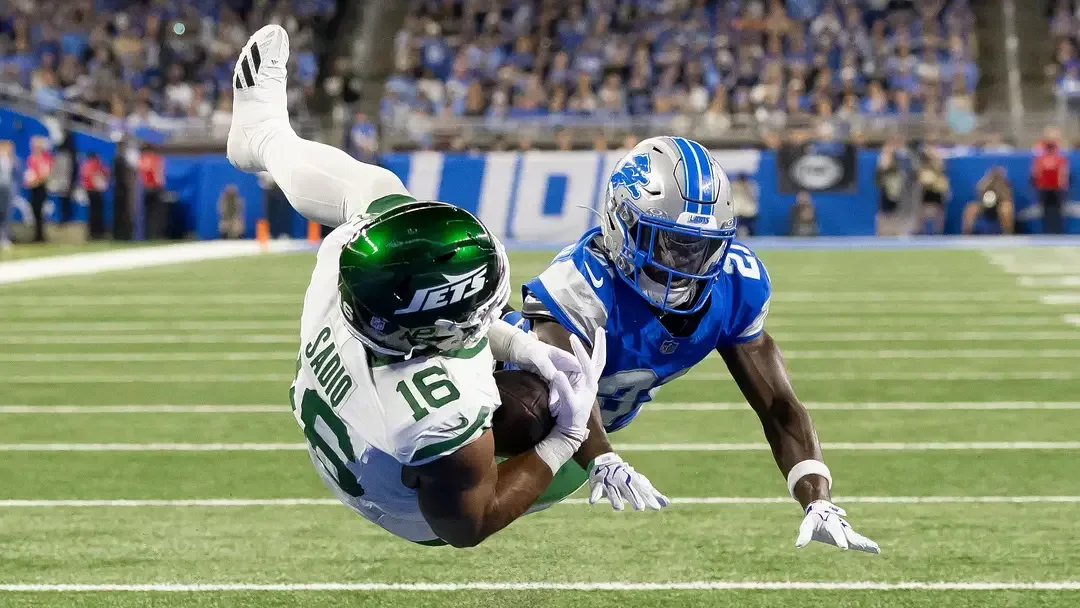
- Kenyon Sadiq, Jets — down from No. 4
- Ty Simpson, Rams — down from No. 5
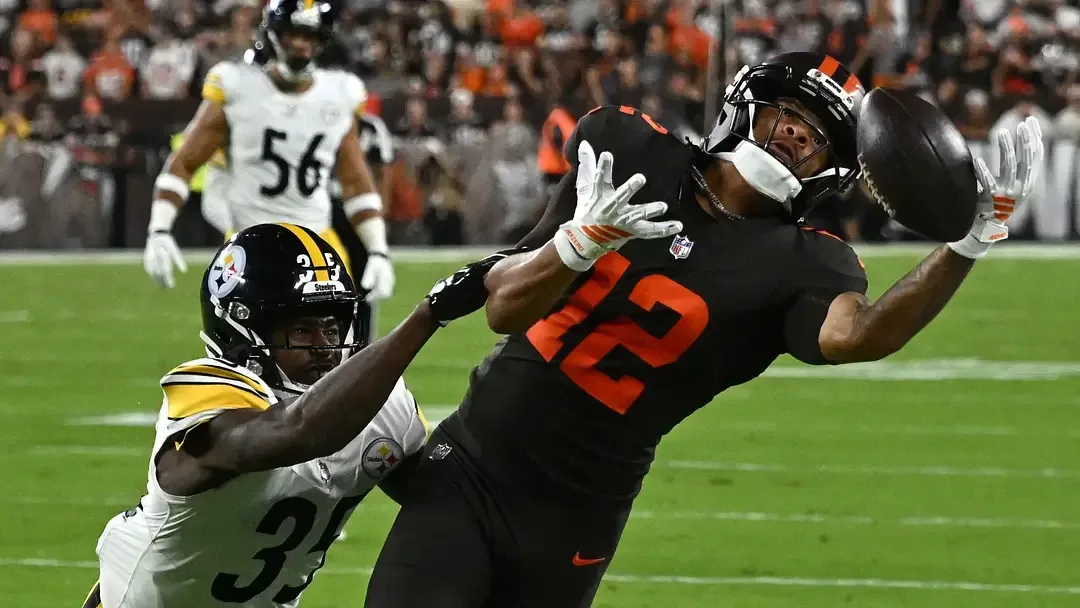
- Denzel Boston, WR, Browns — up from No. 8
- Jadarian Price, RB, Seahawks — down from No. 6
- KC Concepcion, WR, Browns — unchanged at No. 9
- Makai Lemon, Eagles — unchanged at No. 10
Tier 3: speculative choices
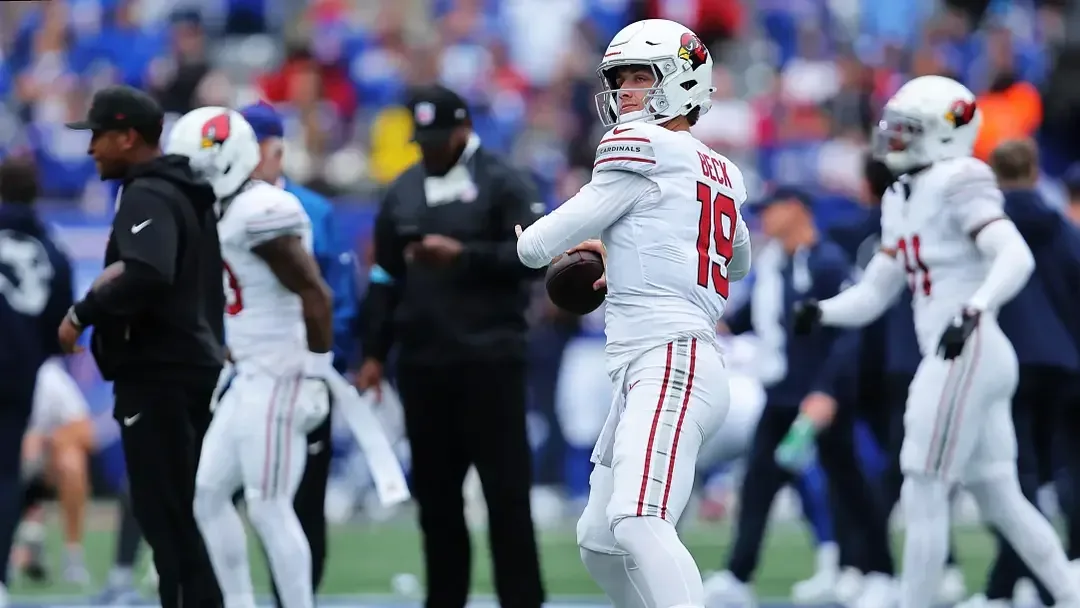
- Carson Beck, QB, Cardinals — unchanged at No. 11
- Ted Hurst, WR, Buccaneers — unchanged at No. 12
- Caleb Douglas, WR, Dolphins — unchanged at No. 13
- Kaelon Black, RB, 49ers — unchanged at No. 14
- De’Zhaun Stribling, WR — up from No. 16
Tier 4: monitor the situation
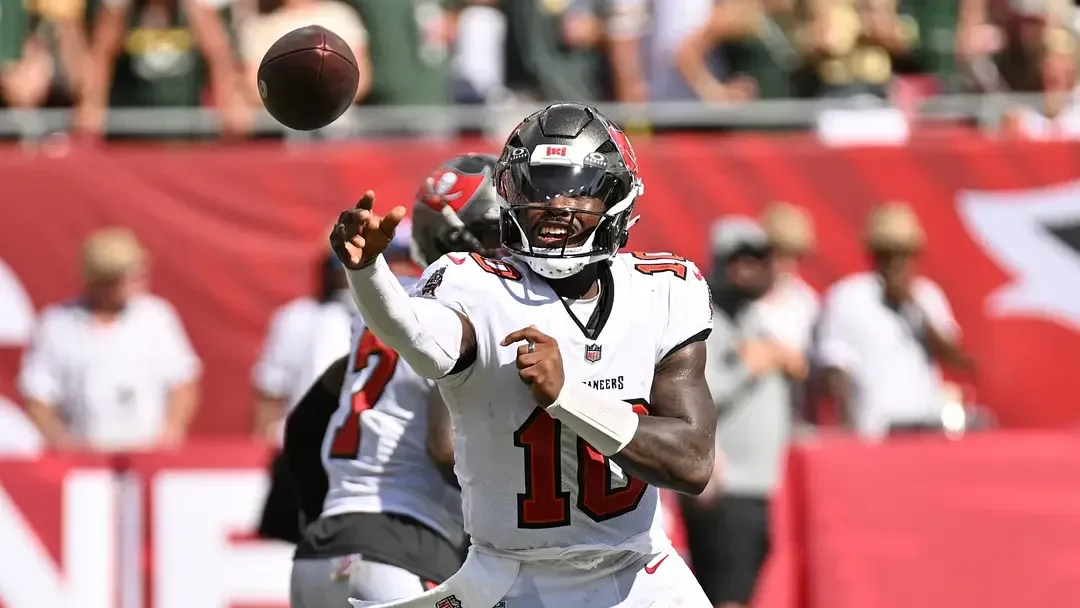
- Jalon Daniels, QB, Buccaneers — up from No. 19
- Sonny Styles, LB, Commanders — unchanged at No. 17
- Arvell Reese, LB, Giants — previously unranked
- Chris Bell, WR, Jets — down from No. 15
- Omar Cooper, WR, Jets — unchanged at No. 20
Why Tate’s Week 4 mattered beyond the box score
Collectors often use the term volume to describe a player receiving regular chances to produce. For a wide receiver, targets are one direct measure of that opportunity. Tate’s nine receptions and 145 yards were notable, but the 12 targets—and 21 over two weeks—supply the more durable part of the argument. Targets are not guaranteed future production, yet they can show that an offense is intentionally putting the player in position to make an impact.
For more context, explore Final Fantasy 7 Revelation’s Day-One Multiplatform Release Signals a New Priority for AAA Games.
The distribution against Baltimore sharpened that point. Wan’Dale Robinson, Calvin Ridley and Elic Ayomanor combined for eight targets, fewer than Tate received by himself. That is only one game, so it should not be treated as a permanent depth-chart ruling. Still, it illustrates why Tate has become the biggest riser: recent usage supports the idea that his role may be growing.
There is a counterweight. The Titans’ overall struggles can limit how much attention even a productive receiver commands. Football cards are influenced by individual performance, but team visibility and meaningful late-season games can amplify it. Tate’s path is therefore not as simple as “big game equals durable rise.” His current appeal rests on becoming one of the few exciting offensive pieces on a struggling team, while his longer-term ceiling will depend on whether that role survives over time.
That distinction matters for collectors deciding between chasing a player after a standout week and building a more deliberate position. A single performance can create momentum. Repeated involvement is what gives that momentum a stronger foundation.
Related coverage includes NFL Rookie Card Rankings After Week 4: Carnell Tate Climbs.
Stability at the top is also information
Mendoza, Love and Tyson maintaining their places is not a sign that nothing happened. It shows that the market conversation is still separating short-term weekly noise from broader expectations. Mendoza remains the leading quarterback name on this board, while Love’s No. 2 standing keeps him ahead of a crowded group of skill-position prospects.
Tyson presents the most unusual case in the top tier. His debut is still expected to be weeks away, so collectors do not have current NFL production to evaluate. His continued place at No. 3 is instead connected to the strong early attention around Saints quarterback Tyler Shough. That is a useful reminder that a player’s card conversation can be affected by the ecosystem around him: quarterback play, offensive optimism and team narrative can influence interest before a receiver even returns to the field.
It also increases uncertainty. An injured player can retain hobby attention, but there is less fresh on-field evidence to confirm the premise. For collectors, that makes Tyson a different kind of choice than Tate. Tate’s case is built on recent targets and production; Tyson’s is a wait-and-see proposition tied to what happens when he is healthy enough to play.
Cleveland has two rookie receivers worth tracking
Denzel Boston rose one spot to No. 7, while KC Concepcion stayed at No. 9. Their shared Browns setting is a major reason to keep both on the radar. Cleveland is 3-1 and also has notable young talent in second-year players Quinshon Judkins and Harold Fannin. A team with several young contributors can generate a more coherent collecting story than a roster with only one isolated prospect.
The real test comes in early November, when Cleveland is scheduled to face the Steelers, Saints and Texans in succession. That stretch is not a guarantee of anything, but it offers a practical checkpoint. If the Browns navigate it well, the club could be positioned for only its third postseason berth since 2002. A playoff push would naturally add attention to the team’s prominent rookies.
For Boston and Concepcion, the important practical takeaway is that team trajectory may become increasingly relevant. Their rankings are close, but the next stage of their card narratives may depend as much on Cleveland sustaining its record as on a single weekly stat line. The same principle applies broadly: postseason relevance can magnify an already-established player narrative, but it cannot substitute for a meaningful role.
Quarterback opportunity: Daniels gains ground, Beck waits
Buccaneers quarterback Jalon Daniels made one of the larger moves in the lower half, climbing from No. 19 to No. 16 following his professional debut against Green Bay. He did not produce a huge scoring output, but Tampa Bay remained within one possession of a win and Daniels showed mobility. With Baker Mayfield likely to miss at least one more week and potentially two, Daniels could have another opportunity to add to his case.
That is what makes quarterback situations so closely watched. The position often has a faster path to visibility when a starter is unavailable. Daniels does not need an assumption of permanent control of the job for collectors to monitor him; the immediate chance to play is the relevant development.
Carson Beck, still No. 11, is an example of a player holding position amid a quieter week. Drew Allar provides a contrast in the same general card range: he remains behind Aaron Rodgers. The lesson is not that backups lack card appeal. It is that depth-chart status creates a practical difference between a prospect with a current opening and one who must wait for circumstances to change.
Injuries turn the middle of the board into a patience test
The speculative tier has little movement, partly because several intriguing receivers are unavailable. Caleb Douglas, De’Zhaun Stribling and Ja’Kobi Lane are all part of that injured group. Douglas remains No. 13, while Stribling moves up to No. 15. Their rankings recognize potential without pretending that unavailable players can provide the weekly confirmation collectors usually want.
Speculative in this context means an approach based more heavily on a possible future outcome than demonstrated present usage. That is not automatically reckless; it simply comes with a different set of risks. Injury timelines, uncertain roles and the lack of new game tape leave more room for expectations to change.
The same applies to the rest of the tier. Beck, Ted Hurst and Kaelon Black all hold their positions at Nos. 11, 12 and 14. A stagnant rank is not necessarily a negative judgment. In an injury-laden week with limited major movement, it can mean the case for a player has neither materially improved nor materially weakened.
Defensive prospects can create their own moments
Offensive players usually offer the easiest weekly stats to follow, but Arvell Reese’s debut at No. 18 shows why defensive rookies should not be ignored. Reese has helped the Giants reach 3-1 and is among the leading Defensive Rookie of the Year candidates. New York’s schedule becomes tougher closer to the end of October, creating a more demanding test of that early record.
Defenders generally need a different kind of visibility. A major athletic play, a timely takeaway or a strong award push can quickly focus attention on a player whose impact does not fit neatly into receiving yards or touchdowns. Reese’s placement remains a watch-list call rather than a declaration that every defensive card should be chased aggressively. But it acknowledges that the ingredients for broader attention are present.
Commanders linebacker Sonny Styles stays at No. 17. Chiefs cornerback Mansoor Delane is another name worth monitoring after Kansas City’s 4-0 start, though he has not joined the top 20 yet. These cases underline a basic collecting principle: defensive relevance often relies on standout moments and team success, so it can be more event-driven than the steady target totals that boosted Tate.
Product timing adds another decision point
The Week 4 read arrives as 2026 NFL Bowman includes chase cards and Topps Inception is approaching the market. A chase card is a scarce or especially desirable card that collectors actively pursue within a release. New product can broaden the number of ways collectors encounter a rookie, but it also means attention may be divided among multiple formats and card designs.
That makes player evaluation even more important. A new release does not change a player’s role, health or target share. It changes the menu of cards available to collectors. Tate’s momentum, the Browns’ emerging rookie tandem, Daniels’ temporary opening and the uncertainty surrounding injured receivers are the football developments that give those cards context.
The clearest Week 4 takeaway is therefore measured rather than dramatic. Tate has earned a sharper look because his recent workload gives his breakout a concrete basis. The leading names remain firmly in place, Cleveland’s receivers have a team-level storyline to watch, and the lower tiers contain players whose opportunity could change quickly. In a rookie market shaped by injuries and new releases, separating current evidence from future possibility is the useful play.