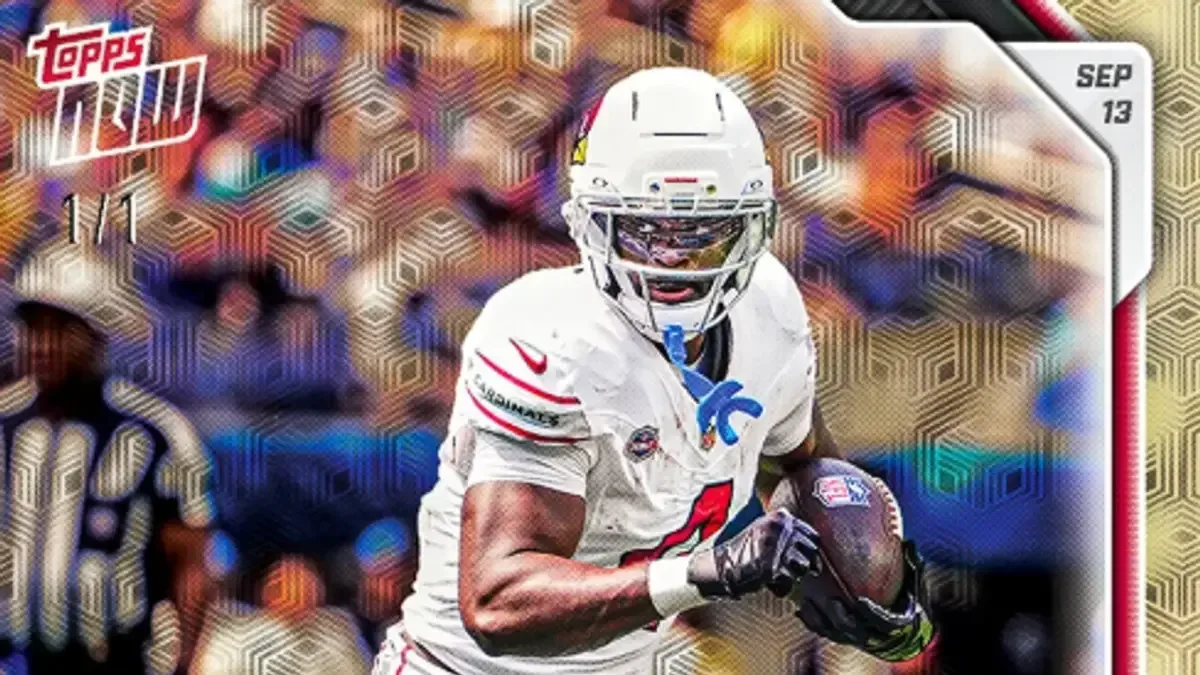
Topps Now has opened its 2026 NFL season with a 13-card Week 1 lineup built around the sort of moments the on-demand program is designed to capture: a long-running career climb, a single-game statistical eruption, a defensive breakthrough, and two rookies putting their first NFL touchdowns on the board.
The headline veteran achievement belongs to Travis Kelce, whose card marks his move into second place on the all-time receiving-yards list for tight ends. At the other end of the career timeline, first-round picks Jeremiyah Love and Kenyon Sadiq each receive a card commemorating their first NFL touchdown, with a particularly scarce autographed Foilfractor version bearing the inscription “1st NFL TD.”
For collectors, the important distinction is that the 13 cards are not a uniform set of identical chase opportunities. Every card has the standard parallel ladder, but only selected players have autograph versions, and only Kelce and Jaxson Dart have image variations. Knowing which version is actually attached to each moment matters more than simply treating the full group as one Week 1 checklist.
What the 13-card Week 1 group covers
Eleven of the releases spotlight veteran players and established NFL achievements. Kelce’s receiving-yardage milestone is joined by cards for Dart, Kenneth Walker, Caleb Williams, Derrick Henry, Jahmyr Gibbs, Trevor Lawrence, T.J. Watt, D’Andre Swift, Josh Allen, and David Montgomery.
- Travis Kelce: Second all-time among tight ends in career receiving yards.
- Jaxson Dart: Three touchdowns in a prime-time game against the Cowboys.
- Kenneth Walker: 173 rushing yards.
- Caleb Williams: Four total touchdowns.
- Derrick Henry: Three scores, moving him to third on the all-time rushing-touchdowns list.
- Jahmyr Gibbs: The sixth player to reach 50 touchdowns in his first 50 career games.
- Trevor Lawrence: Fastest player to 100 career touchdowns in Jaguars history.
- T.J. Watt: His first career interception returned for a touchdown, commonly called a pick-six.
- D’Andre Swift: A career-high three touchdowns in one game.
- Josh Allen: Entry into the top 20 in quarterback rushing yards.
- David Montgomery: Three total touchdowns.
That spread gives the drop a few distinct collecting lanes. Kelce, Henry, Gibbs, Lawrence, and Allen are tied to cumulative career benchmarks. Walker, Williams, Swift, and Montgomery represent standout Week 1 production. Watt’s card isolates one unusually specific defensive play. Dart’s release centers on a three-touchdown prime-time performance.
Those categories can matter when building a collection with a clear focus. A collector who prefers historical milestones may be drawn to the Kelce or Henry cards, while someone collecting a particular team, player, or season story may view the single-game releases differently. The cards are still all part of the same opening-week Topps Now run; the underlying reason for each card is what separates them.
Kelce and Dart get the image-variation wrinkle
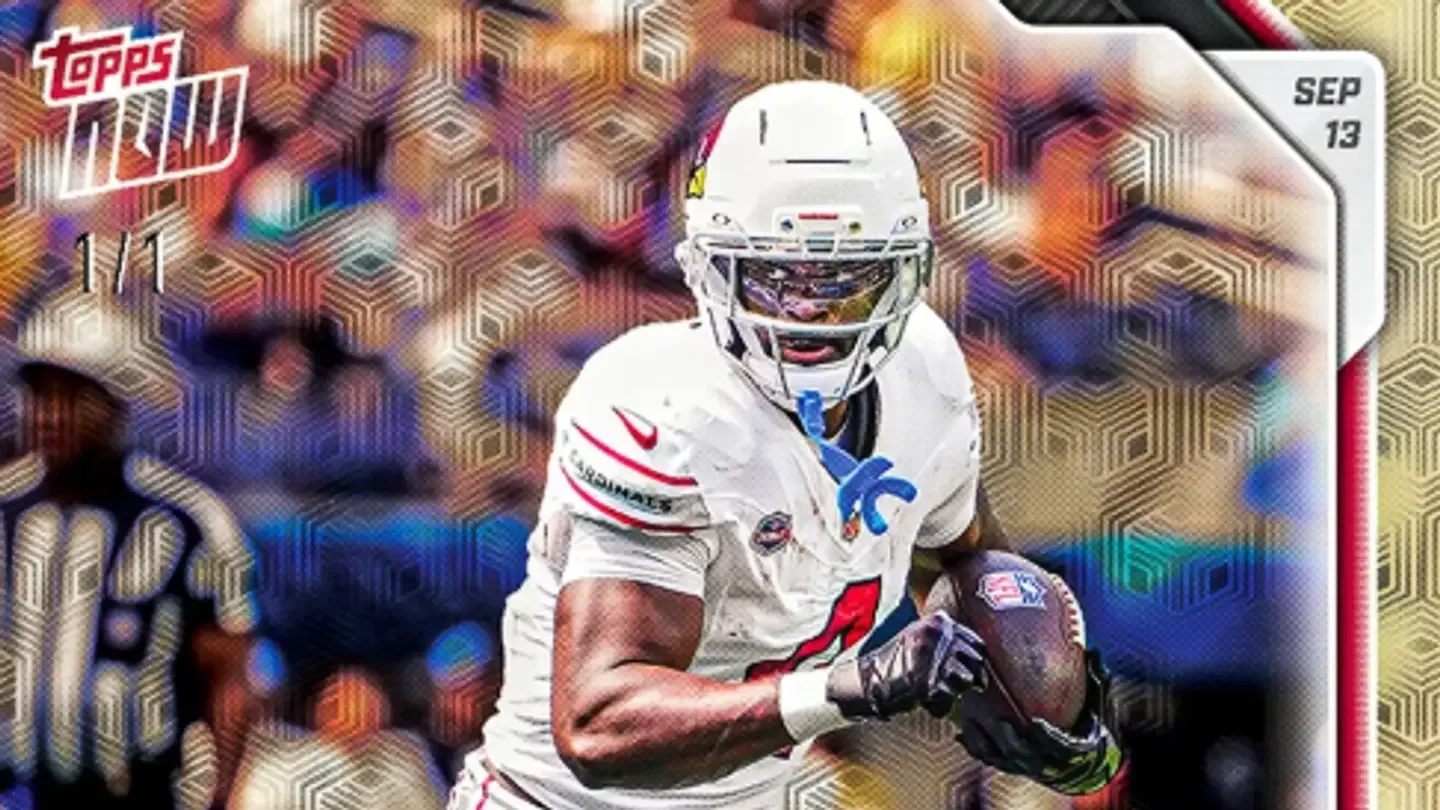
Kelce and Dart are the two players in this batch with an image variation. In card collecting, an image variation is a version that uses a different photograph or card image from the normal base design. It is not simply another serial-numbered foil color. Here, it is a separate visual chase attached to the Kelce and Dart cards.
That distinction is useful because collectors can encounter several kinds of scarcity in one release. A parallel changes the treatment and its stated production number; an image variation changes the visual presentation; an autograph adds a signed component. One should not assume that an image variation is available across all 13 subjects, because the listed variations are limited to Kelce and Dart.
Kelce’s card has obvious significance beyond Week 1 box-score collecting: it documents a movement on an all-time tight end leaderboard. Dart’s card, by contrast, ties its alternate image to an immediate game performance. Both are examples of Topps Now using a short purchasing window to turn a current NFL moment into a card that can carry more than one version.
Autographs are limited to five players
Only five of the 13 players are listed with autograph opportunities: Dart, Walker, Henry, Love, and Sadiq. The restriction is worth emphasizing. A card’s presence in the release does not mean there is an autographed version of that player’s card.
Among the veteran group, Dart, Walker, and Henry are the three autograph subjects. Henry’s release connects a three-score game to his rise to third all-time in rushing touchdowns, making it a card that combines a current performance with a broader career marker. Walker’s 173-yard outing and Dart’s three-touchdown game are more immediate Week 1 snapshots.
For a quick terminology check, an autograph card is a version signed by the player. The supplied release information identifies which players have autographs but does not establish autograph quantities for every version. Collectors should therefore separate what is explicitly listed from assumptions about broader print runs or odds.
For readers tracking the hobby across different franchises and card types, Joking Joystick’s trading-card coverage also illustrates how collecting news can range from sports releases to character-driven card collecting.
Love and Sadiq turn first touchdowns into premium rookie chases
The two rookie cards in the release belong to Love and Sadiq, both first-round picks. Love, a running back, scored his first NFL touchdown against the Chargers after displaying a physical, aggressive running style during the preseason. His Topps Now card memorializes that first score.
Sadiq, a tight end and the Jets’ first-round selection, scored his first career touchdown in his first NFL game. The touchdown was also the Jets’ first of the season in a 23-10 win over the Titans. That gives his card a layered piece of game context: debut game, first personal touchdown, and the first Jets touchdown of the season.
Both rookie cards have a stated top-end version: a one-of-one autographed Foilfractor inscribed “1st NFL TD.” A one-of-one, often written as 1/1, means the version is uniquely numbered: just one copy is designated in that form. The inscription adds handwritten wording beneath the signature, making the card more specifically tied to the event rather than functioning as a generic signed rookie card.
Foilfractor is the name used for the one-of-one foil treatment in this release’s parallel structure. It should be read as the rarest stated rung in the ladder, not as a catch-all label for every shiny or foil card. Love’s and Sadiq’s Foilfractors combine three elements at once—unique serial status, autograph, and inscription—which is why they stand apart from the regular rookie cards.
There is also a practical collecting reality: the existence of a 1/1 does not mean a buyer can select it directly. It is a rare pull associated with the card release. Collectors who want a particular player’s standard card have a different goal from those pursuing an autograph, a numbered parallel, or the singular Foilfractor.
The parallel ladder, explained
All of the Week 1 Topps Now football cards are listed with parallels. A parallel is an alternate version of a base card, usually differentiated by a color, foil finish, and limited numbering. It is still tied to the same player and moment, but is made in a smaller stated quantity than the ordinary base edition.
The five listed parallel tiers are:
- Gold foil: numbered to 50.
- Orange: numbered to 25.
- Black foil: numbered to 10.
- Red foil: numbered to 5.
- Foilfractor: a one-of-one.
“Numbered to 50,” for example, indicates that the parallel has a stated limit of 50 copies. The ladder narrows from 50 to 25, then 10, five, and finally one. This does not make every card equally scarce in every sense—image variations and autograph availability are separate considerations—but it provides the standard numbered chase structure across the 13 subjects.
For buyers, the cleanest approach is to identify the exact target before ordering: base card, numbered parallel, image variation where offered, autograph where offered, or the rookie 1/1 chase. That prevents a common category error in modern on-demand cards, where several visually or materially different versions can be attached to the same headline moment.
Purchase window and checklist priorities
The cards are available through the Topps website until 3:45 p.m. Eastern on September 16. Since Topps Now cards are built around a limited order period, the timing is part of the product format. The window is not merely a reminder for a later retail release; it is the listed period for purchasing these Week 1 cards.
There is no single obvious “best” card in a group like this because the appeal is split among career history, current performance, rookie debuts, and version-specific scarcity. Kelce is the clearest career-leaderboard entry. Henry offers both a three-touchdown game and an all-time rushing-touchdown advance. Love and Sadiq deliver first-touchdown rookie narratives with specially inscribed 1/1 Foilfractors. Dart and Kelce alone provide image variations, while Dart, Walker, Henry, Love, and Sadiq carry the autograph angle.
In short, the Week 1 release is a compact snapshot of an NFL opening weekend, but not a one-note one. It pairs established records and production with two first-round rookies reaching an early landmark—and gives collectors a defined set of parallels and special versions to distinguish along the way.