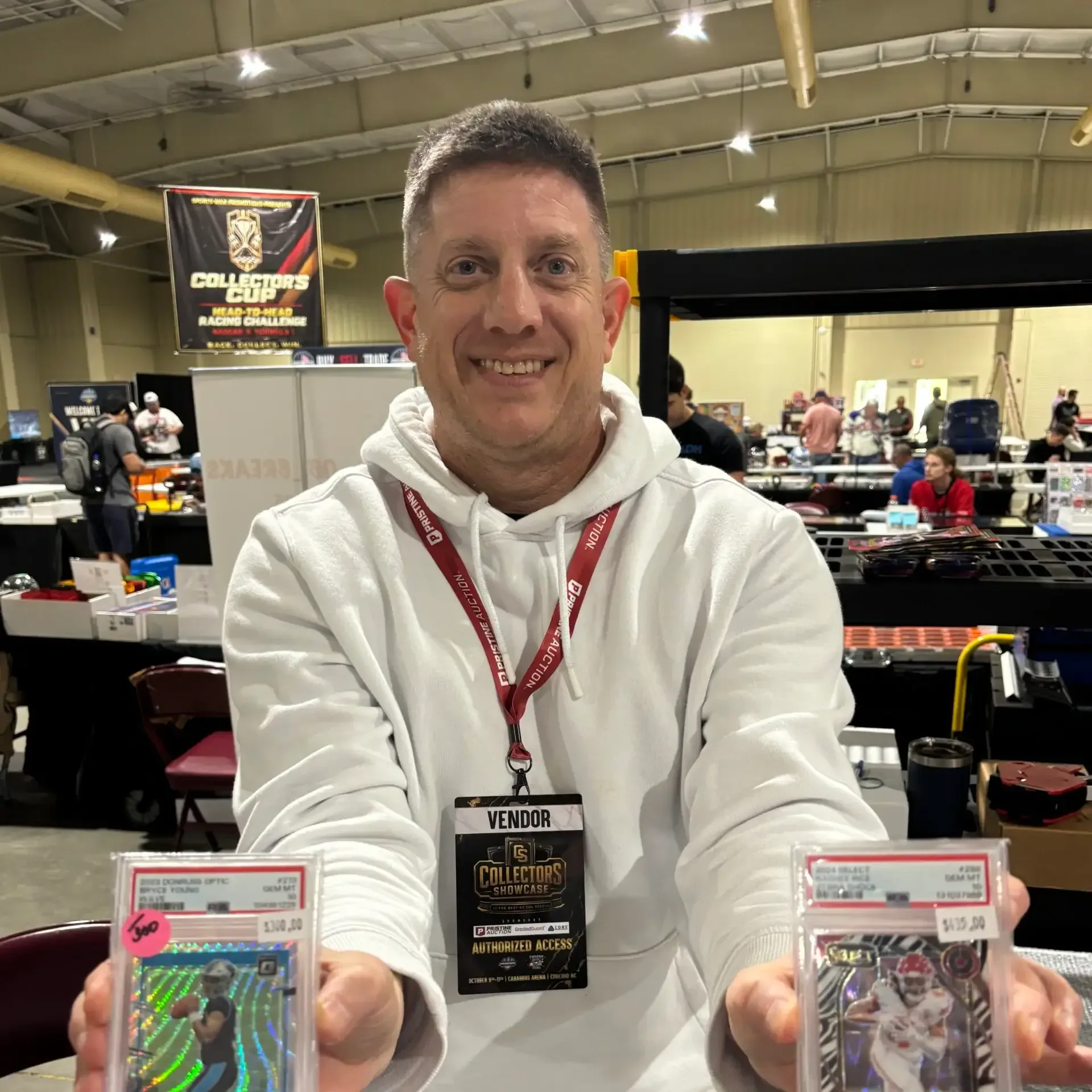
Football cards are still moving, but the people buying and selling them do not appear to agree on a simple definition of a healthy market. At the Sports Wax Promotions Collectors Showcase, held October 9-11 at Cabarrus Arena and Event Center near Charlotte, more than 500 tables created a useful snapshot of the contradiction: football cards were prominent and actively traded, yet dealers and collectors repeatedly described values as volatile, quarterback-heavy and occasionally difficult to justify.
That is an important distinction. A market can have steady activity without giving every card a steady price. Football’s short season, its week-to-week storylines, its dependence on star quarterbacks and the rise of fantasy football all make the category unusually reactive. A big Sunday performance can move attention toward a player almost immediately. A poor game or injury can send that attention somewhere else just as quickly.
For collectors, the lesson is not that football cards have stopped mattering. It is that the word value needs more context than it often gets. A card may have a dealer’s asking price, a recent sale price, a personal-collection value and a short-term resale value, and those figures are not automatically the same thing.
A showcase full of football, despite uneven broader momentum
The event’s tables included cards across the price spectrum. One dealer had a 2023 Donruss Optic Bryce Young rookie card marked at $300. At the higher end, one-of-one cards of Lamar Jackson and Shedeur Sanders were marked at $2,500 and $2,000, respectively. A one-of-one is a card with a stated print run of one copy, an extreme-scarcity designation that generally makes condition, player demand and buyer interest especially consequential.
For more context, explore YouTube Starts Labeling AI-Generated Music on YouTube Music, With Main Platform Rollout Ahead.
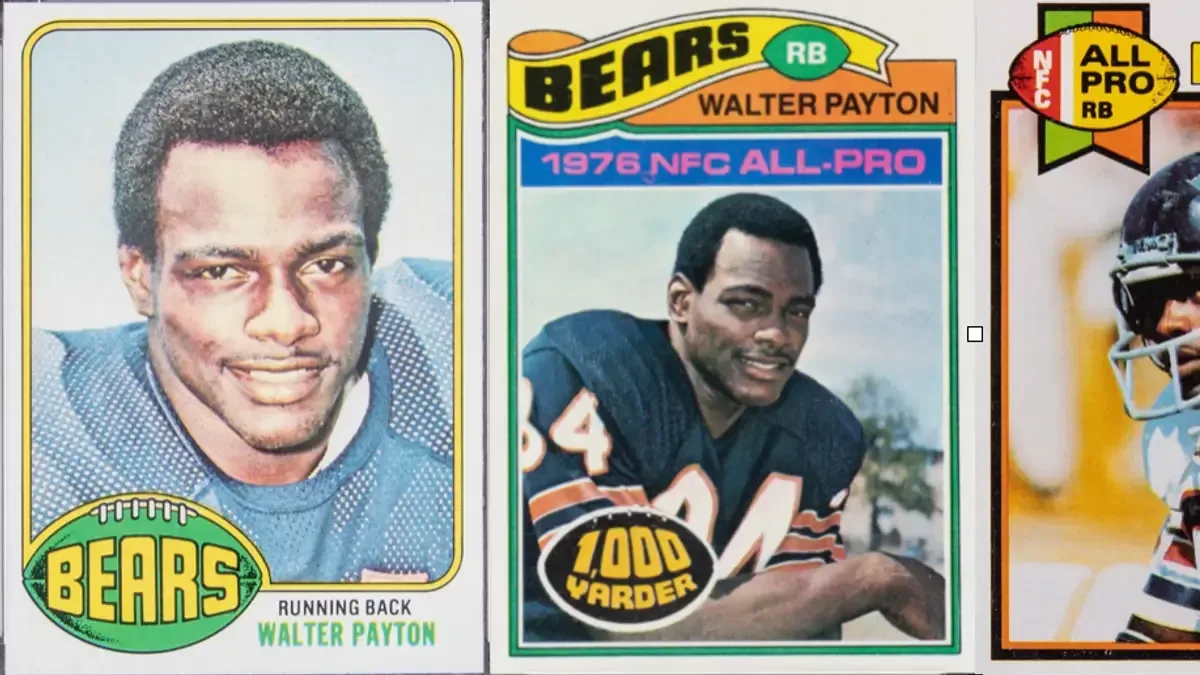
At another table, vintage Topps cards of Hall of Fame quarterbacks Terry Bradshaw, Joe Theismann and Len Dawson were marked at $5 each. That juxtaposition is the story in miniature: unique cards of current quarterbacks were positioned as high-end items, while established historic names could be bought at an entry-level price.
Football cards have recently trailed baseball and basketball cards in fan interest and dollar values, even as the NFL remains the leading sports brand in the United States and expands its international schedule. But the activity seen in Concord suggests that lower relative attention should not be confused with no demand. Local dealers still described football as a major sales category, and one card-shop owner said it was the top mover at her Sanford, North Carolina store, ahead of baseball.
The more accurate reading is that football can be both broadly softer than other card segments and extremely active in individual pockets. Quarterbacks, rookies, graded cards in accessible price ranges and players coming off headline-making games can all generate their own bursts of demand.
Why football cards can swing from week to week
Football’s calendar encourages compressed reactions. There are fewer regular-season games than in baseball or basketball, so each outing can carry a larger share of a player’s annual narrative. That effect becomes even stronger for quarterbacks, who are the sport’s most visible individual figures and are often treated by the hobby as the central collectible position.
Dealers at the show described the usual demand order as quarterbacks first, then wide receivers and running backs. That does not mean every player at another position lacks a market. It means that the largest share of speculative attention tends to concentrate around the player most closely associated with a team’s success or failure.
Fantasy football contributes to that behavior. Participants may follow players and teams with an intensity that extends beyond their local fandom, and card demand can follow those changing loyalties. A breakout performance from a player who suddenly matters to fantasy lineups can create a short-term rush that has little to do with a long historical record.
Scarcity is another piece of the puzzle. Dealers pointed to relatively smaller football-card production batches as a factor affecting value. Still, scarcity by itself does not establish durable demand. A card can be hard to find while attracting few buyers; conversely, a more available card can be easy to sell because collectors recognize the player, design, set or grading company. The market ultimately needs both limited supply and willing demand.
For a broader look at the same weekly-swing discussion, football-card market coverage from the show similarly underscores how quickly current-player attention can change.
Liquidity is not the same thing as long-term strength
One dealer, Curtis Van Duren of Davidson, North Carolina, characterized football cards as among the hobby’s most liquid assets, meaning cards can be converted into cash relatively quickly when there are active buyers. Before general admission began in Concord, he sold several graded football cards during the early VIP period quickly enough that he did not have time to track which specific cards had moved.
That observation is useful, but it needs careful interpretation. Liquidity refers to how readily something can sell; it does not guarantee that it will sell at a desired price. A card priced too high may sit. A seller needing a fast sale may accept less. And a card with an enthusiastic audience in October may face a much different audience after a downturn in a player’s on-field fortunes.
Van Duren’s practical focus was graded cards in roughly the $30-to-$100 range. These are the kinds of cards that may appeal to buyers who want a recognizable player, an encapsulated condition assessment and a manageable purchase rather than a four-figure gamble. A slabbed card is one sealed in a hard plastic holder after third-party grading; the label typically identifies the card and records its assigned grade. The holder can make cards easier to display, transport and transact, but grading does not erase market risk.
His view was that even lesser-known players can become sellable after creating a memorable moment on the field. That is a sensible explanation for football’s fast-moving lower and middle tiers: collectors are not exclusively chasing all-time icons. They may be reacting to a current game, a local team, a favorite fantasy player or the simple pleasure of finding an affordable card.
The modern-rookie premium versus vintage quarterback value
Michael Heffner, owner of Card Sharks Sports Cards in Cherryville, North Carolina, argued that vintage football stars are undervalued relative to some newer quarterback cards. He compared the roughly $300 listing price of a Joe Montana rookie card with the much higher prices achieved by recent rookie cards tied to unproven quarterbacks, including Cam Ward cards that had been selling for $1,000 after Ward’s rookie season with the Titans.
The key word there is listing. An asking price communicates what a seller hopes to receive, not necessarily what a buyer has recently paid. It is still revealing, though, because it captures the complaint many traditional collectors have about the category: a player’s established career accomplishments are not always what drive the largest short-term premium.
Modern quarterback cards often carry an expectation premium. Buyers are not necessarily paying for what a player has already accomplished; they may be paying for the possibility of what that player could become. That creates the potential for rapid appreciation if the player succeeds, but it also creates exposure if results, health or public enthusiasm change. Heffner said that imbalance had caused him to reduce his own football-card buying, particularly when a box break does not yield a quarterback.
Vintage has a different appeal. The player’s legacy is known, the card has survived for decades, and collectors can concentrate on eye appeal, scarcity, condition and historical importance rather than forecasting an active career. Yet the $5 Bradshaw, Theismann and Dawson cards at the show show that “vintage” does not automatically mean expensive. A card’s year, set, condition, availability and exact player all matter, as does whether the buyer wants a landmark rookie or simply a pleasing old card.
Local-team success does not automatically become card demand
The Carolina market offered another reminder that team proximity alone is not enough. Dealers reported limited interest in Bryce Young cards and in cards of Panthers wide receiver Tetairoa McMillan, despite Young improving in his fourth season and McMillan having won NFL Rookie of the Year the previous season.
A 2025 Topps Chrome McMillan card graded PSA 9 carried a $225 price tag at one table, while some other McMillan rookies were around $5. PSA 9 is a numerical grade assigned by PSA, with 9 generally labeled Mint. The difference between that card and lower-priced examples may reflect the particular product, card variation and assigned grade as much as it reflects the player himself.
For shoppers, that is a reminder to compare like with like. “Tetairoa McMillan rookie card” is not a single product category. A base card, a parallel, an autograph, a serial-numbered card and a graded copy can have dramatically different supply and appeal. A price tag also remains an offer, not proof that a market has accepted that figure.
A hobbyist approach offers a useful counterweight
Collector Kelly Crisco offered perhaps the clearest practical philosophy at the event. He follows college quarterbacks he believes may eventually establish themselves in the NFL, naming Giants quarterback Jaxon Dart as one example, while acknowledging that injuries have affected Dart’s first two seasons. But Crisco also said he does not expect to recover all the money he spends opening cards. His aim is to recoup enough to buy more cards he enjoys.
That approach separates collecting from treating sealed product as a dependable investment vehicle. Opening a box involves uncertainty: the purchaser does not control which players, inserts or parallels are inside. Buying singles, by contrast, lets a collector direct spending toward a favorite team, player, set or budget.
Crisco also emphasized the small purchases—$3, $5, $10 and $20 cards—as the heart of genuine collecting. In a market where one-of-one quarterbacks can command four-figure asking prices, that perspective matters. The hobby is not only about the card that might spike after Sunday’s game. It is also about affordable vintage finds, player collections, local fandom and the process of sharing an interest with someone new, as Crisco did with his nephew Sawyer McDaniel.
What buyers should take from the volatility
- Separate a price tag from a completed sale. Dealer marks establish an asking point, not a universal market value.
- Know whether you are buying a player, a specific card or a grade. These are related but different sources of demand.
- Expect quarterback cards to be narrative-sensitive. Weekly performance and injuries can change attention rapidly.
- Do not assume old means expensive or new means secure. Vintage and modern cards each depend on exact issue, condition, supply and buyer interest.
- Set a purpose before buying sealed boxes. If the goal is a specific player or card, singles may align better with that goal than chasing a pull.
- Leave room for enjoyment. The fastest-moving card is not necessarily the best card for a personal collection.
Football cards remain a lively category precisely because the season keeps producing new reasons to care. That same immediacy is what makes the market hard to read. A collector who understands the difference between scarcity, liquidity, grading, performance hype and personal enjoyment is in a better position to appreciate the action without mistaking every weekly swing for a permanent verdict.