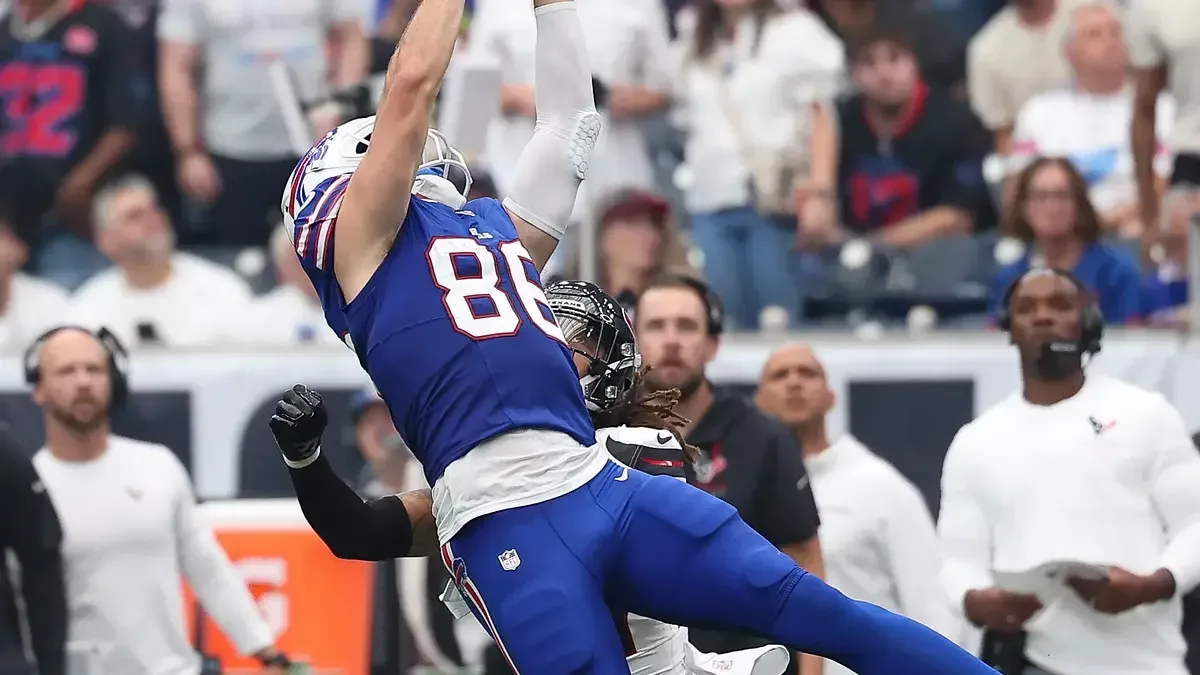
NFL tight ends can make for an unusual corner of the sports-card market. A great receiver may attract demand on highlight power alone, while quarterbacks sit at the center of every offensive storyline. Tight ends, even productive ones, often need a clearer catalyst: a breakout game, a changing role, a record chase or a truly scarce card that gives collectors a focused target.
Week 1 supplied potential catalysts for three established names at very different points in their hobby profiles. Buffalo’s Dalton Kincaid posted a huge receiving total, Philadelphia’s Dallas Goedert found the end zone twice, and Kansas City’s Travis Kelce led his team in receiving while moving up the all-time tight-end receiving list.
Those performances do not automatically create a sustained price rise. They do, however, put attention on players whose existing sales histories reveal sharply different collector propositions: Kincaid as a young player with a recent burst of buying activity, Goedert as a comparatively affordable veteran, and Kelce as an established high-end market with historic and cultural appeal.
Dalton Kincaid: attention arrives fast after a statement game
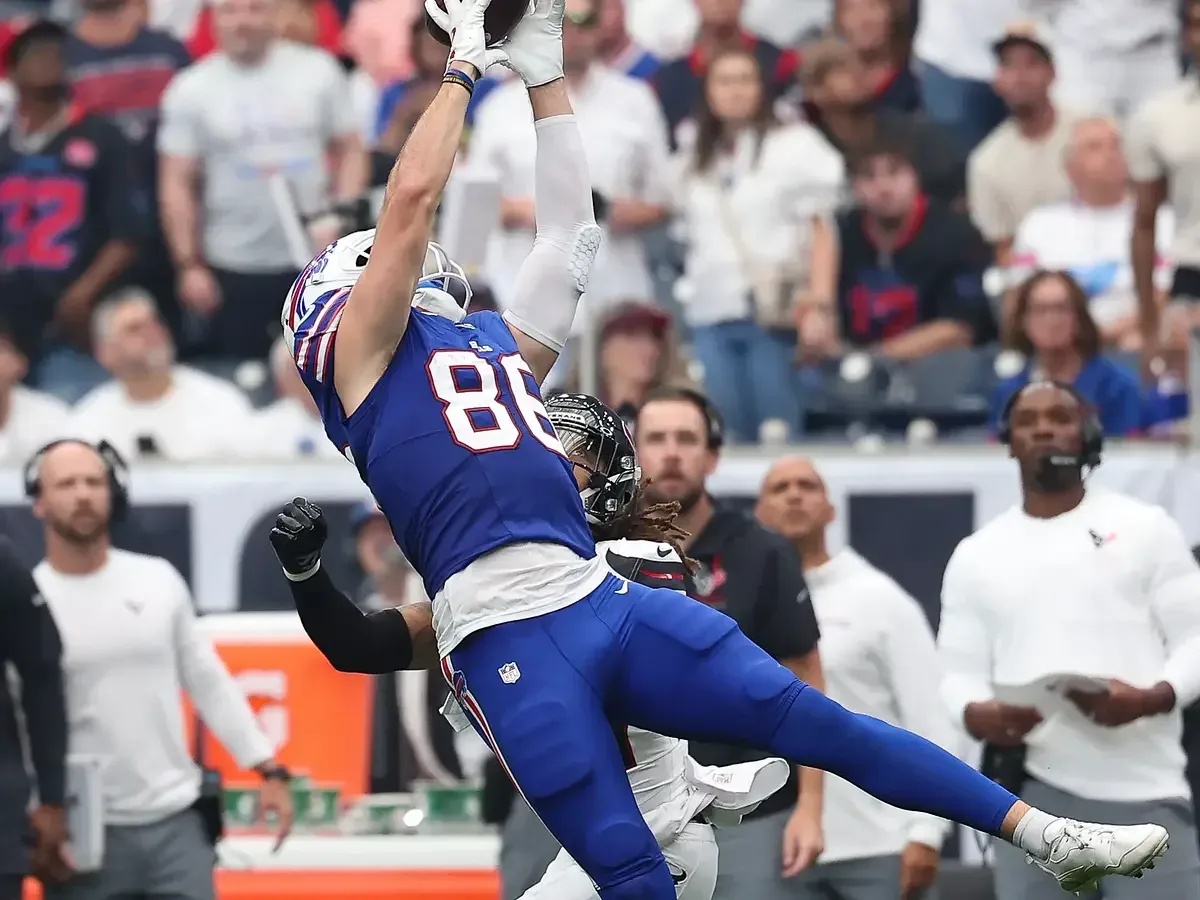
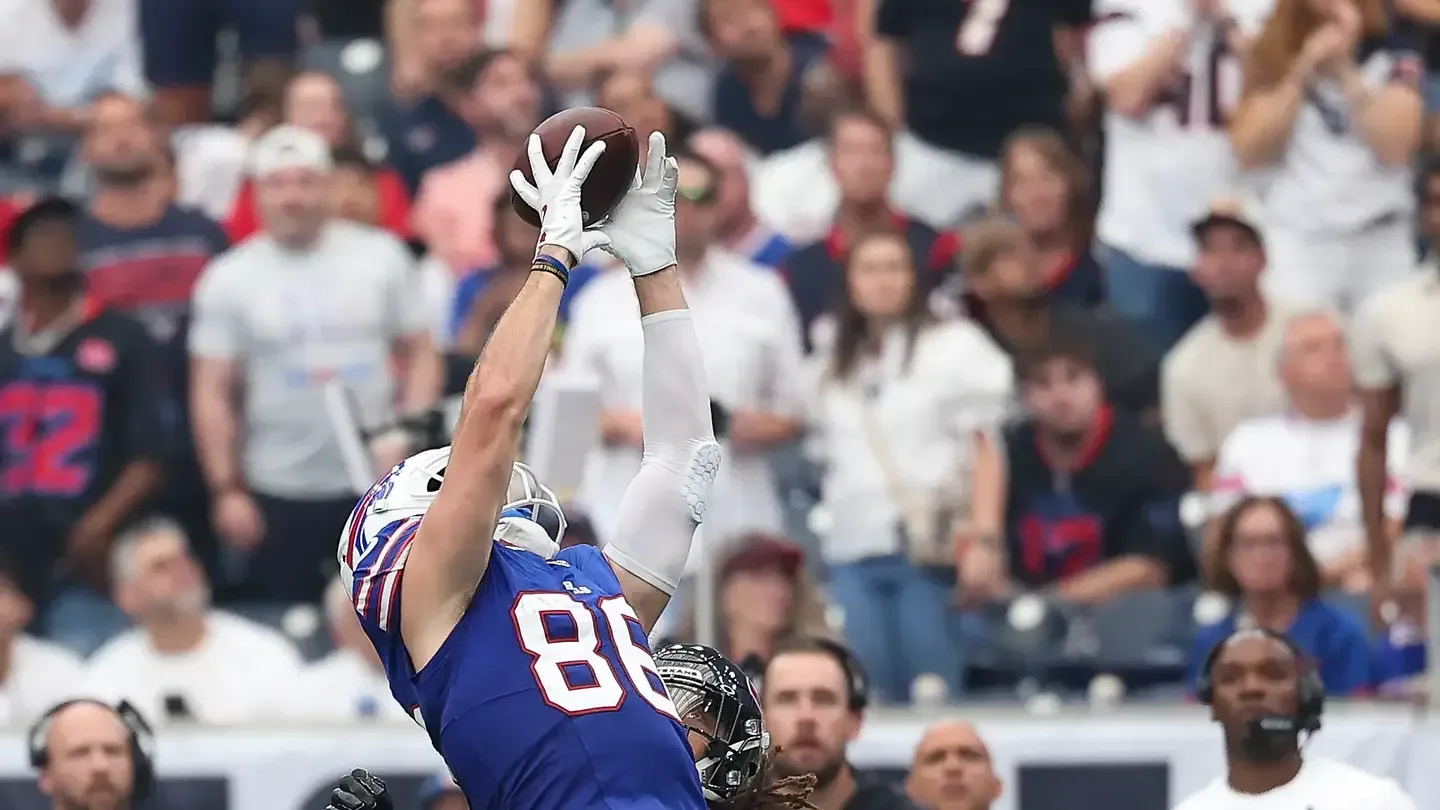
Kincaid led the Buffalo Bills in receiving in a Week 1 win over the Houston Texans. His five catches produced 130 yards, the highest receiving-yard total among tight ends in the league that week. The stat line matters beyond its size. For collectors, it presents a simple and persuasive storyline: a quarterback’s apparent trust in a young tight end translated directly into volume and explosive production.
That interest was visible in transaction activity. Card Ladder recorded 282 Kincaid card purchases during the three days following the game. It is important to separate sales volume from card value. Sales volume is the number of transactions, while value is the price collectors are willing to pay for a particular card. A rush of purchases shows that more buyers were active; it does not, by itself, establish that every Kincaid card increased in price.
Still, a concentrated burst of activity can matter in a modern-player market. It raises visibility for rookie cards, numbered parallels and autographs that might otherwise be overlooked. It can also narrow the available supply of lower-cost cards, which may draw further attention from collectors looking for an entry point.
Kincaid already has an obvious ceiling sale attached to his résumé. A 2023 Donruss Optic Rated Rookie Gold Vinyl on-card autograph, a one-of-one, sold for $4,999.99 on November 21, 2024. “One-of-one” means the manufacturer designated that card as the sole copy of that precise version, while an on-card autograph is signed directly on the card rather than on a separately applied sticker.
That result is meaningful, but it should not be used as a universal price guide. A Gold Vinyl rookie autograph numbered 1/1 is a singular collectible, and its buyer pool is very different from that for a standard rookie card or a more widely available parallel. The stronger takeaway is that collectors have already assigned meaningful value to Kincaid’s rarest rookie material. Week 1 created fresh attention; a larger body of performance would be needed to determine whether that attention becomes a more durable market trend.
Related coverage includes Week 1 Tight End Breakouts Put Dalton Kincaid, Dallas Goedert and Travis Kelce Back on the Card Market Radar.
Dallas Goedert: production versus affordability
Goedert’s Week 1 case is almost the mirror image. The Philadelphia Eagles veteran caught four passes and led the league’s tight ends with two touchdown receptions. The immediate football argument for increased attention is straightforward: with A.J. Brown in New England, Goedert has a potential path to a bigger role in Philadelphia’s receiver room.
Goedert and Jalen Hurts have worked together since 2020, and the pair won Super Bowl LIX on February 9, 2025. Yet his available headline sales remain comparatively modest against the premium associated with major quarterback markets or the hobby’s most famous skill-position stars.
His highest recorded sale is a 2023 Panini Prizm Black Finite Prizm one-of-one, which sold for $1,200 on August 27, 2025. As with Kincaid’s top result, the 1/1 designation makes this a rarity benchmark rather than a broad market average. The price represents one specific card, in one sale, at one moment. It does not mean all Goedert cards are valued near that level.
A particularly interesting data point sits with his rookie-year material. A 2018 Panini Contenders #203 Cracked Ice Autograph graded PSA 10 sold for $730 in 2019, and Card Ladder now places its value at nearly $4,500. A PSA 10 is a top numerical grade from Professional Sports Authenticator, indicating a card judged to be in Gem Mint condition. Grading can be especially consequential for modern cards because condition, centering and surface quality can create substantial separation between copies of the same issue.
The contrast between the $1,200 2023 one-of-one sale and the nearly $4,500 valuation attached to the PSA 10 Cracked Ice rookie autograph is a useful reminder that rarity is not the only force at work. Rookie status, autograph format, grade, set identity and collector demand all shape a card’s desirability. A newer one-of-one can be extraordinarily scarce, but a heavily collected rookie parallel in top condition may carry its own premium.
For collectors, Goedert’s market illustrates the difference between buying a player’s most exclusive card and buying into a player narrative. His two-touchdown opener and prospective larger offensive role may make his cards more visible. But the existing sales cited here suggest collectors should evaluate individual cards rather than assume a Super Bowl résumé or one productive game makes every issue equivalent.
Travis Kelce: the mature market with five-figure landmarks
Kelce enters the discussion from a different position entirely. In Kansas City’s Week 1 Monday-night home opener against the Denver Broncos, he led the Chiefs in receiving with three catches for 71 yards. It was his highest receiving-yard total since the 2022 season opener, when he recorded 121 yards.
He also passed Jason Witten to move into second place all-time in receiving by a tight end. That kind of record progression can be especially relevant in established-player collecting. Rookie cards of veterans are no longer primarily a bet on whether the player will become notable; they can be tied to legacy, championships, milestone pursuits and the prospect of a final statistical ranking.
Kelce’s top sale shows the level of capital already present at the elite end of his market. His 2013 National Treasures Red rookie NFL Shield patch autograph, numbered 1/1 and graded PSA 8, sold for $32,700 on September 25, 2025. An NFL Shield patch card contains a shield-logo piece associated with NFL equipment, while National Treasures is a brand frequently associated with premium rookie patch autographs. Combined with rookie status and a 1/1 serial number, those attributes make this a flagship-level Kelce collectible.
The PSA 8 grade is also worth noting. High-grade examples often command attention, but vintage and premium rookie cards do not require a PSA 10 to be important. In this case, the rarity and configuration of a unique Shield autograph carry enormous weight. It is a market landmark, not a price floor for ordinary Kelce cards.
Kelce’s collector profile has multiple pillars: major on-field accomplishments, a contending team, an active record chase and broad cultural visibility following his marriage to singer Taylor Swift this summer. That combination helps explain why participation in the Kelce market can require five-figure spending at its most exclusive tier. It also distinguishes him from Kincaid and Goedert, whose markets are more closely tied to future offensive opportunity and the possibility of continued production.
What Week 1 can—and cannot—tell collectors
The three players demonstrate why the phrase “tight end market” can be misleading. There is no single price curve for the position. Kincaid’s 282 purchases over three days reflect a short-term spike in buyer attention after a 130-yard game. Goedert’s market offers examples where a graded rookie autograph carries a markedly different proposition from a later one-of-one. Kelce’s sales are shaped by legacy-card dynamics and an elite, scarce rookie-card benchmark.
Collectors reacting to early-season production can use a few practical distinctions:
- Look at the specific card. A base card, a numbered parallel, an autograph, a patch card and a one-of-one are not interchangeable measurements of a player’s market.
- Separate transaction count from sold price. More sales can indicate interest, but actual completed prices determine whether a given card’s market moved.
- Account for grade and rookie status. The nearly $4,500 valuation for Goedert’s PSA 10 Cracked Ice rookie autograph highlights how condition and a favored rookie design can outweigh simple scarcity comparisons.
- Treat early-season results as a signal, not proof. A Week 1 breakout can increase search activity and buying, but continued targets, touchdowns and team success are the longer-running storylines collectors will watch.
Football cards regularly turn a Sunday or Monday performance into a burst of attention. The more difficult question is whether that attention has a foundation. Kincaid has an immediate usage story and a rare rookie-card high point. Goedert has touchdown production and a market that remains accessible relative to his accomplishments. Kelce has the most established collector base, a $32,700 pinnacle sale and milestones that can reinforce a legacy already built.
For hobbyists following sports-card sales alongside major memorabilia activity, the distinction between a unique trophy piece and a broadly tradable issue is essential—the same principle that applies when evaluating historic items heading to auction. Week 1 has put three tight ends in the spotlight. The next meaningful measure will be whether their individual markets retain that attention once the season’s weekly noise grows louder.