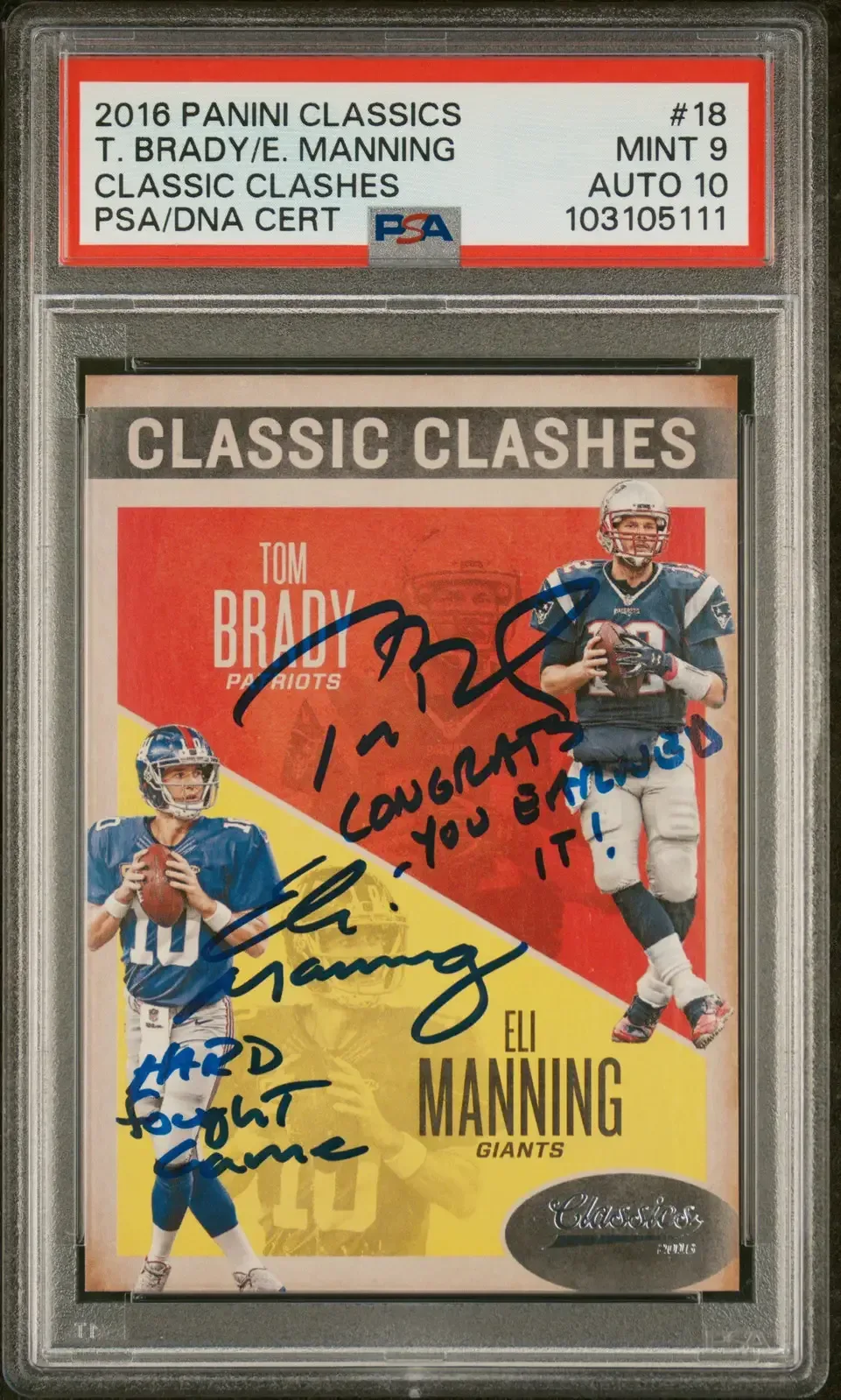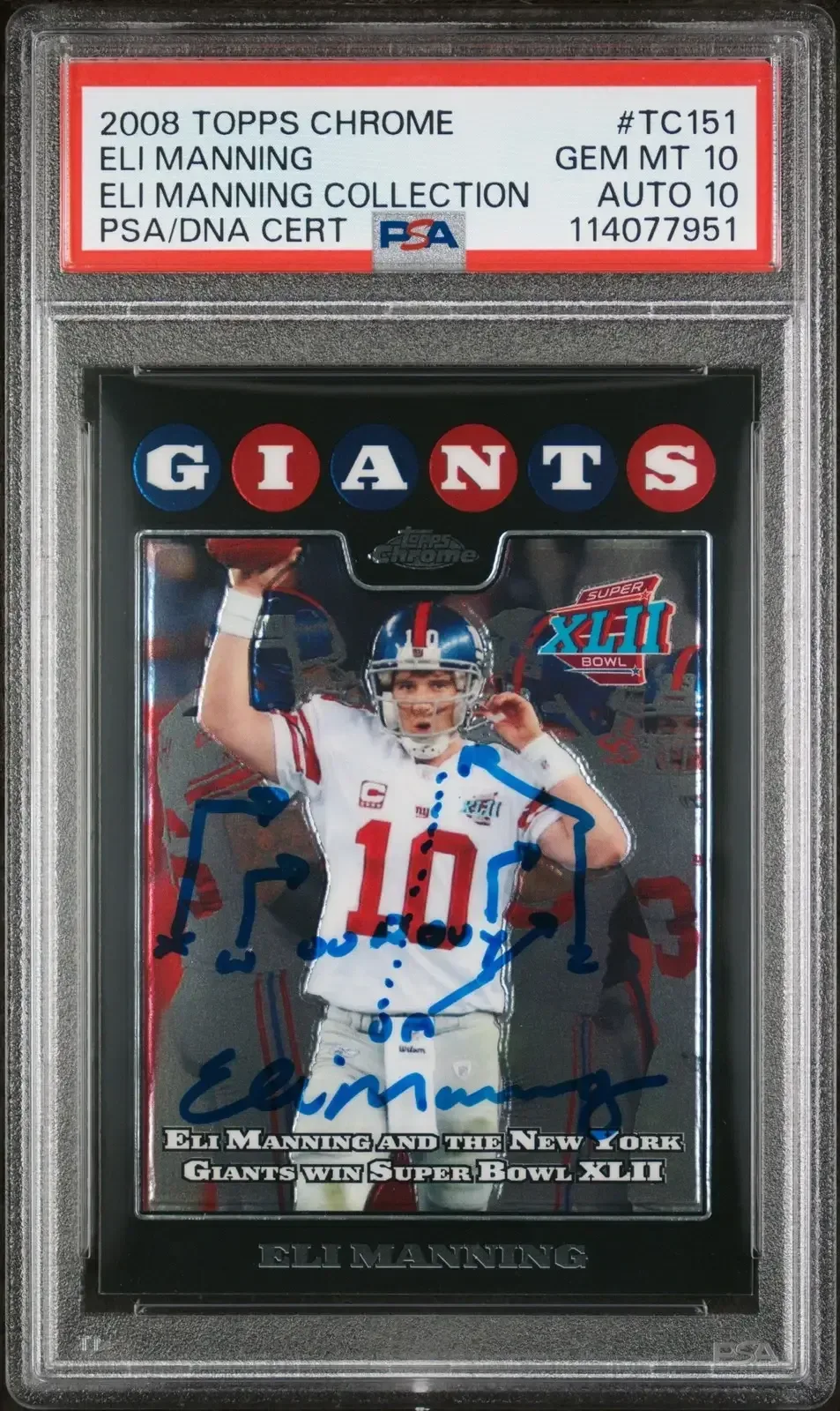
Eli Manning’s football-card appeal is inseparable from the games that made his career unusual. The regular-season case can invite debate, but the postseason record is built around two championships, two Super Bowl MVPs and two victories over Tom Brady and Bill Belichick on the NFL’s biggest stage. For collectors, that gives Manning cards something more enduring than a stat line: a clearly defined legacy with a pair of instantly recognizable moments at its center.
That context matters when sorting through his 2004 rookie cards, later autographs and post-retirement inserts. A Manning card is not automatically important because it is old, scarce or expensive. The most compelling examples tend to combine one or more of four traits: rookie status, a direct connection to the Giants quarterback’s career, meaningful memorabilia or an autograph configuration that cannot easily be replicated.
The five cards below reflect different ways of collecting Manning. There is a foundational chrome rookie, two rookie patch autographs, a modern Super Bowl tribute and a card that turns the Manning family name into the entire premise. Recent public sales provide useful reference points, but they should not be read as fixed values. Grade, eye appeal, autograph quality, patch variation and the timing of a sale can all change what a particular copy brings.
Why Manning’s playoff story remains central to his cards
The Giants’ two title runs supply the emotional foundation for much of the demand around Manning. In the 2007 postseason, New York beat the Buccaneers, a 13-3 Cowboys team with 13 Pro Bowlers, and Brett Favre’s Packers on the road in exceptionally cold conditions before meeting the undefeated Patriots in Super Bowl XLII. Four years later, the Giants went through the Falcons, Aaron Rodgers’ 15-1 Packers and a formidable 49ers defense, then faced New England again.
Manning won the Super Bowl MVP in each win over the Patriots. An analysis of his first 11 playoff games found that the Giants were underdogs in seven of them; simulations cited in that analysis put the chance of a quarterback at Manning’s level winning at least eight of those 11 games at about 1%, compared with roughly 0.1% for a replacement-level quarterback. Those estimates are not card-market forecasts, but they help explain why the postseason narrative has remained so powerful.
It is also why a modern card can carry as much thematic interest as a rookie card. A 2025 insert dedicated to Super Bowl XLII is not a rookie, but it speaks directly to the reason many collectors remember Manning. In a hobby that regularly revisits both history and new releases, other card lines are also built around familiar characters and long-running narratives, as seen with a future Marvel-themed trading-card release. Manning’s strongest cards work on the same basic principle: scarcity helps, but an immediately understandable story helps more.
5. 2004 Topps Chrome #205
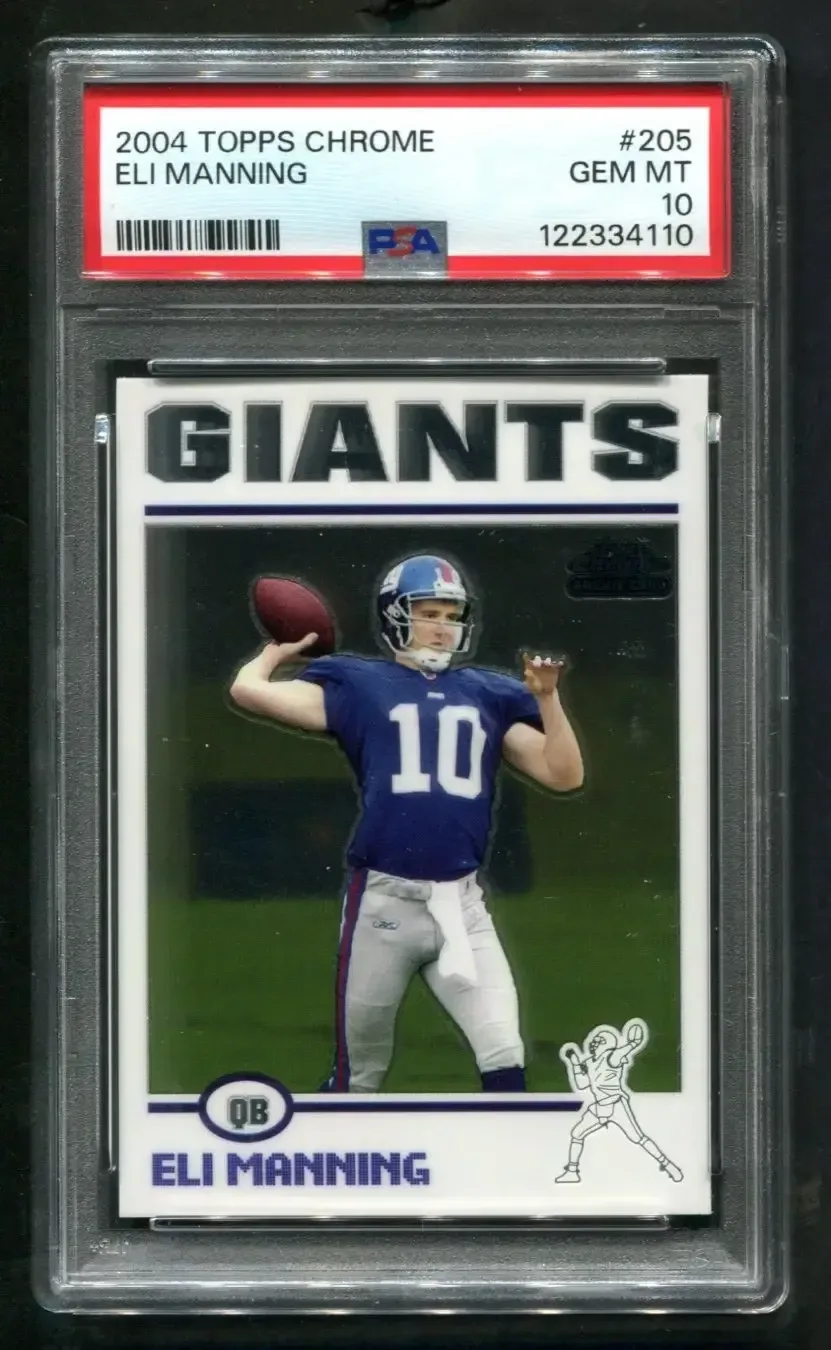
The 2004 Topps Chrome #205 is the clean, mainstream starting point for an Eli Manning rookie-card collection. Its simple layout, including “GIANTS” across the top, is part of the attraction. It does not need a patch window, serial number or autograph to announce itself. It is a recognizable rookie from a major chrome set, and that straightforward identity is valuable for collectors who want a classic card rather than a highly specialized chase.
Condition is the important complication. PSA has graded 1,006 copies in total, with 141 reaching Gem Mint 10. A PSA 10 price of $671 was listed. The gap between overall graded population and top-grade population illustrates a basic grading reality: a card can be available in the abstract while still being difficult to locate in the condition many collectors prioritize.
Parallel versions change the scarcity equation
The Refractor version is materially tougher in the available grading data: PSA has graded 141 copies, and only one was graded PSA 10. The Gold X-Fractor is numbered to 279; a PSA 9 sold for $1,170 in March. The Black Refractor is numbered to 100, and a PSA 9 sold for $2,700 in June.
A parallel is a variation of a card distinguished by a different finish, color or serial-numbered print run. A Refractor is known for its reflective chrome treatment. These versions are not substitutes for one another: the base rookie has the broadest recognition, while parallels introduce additional scarcity and a more focused chase. Buyers should verify the exact parallel and grade before treating one sale as comparable to another.
4. 2025 Absolute Kaboom Super Bowl #2 SSP
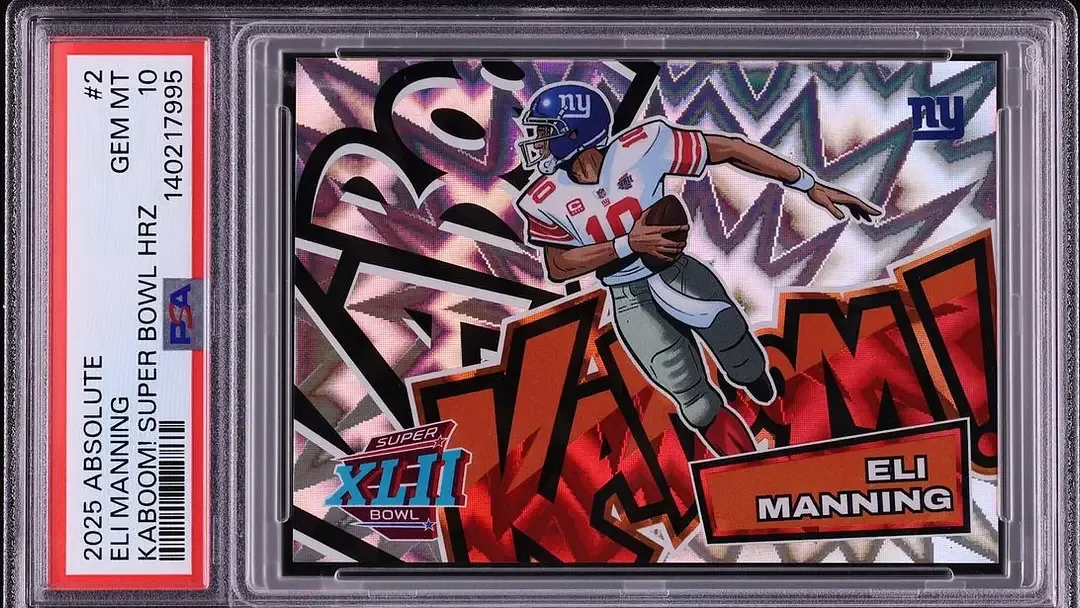
Manning retired following the 2019 season, yet the 2025 Absolute Kaboom Super Bowl #2 shows why post-career cards can still be important. Rather than trying to compete with his 2004 rookies on rookie status, this card is built around Super Bowl XLII, the achievement most closely linked to his NFL identity. It is a modern visual tribute to a historic game.
The base Kaboom is described as an SSP, short for super-short print. That term generally signals a deliberately scarce insert, although it is not itself a numbered print run. The reported PSA 10 price is $3,500, and PSA’s population is 30. The card’s appeal is therefore a blend of a popular modern insert format, relatively limited graded supply and the direct Super Bowl connection.
Its variants escalate quickly. A Gold Kaboom numbered to 10 sold in PSA 10 for $20,000 in July. A raw Purple Kaboom sold for $8,350. A Green one-of-one has not recorded a public sale. “Raw” means ungraded, so the Purple sale should not be compared mechanically with a graded Gold sale. Grading authentication, numerical condition assessment and a card’s specific parallel all affect the comparison.
The one-of-one is especially worth handling carefully in discussion. A one-of-one, often shortened to 1/1, is a card marked as the sole copy of that version. It may be exceptionally scarce, but the absence of a public sale does not establish a market value. It simply means there is no public transaction here to use as a benchmark.
3. 2004 SP Authentic Rookie Patch Auto #216 /299
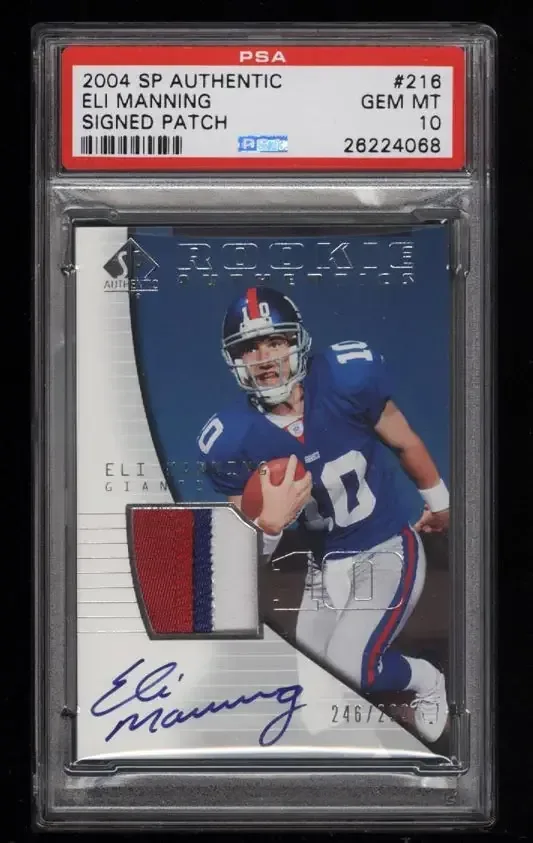
The 2004 SP Authentic Rookie Patch Auto #216 is among the clearest examples of why collectors gravitate toward premium rookie cards. It is numbered to 299, includes a game-worn jersey patch and features an on-card autograph. The cited PSA 10 sale is $2,550, dated November 17, 2016, with a total PSA population of 38.
RPA means rookie patch autograph: a rookie-year card that combines an autograph with a memorabilia patch. It is one of the hobby’s most used shorthand terms, but it does not make every RPA identical. The details on this Manning matter. The autograph is signed directly on the card rather than on a separate label applied later, and the patch is described as coming from a game-worn jersey.
Patch appearance can create significant differences between copies of the same numbered card. A multi-colored swatch is often more desirable than a single-color piece because it can be visually distinctive and may come from a more detailed area of the jersey. That does not mean every multi-color patch deserves the same premium, but it explains why serial number and grade alone do not tell the whole story for memorabilia cards.
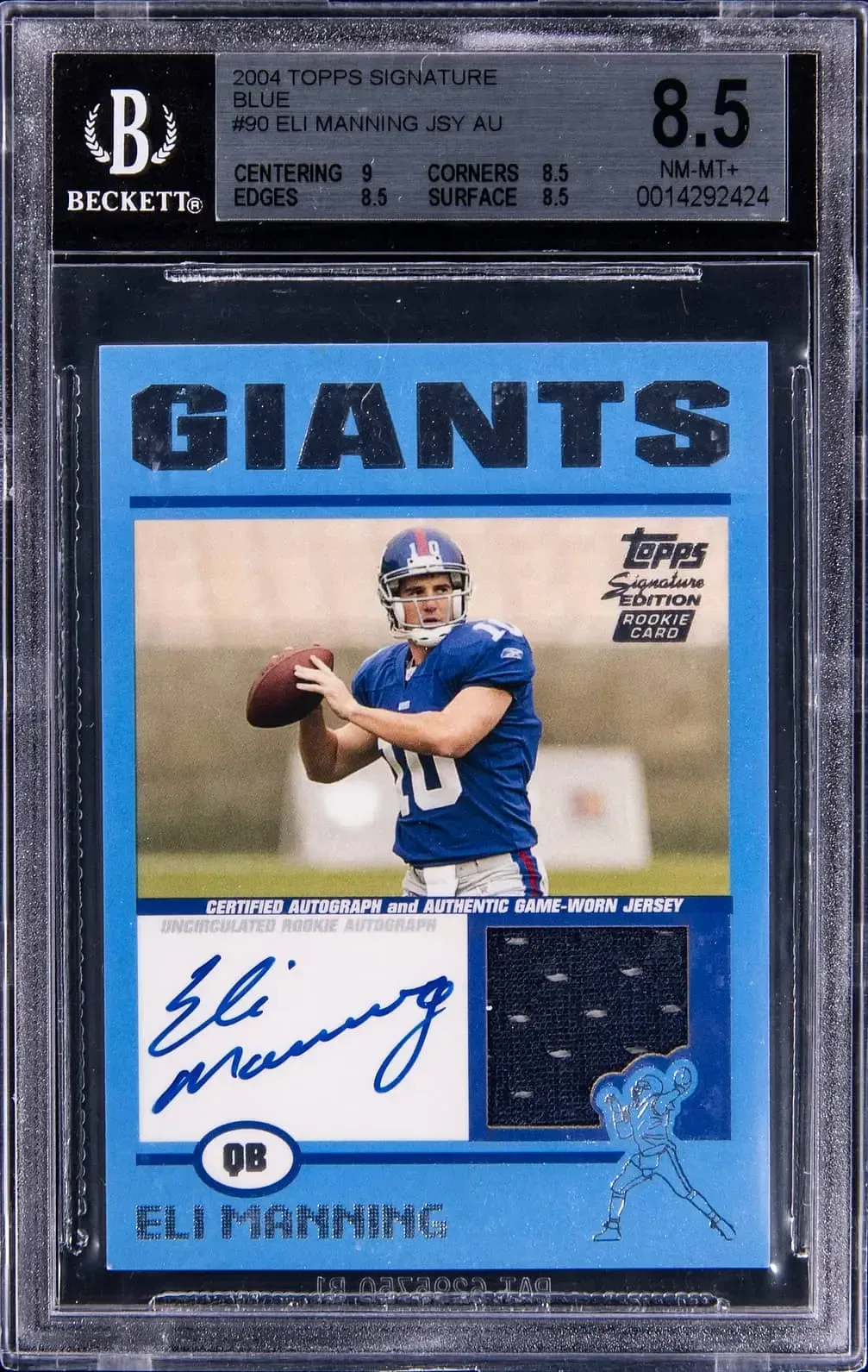
2. 2004 Topps Signature Edition Rookie Patch Auto #90 Blue /50
The 2004 Topps Signature Edition Blue Rookie Patch Auto #90 brings together several traits collectors routinely seek: rookie-year status, an on-card autograph, a game-worn patch and a print run of 50. One BGS 9 sold for $800 on January 16, 2026, while the stated total PSA population is seven.
The Blue version adds a “color match,” meaning the card’s blue design complements Manning’s Giants uniform. Color matching is an aesthetic preference, not a separate measure of rarity or condition, but it can make a card more visually satisfying to collectors who build player, team or uniform-focused displays.
There is also a useful grading distinction here. PSA and BGS are different grading companies, and a BGS 9 should not be automatically equated with a PSA 9. Their scales, subgrade practices and market preferences can differ. The sale establishes what that particular BGS 9 brought at that time; it does not set an interchangeable price for every copy.
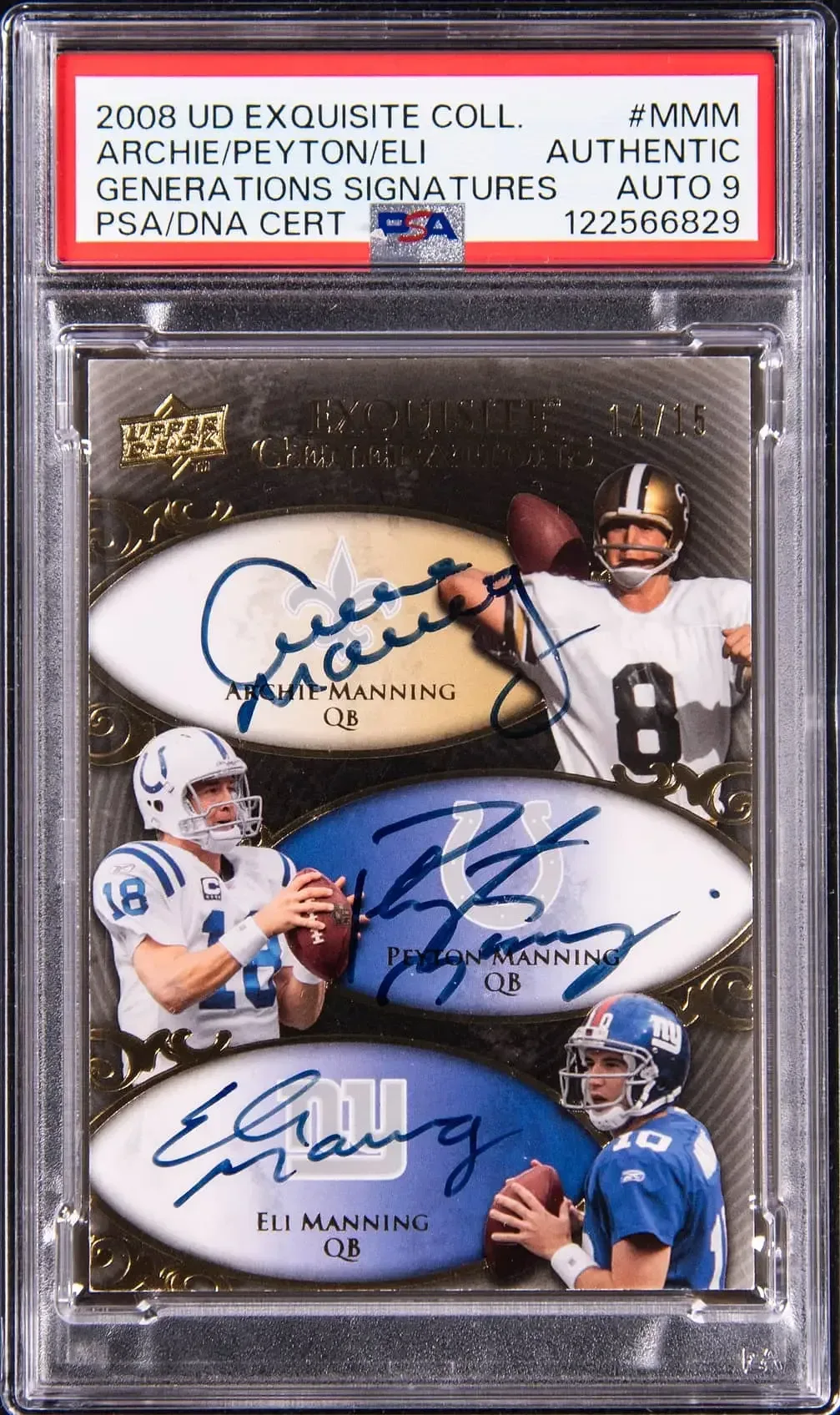
1. 2008 Upper Deck Exquisite Generations Signatures Archie, Peyton and Eli Manning /15
The top spot is not an Eli rookie at all. The 2008 Upper Deck Exquisite Generations Signatures card is numbered to 15 and features on-card autographs from Archie Manning, Peyton Manning and Eli Manning. Its strength is the configuration: it places three quarterback members of the same family on a single scarce card. A PSA Authentic example sold for $5,074 on January 16, 2026, and the total PSA population is three.
PSA Authentic is an important label to read accurately. It confirms the item is authentic, but it is not the same as a numerical condition grade. That distinction is particularly relevant for autographed cards, where authentication can be the central concern even if the card does not receive a conventional numeric grade.
For collectors whose priority is the family connection, another option is the 2004 Ultra Passing Kings Eli/Peyton/Archie Manning autograph, numbered to 50. It also benefits from being an Eli rookie-year release. The Exquisite card remains the more compact statement piece because its premise is so direct: three Mannings, three on-card signatures and a print run of 15.
High-end sales and accessible entry points
The biggest public sales cited for Manning cards are led by the 2004 Upper Deck Ultimate Collection Rookie NFL Shield Logo Autograph 1/1 at $37,000. Second is the 2005 Upper Deck Exquisite Collection Peyton Manning/Eli Manning Dual NFL Patch Autographs at $33,600. Both pair extreme scarcity with attributes collectors understand immediately: a unique rookie Shield auto in the first case, and dual patches plus the Eli-Peyton pairing in the second.
Neither is required for a meaningful Manning collection. The 2004 Fleer Tradition rookie shared by Manning, Ben Roethlisberger and Philip Rivers provides a more accessible route. A PSA 10 sold for $358, while raw copies are said to sell for around $40. The 2004 Topps #350 is another lower-cost foundational choice: a PSA 10 sold for $260, while raw copies are said to sell for around $10.
For a practical purchase, decide first whether the target is a historically recognizable rookie, a visually striking insert, a signed relic or a family-themed autograph. Then check the exact card number, parallel, serial number, grading company and label before comparing it with past sales. That discipline is especially helpful with Manning, whose market ranges from inexpensive raw rookies to elite 1/1 and multi-autograph pieces.
The common thread across the best examples is not merely rarity. It is that each card gives collectors a different way to preserve Manning’s place in football: a rookie who became a Giants fixture, a two-time Super Bowl MVP, the quarterback tied to Super Bowl XLII, and one member of the sport’s most prominent quarterback family.