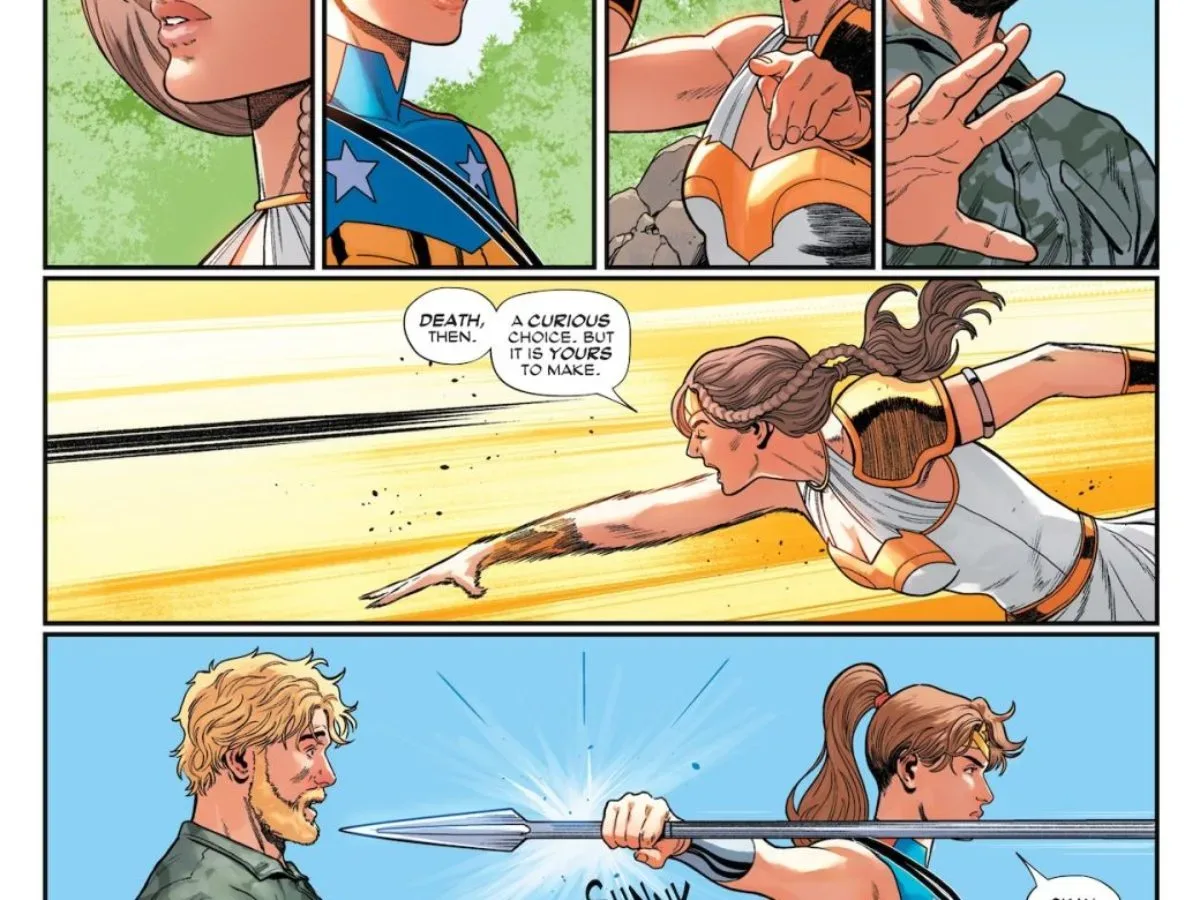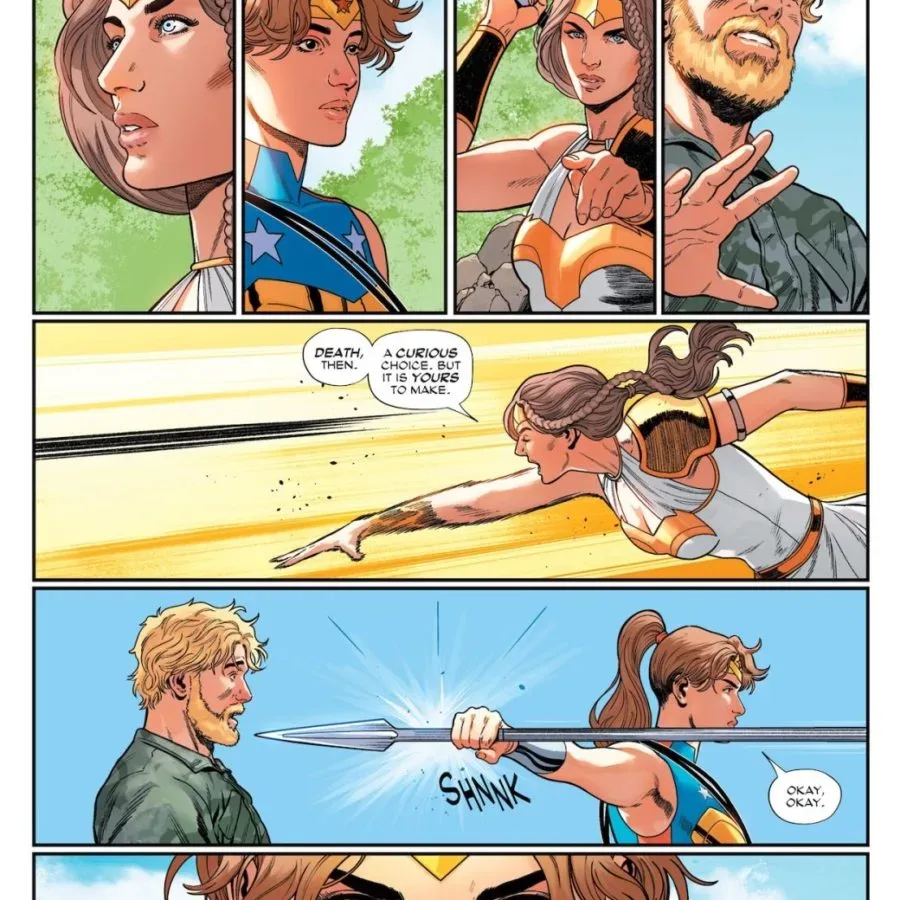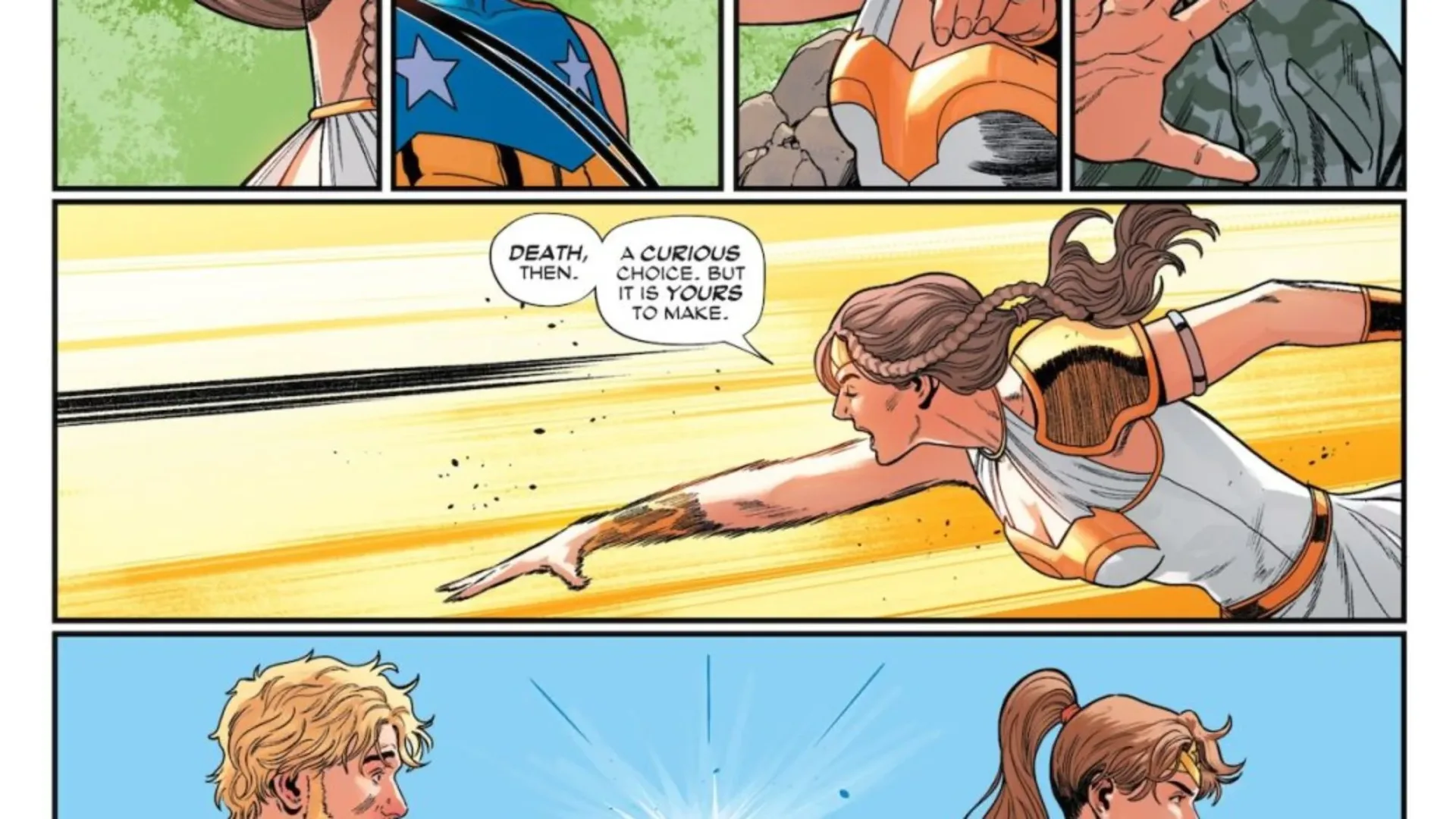
Wonder Woman #37 is set to begin the second act of The Wonder War on September 16, 2026, putting a family-centered time-travel crisis at the heart of its new chapter. Written by Tom King and drawn by Daniel Sampere, the issue brings Steve Trevor and his daughter Trinity into the present after a defeat by the Matriarch two decades ahead of the current timeline.
Their mission is immediately difficult: they need to find Wonder Woman and persuade her that a child who appears harmless in the present will become a devastating threat in the future. That setup frames the issue less as a conventional “stop the villain” story than a conflict over knowledge, trust, fate and the consequences of acting against someone for a crime they have not yet committed.
For readers following the larger storyline, #37 is explicitly billed as the first chapter of The Wonder War Act 2. The immediate hook is not merely that the future has gone wrong, but that people closest to Diana are now carrying the burden of proving why the present must change.
A future defeat brings Steve and Trinity back to Diana
The central premise gives Steve Trevor and Trinity an unusually direct role in driving the plot. They have not arrived in the present with a vague warning; they have already encountered the Matriarch and lost. Their knowledge comes from a future shaped by that defeat, with the Matriarch positioned as the major danger behind the crisis.
Time travel stories often use a future visitor to establish stakes fast. In practical storytelling terms, it allows a series to show the possible outcome before explaining every step that leads there. Here, the reported twenty-year gap gives the warning a personal dimension as well as a cosmic one. Steve and Trinity are not only discussing an abstract catastrophe. They have lived in the version of events Diana is being asked to prevent.
That does not automatically make their solution simple. A future is evidence in this sort of story, but it is also a problem. If the future can be changed, then characters must decide how much faith to place in what they have seen and what moral line they are willing to cross to avoid it. The issue’s solicitation asks whether the truth will prevail, suggesting that convincing Wonder Woman may be as important as confronting the prospective threat itself.
That tension is especially fitting for Wonder Woman. The premise hinges on a warning, but warnings can be manipulated, misunderstood or resisted. Diana will have to judge not only the danger described by Steve and Trinity, but the implications of defining an apparently innocent child through a prophecy of future destruction.
What “Act 2” means for The Wonder War
An “act” is a structural division within a larger story, comparable to a new movement in a play or the next major phase of a serialized narrative. Calling #37 the opening chapter of Act 2 tells readers that the series is moving into a fresh section of The Wonder War, while also indicating that the preceding material remains important context.
The new act appears poised to narrow huge stakes through an intimate conflict. The Matriarch and the future defeat establish the scale, but the immediate dramatic question is a family question: can Steve and Trinity make Diana understand what they know, and what will she choose to do with that knowledge?
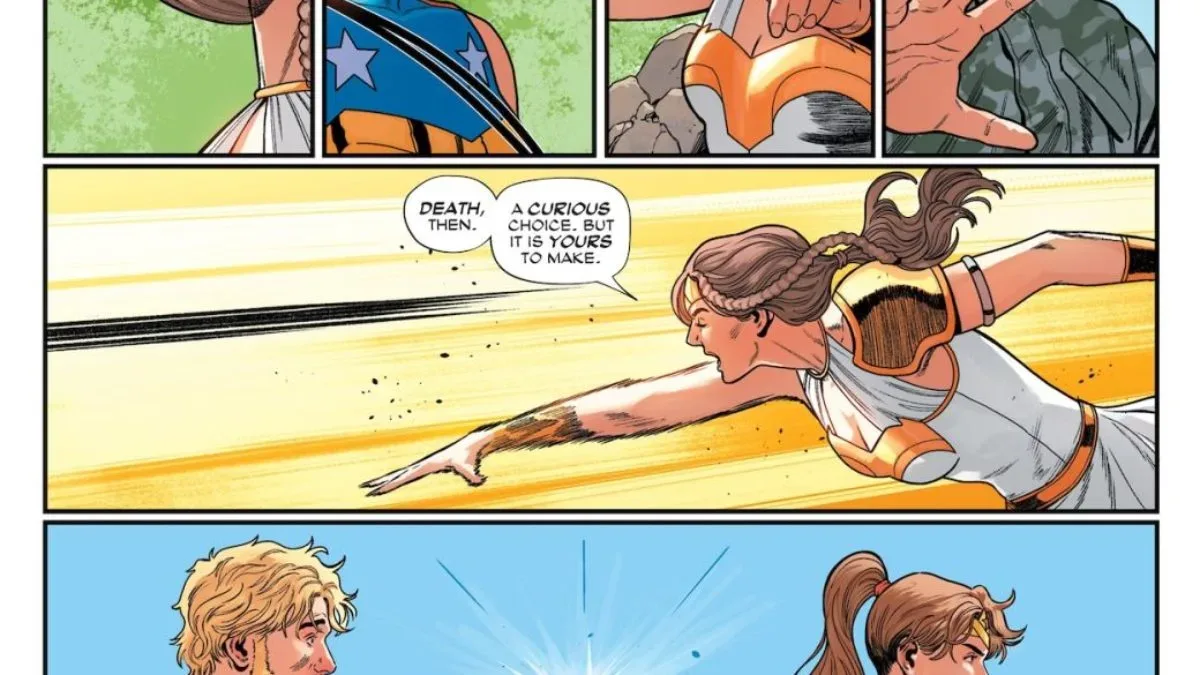
Trinity’s place in the setup matters. Rather than functioning simply as another person from the future, she is identified as Steve’s daughter and comes back alongside him. In preview material, a young Trinity introduces herself to Amazons as Wonder Woman’s daughter, an awkward but revealing moment that situates the time-travel threat alongside questions of belonging and identity.
Another preview sequence reportedly shows an adult Wonder Woman with twin infants, Lizzie and Lyssa, during a waterfall plunge connected to a monster hunt. Without further issue context, it would be premature to assign the children a specific role in the Matriarch conflict. Still, their appearance reinforces that the series is placing childhood, care and inherited danger near the center of its imagery and ideas.
Themyscira is not a neutral meeting ground
Preview pages also place Trinity before spear-bearing Amazons, with a hostile warning to outsiders tied to the sacred shores of Themyscira. That detail adds a political complication to Steve and Trinity’s arrival. Themyscira is Wonder Woman’s home, but it is also a guarded Amazonian society with its own boundaries and responsibilities.
The result is a layered opening for Act 2. Steve and Trinity must cross time to bring their message to Diana, but reaching Diana is not necessarily the same as being welcomed by every Amazon. Their relationship to Wonder Woman may provide emotional urgency, yet it does not erase the tension of arriving as outsiders in a place prepared to defend itself.
It also gives Sampere material suited to both scales of the premise: the emotional strain of a reunion and the visual spectacle of Amazons, monsters and a looming war. The supplied credits list Sampere as both artist and cover artist for the main edition, making him a key figure in presenting the transition into the story’s new act.
The ethical problem at the center of the warning
The solicitation’s phrase “seemingly innocent child” is doing much of the narrative work. It establishes an unsettling contradiction. A future catastrophe may be real, but the person associated with it is, in the present, a child who does not outwardly match the threat described by the travelers.
This is a classic predictive dilemma: should people intervene because they believe a future outcome is inevitable, or does intervention itself risk creating the feared outcome? The available details do not reveal how Wonder Woman #37 answers that question, who the child is, or why the Matriarch becomes such a menace. Those are the mysteries the issue appears designed to advance.
What can be said from the setup is that King and Sampere are using the future not just to promise bigger action, but to create a conflict where certainty is impossible. Steve and Trinity know what happened in their timeline. Diana must determine whether that knowledge calls for protection, prevention, skepticism or some response that does not repeat the logic of condemning a child for a future they may still avoid.
That combination of superhero stakes and family drama makes #37 a potentially important entry point for the current arc. It supplies a clear immediate crisis, identifies the Matriarch as the looming adversary and places Wonder Woman in a position where strength alone cannot settle the problem.
Release, credits and cover information
Wonder Woman #37 arrives in comic shops on September 16, 2026. The main issue has a listed suggested retail price of $4.99, with Tom King credited as writer and Daniel Sampere credited for interior art and the main cover.
Three additional cover listings are provided at $5.99 each:
- David Nakayama cover
- Kyuyong Eom cover
- Mahmud Asrar cover
Variant covers offer different cover artwork for the same issue; they are not, based on the available listing, separate story chapters. Readers choosing between editions can therefore treat the decision as one of cover preference and price, while the main narrative begins in the standard issue.
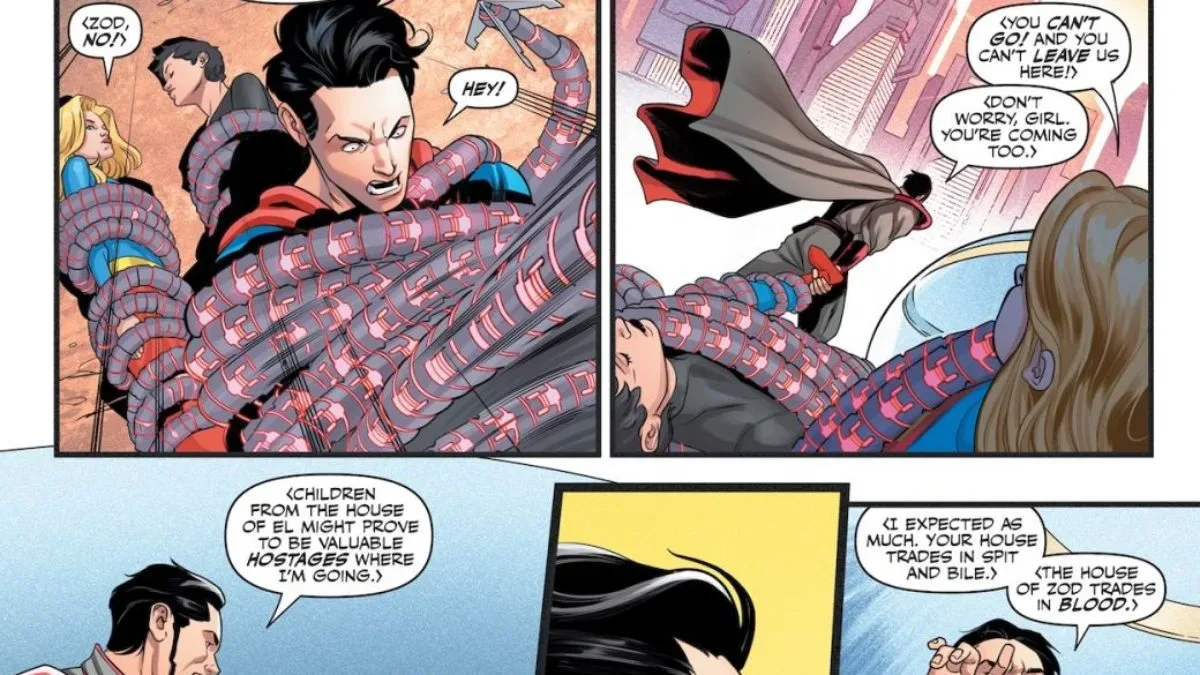
For another DC-focused comic preview, readers can also see Superman Unlimited #17’s conflict involving Zod and kryptonite.
With a failed future mission, an escalating threat called the Matriarch, and a warning that asks Wonder Woman to judge a child by what they might become, The Wonder War Act 2 begins by making its biggest question an intensely personal one.