Anfernee “Penny” Hardaway has the kind of card market that makes sense only after looking beyond career totals. His NBA peak did not last as long as collectors once expected, but it was spectacularly vivid: a 6-foot-7 playmaker who could create in traffic, finish above the rim and make the pass that seemed unavailable a moment earlier. In Orlando, alongside Shaquille O’Neal, Hardaway became one of basketball’s most compelling young stars before knee injuries changed the direction of his career.
That mixture of brilliance, brevity and unmistakable 1990s presentation remains central to his hobby appeal. Hardaway’s most wanted cards are not simply rookie cards or cards of an all-time statistical giant. They are artifacts of a period when he looked poised to own the league, rendered in foil, die-cuts, Refractors and scarce Precious Metal Gems. For collectors, the story attached to the card can be just as important as the player image on its front.
A related look at Hardaway’s 1990s card market similarly illustrates how strongly that early-career legacy still resonates. Recent reported sales show that demand spans the spectrum: from accessible graded rookie cards to five-figure premium parallels.
A career arc that shaped the cards
Hardaway entered the league amid enormous expectations. Orlando had won the draft lottery for a second consecutive year and initially appeared positioned to add Chris Webber next to O’Neal. Instead, after Hardaway impressed the team in a second private workout, the Magic made a draft-night deal with Golden State, moving the No. 1 selection in return for the Memphis State guard and future picks.
For more context, explore The Rise and Fall of Yuzu: Shutdown, Forks and the Preservation Debate.
The gamble rapidly looked inspired. Before turning 25, Hardaway made two All-NBA First Teams. In his second season he was an All-Star starter and a fringe MVP candidate, helping Orlando to a then-franchise-record 57 wins and a run to the NBA Finals after the Magic got past Michael Jordan and the Bulls in the playoffs. He followed that with another All-NBA First Team selection, another All-Star start and a third-place finish in MVP voting in 1995-96.
Those achievements matter because the best Hardaway cards are closely tied to the moment when his ceiling seemed limitless. The cards do not merely say “Penny Hardaway”; many are visual reminders of Orlando pinstripes, signature Air Penny 1s, high-flying drives and the era’s maximalist card design. His popularity was amplified outside basketball, too, by Nike’s Lil’ Penny campaign, with the puppet character voiced by Chris Rock.
Injuries complicated the rest of the narrative. A major knee surgery cost Hardaway most of the 1997-98 season, and later injuries and microfracture surgery further limited him. He played all 50 games in the lockout-shortened 1998-99 campaign, then moved to Phoenix, where he had one productive season alongside Jason Kidd before his role and production declined. The eventual gap between the anticipated career and the realized one is part of what gives the strongest Orlando-era cards their emotional pull.
1993 Finest #189: the foundational Penny rookie
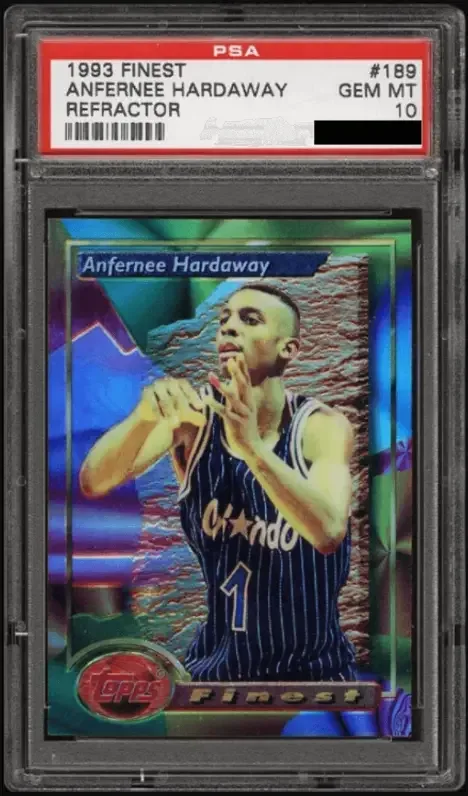
The centerpiece for many collectors is 1993 Finest #189, Hardaway’s rookie card. The base version offers an entry point to the player’s most important release, while the short-printed Refractor is the card’s considerably scarcer rainbow-foil parallel.
A parallel is a version of a standard card made with a different finish, color treatment or other distinguishing feature. Here, the Refractor treatment is the key distinction. It makes the card visually flashier and, crucially, much tougher to obtain than the base issue. That combination has long separated their price tiers.
Historical guide figures show that distinction was obvious almost immediately. Shortly after release, the base rookie was selling around $20, while the Refractor was listed between $200 and $250. Two years later, listed prices were $24 for the base card and $225 for the Refractor; by 1998 they were $35 and $250, respectively.
More recently reported market data puts a PSA 10 base rookie around $400, a 55.63% increase over a year. A PSA 9 reportedly rose from $25 to $58 over the same period. The dramatic end of the scale is the PSA 10 Refractor: the last reported sale was $4,440, up 83.09% year over year, with only 33 examples recorded in that grade.
Those labels require a little decoding. PSA is a third-party card grader, and its numerical scale is commonly used by buyers to compare condition. A PSA 10 denotes a gem-mint example, while a PSA 9 is one level lower. The reported population of 33 is the number of PSA 10 examples cited in the available data, not necessarily the total number of cards in existence. For buyers, the practical lesson is straightforward: the same card can be a much different purchase depending on whether it is raw, graded at 9 or graded at 10.
Natural Born Thrillers captures peak Orlando
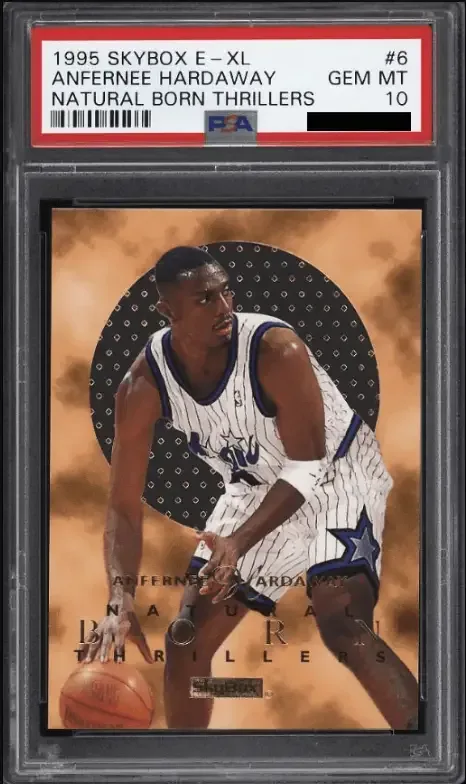
The 1995 SkyBox E-XL Natural Born Thrillers #6 is a particularly fitting representation of Hardaway’s ascent. He is one of 10 players in an insert set built around the NBA’s marquee attractions of the time. Its gold-foil, die-cut construction gives the card a distinctive period personality, matching a player who was then among the league’s premier must-watch talents.
An insert is a card placed into packs at a lower frequency than the main base set. A die-cut card has been cut into a nonstandard shape or has sections removed from its usual rectangular form. These treatments can make a card visually memorable, but they also introduce condition risks along the edges and corners.
That card’s reported PSA 9 price performance underlines the continuing appetite for a strong design connected to a defining year. The latest noted PSA 9 sale reached $225, a record for that grade in the available data and a 236.62% increase over 12 months. A single sale does not establish a permanent value, especially for a niche vintage insert, but it does demonstrate that collectors are responding to more than just rookie-card status.
A Cut Above is a condition challenge by design
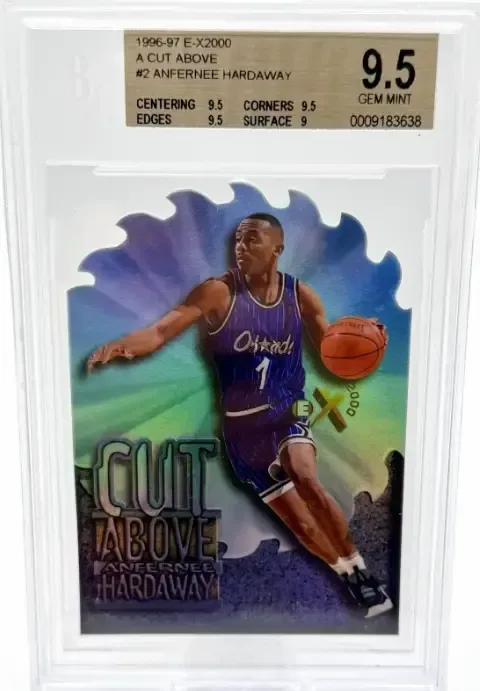
Few 1990s basketball inserts make a stronger first impression than 1996 E-X2000 A Cut Above. SkyBox made the concept literal: Hardaway’s card has a circular saw-blade-style die-cut at the top and reflective silver holographic foil. The design is unapologetically loud, and it is precisely the type of format that has become a major appeal of the decade’s premium inserts.
It is also an example of why condition commands such a premium. Unusual edges, thin points and reflective surfaces can reveal flaws that a standard card might hide. A raw card means one that has not been authenticated and assigned a grade in a holder, often called a slab. Reported results show a raw A Cut Above selling for $609, while a BGS 9.5 sold for $2,500 on September 21.
BGS refers to Beckett Grading Services. Its 9.5 grade is not directly interchangeable with a PSA 10 or PSA 9; grading companies have their own scales, standards and buyer followings. Still, the large gap between an ungraded example and a high-grade encapsulated copy reflects a broader reality of collecting elaborate 1990s inserts: scarcity is only one part of the equation. Surviving in elite condition is another.
The card also represents a transitional point in Hardaway’s career. After O’Neal left for Los Angeles, Hardaway became Orlando’s focal point. He earned his third consecutive—and final—All-NBA selection and delivered back-to-back 40-plus-point games against the Pat Riley-led Heat while carrying a depleted seventh-seeded Magic squad. For collectors, that makes a 1996 Hardaway insert more than a design novelty; it lands at the end of his established superstar phase.
Precious Metal Gems sit at the high end
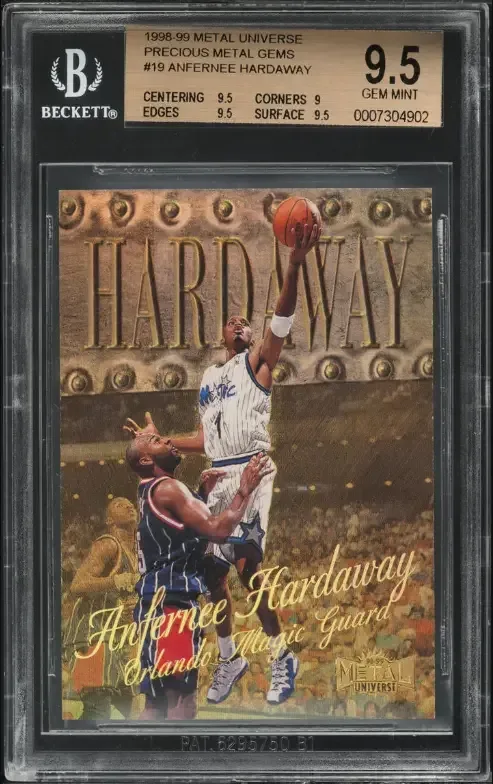
The premium tier of Hardaway collecting is led by Metal Universe Precious Metal Gems, commonly abbreviated as PMG. These were short-printed parallels that were not necessarily treated as the hobby’s crown jewels at release, but their scarcity and distinctive metallic look have made them exceptionally sought after.
The reported sales are substantial. A 1998 PMG in PSA 7.5 sold for $15,600 on September 25. A BGS 9.5 example brought $43,200 in February, the second-highest price recorded for a Hardaway card in the available tracking data. His 1997 PMGs have also been major-ticket items: a Red /100 in PSA 6 finished just under $27,000 at an October auction, while the Metal Universe Championship /50 version has sold between $13,000 and $15,000 depending on grade.
The “/100” and “/50” marks mean the cards are serial-numbered to stated production totals of 100 and 50, respectively. This is different from a grade population. Serial numbering identifies the intended limited run, while a population report counts examples a particular grading company has handled at a particular grade. Both details can affect demand, but they answer different questions.
PMG prices also show why collectors should resist treating a player’s market as one single number. A Hardaway collector can pursue a comparatively accessible PSA 9 rookie, a difficult die-cut insert, or a high-end serial-numbered parallel with radically different budget and condition considerations. The common thread is the player’s legacy; the purchasing decision is shaped by rarity, grade, design and how much risk a buyer is comfortable taking in a thinly traded market.
Phoenix and late-career cards tell a different story
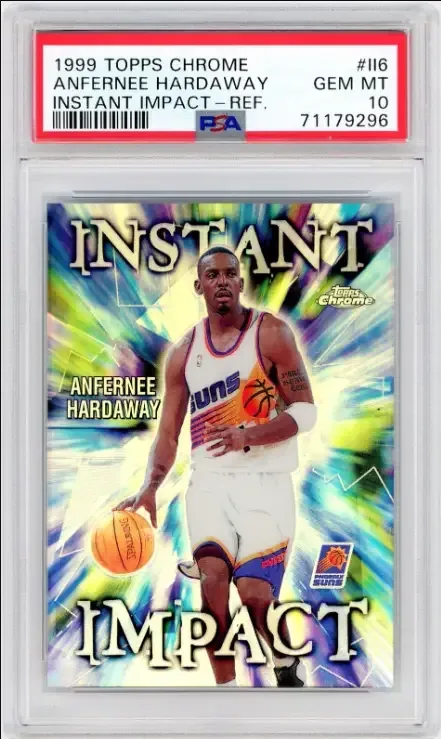
Hardaway’s 1999-00 Topps Chrome Instant Impact Refractor is a useful historical marker rather than a direct rival to his best Orlando cards. The 10-card insert set focused on players joining new teams, and Hardaway’s move to Phoenix was viewed as the start of an important new chapter. A PSA 10 last sold for $150 on September 9, while a PSA 9 has been available for under $40.
Those figures put the card in a different collecting lane: it remains an appealing Refractor and a snapshot of a major move, but it does not carry the same peak-Orlando mythology as the 1993 Finest rookie or the best 1990s inserts. That distinction is valuable for collectors building a coherent player collection. Not every meaningful card has to be the most expensive one.
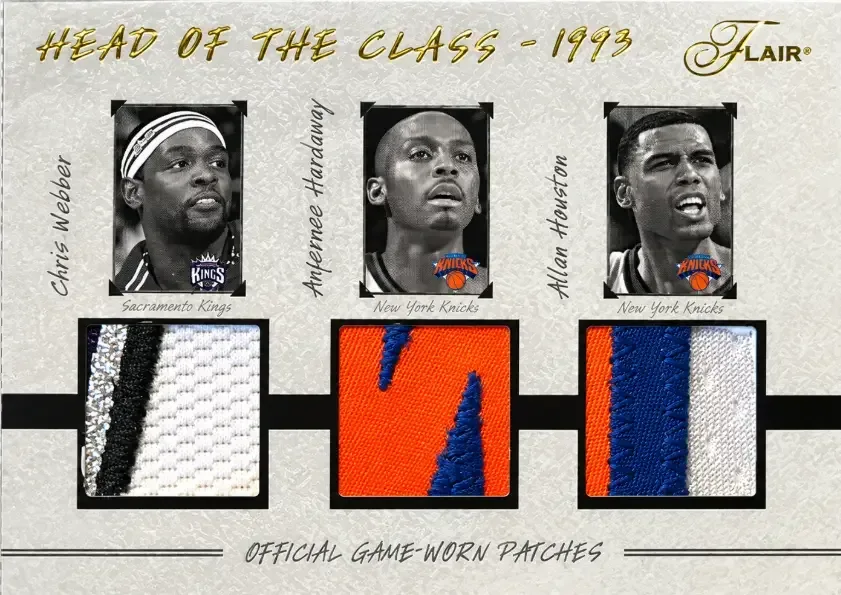
The 2004 Flair Head of the Class Patches card, numbered to 33, is another late-career curiosity. It includes a Hardaway Knicks-uniform swatch alongside pieces tied to Chris Webber and Allan Houston, linking three notable members of the 1993 draft class. Only two sales were reported over five years; the most recent was a jersey-number match, serial-numbered 1/33, for $160 in October 2023.
A jersey-number match is a serial number that corresponds to the player’s uniform number—in Hardaway’s case, No. 1. Such matches can attract extra attention from player collectors, but the limited number of sales here also emphasizes an important practical point: rare does not always mean easy to price. When transaction history is sparse, an isolated sale can reflect the preferences of the specific bidders involved rather than a stable, repeatable market level.
What Penny’s market says about 1990s basketball collecting
Hardaway’s market is a reminder that collecting does not function as a simple ranking of accolades. His career was altered before he could fully test its highest possibilities, yet the hobby continues to reward the force of his early impact. Collectors remember the oversized point guard, the Magic’s rise, the All-NBA seasons and the feeling that a pack might yield a gleaming piece of basketball’s next great era.
For anyone considering Hardaway cards, the sensible approach is to identify which part of that story matters most. The 1993 Finest base rookie connects to his arrival. The Refractor adds scarcity and visual appeal. Natural Born Thrillers and A Cut Above showcase the era’s imaginative insert culture. PMGs are the elite, limited-print chase. Phoenix and late-career issues fill out a player collection with chapters that are less celebrated but still historically meaningful.
That range is the real strength of Penny Hardaway’s cardboard legacy. Even decades after his peak, the cards preserve both the player he was and the superstar many believed he was still becoming.