Jason Williams built a lasting basketball-card following the same way he built his reputation on the court: by being impossible to mistake for anyone else. The point guard known as “White Chocolate” made improvisation part of his identity, turning behind-the-back passes, hesitation dribbles and ambitious fast-break shots into appointment viewing. That distinct appeal now gives his card catalogue an unusually broad shape, with inexpensive relic cards at one end and five-figure rarities at the other.
For collectors, the interesting part is not simply that certain Williams cards have risen. It is that several different kinds of cards are drawing attention at once: 1998 rookie cards in top grades, a small pool of licensed rookie-year autographs, early memorabilia inserts, and premium one-of-ones from later releases. The result is a player market driven less by conventional superstar résumé logic than by enduring cultural recognition and a memorable style of play.
Why Williams’ cards retain their pull
Williams arrived in the NBA as the No. 7 draft pick and became closely associated with Sacramento and No. 55. His play was built around surprise. A defender could not always anticipate whether he would attack, pull up, or find a passing lane that seemed unavailable a second earlier. Highlights including a hesitation move against Gary Payton and a behind-the-back dribble in Philadelphia helped establish the image that still circulates widely in clips and mixtapes.
That history matters to the trading-card market because collecting often turns on a player’s recognizability as much as statistical accomplishment. Williams’ cards evoke a specific late-1990s basketball aesthetic: early Chrome technology, rookie photo-shoot images, game-used material inserts, and scarce autographs from an era before signatures became as plentiful as they are in many modern products.
His popularity also was tangible during his playing career. At one point, his No. 55 jersey reportedly ranked second in league sales, behind Kobe Bryant’s No. 8. In card terms, that widespread fan connection helps explain why Williams remains compelling to people who watched him in Sacramento, as well as collectors discovering his game through the modern circulation of old highlights.
1998 rookies: the central cards, but not all the same market
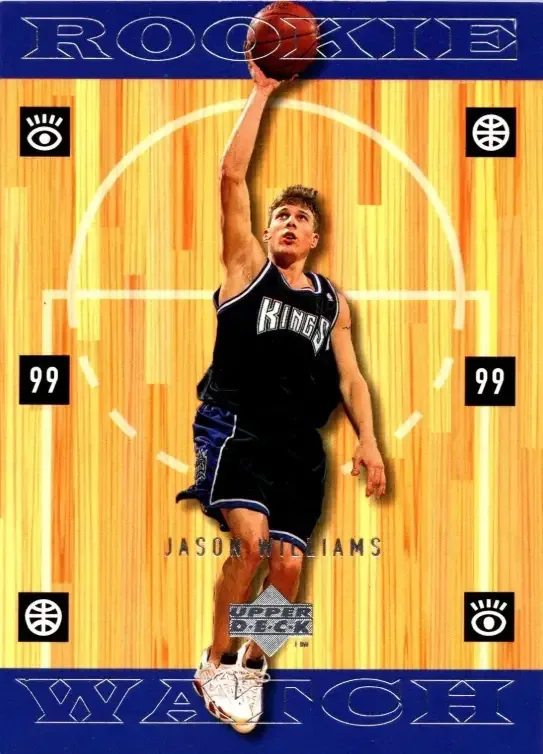
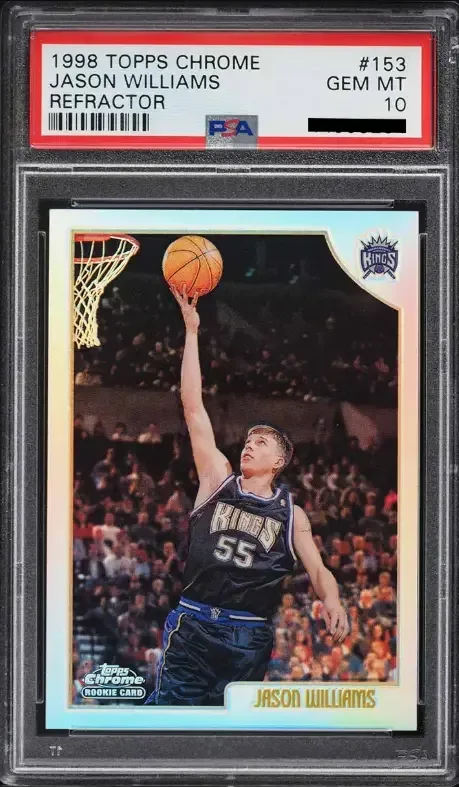
Williams’ rookie cards came out in 1998, and many use relatively restrained photographs for a player remembered for anything but restraint. Topps, Finest and Topps Chrome base cards show him going up for a finger roll. SkyBox and Upper Deck rookie issues include shots from a photo session, with Williams in a blank Kings uniform before he settled on No. 55.
That visual contrast is part of the appeal. The cards are period artifacts from the beginning of a career whose on-court persona quickly became much louder than the imagery manufacturers had available at the time.
The principal price movement described for the 1998 Topps Chrome cards is concentrated in condition and scarcity. That distinction is essential for anyone reading sale prices:
Related coverage includes Jason Williams Cards Still Have Heat as Rookie Chrome, Rare Autos and Memorabilia Climb.
- Base card: the standard, non-parallel version from the set.
- Refractor: a parallel with a reflective finish, generally scarcer and typically more valuable than the base version.
- PSA 9 and PSA 10: third-party grading designations. A higher numeric grade signals a card judged to be in stronger condition, though it does not make two cards otherwise identical.
- Population: the number of copies a grading company has recorded at a particular grade. It is useful context for scarcity, but it is not a complete census of every copy that exists.
A PSA 9 1998 Topps Chrome Refractor changed hands for $1,500 on October 30, a reported database high and a 150% year-over-year increase. A PSA 10 Refractor, with a reported population of 12, rose from just under $3,000 to $5,759 over the same period, a gain of 92.03%.
The regular 1998 Topps Chrome rookie has also moved, albeit at a far more accessible price point. A PSA 10 set a reported record at $239 on September 5, up 138.09%, while a PSA 9 went from $32 to $70, an increase of 115.02%.
The practical takeaway is straightforward: “Topps Chrome rookie” is not one uniform price category. Refractor versus base, and PSA 9 versus PSA 10, can change the financial commitment dramatically. Collectors who want the card’s rookie-year identity rather than a top-grade chase have more options than headline sale figures might suggest.
Early certified autographs are a genuine scarcity story
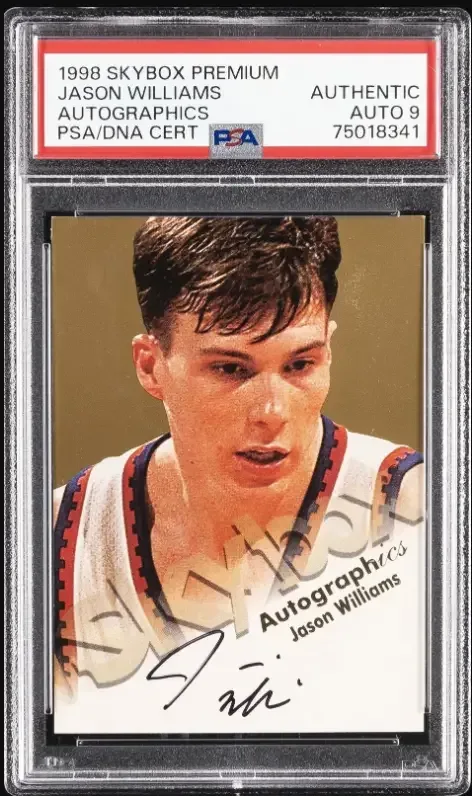
Williams’ rookie-year licensed autograph checklist is notably compact. He has three NBA-licensed 1998 autograph cards: the black-ink and blue-ink versions of SkyBox Autographics, plus Upper Deck Ionix UD Authentics. He also appears on autograph checklists from Collector’s Edge, Press Pass and SAGE, but the NBA-licensed trio is the key distinction for collectors who prioritize league-licensed material.
That detail makes Williams different from many current players, whose signed cards can appear in very large quantities across numerous parallel tiers. In the supplied comparison, Cooper Flagg had 642 autographs in a year—more than 200 times the number attributed to Williams’ licensed rookie-year autograph output.
The split within 1998 SkyBox Autographics illustrates how parallel scarcity changes the market. Raw and PSA 9 examples of the black-ink Autographics and Ionix UD Authentics have sold in the $150 to $170 range. The blue-ink SkyBox Autographics parallel is numbered to 50 and recently exceeded $1,800 at auction.
A serial number such as “/50” means the card is individually numbered within a stated production run of 50 copies. It does not guarantee a condition or price, but it provides a hard print-run ceiling that a standard autograph card may not have. Here, it is one reason the blue-ink card occupies a distinctly higher tier.
Williams did not immediately become a frequent signer after his rookie season. Another pack-issued autograph did not arrive until 2002 Stadium Club Lone Star Signatures. After several dozen signed cards during his Grizzlies and Heat periods, he then spent a decade absent from pack-issued autograph products despite continued collector interest.
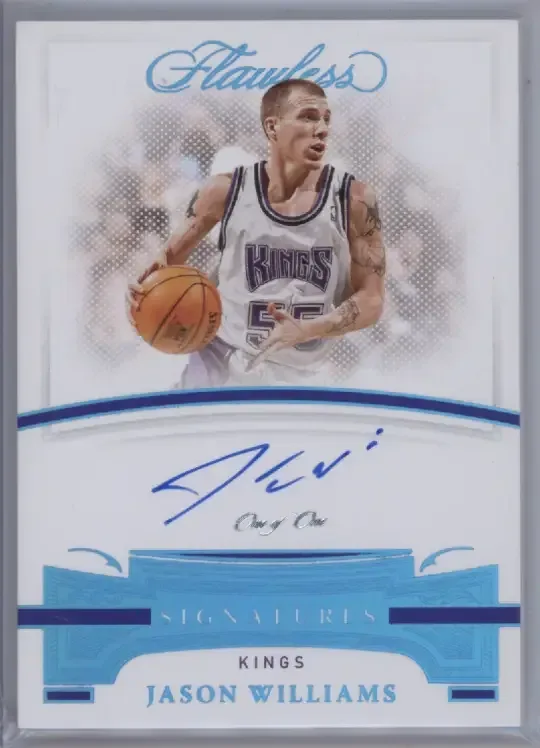
His return came in 2017-18 Panini National Treasures. He has since appeared in a number of Panini and Leaf products, creating a more substantial modern autograph supply. Still, the early gap and tiny rookie-year licensed checklist preserve the appeal of those original issues. More recent one-of-one examples, including a 2020 Flawless Signatures Platinum and a 2024 Prizm Black Nebula FOTL Legends Autograph, have each sold for more than $2,000.
Memorabilia cards offer a lower-cost route—if collectors read the wording closely
Williams was featured in some early player-worn and game-used memorabilia products. These cards are especially useful for collectors who want a physical connection to the player without necessarily pursuing a rare rookie parallel or certified autograph.
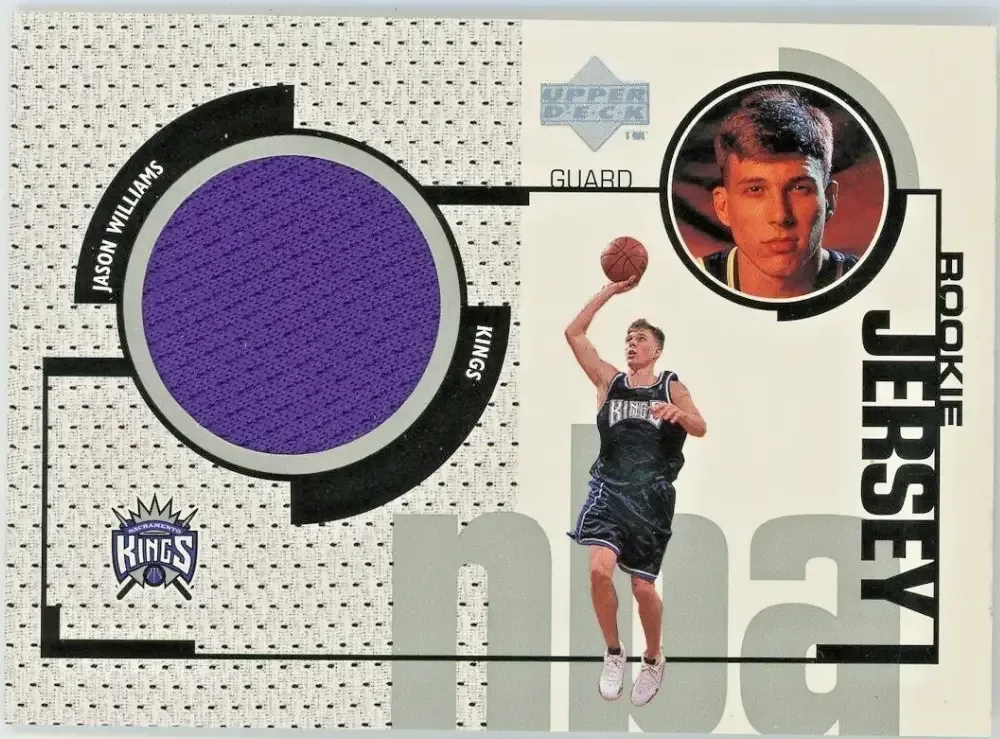
The terminology deserves care. The 1998-99 Upper Deck Game Worn Jerseys / Rookie Jerseys cards contain purple and black pieces from a Kings uniform Williams wore during his rookie photo shoot. That is meaningful provenance, but it is not the same claim as fabric used in an NBA game. “Player-worn” generally indicates an item worn by the athlete; “game-used” means the material is represented as having been used in game action. Those descriptions should never be treated as interchangeable.
A raw copy of that Upper Deck rookie jersey card sold for $1,200 on November 17, while the most recent PSA 9 auction result ended at $1,950. Those are strong results for a player-worn rookie relic and demonstrate that early memorabilia does not automatically equal bargain-bin material.
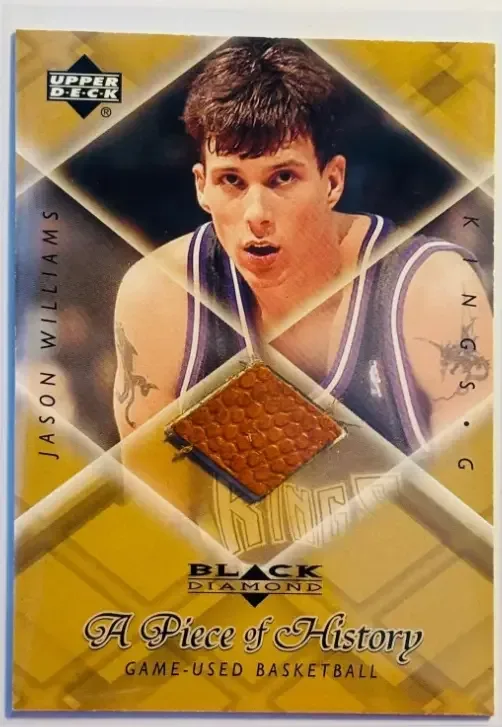
Other Upper Deck and Fleer releases expanded the range of materials, incorporating game-used jersey fabric as well as pieces of court flooring, nets and basketballs. Yet not every relic card sits in a premium bracket. Williams’ 1999 Upper Deck Black Diamond A Piece of History has been available for roughly $20 to $30, while rarer low-numbered parallels have reached as much as $300.
That variety is valuable in practical terms. A collector can pursue a game-used basketball or court-related card as a thematic, relatively affordable addition, then reserve bigger spending for a scarce autograph or a condition-sensitive rookie. It is a more deliberate approach than treating every memorabilia window as equivalent.
The high-end benchmark cards
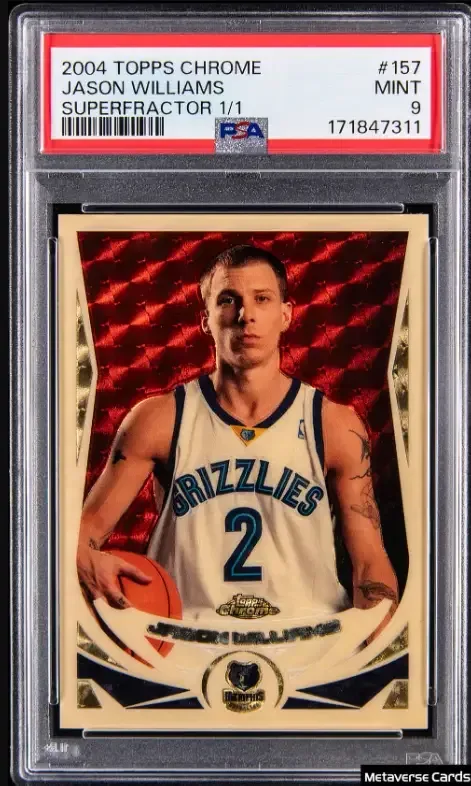
At the top of the market, Williams cards have produced several striking results. A PSA 9 copy of the one-of-one 2004 Topps Chrome SuperFractor #157 sold for $23,180 at auction on August 15. A SuperFractor is a one-of-one parallel in the Topps Chrome ecosystem; one-of-one means the card is the sole stated copy of that particular version.
That sale stands nearly $9,000 above any other reported Williams card transaction. Two PSA 7 copies of his 1998 SkyBox Rubies, numbered to 25, have each sold for around $13,000, with the latest reported sale at $13,200.
The SkyBox Rubies results are a reminder that grade alone is not the entire story. A PSA 7 is below the grades that dominate many modern-card price conversations, but a celebrated late-1990s parallel with only 25 copies can still be a major card. Rarity, set identity, player demand and the historical place of the insert can collectively outweigh the instinct to focus only on the highest possible grade.
Williams memorabilia has also produced a major non-card benchmark. A white, rookie-season Kings jersey that was authenticated and photo-matched to multiple games sold privately for $140,000 in January 2026. A photo-match is the process of connecting a physical item to photographs from a specific use, such as identifiable details in game images. The reported price is the highest paid for a piece of Williams memorabilia.
What a sensible Williams collection can look like
The Williams market is easiest to navigate by deciding which part of his legacy matters most to the buyer. There is no need to frame every purchase as an investment thesis, especially in a market where individual auction results can vary with timing, grade, presentation and bidder competition.
- For the rookie-card collector: compare base Topps Chrome with the Refractor and treat PSA grade as a central part of the decision. A PSA 9 base and a PSA 10 Refractor serve very different goals and budgets.
- For the autograph collector: distinguish NBA-licensed rookie autos from other 1998 signed issues. The black-ink SkyBox Autographics, blue-ink /50 parallel and Ionix UD Authentics have different scarcity profiles.
- For the memorabilia-focused collector: read whether a card is player-worn, photo-shoot worn or game-used, and identify the material—jersey, ball, net or floor—before comparing prices.
- For the high-end collector: the 1998 SkyBox Rubies /25 and 2004 Topps Chrome SuperFractor demonstrate where extreme scarcity and established set appeal meet.
The broader lesson extends beyond one player: the most interesting collections often work because they connect an object to a specific memory. For Williams, that memory is not just a box score. It is the expectation that any possession might produce a pass or dribble move worth replaying. In the wider overlap between sports, fandom and interactive culture, that same relationship between spectacle and collecting is part of why initiatives such as Snoop Dogg’s support for a North Texas game design program resonate beyond their immediate news cycle.
Williams’ cards preserve an era when his style felt unpredictable in real time. Whether the target is a $20 memorabilia card, a key 1998 rookie, a blue-ink autograph limited to 50, or an elite late-1990s parallel, the strongest pieces are the ones that make that identity feel present again.