1. The Switch Was a Moving Technical Target
Yuzu did not begin with an abstract challenge called “emulate the Switch.” It began with a particular machine, introduced into a particular software environment, whose behavior changed over time. Nintendo’s launch material dates the system’s release to March 3, 2017 and presents it as both a home console and a portable device. In the dock, the Switch connects to a television and uses external power and display hardware. Removed from the dock, the same general system becomes a handheld with its own screen, battery, speakers, and physical controls. That dual arrangement is not merely a change in display output. It creates a collection of states that software can observe or respond to, including changes in power management, controller attachment, screen configuration, audio routing, and available accessories.
The launch package also established the Joy-Con as more than two conventional gamepad halves. They could be attached to the sides of the handheld unit, placed together in a grip, or used separately. Nintendo described their buttons, sticks, motion capabilities, vibration features, and wireless use in different configurations. A game that treats two separated controllers as independent devices is making different assumptions from one that expects a single conventional pad. A title may also expect a controller to be present, absent, paired in a particular way, or capable of reporting a motion or input event. For an emulator, reproducing the visible button layout is therefore only one part of input compatibility. The surrounding rules—device enumeration, timing, orientation, attachment state, and response to changing configurations—can matter just as much.
The official documentation separates the Switch family into models and regional product pages rather than treating every retail unit as interchangeable. Nintendo’s manuals and support material document differences in hardware descriptions, included accessories, warnings, operating procedures, and regional documentation. Those differences do not automatically create separate software platforms, but they are reminders that “Switch” describes a product family with documented variants rather than one frozen reference machine. Claims about altered internal components or other undocumented revisions should not be inferred from the general manuals index alone.
The software environment was moving too. Nintendo maintains a system-update history for the console, with releases that add, change, or correct system functions. An update may affect the behavior of an operating-system service, alter how a game communicates with the system, introduce new settings, or change an interface that software relies upon. The public update record does not disclose every implementation detail, and it cannot be used to infer a complete account of security or compatibility. It does establish a basic historical fact: the official environment Yuzu sought to reproduce was not static after launch. It was revised through downloadable system software while the hardware family continued to exist in multiple forms.
That matters because a game does not interact with “the console” at only one level. It may rely on processor behavior, graphics commands, memory ordering, filesystem responses, account-related services, controller reports, audio timing, network behavior, and system notifications. Some of those interfaces are supplied by the operating system rather than by the game’s own code. Some depend on the current version of the system software. Others emerge from the interaction between software and hardware. Reproducing a documented function is not always enough; an emulator may need to reproduce its timing, error behavior, data format, or relationship with another service.
Graphics provide a particularly visible example. The original machine presents a console-specific graphics environment to games, while an emulator must translate that work for a host computer through a graphics backend. A title may appear to render correctly in one scene and fail when it reaches a less common shader, synchronization pattern, texture format, or memory assumption. A game can therefore be “playable” in a broad sense while still exhibiting missing effects, rendering errors, crashes, sound problems, or failures in a particular mode. These are not contradictions. They reflect the fact that compatibility is a collection of behaviors rather than a single switch that turns on when a title launches.
The 3DS platform documented in Nintendo’s manuals presents a different target for the same reason. It has its own dual-screen arrangement, input hardware, operating-system services, graphics behavior, software formats, and model history. The upper and lower screens, the touchscreen, the stylus-oriented interface, the cameras, the circle pad, and the system’s other hardware assumptions create a different set of interfaces from those of the Switch. Citra was designed around that 3DS environment. Yuzu was designed around the Switch environment. The two projects belonged to the same broad field of console emulation, but the technical objects they modeled were not interchangeable.
This distinction is easy to lose when compatibility reports are reduced to lists of game names. A list can be useful, but it tends to hide the conditions behind each entry: a specific build, a particular system version, a particular graphics backend, a specific controller arrangement, or a workaround that later becomes obsolete. It may also conflate reaching a title’s menu with completing a long session without a defect. Official console updates and game patches can change the software behavior being reproduced, while emulator updates can change the approximation on the other side.
Yuzu’s technical problem was therefore cumulative. It had to model a hybrid console whose public identity included portable and docked states, changing controller arrangements, system software that received updates, multiple hardware variants, regional documentation, and games with different assumptions. That description does not predict a performance level or prove that any particular title worked. It explains why a serious account of Yuzu cannot treat the Switch as a single specification sheet or compatibility as a simple “runs” or “does not run” result. The moving target was part of the project’s engineering context from the beginning.
2. Yuzu’s Origin and the Citra Lineage
Yuzu’s history is best understood through the development culture around Citra rather than through the later controversy that ended Yuzu. Preserved project metadata describes Citra as an open-source Nintendo 3DS emulator and debugger. That wording matters. It places the project in a technical and research-oriented tradition in which emulation is not only a way to launch commercial software. It can also provide a controlled environment for examining system behavior, developing homebrew, testing software, reproducing bugs, and learning how a platform exposes its interfaces.
An open-source emulator is not simply a binary distributed to an audience. It is a body of source code, build configuration, dependencies, issue discussions, test information, documentation, and decisions about what the project will and will not support. Contributors work across abstractions that are difficult to separate cleanly: processor translation, graphics, operating-system services, input, audio, storage, user interfaces, and platform portability. A mature project can also accumulate habits for reviewing changes, handling regressions, describing compatibility, and communicating with users. Those habits are part of what can move from one project to another even when the target hardware changes.
Yuzu’s relationship to Citra should be described as a limited, documented lineage rather than a fully reconstructed personnel or infrastructure history. Preserved Citra metadata identifies a separate open-source Nintendo 3DS emulator and debugger, while preserved Yuzu build metadata identifies a distinct C++ Switch-emulation project and its dependencies. Those records support the conclusion that the projects targeted different platforms and existed within related open-source emulator history. They do not, by themselves, establish the identities of all overlapping developers, shared repositories, or the precise movement of governance practices between the projects.
The preserved build records help make that distinction concrete. Historical Yuzu metadata identifies a C++ source tree, a source revision, and dependencies used to construct the project. Such records are valuable evidence of how a historical build was organized and of the project’s portability and reproducibility concerns. They do not, by themselves, establish the performance of the resulting program, the size of its audience, the motives of contributors, or the complete relationship between Yuzu and Citra.
Portability was part of the design problem. A console emulator must translate a platform created for one hardware and software environment into an application that can run on different host operating systems and processor families. That requires abstractions, conditional code, graphics backends, input layers, build systems, and libraries capable of working across host configurations. Experience from Citra could be useful because many engineering questions recur: how to represent guest memory, how to schedule work, how to isolate platform-specific code, how to make debugging information usable, and how to keep a large volunteer or semi-professional codebase coherent.
But recurring questions do not mean identical solutions. The 3DS and Switch expose different processors, graphics systems, displays, controllers, operating-system services, and software expectations. A contributor familiar with one platform could carry methods and knowledge into another project, while still having to learn a new target from the ground up. The lineage is therefore better described as organizational and technical inheritance than as direct interchangeability. It explains why Yuzu could draw on an existing community’s experience without implying that every component or every individual’s role is fully documented.
Governance shaped that inheritance. Open-source work distributes authority through repositories, review practices, licenses, maintainers, issue trackers, release channels, and community norms. Those structures can make a project appear more transparent than a closed commercial product, but transparency is uneven. Some decisions are recorded in code and commit history. Others occur in private administration, support channels, funding arrangements, or conversations that later disappear. A preserved build manifest may prove that a dependency was used; it cannot prove why a maintainer selected it. A project description may state a purpose; it cannot establish that every user followed that purpose.
The distinction between stated purpose and actual use became increasingly important as Yuzu developed. An emulator can be presented as useful for homebrew, debugging, research, and preservation while also attracting people interested in commercial releases. Those uses can coexist. The existence of infringing behavior by some users would not logically prove that emulation itself is identical to infringement, just as a project’s stated research purpose would not prove that all users behaved within it. A careful history must hold both facts in view without converting either into a total explanation.
Citra’s role in the story is consequently neither a footnote nor a claim that the projects were one organization in every meaningful sense. It was the earlier platform, the documented project context from which a limited technical and organizational lineage can be traced, and a separate technical undertaking. Yuzu became a new emulator with its own source tree, dependencies, compatibility work, and governance pressures. That lineage helps explain Yuzu’s origin, but it does not establish that Citra supplied every contributor, practice, or administrative structure, and it does not settle the later legal questions or tell us what every person associated with either project intended.
The surviving evidence is also uneven. Official project pages and repositories were later closed, archived, or made unavailable through their original organizations. Preserved metadata therefore has an importance beyond build archaeology. It records names, licenses, target platforms, dependencies, and historical relationships at a time when the projects were active. It cannot restore every issue, discussion, or release. It can, however, prevent the origin story from collapsing into a later allegation that Yuzu appeared fully formed as a consumer piracy service. The documented lineage points to something more complicated: a technical project built from an open-source emulator culture, aimed at a distinct platform, and gradually pulled toward expectations that its original research and development framing could not contain.
3. Technical Design: Translation, Services, and Compatibility
Yuzu can be understood as a stack of translations and approximations rather than as one program that “copies” a console. At the lowest conceptual level, the emulator receives software written for the guest platform and presents that software with an environment resembling the original machine. The host computer, meanwhile, has a different processor, memory system, graphics interface, operating system, input devices, and timing behavior. Yuzu’s work lay in mediating between those worlds. Every layer that appears simple from the outside can contain assumptions that a game depends upon.
The processor layer illustrates the problem. Switch software is built for an ARM-based guest environment, while the computer running an emulator may use a different ARM implementation or an x86 processor. A dynamic recompiler, or just-in-time translator, converts blocks of guest instructions into host instructions while the program is running. Dynarmic’s documentation describes this general relationship in terms of ARM guest and host architectures and dynamic recompilation. Instead of interpreting every guest instruction in the most direct way each time, a JIT can translate a block, cache a result, and reuse it when appropriate. That is a technical mechanism, not a guarantee of speed or correctness.
Translation must preserve more than the apparent outcome of an isolated instruction. Guest code expects particular registers, memory operations, exceptions, synchronization behavior, and relationships between threads. The host has its own rules. A recompiler therefore needs mechanisms for mapping state, handling events, invalidating translated blocks when necessary, and dealing with operations that do not have a direct equivalent. Small differences can remain invisible in ordinary code and become decisive in a game subsystem that depends on timing or concurrency. Dynarmic’s documentation supports an account of the translation architecture, but it does not establish how a particular Yuzu build performed across particular software.
Graphics create another translation boundary. Games issue commands for a guest graphics environment; the emulator maps those commands to a host graphics API through backends and supporting libraries. Preserved Yuzu build metadata identifies Vulkan-related dependencies and other libraries in the historical project structure. That evidence shows the project’s dependency architecture, not a universal rendering result. A backend may need to handle shader translation, resource formats, synchronization, memory visibility, presentation, and feature differences between host graphics devices. A title that uses common rendering paths may behave differently from one that exercises a less frequently used feature.
The operating-system layer is just as important, though less visible in screenshots. Games often request services rather than manipulate hardware directly. They may expect processes to be scheduled, files to be opened, controllers to be enumerated, audio buffers to be submitted, network requests to be routed, or system events to be delivered. An emulator must supply compatible service interfaces and return plausible results. Some services can be implemented locally. Others may depend on external systems or on functions that are difficult to reproduce outside the original console. The phrase “system services” therefore covers a wide range of emulated behavior, not a single switch that an emulator either possesses or lacks.
Input is similarly layered. A host computer may provide a keyboard, mouse, gamepad, motion sensor, or touchscreen, while the guest software expects one or more Joy-Con arrangements, a handheld state, or another console-specific device. The emulator must translate host events into guest reports with suitable identity, timing, and configuration. Audio requires its own scheduling and buffering decisions. Storage requires a representation of files, directories, metadata, permissions, and persistence. Networking introduces interfaces, timing, failure behavior, and the question of which services can be meaningfully represented without reproducing the original network environment.
These components interact. A controller event can affect a game state that causes new graphics work and audio output. A storage response can alter a loading sequence whose timing exposes a synchronization defect. A system update can change an interface that a game or emulator service expects. A bug that appears to belong to graphics may originate in memory management or scheduling. This is why compatibility reports should not be read as a scoreboard for one subsystem. They describe an outcome produced by a chain of translations, dependencies, and approximations.
Build metadata is useful here because it preserves the project’s material structure. The historical records identify C++ source, graphics-related libraries, and other dependencies, allowing researchers to reconstruct what kinds of components were present. They do not supply a complete architectural diagram, and they cannot prove that a particular feature worked in every release. They also do not justify reproducing restricted technical material. A dependency list can support a conceptual explanation of translation and portability without becoming an installation recipe or a guide to handling protected software.
The same caution applies to claims about “compatibility.” Reaching a menu, rendering a scene, or running a test is not the same as reproducing an entire title’s behavior. A game may depend on a service that is only used later, an unusual graphics path, a particular controller state, or a sequence that stresses timing. Conversely, a visible defect may be confined to one subsystem while the rest of the software remains functional. The meaningful unit is often not the game name but the combination of emulator build, host environment, system software assumptions, controller arrangement, and tested behavior.
Yuzu’s technical design was therefore a problem of interface fidelity. The emulator translated CPU execution, graphics work, operating-system requests, input, audio, storage, and networking across a boundary between unlike machines. It used portable source and external libraries to make that work maintainable across hosts. The result could be improved through engineering, testing, and compatibility reporting, but it could never be reduced to one performance claim. That layered design also explains why the project generated both serious research interest and strong consumer expectations: the same architecture that made the platform accessible made its gaps visible whenever a game relied on behavior not yet reproduced.
4. From Research Project to Consumer-Facing Platform
Yuzu’s growth was not only a story of code becoming more capable. It was also a story of a project’s public role changing as development, distribution, funding, and support became more visible. An open-source emulator can begin as a technical experiment and become a service that users expect to build, update, troubleshoot, and explain itself. That change can be observed through dated project records, release material, compatibility reporting, community activity, and—where documented—funding arrangements. It should not be inferred merely from the existence of an emulator or from general community interest.
The open-source setting encouraged participation but also created a complicated governance structure. Source code, build records, issue reports, documentation, and community discussions could exist in different places and under different levels of control. Maintainers decided which changes were accepted, which platforms received attention, and how regressions were communicated. Users often supplied valuable reports, but reports varied in quality and completeness. A project could gain a reputation for supporting a title or feature without possessing a standardized measurement of what “support” meant. One person’s successful launch might be another person’s crash during a later sequence.
Support systems amplified that tension. Once an emulator has a substantial audience, questions about controllers, graphics, updates, saves, crashes, and configuration can become a second project layered on top of development. The community may create wikis, compatibility lists, troubleshooting discussions, and unofficial explanations. Those materials can help preserve knowledge, but they also blur the boundary between what maintainers verified and what users inferred. A claim repeated across forums is not automatically a project statement, and a project statement does not establish that every user experienced the same result.
Nintendo’s complaint described Patreon growth associated with Yuzu, and any discussion of that activity should remain attributed to the complaint unless a dated first-party funding record is available. Funding can support maintainers, infrastructure, testing, release work, and sustained labor, but the cited court filing does not establish how every payment was used or prove that funding itself represented infringement. The existence of funding may help explain why Nintendo characterized Yuzu as a visible commercial threat; it does not independently establish the project’s audience, legal status, or internal arrangements.
The project’s stated purposes and user behavior must remain separate. Homebrew developers may use an emulator to test software without access to original hardware. Researchers may use it to study interfaces and reproduce behavior. People who own a game may have reasons to seek a different display, accessibility arrangement, or development environment. At the same time, an emulator can be used by people who acquire unauthorized copies or who want to play software before its legitimate release. The existence of those different users does not make them one category. Emulation is not automatically equivalent to piracy, and a research purpose does not prove that every use was lawful.
Nintendo’s later complaint presented a different account of Yuzu’s scale and commercial effect. It alleged broad consumer use, rapid compatibility with commercial releases, growth in Patreon support, and conduct connected with unauthorized copies of The Legend of Zelda: Tears of the Kingdom. Those allegations are historically important because they show how the rights holder interpreted the project and what it placed before the court. They are not independent audience measurements or findings reached after a contested trial. Figures and causal claims drawn from a complaint should therefore be identified as allegations, especially where the pleading used information-and-belief language.
The distinction matters because popularity is often reconstructed from the wrong evidence. Repository activity can show that code was changed. A release record can show that a package or source revision was published. A funding page can show that patrons supported a project at a given time. None of those records alone establishes a total user count, universal compatibility, or the proportion of users who engaged in infringement. Even a large visible community may not represent silent users, abandoned installations, or people who only tested homebrew. Historical analysis should use the evidence each record can actually bear.
Yuzu’s consumer-facing turn also changed the meaning of failure. In a research project, an incomplete subsystem may be a known area of work. In a project treated as a product, the same defect becomes a support complaint or a promise that appears unmet. Compatibility reporting can help developers prioritize work, but it can also create a simplified public map in which a title is labeled working or broken. The underlying reality remains conditional: different builds, hosts, graphics paths, controller arrangements, and system assumptions can produce different outcomes. Consumer expectations tend to compress that complexity.
Distribution made the project more than a repository. Builds, release channels, community infrastructure, and support services connected code to users. That connection was productive: more users could report issues, test changes, and expose unusual cases. It also increased the project’s visibility and made questions about commercial use harder to separate from questions about engineering. A project can be open-source while still having controlled releases, community communication, funding, and a recognizable public brand. “Open source” describes an important property of the code and licensing context; it does not describe every aspect of governance or use.
By the time Yuzu became widely recognized outside specialist circles, it occupied several roles at once. It remained a technical project with difficult translation and compatibility problems. It was an open-source development effort with inherited practices from the Citra lineage. It was a community with issue reports, support expectations, and public claims. It was also a funded distribution platform whose alleged relationship to commercial releases became central to Nintendo’s case. Those roles overlapped without becoming identical. The rise of Yuzu was therefore not simply a measure of how many games it could start. It was the accumulation of code, infrastructure, community labor, funding, and expectations that turned an emulator into a visible platform—and made its eventual shutdown a loss of both software and institutional history.
5. The Tears of the Kingdom Flashpoint
The controversy that brought Yuzu into the center of public attention did not begin with the filing of Nintendo’s lawsuit on February 26, 2024. It developed during 2023, around the release of The Legend of Zelda: Tears of the Kingdom, and became a story about timing, compatibility, unauthorized copies, funding, and the meaning of an emulator’s design. Those subjects became intertwined in public discussion. They should not be treated as interchangeable evidence.
Tears of the Kingdom was scheduled for Nintendo’s official release in May 2023. Nintendo’s February 26, 2024 complaint alleged that unauthorized copies circulated before that release, that those copies could be played in Yuzu, and that pirate sites recorded more than one million downloads. The complaint also alleged rapid compatibility and growth in Yuzu’s Patreon support. Those are allegations in Nintendo’s pleading, including assertions made on information and belief where indicated; they are not independently adjudicated measurements or findings reached after trial.
The distinction is important because several different propositions can be true without proving one another. Unauthorized copies of a game may exist. Some people may use an emulator to run those copies. An emulator may be technically capable of running a title near its commercial release. None of those facts, standing alone, demonstrates that the emulator caused every unauthorized acquisition, that every user copied the game, or that each alleged copy represented a lost sale. Causation was one of the questions Nintendo asked the court to accept, not a fact independently adjudicated in the later settlement.
Nintendo’s complaint presented Yuzu as a system that facilitated unauthorized access to protected Switch software. It alleged that the project’s design and distribution allowed users to bypass technological restrictions and play copied games on other devices. It also alleged that Yuzu was primarily directed toward commercial Switch games rather than being merely a general research tool. The complaint pleaded legal theories involving circumvention, copyright infringement, secondary liability, and inducement. Those theories described Nintendo’s claims against Tropic Haze and the project’s associated conduct.
The wording of the pleading matters. Some factual assertions were stated “on information and belief,” a conventional formulation indicating that the plaintiff believed the proposition to be true based on the information available when the complaint was filed, while reserving the possibility that evidence would be developed later. Such language is not an admission that a claim is speculative, but it is also not a trial finding. A careful history should preserve that distinction instead of converting allegations into settled measurements.
One of Nintendo’s central allegations concerned the relationship between Yuzu’s compatibility work and the appearance of unauthorized Tears of the Kingdom copies. Nintendo argued that Yuzu’s ability to run the game made the unauthorized distribution more useful and therefore increased the harm caused by copying. The complaint described the project’s technical development and public-facing support as evidence of that relationship. It also connected the project’s funding model and Patreon activity to the alleged commercial benefit obtained from making the emulator available.
That argument was not simply that an emulator existed. Nintendo’s theory was that particular design choices, development practices, and distribution arrangements helped users access Nintendo’s copyrighted games in circumstances Nintendo considered unlawful. The legal significance of that theory depended on details about technological measures, project purpose, knowledge, encouragement, and the relationship between Yuzu’s conduct and users’ conduct. Those questions were pleaded in the complaint and later addressed through the parties’ negotiated resolution. They were not tested through cross-examination and competing expert evidence at trial.
The complaint also described Patreon growth and other indicators of public demand. Such information can help explain why Nintendo viewed the project as a commercial threat rather than as an obscure research experiment. It does not, by itself, establish the project’s total audience, the source of every payment, the number of users who possessed unauthorized copies, or the amount of any actual lost revenue. Funding records are evidence of support. They are not automatically evidence of infringement or a causal sales calculation.
Nintendo further alleged substantial financial effects from the unauthorized availability of Tears of the Kingdom. The complaint connected alleged downloads and user behavior to claimed losses and to the value of Nintendo’s exclusive release window. Those claims were part of the requested relief and the explanation for seeking immediate legal intervention. They should be reported as Nintendo’s estimates or allegations, not as court-verified economic findings. The $2.4 million figure that later appeared in the judgment was a negotiated award, not a judicial endorsement of every loss calculation in the complaint.
The chronology also contains a technical argument that became important in the legal narrative. Nintendo alleged that Yuzu’s compatibility with a major commercial release developed unusually quickly and that this compatibility depended on access to protected system materials or on bypassing technological measures. The complaint used that alleged capability to support its claims about design and purpose. But technical compatibility alone does not reveal how a user obtained a game, whether a user possessed an authorized copy, or whether every component required for a particular use was distributed by the project.
This is where public shorthand became especially misleading. “The emulator played the game” is not equivalent to “the emulator caused all unauthorized copies.” Nor is “unauthorized copies were circulating” equivalent to “every emulator user infringed.” An emulator may have lawful and unlawful uses in different circumstances. The controversy concerned Nintendo’s allegations about Yuzu’s specific design, conduct, and relationship to copying—not a universal proposition that software emulation always has the same legal character.
The complaint’s filing on February 26, 2024 transformed a fast-moving controversy into a federal case. By then, the public dispute had already combined technical claims, user behavior, Patreon funding, and Nintendo’s concern about the release of a major title. The filing supplied a formal account of those events, but it did not close the evidentiary questions. Its allegations became part of the settlement context; they did not become a substitute for a contested factual record.
6. Seven Days from Complaint to Shutdown
The legal chronology moved with unusual speed. Nintendo filed its complaint against Tropic Haze LLC on February 26, 2024. The filing sought relief concerning Yuzu’s development, distribution, and associated conduct. It placed the emulator’s technical design and public operation inside a dispute involving the Digital Millennium Copyright Act, copyright law, and theories of secondary responsibility and inducement.
The complaint was the opening pleading, not a judgment. At that stage, Nintendo had stated claims it intended to prove or resolve. Tropic Haze had not been found liable after a trial. No appellate court had reviewed the merits. The case therefore began with an adversarial claim but ended before the ordinary process of discovery, expert evidence, summary judgment, and trial could establish which disputed allegations would survive challenge.
On March 4, the parties filed a joint motion seeking a consent judgment. The motion changed the procedural character of the dispute. Instead of asking the court to decide the allegations after a contested presentation of evidence, the parties presented an agreed resolution. The documents included proposed findings, monetary terms, and permanent injunctive obligations. The agreement allowed the case to conclude before the factual and legal theories in the complaint were tested in open litigation.
Two days later, on March 6, the court entered the final judgment and permanent injunction. The judgment gave legal force to the settlement’s obligations and awarded Nintendo $2.4 million. It also required the defendants to stop specified activities connected with Yuzu and the associated project infrastructure. The speed of the sequence—complaint on February 26, joint motion on March 4, judgment on March 6—helps explain why the event was often described as a shutdown rather than as a conventional lawsuit unfolding over years.
The contemporaneous project statement made the practical outcome unmistakable. Citra announced the immediate discontinuation of Yuzu and Citra, along with the closure of repositories, Patreon, Discord, and websites connected with the projects. The statement did not describe a plan for a gradual transition, a final maintenance period, or a public succession process. It communicated that the existing organizational structure and its official services were ending at once.
That statement is significant for historical reasons. It announced the project operators’ immediate response: Yuzu and Citra would be discontinued, repositories and Patreon accounts would be taken offline, Discord servers would be discontinued, and websites would soon close. It does not establish that the operators had already complied with every obligation later entered in the judgment. Its historical effect was to mark the disappearance of centralized locations where source code, issue histories, compatibility information, build records, documentation, and community discussions had been collected. Some material survived through independent preservation, but the official project presence no longer served as a stable public archive.
The chronology should not be described as “Nintendo won at trial.” There was no contested merits trial. There was no published merits opinion explaining, after adversarial briefing and evidence, whether each element of Nintendo’s causes of action had been proved. There was no appellate ruling declaring emulation unlawful as a category. The court entered a consent judgment because the parties agreed to the resolution presented to it.
That does not make the judgment insignificant. A consent judgment is enforceable, and its injunction can impose immediate and concrete obligations on the parties bound by it. The agreement also contains stipulated findings that shaped the legal record of Yuzu. But negotiated findings have a different precedential character from findings reached after one side proves its case and the other side has a full opportunity to contest the evidence.
The distinction between consent and trial is particularly important in technology cases. A settlement can reflect litigation risk, cost, access to evidence, business priorities, the threat of an injunction, and the parties’ assessment of what they can afford to fight. It may resolve a dispute without answering every question that observers hoped the court would decide. That is what happened here. The result was powerful for Yuzu’s operators while remaining limited as a general statement about all emulators.
The March 6 judgment also did not automatically determine the status of every copy of Yuzu held by an unrelated person or every project built by an unrelated developer. The obligations applied to the defendants and to conduct, assets, services, and materials covered by the judgment. A person who later encountered a source mirror, a rebuilt project, or a differently governed emulator could not infer its legal status solely from the fact that Yuzu had been shut down. That question would require separate analysis of provenance, conduct, licensing, and applicable law.
The seven-day sequence nevertheless altered the technical ecosystem immediately. A project that had maintained repositories, funding channels, community services, and official releases stopped operating through those channels. Developers and users lost the ordinary mechanisms by which changes were reviewed, issues were reported, and historical records were consulted. The legal case ended quickly, but its practical effects spread across software maintenance, community governance, and preservation.
The best description is therefore precise: Nintendo filed a federal complaint; the parties negotiated and jointly requested a consent resolution; the court entered a final judgment and permanent injunction on March 6; and the Yuzu and Citra project organizations announced immediate discontinuation. That was a decisive shutdown of the defendant-controlled project structure. It was not a trial verdict on emulation generally, and it was not an appellate declaration that every related project had the same legal status.
7. What the Settlement Actually Did
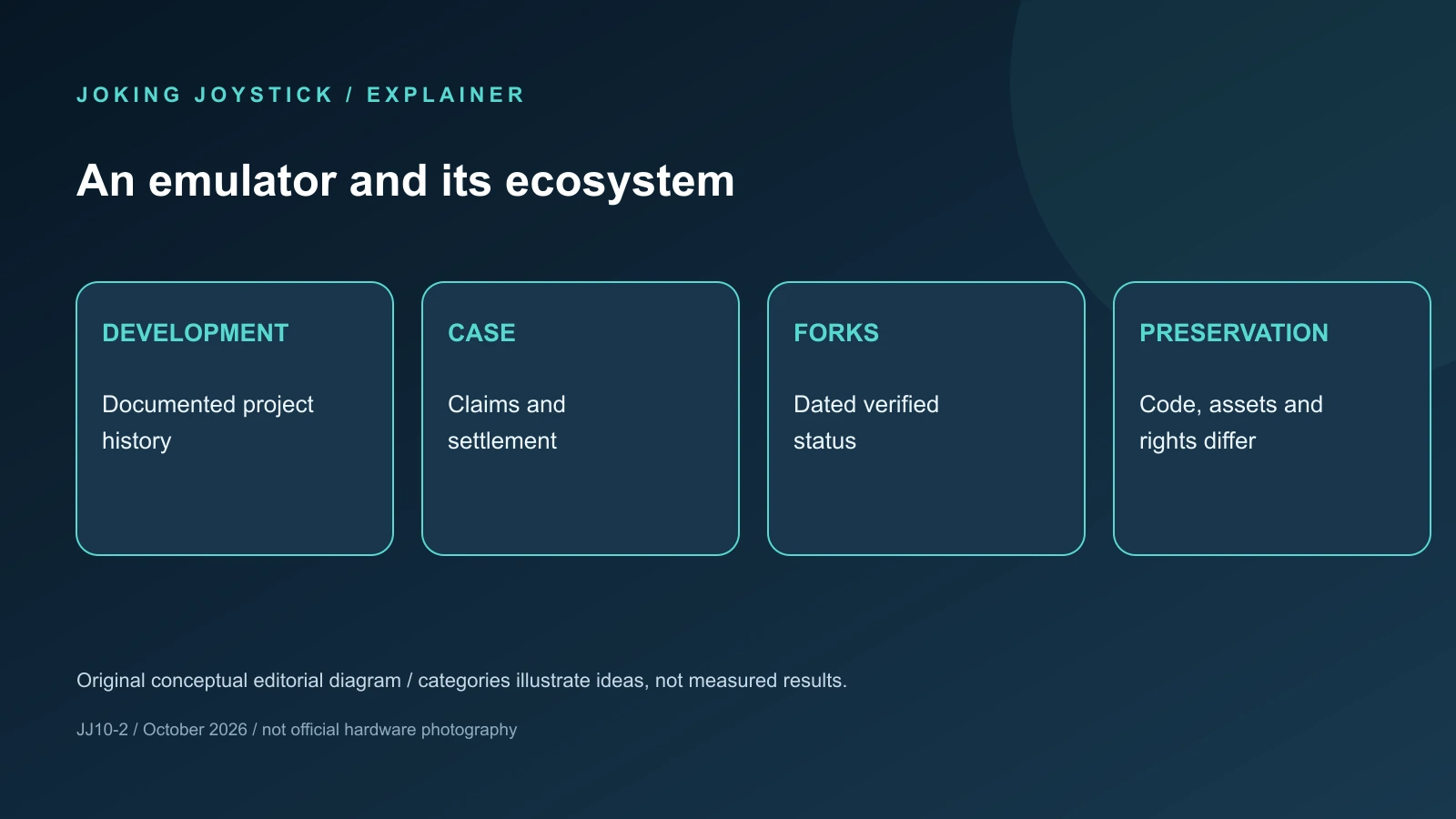
The settlement’s most visible consequence was the end of Yuzu as an operating project under its existing organization. The final judgment awarded Nintendo $2.4 million and imposed permanent injunctive obligations on the defendant and the parties covered by the order. The injunction prohibited offering, providing, marketing, promoting, selling, testing, hosting, cloning, distributing, or otherwise trafficking in Yuzu or its source code or features, as well as specified circumvention software and infringing conduct. It also addressed controlled websites, systems, domains, and materials. The result was not merely a decision to stop publishing new versions.
The injunction’s practical force lay in its combination of conduct prohibitions and asset provisions. The judgment covered the defendant, its members and agents, successors and assigns, and specified third parties acting in active concert or participation. It barred continued trafficking in Yuzu or its source code and features, prohibited efforts to evade the order through new entities or transfers, required the surrender and transfer of specified defendant-controlled domains and systems, and provided for destruction by deletion of covered materials upon Nintendo’s election and to the extent controlled by the defendant or its members. Those provisions explain why the resolution reached beyond the publication of new releases.
The shutdown also affected the infrastructure around the code. A software project is not only its main repository; it may include build systems, issue trackers, documentation, continuous-integration records, release pages, domain names, chat communities, funding accounts, and administrative credentials. The judgment expressly addressed specified websites, systems, and domains under the defendant’s control, while the contemporaneous Citra statement separately announced closure of repositories, Patreon, Discord, and websites. The court order and the project’s operational shutdown therefore should not be collapsed into one claim that every Citra asset was individually adjudicated or destroyed.
The judgment’s monetary award and the shutdown obligations served different purposes. The $2.4 million award resolved the financial component of the dispute. The injunction governed future conduct and project assets. Neither should be treated as a measurement of all alleged Nintendo losses. The amount was part of the negotiated resolution, while the permanent injunction established enforceable restrictions on the defendants. The documents did not say that the award represented a court-calculated price for every unauthorized copy described in the complaint.
The settlement also should not be expanded into an automatic rule covering every independent copy or unrelated emulator. A court order binds the parties and reaches the conduct and property specified in its terms. It does not, merely by existing, transform every program with similar functionality into the defendant’s project. Nor does it establish that an independently developed emulator has the same provenance, design, licensing history, or legal exposure as Yuzu.
That limitation does not mean that a fork or mirror is automatically permissible. An independent project may raise its own questions about source-code provenance, licenses, distribution practices, technological measures, inducement, or the use of project-controlled material. A new name does not erase an old code lineage. Conversely, a project that shares a technical goal with Yuzu is not automatically the same legal entity. The relevant distinction is between what the judgment directly required and what would need to be assessed separately in another context.
The settlement documents also did not authorize public redistribution of material merely because it had once been available. The fact that a repository was historically open, or that a build was once downloadable, does not answer whether the defendants retained the right or ability to distribute it after the judgment. Preservation therefore became a more difficult task. Researchers might want source history, build metadata, issue discussions, and documentation, while the parties’ agreement required the defendant-controlled project to cease specified distribution and address project assets.
A preservation copy and a public release are not necessarily the same thing. An institutional archive may hold records under controlled access, document provenance, and preserve them for historical study. A public mirror may reproduce software without demonstrating authenticity, licensing authority, or compliance with the judgment. The settlement does not provide a general preservation license, and an accessible file is not evidence that distribution is authorized. Those questions are especially important when material may include components with different licenses or records whose legal status changed with the project’s shutdown.
The same caution applies to claims about what was removed. The closure of official repositories does not prove that every historical source file vanished. It means that the original project-controlled public channels were discontinued, archived, or made unavailable through their former organizations. Independent archives, package metadata, repository mirrors, and successor projects may preserve portions of the history. Their existence does not make them identical to an official release, and their contents should not be treated as verified solely because they use familiar names.
The injunction’s significance is thus both narrower and stronger than popular summaries suggest. It was narrower because it did not automatically govern every emulator, fork, mirror, or private copy in the world. It was stronger because it directly ended the defendants’ ability to continue Yuzu through their existing project structure and required action concerning associated services and materials. The distinction prevents two opposite errors: claiming that the judgment settled the legality of all emulation, or minimizing it as if nothing beyond a website closure had occurred.
For users and historians, the immediate consequence was uncertainty about provenance. Official project pages stopped being the default place to verify whether a release was genuine, current, or authorized. Later repositories could document lineage, but they could not retroactively become the original project. A preserved build record could establish that a dependency or revision existed at a particular time, but it could not establish that a later binary was safe, authentic, or approved for redistribution. Preservation required metadata and institutional care, not simply copying a familiar executable.
The settlement therefore created a boundary around defendant-controlled conduct and materials while leaving broader questions open. It ended Yuzu’s official development and distribution, imposed a monetary judgment, and required compliance concerning the project’s infrastructure. It did not issue a universal ruling against emulation, grant permission to redistribute historical software, or decide that every successor had the same legal status. Understanding that boundary is essential to describing both the shutdown and the fragmented projects that followed.
8. What the Case Did and Did Not Hold
Nintendo’s complaint and the consent judgment belong to different categories of legal record. The complaint stated Nintendo’s theories. The consent judgment memorialized the resolution the parties accepted and the obligations the court entered. Treating the two documents as if they were both contested findings obscures how the case actually ended.
The complaint pleaded several theories. It alleged circumvention of technological measures under the Digital Millennium Copyright Act, copyright infringement, secondary liability, and inducement. In broad terms, Nintendo argued that Yuzu was designed and operated in a way that enabled users to access and copy protected Switch games, and that the project’s public distribution and support encouraged or facilitated that conduct. Those were claims for the court to resolve if the case proceeded.
The complaint’s legal theories were connected to factual allegations about Yuzu’s architecture, its relationship to protected system materials, its compatibility with commercial games, its funding arrangements, and the conduct of users. Nintendo argued that those facts showed more than a neutral tool with many possible uses. It sought to characterize the project’s design and operation as contributing to unauthorized access and copying. Whether each inference would have been accepted after litigation is a question the settlement left unanswered.
The consent judgment included stipulated findings concerning Yuzu’s design and conduct. It states that Yuzu circumvents Nintendo’s technological measures, decrypts Switch game files or component files immediately before and during runtime, ordinarily requires proprietary cryptographic keys to gain access to and play Switch games, and is primarily designed to circumvent and play Switch games. The defendants acknowledged that the findings were true and accurate as part of the joint motion. They therefore became part of the enforceable consent-judgment record, but they were not conclusions reached after a contested trial with competing evidence and a reasoned merits opinion.
A stipulated finding can have real legal consequences without functioning like binding appellate precedent. The defendants agreed to the judgment and its obligations. Nintendo obtained an enforceable injunction and monetary award. The court entered the agreed resolution. But another court considering a different emulator would not simply be applying a universal rule that all emulation is unlawful. It would examine the new project’s facts, design, conduct, licensing, distribution, and relationship to protected works and technological measures.
This is why the case did not decide the legality of emulation generally. There was no published merits opinion holding that emulation as a category violates copyright law or the DMCA. There was no appellate ruling establishing a categorical prohibition. The case resolved a dispute about Yuzu and Tropic Haze through consent. Its findings and injunction are consequential, but they should not be enlarged into a general ban on software that reproduces the behavior of another platform.
That conclusion is not a declaration that clean-room emulation is lawful in every circumstance. It is a statement about the scope of this record. Different projects may use different development methods, source histories, licensing arrangements, technical approaches, and distribution practices. They may also make different public claims or provide different services. A legal analysis of one cannot be replaced by a slogan derived from another.
The case also did not establish that every Yuzu user committed infringement. Nintendo’s complaint described alleged user conduct involving unauthorized copies and access. The settlement resolved claims against the project defendants, not a series of individual adjudications against every person who had used Yuzu. Some users may have engaged in unlawful activity; others may have used the software for different purposes. The record does not support collapsing those categories into one universal conclusion.
Nor did the case prove every claimed economic effect. Nintendo alleged that unauthorized copies and Yuzu’s compatibility caused financial harm, and it sought relief based on those allegations. The parties agreed to the $2.4 million judgment. That award is legally enforceable, but it is not a court-verified calculation of all alleged downloads, all lost sales, or a causal rate linking every copy to a specific commercial loss. Settlement figures often reflect the value of resolving litigation rather than a judicial accounting of each disputed variable.
The technical findings should also be read within their context. A statement that Yuzu was designed to play Switch games describes the project’s principal function. It does not mean that every emulator with the same broad function has the same legal character. A statement about circumvention in the agreed findings reflects the parties’ resolution concerning Yuzu. It does not supply a technical or legal test that can be applied mechanically to any future project without examining how that project operates.
The Citra shutdown illustrates the same distinction. Citra targeted the 3DS and was documented as an open-source emulator and debugger. It was discontinued alongside Yuzu because of the connected organizational and infrastructure structure. The supplied case materials do not provide a contested merits adjudication that Citra’s own 3DS emulation was unlawful. Citra’s disappearance was a practical consequence of the shared project environment and the decision to end the associated operations, not a separate trial verdict about the 3DS emulator.
Consent judgments can still influence governance even when they do not create broad precedent. Developers may become more cautious about centralized services, funding models, public compatibility claims, and the relationship between source code and distributed builds. They may preserve fewer official channels, separate organizations, or avoid features that could be characterized as facilitating access to protected software. Those responses are editorially observable changes in project practice, not proof that a particular legal strategy would succeed or fail.
The most accurate account holds those propositions together. Nintendo alleged that Yuzu’s specific design and operation facilitated unlawful access and copying. The defendants consented to a judgment containing stipulated findings and enforceable obligations. The court entered that judgment on March 6, 2024. The original Yuzu and Citra organizations then shut down their official operations. What remains unresolved for future projects is not whether the shutdown happened, but how the facts and law apply to software with different provenance, governance, technical design, and distribution choices.
9. Citra’s Collateral Shutdown and Preservation Contradiction
Citra did not emulate the Nintendo Switch. Its preserved project metadata describes an open-source Nintendo 3DS emulator and debugger, aimed at a different console, a different generation of system software, and a different technical environment. That distinction matters. The March 2024 shutdown was not a court finding that Citra’s 3DS emulation had independently been proved unlawful. The supplied case record contains no contested merits adjudication of Citra’s code or of 3DS emulation as a separate matter.
Citra nevertheless disappeared at the same time as Yuzu. The project statement establishes the operational fact that Yuzu and Citra would both be discontinued and that repositories, Patreon accounts, Discord servers, and websites associated with the projects would close. It does not, standing alone, establish the full personnel, administrative, or infrastructure relationship between the projects. The most defensible description is therefore that Citra was included in the connected organizational shutdown, while the reasons for that structure and the extent of shared administration remain partly an editorial inference unless supported by additional archived evidence.
This is best understood as a question of organizational exposure rather than platform identity. Yuzu’s target was the Switch; Citra’s target was the 3DS. Their codebases, services, user communities, and development histories were not interchangeable. But if the same defendant-controlled structure administered projects, accounts, repositories, funding arrangements, and communication systems, a legal settlement directed at that structure could have consequences beyond the particular program named in public discussion. The connection did not make Citra Yuzu. It made Citra part of the environment that the defendants chose, or were required, to shut down.
The distinction resembles the difference between a company’s product line and its corporate infrastructure. A court dispute may concern one product’s alleged design and use, while the practical resolution affects accounts, staff, repositories, domains, and shared services supporting several products. The second project can be discontinued without having been separately tried. That is what the available record supports here. Citra was collateral to a connected shutdown, not independently declared unlawful on the merits.
The shutdown statement also illustrates why project history cannot be reconstructed from source code alone. A repository may reveal commits, licenses, dependencies, and build instructions, but it does not necessarily preserve the reasons for a governance decision, the conversations that shaped a feature, the history of a compatibility report, or the relationship between maintainers and users. When the official organization closes its websites and communication channels, those records can vanish even if fragments of source code remain elsewhere.
Citra’s preserved metadata therefore has unusual historical value. It identifies the software as a 3DS emulator and debugger, records its open-source character, and places it within a defined project and packaging context. Such metadata is not a substitute for the complete repository or its issue history. It does, however, preserve facts that might otherwise be lost: the project’s intended platform, its stated purpose, its licensing context, and the distinction between Citra and Yuzu.
The same problem affects Yuzu. Preserved build metadata can identify a historical source revision, dependencies, and reproducibility information without reproducing an entire official release. It can show that a project was assembled from particular components at a particular point in time. It cannot by itself establish that a later mirror is authentic, that a binary was produced from the recorded source, or that redistribution is authorized. Metadata is evidence of provenance, not a universal permission slip.
The closure also disrupted the ordinary process by which technical knowledge is corrected. Compatibility reports are often provisional. A user may describe a graphics problem, another may identify a system-version difference, and a maintainer may later revise the diagnosis. Over time, those exchanges become an informal record of how an emulator interacted with hardware behavior, operating-system services, controllers, graphics backends, and game-specific assumptions. Removing the issue tracker does not merely remove conversation; it removes the trail by which later researchers can distinguish an original limitation from a later regression.
Documentation has a similar layered character. A project’s user-facing description may explain its purpose. Developer documentation may identify dependencies and build assumptions. Release notes may record changes without explaining their implementation. Continuous-integration records can show that a source revision was built, while not proving that the resulting artifact was tested comprehensively. Each layer answers a different historical question. The shutdown made several layers harder to consult through official channels at precisely the moment when the legal controversy made them more important.
There is a preservation contradiction at the center of Citra’s disappearance. The project was software history in an unusually concrete form: a record of attempts to reproduce the behavior of a named handheld platform, with documentation of debugging and homebrew-oriented uses. Yet the organizational structure that kept those records coherent was also the structure exposed to the Yuzu dispute and settlement. Ending that structure reduced legal and operational exposure for the defendants while making independent historical reconstruction more difficult.
That contradiction does not mean the shutdown was improper, nor does it justify ignoring the settlement. The judgment imposed obligations on the defendant-controlled project and associated materials. A researcher cannot assume that every former official file may be republished simply because it has historical value. Preservation must account for ownership, licensing, court-ordered treatment, personal information, third-party dependencies, and the difference between holding a record in an archive and distributing software to the public.
Nor should Citra’s absence be read as proof that the 3DS emulator had no lawful or technical uses. The metadata’s description of an emulator and debugger records the project’s stated function. Users, developers, and researchers may have interacted with that function in different ways. The shutdown resolved the defendants’ position; it did not adjudicate every historical use by every individual.
As of October 26, 2026, the original Citra organization is best described as discontinued or archived according to the available project and repository record. That status says something about current institutional continuity. It says nothing, by itself, about whether every historical source fragment survived, whether every independent archive is accurate, or whether a later project using related code is officially Citra. Those questions require provenance evidence, not branding.
10. Forks Are Not One Movement
The word “fork” suggests a simple event: one codebase divides, and two projects proceed along parallel paths. Post-shutdown emulator development is less tidy. Some projects describe themselves as direct continuations. Some preserve or rebuild a codebase under new governance. Some are mirrors whose primary function is archival. Some are experimental branches. Others use familiar names without establishing a documented relationship to the original organization. Treating all of them as one movement confuses technical inheritance with institutional succession.
The first evidence rule is therefore straightforward: current activity must be tied to an official project repository, project statement, release page, or dated record. A repository’s existence is evidence that someone has published something. It is not automatically evidence that the project is maintained, that a binary is trustworthy, that a release corresponds to the visible source, or that the project has inherited the original organization’s rights or responsibilities.
Eden provides one documented form of lineage. Its official project materials identify it as a new Yuzu fork intended to continue emulator work. That description supports a narrow claim: Eden presents itself as a successor project built from Yuzu-related history. It does not establish Nintendo’s approval, clean-room development, legal independence, or universal technical compatibility. Those are separate questions requiring separate evidence.
The word “new” also matters in Eden’s self-description. A new project can inherit source code, technical knowledge, naming conventions, and unresolved engineering problems while changing governance. It may establish new maintainers, new accounts, new release practices, and new policies concerning infrastructure. Those changes can be significant without erasing the project’s lineage. A fork is not made historically unrelated merely by moving to a new organization.
Suyu illustrates a more complicated succession record. Its maintained repository documents lineage involving archived Suyu and Eden, along with later work described in terms of static or hybrid recompilation. The repository therefore supports a documented chain of development claims. It does not prove that every intermediate artifact was produced by the same team, that every historical repository remains authoritative, or that all code was developed under identical governance. Lineage is a record of stated inheritance, not a guarantee of uniform provenance.
The distinction between archived Suyu and the later Suyu organization is especially important. An archived predecessor may preserve a historical project identity without showing current maintenance. A later organization may publish current source and release records while using a related name. The two should not be collapsed into one continuous institution unless the project’s own records demonstrate that continuity. The later repository can document its relationship to the predecessor, but its activity must be measured from its own dated evidence.
Citron Neo describes itself as continuing the Citron codebase. That is a lineage claim about a particular code history, not a declaration that Citron Neo is the official continuation of every project associated with Yuzu or Citra. Its repository provides the relevant evidence for its stated codebase, supported platforms, license, and build-development status. The fact that a project describes itself as a continuation does not settle questions about licensing compliance, source provenance, or legal exposure.
Other categories should remain separate. A mirror may preserve files without directing development. An experimental branch may test a technical idea without offering a stable public release. A project focused on a particular platform may share ancestry with a broader emulator while having a different maintenance model. A repository that merely reuses a familiar name may have no documented connection at all. Popularity, search placement, social-media discussion, and community confidence cannot substitute for a project’s own records.
Editorial inference: The shutdown may have encouraged successor projects to reconsider centralized services, self-hosting, public claims, licensing explanations, and provenance records. The available project pages do not establish a universal post-settlement governance response. Concrete changes should be attributed to the individual project’s own repository, release page, or statement rather than presented as a general legal consequence.
Self-hosting can reduce dependence on a single platform, but it creates a different preservation problem. A project may control its own domain and release system while making less of its history visible to outside researchers. Centralized services often provide timestamps, change histories, mirrors, and familiar archival mechanisms. Decentralized operation can improve autonomy while making it harder to establish which repository is authoritative or whether a release has been altered. Neither model is automatically superior; each changes the evidence available later.
Public claims also became more consequential. Describing a project as a research tool, a compatibility effort, or a continuation may communicate legitimate goals, but the description does not determine user conduct or legal status. Conversely, a project’s ability to run commercial software does not by itself establish that every use is infringing. The responsible historical question is what the maintainers claimed, what the code and records show, and what the settlement did or did not decide.
Licensing and provenance are linked but not identical. A license may authorize certain uses of source code while imposing attribution or notice requirements. Provenance asks where the code came from and how it changed. A project can publish a license while still needing to explain its relationship to an inherited codebase. It can also document lineage without proving that every component satisfies every licensing obligation. These are governance tasks, not conclusions that follow from a project name.
The same caution applies to binaries. A current repository can demonstrate source activity. A release page can demonstrate that a project published a dated artifact. Neither fact guarantees that an executable is safe, authentic, complete, or identical to the source visible in the repository. Package contents, build systems, third-party dependencies, signing practices, and distribution channels all matter. This feature therefore records release evidence without recommending downloads or treating any project as approved by Nintendo or another authority.
Forks also do not inherit the original project’s users, support promises, or institutional memory automatically. A new issue tracker may contain useful reports but not the full historical context. A new compatibility list may use familiar categories while changing their definitions. A new release may preserve behavior while changing defaults, platform support, or dependencies. The technical lineage can be real even when the governance lineage is broken.
By October 26, 2026, the evidence supports a plural account rather than a single successor narrative. Eden documents a new Yuzu-fork identity. The maintained Suyu repository documents a lineage involving archived Suyu and Eden and publishes later development evidence. Citron Neo documents continuation of the Citron codebase. These statements support lineage claims. They do not establish legal approval, clean-room status, universal compatibility, or a single community consensus about succession.
The useful question is not which project has inherited the most attention. It is which claims can be verified, by which records, and for what date. A fork is a technical and organizational relationship. It is not a ranking, a warranty, or a legal conclusion.
11. Status Ledger as of October 26, 2026
A status ledger is more useful than a winner’s podium because emulator projects have several kinds of status at once. The entries below separate identity and lineage from repository or release evidence, and they record only what can be supported by first-party materials available by October 26, 2026. Original Yuzu and Citra are discontinued through their former project structures. Eden’s official organization record shows mirror activity observed through October 26, 2026. Citron Neo’s official organization record shows emulator activity observed through October 25, 2026, with CI repository updates through October 26, 2026 and separate release evidence dated October 16, 2026. The later Suyu repository and release records provide activity through the release of suyu v14.1.0 on October 12, 2026; the same project history separately identifies suyu v0.0.4 as an archived predecessor. These dates establish public project evidence, not runtime quality, binary safety, legal approval, or universal compatibility.
| Project or organization | Identity and lineage | Status evidence available by October 26, 2026 | What the evidence does not establish |
|---|---|---|---|
| Original Yuzu | Original Switch emulator organization and project | Discontinued through the original project structure after the March 2024 settlement and shutdown | It does not show that every historical source fragment disappeared or that every independent copy has the same legal status |
| Original Citra | Separate 3DS emulator and debugger, connected organizationally with Yuzu | Discontinued following the contemporaneous shutdown statement and closure of related infrastructure | It was not separately adjudicated unlawful on the merits in the supplied court record |
| Eden | Official materials identify it as a new Yuzu fork intended to continue emulator work | Official organization record shows mirror activity observed through October 26, 2026 | Lineage is not legal approval, clean-room status, binary safety, or measured compatibility |
| Archived Suyu | Earlier Suyu project identity documented separately from later Suyu activity | Archived predecessor status | Archive status does not describe the activity of the later Suyu organization |
| Later Suyu organization | Maintained repository documents lineage involving archived Suyu and Eden | Official repository and release evidence through October 12, 2026, including the release of suyu v14.1.0 | Release records do not establish universal performance, legal approval, or binary safety |
| Citron Neo | Official repository describes continuation of the Citron codebase | Official organization record shows emulator activity observed through October 25, 2026; CI repository updates extend through October 26, 2026, with separate release evidence dated October 16, 2026 | Continuation claims do not settle licensing, legal independence, or runtime quality |
The first ledger entry concerns Yuzu itself. The original organization’s public repository record and the March 2024 shutdown statement support describing Yuzu as discontinued through its former project structure. That conclusion does not require claiming that every historical commit, package record, or independent archive vanished. It means that the original project no longer operates as an official development and distribution organization through those channels.
Citra occupies a parallel but distinct entry. Its project metadata identifies a 3DS emulator and debugger, not a Switch emulator. Its official shutdown statement announced discontinuation alongside Yuzu and the closure of related repositories, Patreon accounts, Discord servers, and websites. The supplied legal materials do not provide a contested merits decision about Citra’s own code or 3DS emulation. Its discontinued status is therefore organizational and operational, not a separate finding of unlawfulness.
Eden’s entry is supported by its own repository and project materials. Eden describes itself as a free and open-source Switch emulator, and its official organization record shows mirror activity observed through October 26, 2026. Its materials also identify a GPLv3 license and acknowledge historical relationships with Yuzu and other projects. Those facts support recording Eden as a project with recent first-party activity and documented lineage. They do not establish Nintendo’s approval, clean-room development, legal independence, binary safety, or universal compatibility.
Suyu requires two entries because its history contains a predecessor and a later organization. The repository identifies suyu-emu/suyu-v0.0.4 as a public archive where no further development was planned. The later suyu-main repository states that it picked up the codebase from a specified commit, continues development, and had reached suyu v14.1.0 by October 12, 2026. Those records support distinguishing archived Suyu v0.0.4 from later Suyu activity. They do not convert the later project into an official corporate or legal continuation of Yuzu.
The existence of a release record also needs careful interpretation. It shows that a project published an artifact or source-associated release at a particular time. It does not provide an independent measurement of compatibility across games, hardware variants, system versions, controllers, graphics backends, or operating systems. Nor does it establish that the package contents are safe for every user. The ledger records publication evidence, not a recommendation.
Citron Neo’s status rests on its own documented lineage and dated activity. Its repository states that it is an open-source emulator continuing the Citron codebase, identifies Windows, Linux, macOS, and Android arm64 as supported targets, and records active issue and pull-request infrastructure. The official organization record shows emulator activity observed through October 25, 2026, while its CI repository shows updates through October 26, 2026 and separate release evidence dated October 16, 2026. Those materials support a current project identity and public activity by the October 26, 2026 cutoff. They do not justify merging Citron Neo into the Yuzu lineage, treating it as an official Citra successor, or assuming that code continuation resolves licensing, provenance, legal, or runtime questions.
The ledger also demonstrates why “active” is a limited word. Activity may mean commits, issue responses, build changes, a release, or an updated project statement. It does not automatically mean that development is continuous, that the code works as claimed, or that a release has been tested across all supported configurations. A project can be active and technically immature. Another can be quiet while preserving a stable historical state. Status and quality are different dimensions.
Platform claims must be recorded separately from project identity. A repository may state that it supports desktop systems, mobile systems, or particular processor families. Those statements describe intended or declared scope. They do not establish identical behavior across models or operating systems. The Switch itself changed through hardware variants and system updates, while emulator behavior depends on graphics APIs, input, services, and game-specific assumptions. A project’s platform label cannot replace compatibility evidence.
Repository activity is similarly distinct from institutional continuity. A new organization may contain active developers and a documented code lineage while having no legal or administrative relationship with the original Yuzu organization. An archived predecessor may retain historical importance while no longer accepting changes. A mirror may preserve files while lacking maintainers. The ledger keeps these states visible instead of translating them into a single word such as “alive” or “dead.”
The cutoff date matters because project status changes. The entries above describe the evidence available through October 26, 2026. They do not predict future releases, future shutdowns, or future legal events. Nor do they claim that an organization’s public repository is the only place where work exists. They identify what can be responsibly said from official project materials and dated records at the specified time.
Most importantly, the ledger is not a buying guide or installation guide. It does not recommend a binary, mirror, package, or successor. It records project identity and evidence while withholding conclusions that the records cannot support. A public repository demonstrates publication and activity. It does not guarantee authenticity, safety, legality, compatibility, or approval.
12. Preservation After Yuzu
The preservation question begins by refusing to treat “the emulator” as a single object. Source code is one layer. Build metadata is another. Issue history, compatibility reports, documentation, release notes, binaries, user-created saves, hardware observations, community discussions, domain records, funding history, and institutional correspondence are separate materials with different evidentiary and legal characteristics. Losing one layer can distort the meaning of the others.
Source code can show how a project attempted to reproduce platform behavior. It can reveal architectural boundaries, dependencies, portability decisions, and the order in which features changed. But source code without history may conceal why an implementation was chosen, whether it was experimental, and whether a later change fixed a regression or introduced one. A preserved commit graph and issue record can turn a static code snapshot into a developmental record.
Build metadata answers a different question. It may identify a source revision, compiler assumptions, external libraries, platform targets, and reproducibility information. The preserved Yuzu metadata is valuable for this reason: it records aspects of how historical builds were assembled without requiring the preservation of every distributed artifact. Yet build metadata does not prove that an unrelated package was produced from the same inputs. Reproducibility is a method for checking provenance, not a guarantee that any accessible file is genuine.
Compatibility reports are observations, not laws of nature. They often depend on hardware, system software, graphics drivers, controller configuration, and the particular revision being tested. Nintendo’s manuals and system-update history provide context for the original hardware and software environment. They do not measure emulator performance. Conversely, an emulator issue report may reveal behavior that official documentation never describes. Preservation requires keeping both kinds of record while avoiding the claim that either one alone provides a complete technical specification.
Documentation also preserves intent. Project metadata describing Citra as an open-source 3DS emulator and debugger helps prevent later histories from incorrectly folding Citra into Yuzu. Yuzu build records preserve a separate Switch-oriented lineage. Successor repositories document how later projects describe their inheritance. These statements are not neutral in every detail, but they are evidence of how the projects understood and presented themselves at particular times.
Binaries are historically important and legally sensitive. A source tree may not reproduce the behavior of a release without the correct build environment and dependencies. A binary may preserve a user-facing state that source alone cannot easily reconstruct. At the same time, distribution of a binary can implicate licensing, provenance, court-ordered obligations, bundled components, and authenticity. The historical value of an artifact does not automatically authorize public redistribution.
The settlement sharpened that tension. The defendants agreed to obligations affecting Yuzu’s development, distribution, specified services, controlled websites and systems, and covered project materials. A preservationist may reasonably believe that future researchers should be able to study the software and its history. That belief does not override the judgment or establish a general right to republish material covered by it. The proper question is not simply whether a file matters, but who controls it, what rights attach to it, what the order requires, and what form of access is being proposed.
Controlled archival access may differ from a public download. An institutional archive can record provenance, restrict access where appropriate, preserve hashes and timestamps, and maintain a chain of custody. It can separate source code from bundled materials, retain documentation without distributing prohibited assets, and document uncertainty rather than presenting a mirror as official. These practices do not resolve every legal issue, but they make the preservation claim more precise.
Institutional archives could also preserve records that volunteer mirrors rarely capture. They might retain project statements, organizational metadata, release announcements, issue exports, licensing files, build descriptions, and correspondence with appropriate privacy review. They could preserve the relationship between a source snapshot and the documentation that explained it. Without such work, later histories may overrepresent whatever files happened to remain visible and underrepresent governance decisions, failed experiments, and discontinued branches.
Reproducible builds offer one possible bridge between preservation and provenance. A future researcher could compare a preserved source revision, build metadata, dependency versions, and a recorded artifact rather than relying on a filename or a familiar project logo. This does not require publishing every artifact in every context. It requires preserving enough information to test claims about origin and transformation. The method is particularly valuable after a project loses its official release infrastructure.
Legal safe harbors are a harder institutional question. Libraries, archives, universities, and museums may need clearer rules for preserving historically significant software when the original project has been shut down by settlement. A safe harbor could distinguish preservation copies, research access, public distribution, and commercial use. It could specify how to handle encryption-related material, third-party code, personal information, and court orders. Any such framework would require lawmakers, courts, rights holders, archivists, and developers to define boundaries rather than assuming that preservation and redistribution are identical.
Technical preservation also has limits. A source tree cannot preserve the original hardware’s physical behavior. Manuals can describe controls and system concepts, while update histories can date official software changes, but neither recreates a console’s display timing, controller feel, storage behavior, or peripheral interactions. Hardware observations, test conditions, photographs, diagrams, and contemporaneous reports may be needed to interpret what the emulator was attempting to reproduce.
User-created saves and configuration records present another distinction. They can document how software was used and what state a particular user reached, but they may include data from copyrighted games, personal information, or proprietary formats. Preserving them requires consent and careful separation from game software or other material that should not be redistributed. A save file is not the same historical object as a source repository, even when both are associated with the same emulator.
The successor projects add another preservation layer: lineage after institutional collapse. Eden’s official materials, the maintained Suyu repository and its 2026 releases, and Citron Neo’s description of its codebase continuation provide records of how later developers understood and extended earlier work. These repositories should be preserved as later project histories, not retroactively mislabeled as official Yuzu or Citra releases. Their existence helps document continuity and divergence at once.
Preservation should therefore record uncertainty. An archive may know that a repository was published by a particular organization but not whether every release asset was built from the visible source. It may know that a project claimed continuation without being able to verify every inherited component. It may preserve a metadata file while lacking the original binary. Honest labels are more valuable than false completeness. “Official,” “archived,” “mirror,” “successor,” and “unverified” should describe evidence, not reputation.
The Yuzu case also shows why deletion can create historical distortion. When official channels close quickly, later observers may mistake surviving fragments for the whole project. They may treat a popular mirror as canonical, infer that missing records never existed, or assume that a successor’s description settles every disputed fact. Preservation has to resist that compression. It should retain multiple forms of evidence and make the gaps visible.
None of this requires turning preservation into a route around the settlement. An accessible mirror is not automatically authentic, lawful, safe, or authorized. Historical interest does not justify distributing keys, firmware, game files, leaked assets, or circumvention guidance. The preservation task can focus on source provenance, build records, documentation, institutional history, hardware context, and legally appropriate archival access without reproducing material that the project was required to remove or surrender.
The final lesson is institutional rather than technological. Yuzu’s shutdown did not erase the history of emulation, but it fractured the places where that history had been kept. Citra’s collateral disappearance made the fracture visible on a separate platform. Successor repositories now preserve parts of the lineage under different governance, while archived metadata preserves other parts. The question after Yuzu is not whether software history should be saved. It is who will save which layer, under what authority, with what provenance, and for whom.
A durable preservation model would combine source archives, build metadata, issue histories, documentation, hardware records, and carefully governed access. It would distinguish historical evidence from executable distribution and project lineage from legal succession. It would preserve the record of a settlement without treating that settlement as a universal ruling on emulation. And it would make room for technical research without converting an archive into an invitation to bypass the obligations that ended Yuzu’s original life.
Related reading and hardware searches
Check the exact item, edition, seller, compatibility, regional fit, price and availability before buying.
Affiliate disclosure: As an Amazon Associate, Joking Joystick earns from qualifying purchases. Search results do not guarantee stock or price.