Victor Wembanyama’s latest huge box score has moved from the court to the collecting world. Topps NOW’s 2026-27 NBA release commemorating his 52-point, 24-rebound and eight-block performance is a limited ordering-window card with more going on than its standard edition: numbered foil parallels, a short-printed photo variation and a particularly unusual autograph-relic chase using net material from the game.
The release is built around a format that makes the deadline as important as the subject. The base card is printed to order, meaning collectors may place orders while the card remains listed, rather than buying from a predetermined base-card print run. Ordering closes Saturday, November 7 at 5 p.m. EST.
That creates two related but distinct collecting propositions. One is a direct purchase of the commemorative card itself. The other is the possibility that an order contains a scarce insert instead of—or in addition to—the expected base-card experience: a photo variation or an autographed relic. The latter is not a guaranteed result of ordering, and the stated likelihood is tied to the number of cards purchased.
A moment-specific card built around Wembanyama’s stat line
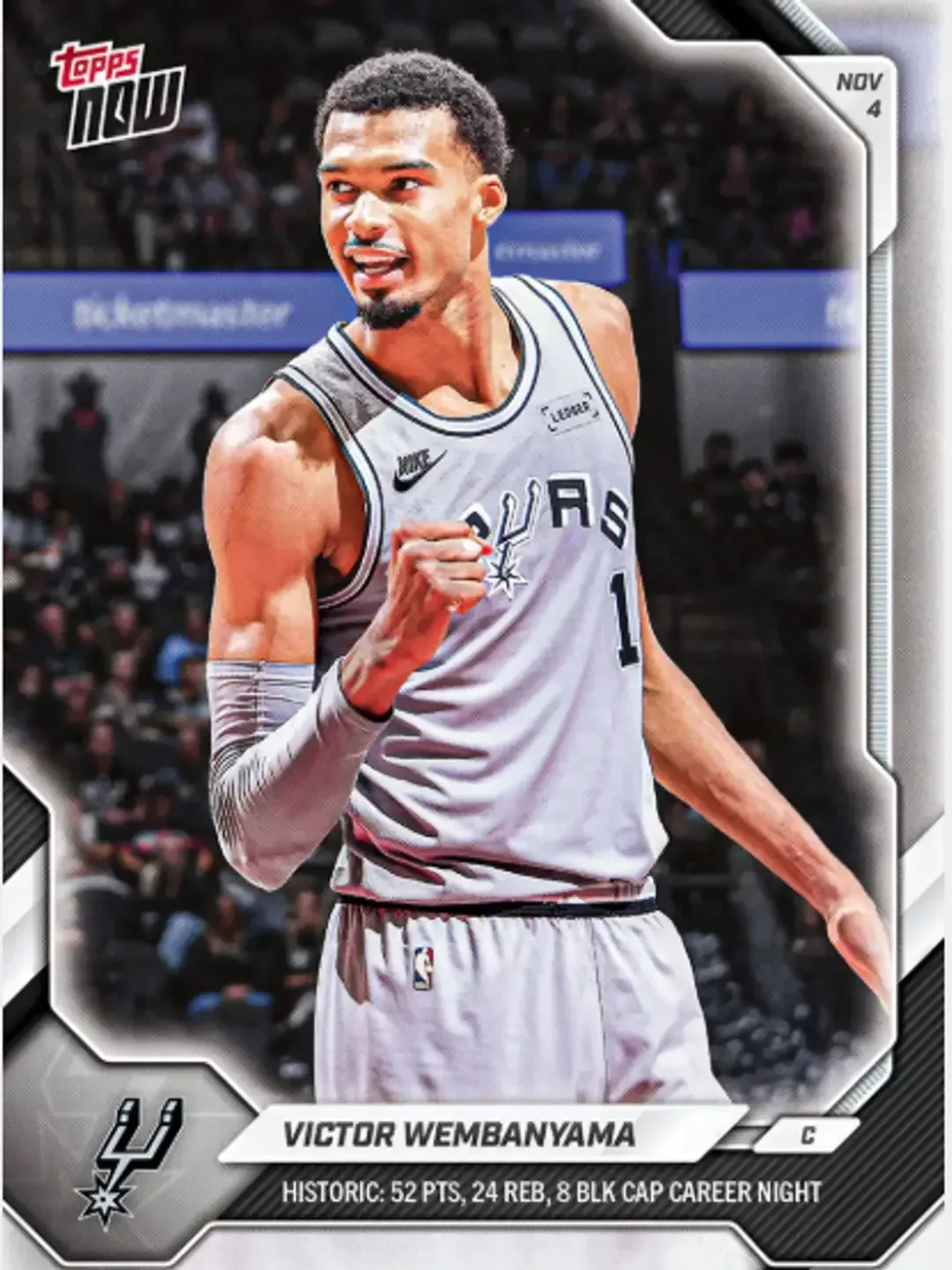
The card centers on Wembanyama’s 52-24-8 line: 52 points, 24 rebounds and eight blocks. That combination is the reason for the release, giving the card a clear event-based identity instead of presenting a general season image or a conventional pack-issued base design.
For more context, explore Battlefield 6 Platoons Slip to 2027 as Season 5 Loses a Key Social Feature.
The standard photograph shows Wembanyama on the court making a fist pump. Its layout follows the familiar Topps NOW approach, with the team logo, player name and information at the bottom, and the date plus Topps NOW branding at the top. For collectors building a Wembanyama run or a San Antonio Spurs-focused collection, the appeal is straightforward: it documents a single performance with a design explicitly tied to that occasion.
Printed-to-order does not mean every version has the same availability. It specifically describes the base-card ordering model. Collectors can order as many base cards as they choose before the listing closes, while the numbered parallels and other chase cards introduce fixed scarcity elsewhere in the release.
What “printed to order” means here
In practical terms, a printed-to-order card is produced in response to orders placed during the sales window. The final base-card quantity therefore depends on how many are ordered before the deadline. That differs from the numbered parallels, where the slash notation identifies a stated maximum number of copies.
A designation such as /50 means the parallel is limited to 50 copies. A /1 is a one-of-one: just one copy of that particular version exists within the release. These serial-numbered variants are central to the chase because their supply is known in advance, even though a collector placing an order cannot assume they will receive one.
The parallel ladder runs from /50 to a one-of-one
Beyond the base card, the release includes five foil parallel tiers:
- Gold Foil: /50
- Orange Foil: /25
- Black Foil: /10
- Red Foil: /5
- FoilFractor: /1
This progression establishes a conventional scarcity ladder. Gold is the most numerous numbered tier listed, followed by Orange, Black and Red, before the single FoilFractor copy. The important distinction for anyone evaluating the checklist is that these are alternate parallel versions of the main card, not six different moments from the game. Their appeal comes from the limited print quantities and foil treatment.
For collectors, the parallel list also helps separate guaranteed and chance-based elements. Ordering during the sale window gives access to the base-card product. A numbered parallel is part of the random chase. That difference matters when deciding whether the release is being purchased as a keepsake of the game, a player collection addition, or a gamble on a limited variant.
The timing is unusually compressed, too. Because the ordering window ends at 5 p.m. EST on November 7, a collector who wants the base card cannot assume it will remain available after the weekend. The numbered cards are even more restrictive by design, but the base card’s availability is restricted by time rather than by a published cap.
The autograph relic is the centerpiece
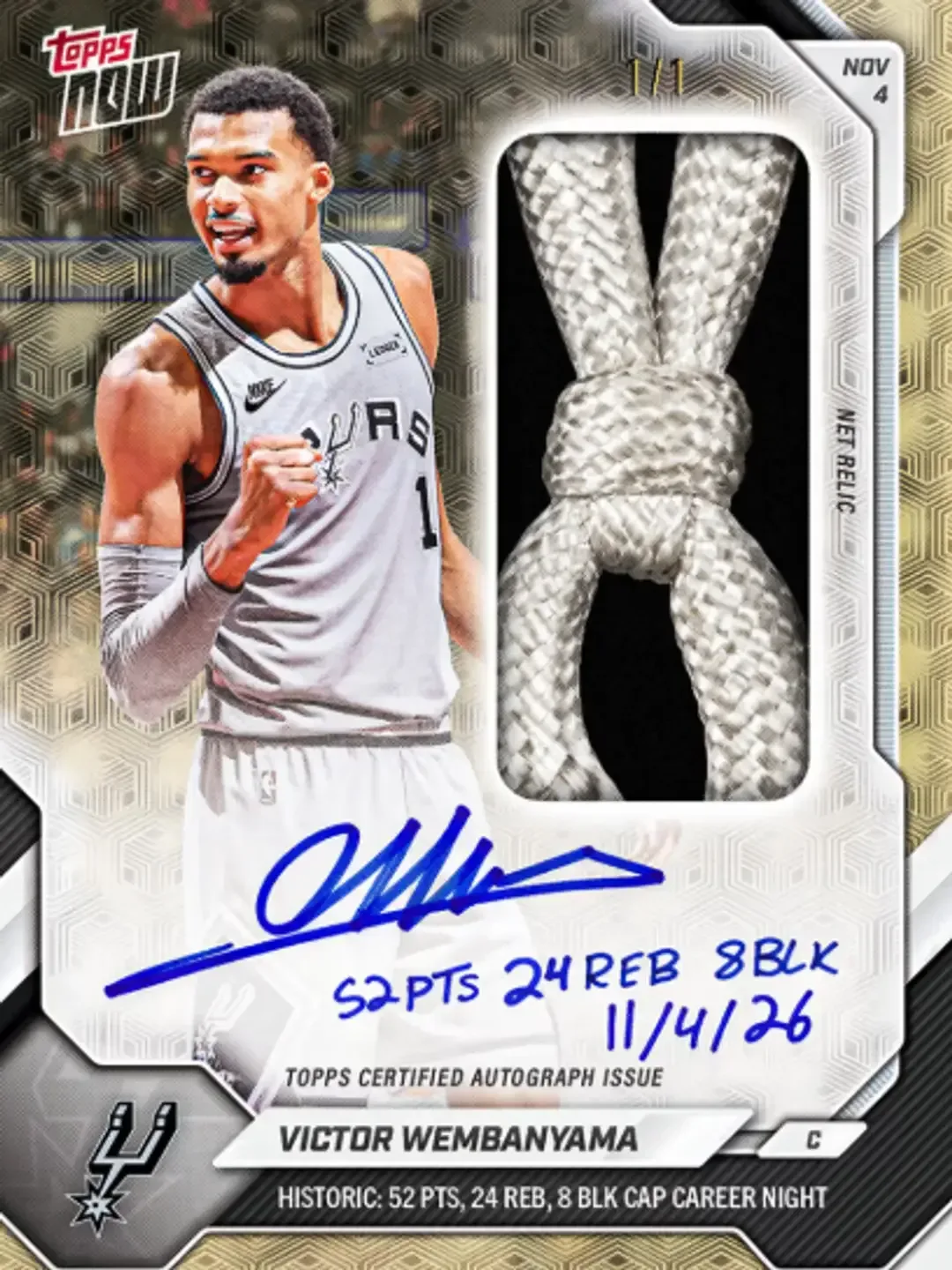
The standout chase card is the autographed relic version. It pairs an on-card autograph from Wembanyama with a relic made from the net used during the game commemorated by the release.
“On-card autograph” is a meaningful description. It indicates that the autograph is written directly onto the card rather than being supplied on a separate signed label later attached to it. The relic element, meanwhile, is a physical piece of game-used net incorporated into the card. Together, those two components connect the card to both the player’s signature and material from the performance it celebrates.
There are six autographed cards across this release: a version numbered to five and a one-of-one. The lone one-of-one adds the game’s stat line and date, making it the most individually specific autograph-relic version described for the checklist.
That is a small autograph-relic population, but scarcity alone does not make the card a universal fit. A collector interested chiefly in the pictured moment may prefer the standard card or a numbered foil parallel. Someone who prioritizes autographs, memorabilia-style relics or game-specific artifacts will see the net piece as the defining feature. The release deliberately serves several kinds of collector through one performance: event-card buyers, parallel chasers, visual variation collectors and high-end autograph hunters.
The card’s net relic also gives the release a more literal connection to the 52-24-8 game than a standard image-and-stat-line issue. A photo documents the performance; the net material is described as having been used during it. That distinction is why the autograph-relic version is likely to command most of the attention despite the base card being the entry point for the broader release.
A short-printed overhead photo variation adds a separate chase
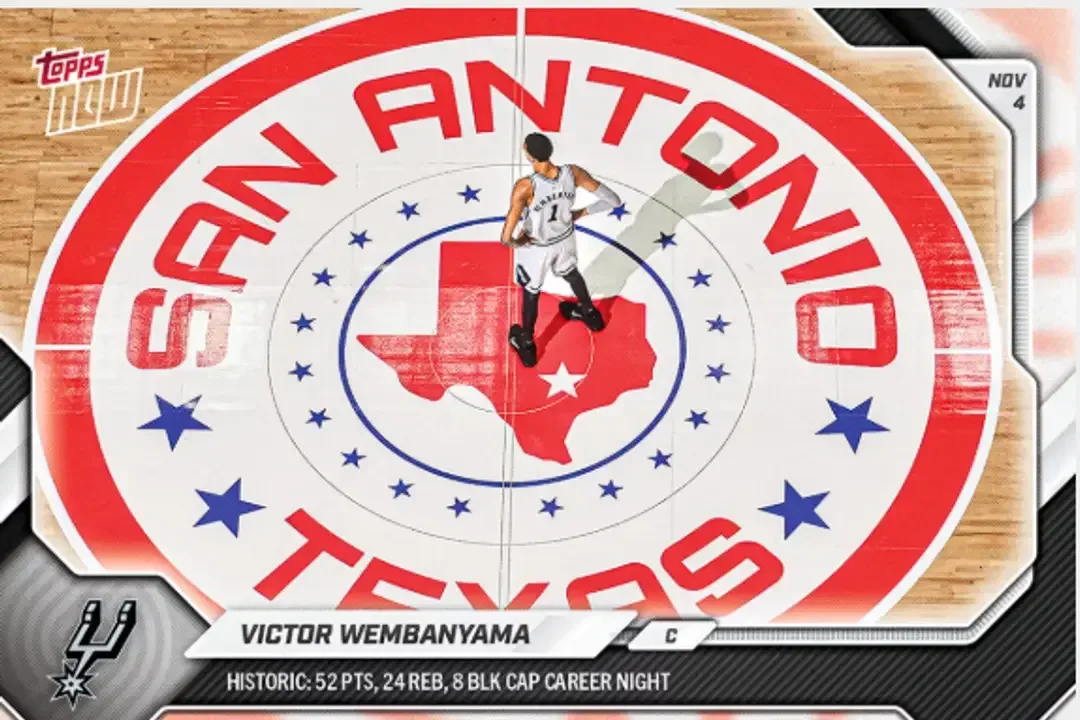
Collectors are not only looking for numbered foil or autographed relics. The release also includes a photo variation showing Wembanyama standing at center court on the event’s logo. The image is shot from above, creating a notably different composition from the fist-pump photo on the standard version.
The variation is short-printed, often abbreviated by collectors as SP. In this context, short-printed means it is intentionally less common than the standard card. However, the exact print run has not been stated. That means its scarcity is confirmed in broad terms, but not quantified in the way the /50 through /1 parallel tiers are.
This is an important uncertainty to preserve when comparing the cards. The photo variation may be hard to obtain, but it cannot be assigned a precise supply count from the available information. By contrast, the foil parallels and autograph relics have explicit numbering. Collectors who prefer verifiable population limits may focus on those serial-numbered versions; collectors drawn to alternate photography may find the overhead image the more compelling target regardless of an unknown total.
Visually, the variation offers a different kind of game memory. The base card captures Wembanyama’s emotional response in the moment. The overhead variation places him in the middle of the floor and makes the game-specific logo part of the composition. Neither image changes the performance being honored, but they offer distinct presentation choices for player collectors.
How to approach the release before the deadline
The clearest way to approach this Topps NOW issue is to separate what is known from what remains chance-based. The known element is the base-card order placed before the November 7 deadline. The known numbered checklist includes Gold Foil /50, Orange Foil /25, Black Foil /10, Red Foil /5 and FoilFractor /1. The known autograph-relic count is six cards total: five numbered copies plus a one-of-one. The known visual alternative is a short-printed overhead photo variation.
What is not known is the final base-card print quantity and the stated print run for the photo variation. Nor does an order guarantee a parallel, variation or autograph relic. The release therefore rewards clear expectations: buy the base card because the game and image belong in a Wembanyama or Spurs collection; treat any premium inclusion as a possible bonus rather than the assumed result.
For a fuller look at the event-card chase, see this overview of Wembanyama’s 52-24-8 Topps NOW autograph-relic release.
Wembanyama’s performance gives this release unusually broad checklist appeal without losing its focus. The standard card is a time-limited record of one extraordinary night. The parallel ladder supplies clearly numbered variants. The short print brings alternate photography, while the autograph relic turns game-used net into the release’s highest-profile prize. With ordering scheduled to end November 7 at 5 p.m. EST, the practical decision for interested collectors is simple: secure the base card before the window closes, and view the rest as the chase it is designed to be.