The 1986 New York Mets occupy an unusually durable place in baseball memory. Dwight Gooden, Darryl Strawberry and Keith Hernandez were among the stars of a club that won the World Series after one of the sport’s most replayed late-game moments: Mookie Wilson’s ground ball went through Bill Buckner’s legs, bringing home the tying or winning run that forced a seventh game. The Mets then won Game 7 and the championship.
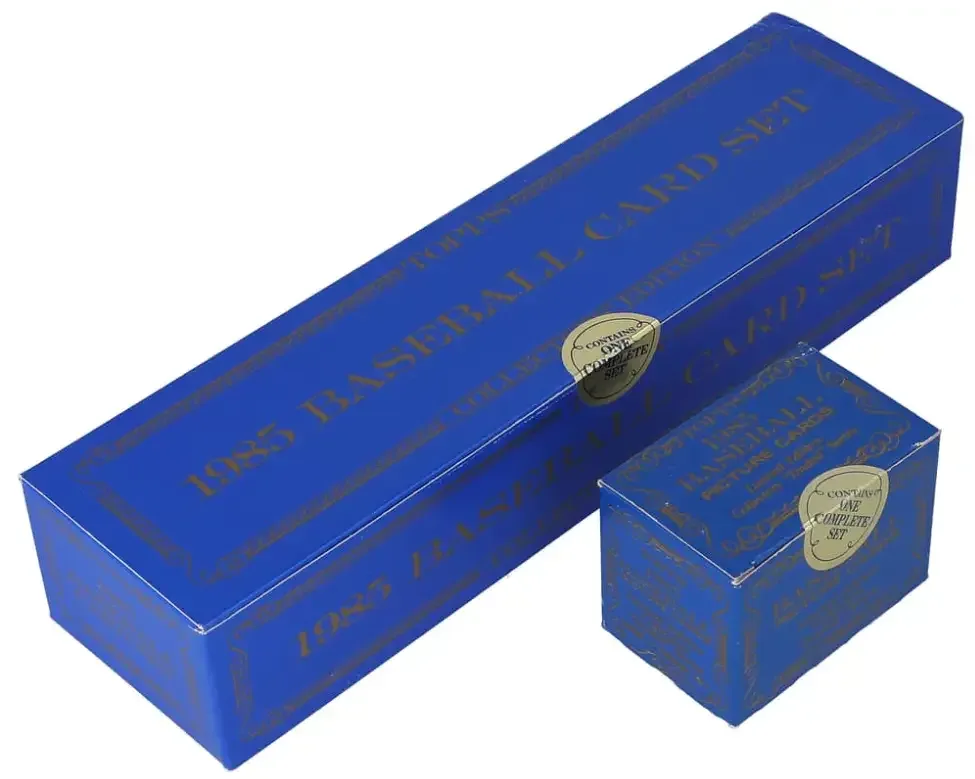
Forty years on, collectors looking for a physical connection to that club have more than the standard 1986 Topps issue to consider. The 1986 Topps Tiffany set uses the same player photography, front design and back information as regular Topps, but it was printed on premium stock and has a noticeably brighter presentation. It was distributed only in box sets, with production reported in the 5,000-to-15,000 range depending on the year.
That combination matters. The base card may supply the familiar image and checklist slot, while the Tiffany version adds a scarcer format, a different physical feel and a collecting identity that predates today’s parallel-heavy hobby. A parallel is a card version that shares a player or design with another release but differs in finish, stock, scarcity or another production attribute. Tiffany is an early example of that basic idea, even if its box-set-only distribution is very different from the modern pack-chase model.
For Mets collectors, the standout reported sales from the 1986 Tiffany release center on Gooden and Strawberry. The figures below are individual, graded-card transactions, not a universal price guide for every copy. That distinction is essential: a sale involving a top grade, an autograph or an unusually clean example is evidence of what that particular card achieved at that moment—not an automatic valuation for a raw copy or a lower-graded one.
For more context, explore Chrome Privacy and Security Settings Worth Changing Before Your Next Tab Spiral.
Why 1986 Topps Tiffany is not simply regular 1986 Topps on shinier cardboard
In a mass-produced era often grouped under the “junk wax” label, Tiffany cards complicate the shorthand. That label generally refers to the widespread perception that many standard cards from the period were printed in huge quantities and therefore are readily available. It does not mean every card made in those years has identical scarcity or collector appeal.
Tiffany’s limited box-set distribution and premium stock distinguish it from the regular issue. The card art and text may be familiar, but condition-sensitive collectors are evaluating a distinct product. A brighter card surface can be visually appealing, yet high-grade vintage-adjacent cardboard still faces the basic hurdles of centering, corners, edges and surface preservation. The gap between a card that looks nice in a binder and one judged Gem Mint can be substantial.
That is why the grades attached to the leading Mets examples deserve as much attention as the players themselves. PSA Mint 9 denotes a high-grade card with limited flaws, while PSA Gem Mint 10 is the highest stated grade in the examples here. The Strawberry has a reported population of 43 at PSA Gem Mint 10, a population figure that refers to the number of copies PSA has graded at that grade—not necessarily the number of copies that exist, or the number available for sale.
Related coverage includes The 3 Biggest 1986 Topps Tiffany Mets Card Sales.
There is also a practical identification lesson for anyone sorting through old baseball cards. A regular 1986 Topps card and its Tiffany counterpart can share the same player and card number. Before treating an apparent Mets find as a Tiffany, collectors should verify the format rather than relying only on the image or nameplate. The premium stock, brighter appearance and original box-set-only distribution are the supplied distinguishing characteristics. Authenticity, condition and whether an autograph has been authenticated remain separate questions.
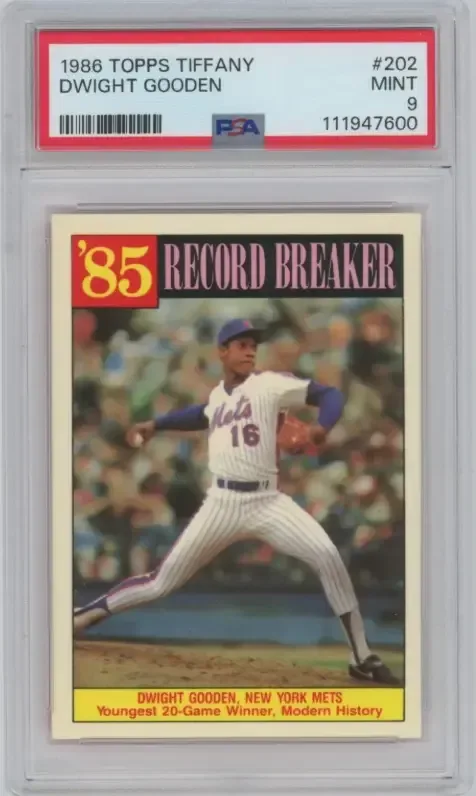
No. 3: Dwight Gooden 1986 Topps Tiffany ’85 Record Breaker #202 — $500 reported sale
The third-largest reported Mets sale is not Gooden’s standard player card. It is his ’85 Record Breaker insert, card #202, graded PSA Mint 9. The card recognizes Gooden’s 24-win 1985 season and pictures him in mid-windup, with his name, team and the featured accomplishment placed along the bottom.
The reported sale price was $500 on May 31, 2025, through an auction. The specific auction venue was not identified in the supplied transaction information. That missing detail does not invalidate the recorded result, but it limits what can be inferred about bidder depth, listing language and the surrounding lot environment.
A later listed value of $85 has also been attached to this card. The gulf between that figure and the $500 sale is the clearest reminder that card-market numbers should be read carefully. A sale price is a completed transaction. A listed value is an estimate or market-tracking figure, and it can change without a new comparable sale at precisely the same grade. Neither number alone tells a collector what every PSA 9 #202 will bring.
The card’s appeal comes from two intersecting pieces of Mets history: Gooden’s role on the 1986 champions and the 1985 milestone commemorated by the insert. For a collector building a team-focused Tiffany run, that makes #202 something more specific than a standard star card. It is both a Gooden card and a period recognition card, which can make it attractive to collectors who prize achievements as much as roster representation.
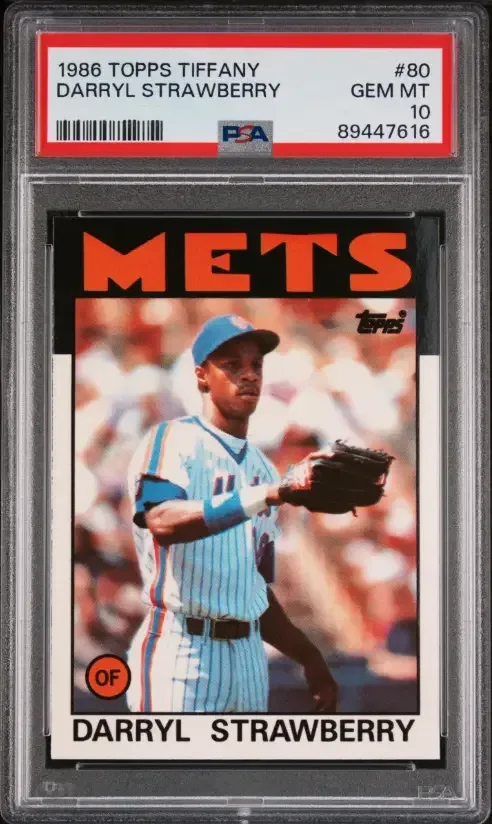
No. 2: Darryl Strawberry 1986 Topps Tiffany #80, PSA Gem Mint 10 — $809 reported sale
Darryl Strawberry’s card #80 takes the second spot with a reported $809 sale on December 23, 2025. This example was graded PSA Gem Mint 10, and its reported PSA 10 population is 43. The image is a waist-up shot of Strawberry that appears to have been taken in a less urgent moment than in-game action.
Unlike the Gooden Record Breaker, this is a standard-numbered player card, which underscores how much condition can matter in Tiffany collecting. The player, the team connection, the premium issue and the top grade all converge in one readily recognizable card. For collectors who want a core 1986 Mets name rather than an achievement insert, #80 supplies a direct route.
The associated listed value was $488, lower than the recorded $809 transaction. It is tempting to describe the difference as a loss or a decline, but that would be too definite without knowing the assumptions behind the estimate or seeing additional comparable sales. Card prices can vary with grade, timing, presentation, buyer demand and the exact copy offered. With only the supplied data, the responsible reading is narrower: the latest reported sale and the cited value estimate do not match.
Strawberry’s example is also useful for understanding population reports. A PSA 10 population of 43 is a count within one grading company’s records. It should not be read as a print run and does not prove that only 43 flawless-looking cards exist in private collections. It does, however, provide a concrete measure of how many copies have achieved that particular grade through PSA, making it relevant context when evaluating a high-grade sale.
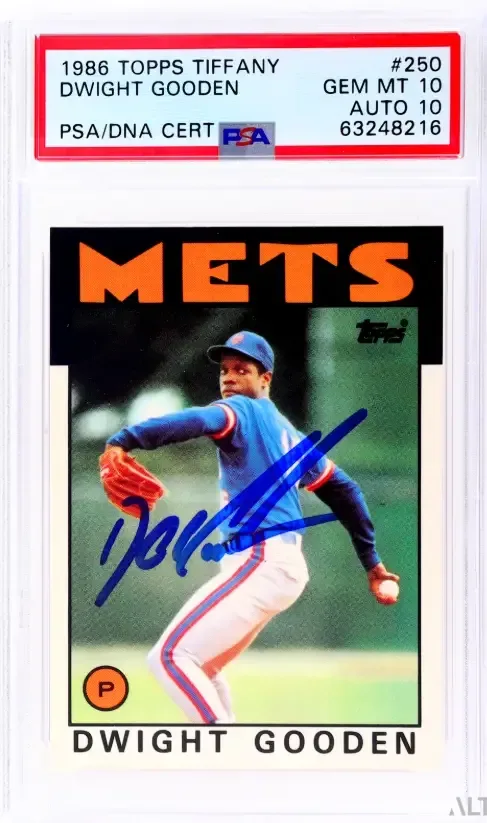
No. 1: Autographed Dwight Gooden 1986 Topps Tiffany #250, PSA Gem Mint 10 card and autograph — $890 reported sale
The top reported Mets result belongs to a Dwight Gooden card #250 that carries an in-person blue-ink autograph. The card shows Gooden pitching toward the batter, and the signature runs across the middle of the card. Both the card and the autograph received PSA Gem Mint 10 grades.
This copy reportedly sold for $890 on March 7, 2023 through a best-offer transaction. That sale method is worth noting. A best-offer result records an agreed price between buyer and seller rather than a public auction’s final bid, so it should not be treated as a direct like-for-like comparison with the $500 auction result for the Record Breaker. The cards also differ materially: #250 includes an autograph and dual Gem Mint 10 grades.
An autograph changes the collecting equation in two ways. First, it creates a more individualized object than an unsigned card, especially when the signature was obtained in person. Second, it introduces an additional condition and authentication consideration. Here, the autograph itself received a Gem Mint 10 grade alongside the card grade. That dual-grade outcome is central to why this card sits apart from an unsigned #250.
The cited current value is more than $1,500, above the 2023 sale price. As with the other estimates, that figure should be understood as a tracked valuation rather than a guaranteed cash offer. The useful takeaway is not that every signed Gooden Tiffany is automatically a four-figure card. Instead, it is that a specific copy combining a sought-after Mets star, the Tiffany format, an in-person autograph and top grades for both card and signature has a distinctly different market profile from its unsigned counterparts.
What these three sales actually show
The leaderboard is a compact demonstration of how baseball-card value is assembled. Player significance matters: Gooden and Strawberry are inseparable from the 1986 Mets’ identity. Product format matters: the Tiffany issue is scarcer and physically distinct from standard Topps. Grade matters: all three examples are in high-end PSA holders, and two feature Gem Mint 10 card grades. Finally, card-specific additions matter: the Gooden #202 is an achievement insert, while the No. 1 Gooden #250 adds an authenticated, graded autograph.
It also shows why collectors should resist reducing a card to a single headline number. The biggest reported sale is $890, but the most ambitious cited tracked value belongs to that same autographed Gooden card at more than $1,500. Strawberry’s $809 sale sits above a $488 listed value. Gooden’s #202 has a $500 sale alongside an $85 listed value. Those disparities are not a clean price chart; they are a reason to examine grade, sale method, special features and the date of each result.
A practical checklist for Mets and Tiffany collectors
- Identify the issue first. Confirm that a card is the premium-stock, brighter Tiffany version rather than the visually similar regular 1986 Topps card.
- Separate raw cards from graded comparables. A PSA 9 or PSA 10 sale is not a shortcut to pricing an ungraded copy.
- Read population data precisely. A PSA population count describes cards graded by PSA at a stated level, not total production or total surviving supply.
- Treat autographs as a separate variable. A card with a graded autograph should be compared with similarly authenticated signed copies, not only unsigned examples.
- Record the sale date and method. Auction and best-offer transactions can reflect different selling circumstances, and older sales may not represent a current asking price.
- Use estimates cautiously. A market-tracking value and a completed sale answer different questions.
For the 1986 Mets anniversary, these three cards offer three versions of the same collecting impulse: commemorate Gooden’s dominant 1985 season, own a top-grade card of Strawberry, or pursue a uniquely enhanced Gooden flagship card. None of them makes the rest of the 1986 Tiffany Mets checklist irrelevant. But together, they explain why this premium parallel still draws attention decades after the Mets finished the job in Game 7.