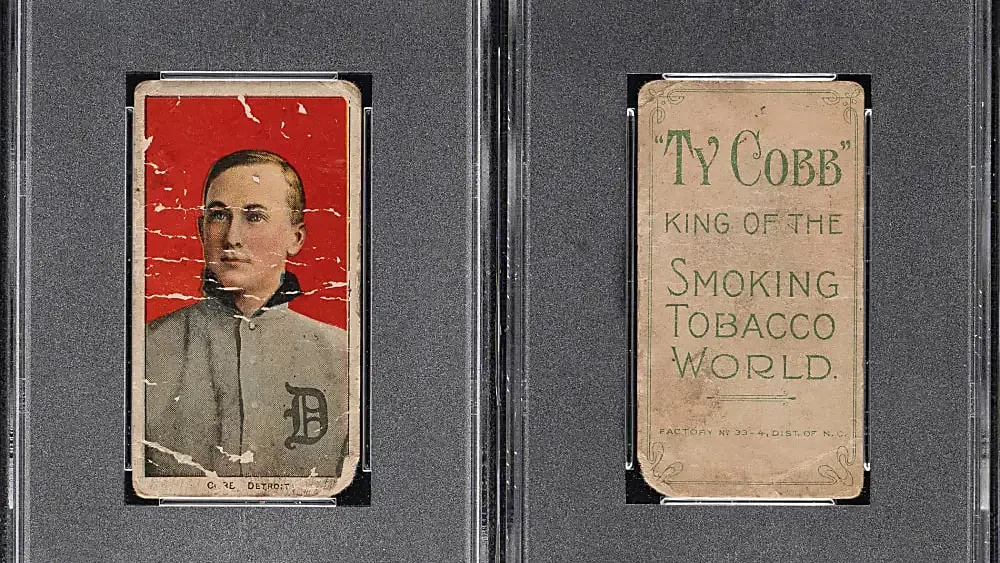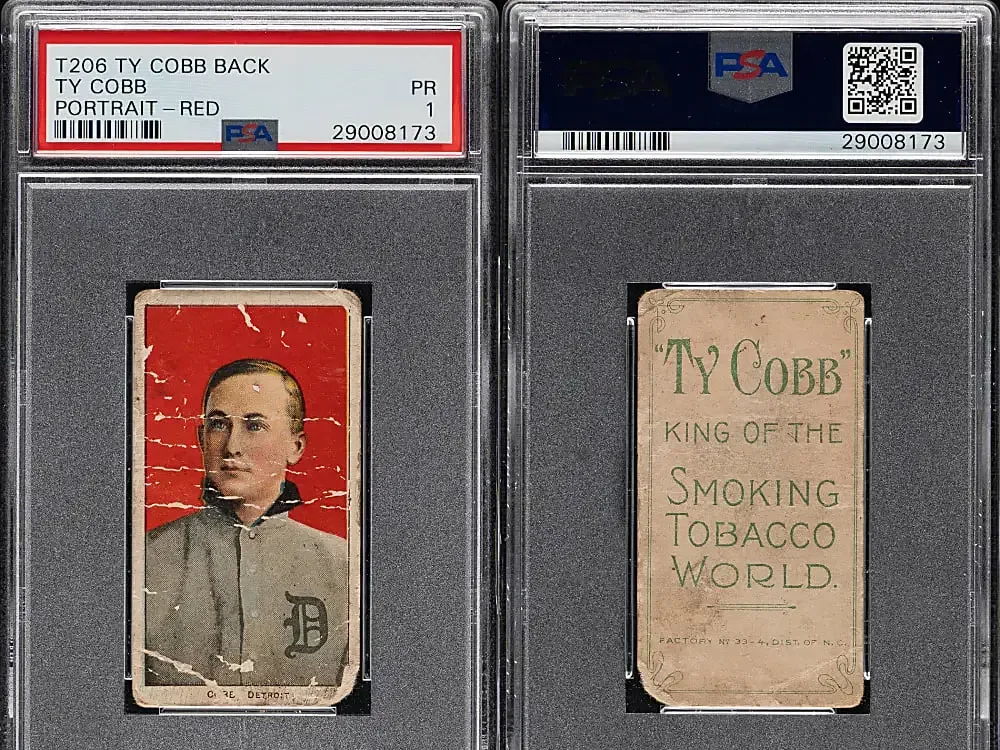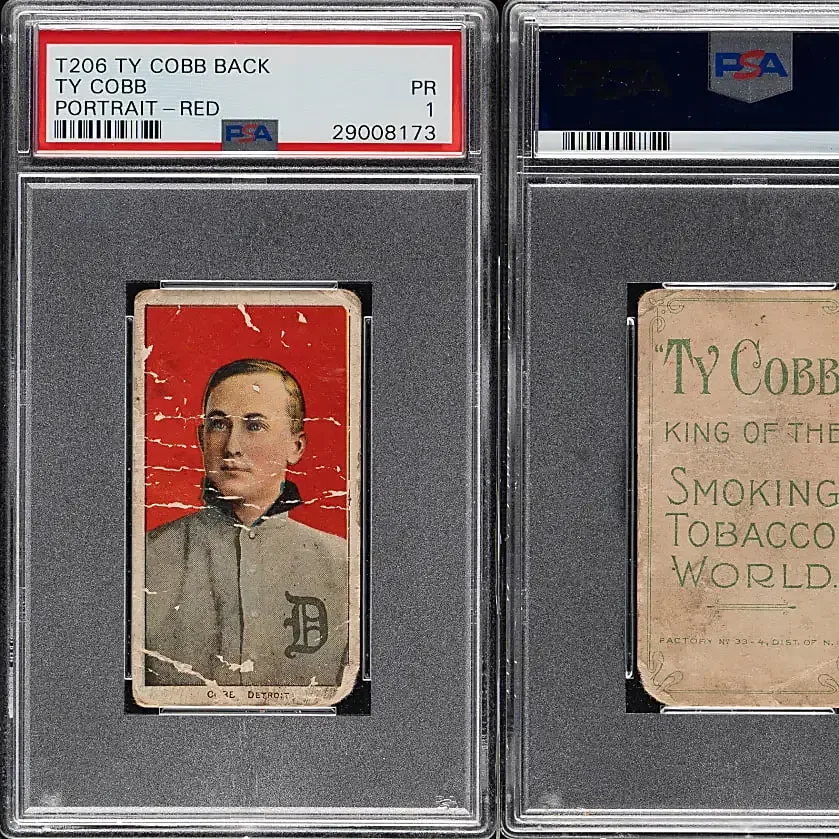
A vintage Ty Cobb card with a stated population of fewer than 30 known examples is the marquee item in REA’s October Auction. The 1909-1911 T206 White Border Ty Cobb Portrait Red Background carries the unusual “Ty Cobb” back and is graded PSA POOR 1. That combination of an early tobacco-era issue, one of baseball’s most recognizable names and a notably scarce reverse variation makes it a very specific kind of centerpiece: one whose appeal is rooted in identification and survival rather than immaculate condition.
The auction runs through Oct. 18 and spans considerably more than the headline Cobb. Its catalog moves across pre-war baseball, postwar stars, set-building lots, modern rookie cards, basketball and unopened material. That breadth matters because the headline lot may draw attention, but the sale offers several different lanes for collectors with different goals: rarity chasers, player collectors, high-grade registry-minded buyers, vintage-set builders and sealed-wax enthusiasts.
The Ty Cobb card’s appeal is in the back as well as the front
The featured card is identified as a 1909-1911 T206 White Border Ty Cobb Portrait Red Background with a Ty Cobb back. In card-collecting terms, the “back” is not merely a descriptive afterthought. It refers to the printing on the reverse side of the card. Here, the reported scarcity specifically concerns T206 examples with the “Ty Cobb” back, rather than every T206 Cobb portrait with a red background.
That distinction is central. Two cards can share the same player image on the front yet occupy very different collecting niches because of their backs, distribution markings or other production variations. The auction’s lead item is therefore not simply a Ty Cobb card from an early baseball-card issue. It is a particular Cobb/front-and-back combination with fewer than 30 known examples reported.
Its PSA POOR 1 grade places condition plainly on the table. The grade is not being presented as a high-condition specimen, and prospective bidders should not confuse scarcity with an assertion that the card is pristine. Instead, the lot illustrates a recurring feature of early-card collecting: a low numerical grade does not erase the importance of a genuinely uncommon version. For vintage material, collectors often have to weigh condition, the exact card variation, player significance and the difficulty of finding another example against one another.
REA’s Cobb selection also provides useful context for how much the exact issue and grade can change the nature of a card. Other Cobb offerings include:
- a 1910-1911 M116 Sporting Life Ty Cobb Blue Background graded SGC EX+ 5.5;
- a 1909-1911 T206 White Border Ty Cobb Portrait Green Background graded PSA VG-EX+ 4.5;
- a 1914 T213 Coupon Cigarettes Type 2 Ty Cobb Bat Off Shoulder graded PSA POOR 1; and
- several more T206 choices featuring Cobb.
For a Cobb-focused collector, that creates options rather than a single all-or-nothing chase. The red-background T206 with its Ty Cobb back has the stated extreme scarcity hook. The green-background T206 offers a different visual and a stronger listed grade. The M116 Sporting Life card and T213 Coupon Cigarettes card sit in different issues entirely. A buyer interested in one player can thus pursue distinct collecting questions: image, set, back variation, condition, era or a combination of all of them.
How to read the grading language in the catalog
The catalog uses grades from PSA and SGC, two grading companies named on the listings. Each entry combines a numerical grade with a condition label in many cases, such as PSA MINT 9, PSA NM-MT 8, PSA VG-EX 4 or SGC EX+ 5.5. The practical lesson is simple: bidders should evaluate the exact listing rather than treating every vintage card or every famous player as equivalent.
Related coverage includes Rare Ty Cobb Cards Lead REA October Auction With Scarce T206 Ty Cobb Back Example.
A 1960 Topps Carl Yastrzemski rookie graded PSA MINT 9, for example, has a very different collecting profile from the Ty Cobb T206 graded PSA POOR 1. Both can be compelling, but the former is represented as a high-grade example of a major rookie card, while the latter derives a substantial portion of its distinction from its scarce “Ty Cobb” back.
The auction’s postwar baseball section includes that 1960 Topps #148 Yastrzemski Rookie, plus a 1963 Topps #300 Willie Mays graded PSA NM-MT+ 8.5 and a 1955 Topps #47 Hank Aaron graded PSA NM-MT 8. Also listed are PSA MINT examples of Aaron’s 1961 Topps and 1964 Topps cards. These are the kinds of lots that make condition a prominent part of the conversation: the named grades are a major element of how each item is presented.
Collectors should also note the difference between a card grade and an autograph grade in the modern LeBron James listing. The 2003-2004 Ultimate Collection Ultimate Signatures #LJ-A LeBron James Rookie is described as PSA MINT 9, with a GEM MINT 10 Signature. The catalog is separately identifying the condition grade of the card and the grade assigned to its signature. That is a useful technical distinction for any bidder comparing signed cards.
More than one path for vintage baseball collectors
The sale’s pre-war and vintage offerings reach far beyond Cobb. One of the most notable is a 1909-1911 T206 White Border Johnny Evers with Bat, Chicago on Shirt, graded PSA GOOD 2, with a Broad Leaf 460 back. As with the Cobb, the reverse is part of the item’s specific identity. Another early lot is a 1915 E145 Cracker Jack #136 Rabbit Maranville graded PSA NM+ 7.5, while the catalog also includes a 1916 M101-4 Sporting News #164 George Sisler Rookie graded PSA VG-EX 4.
Ted Williams appears repeatedly in different forms: a 1954 Topps #1 graded PSA NM-MT+ 8.5, a 1940 R335 Play Ball #27 graded PSA NM-MT 8 and a 1954 Wilson Franks example graded SGC VG 3. Those three listings are a reminder that a player collection does not need to be built around a single flagship set. Different issues can offer different periods, formats and condition levels, even when the subject is the same Hall of Famer.
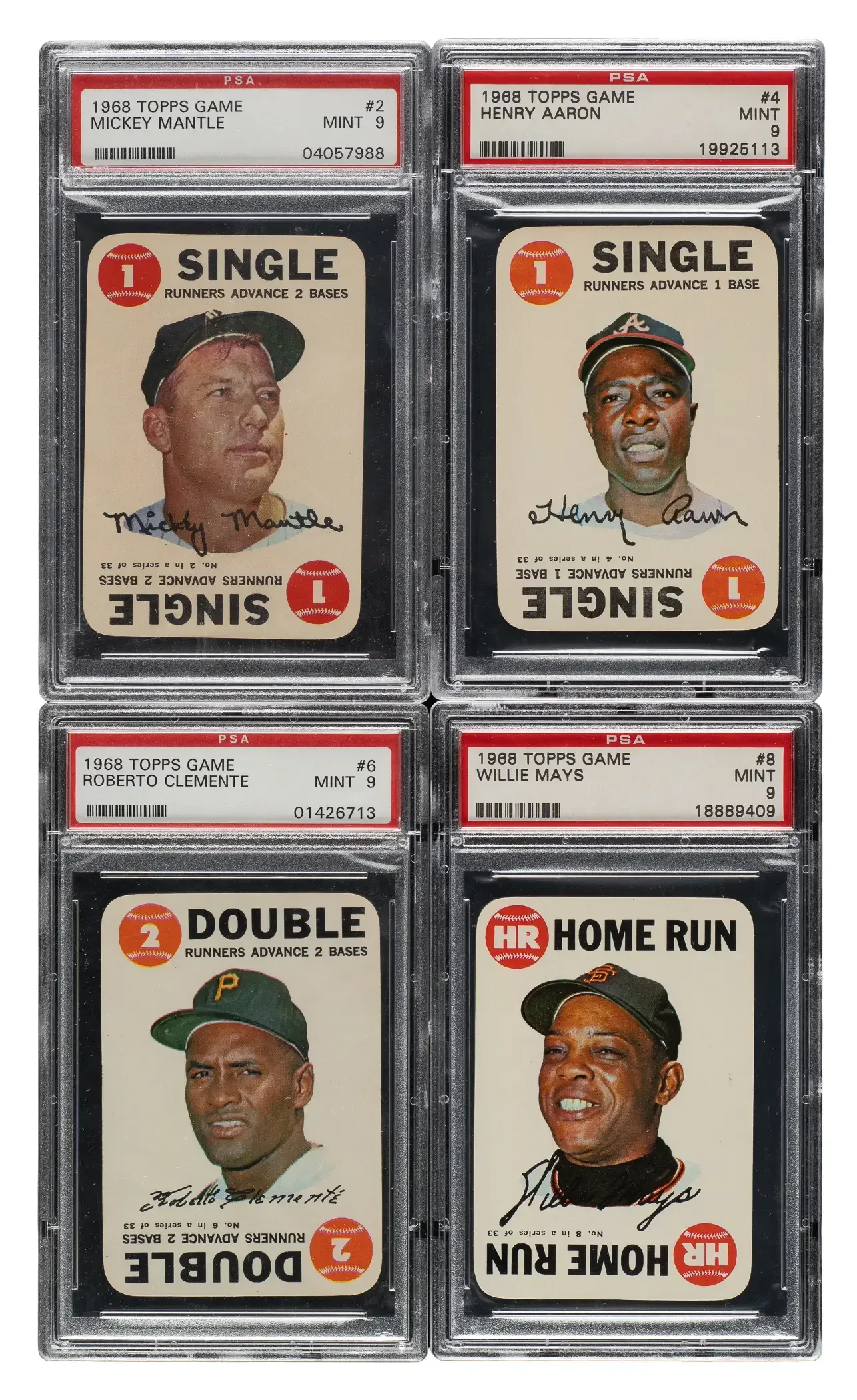
Other baseball highlights include a circa-1947 Bond Bread Jackie Robinson Bat Follow, White Sleeves card graded PSA VG-EX 4 with an MK qualifier; a 1959 Topps #439 Brooks Robinson graded PSA MINT 9; and a 1960 Topps #343 Sandy Koufax graded PSA NM-MT+ 8.5. The 1968 Topps Plaks Checklist #2 National League, which includes Aaron, Clemente, Mays and Rose, is graded PSA VG-EX 4 and offers a markedly different type of piece from a standard single-player card.
Set builders have substantial material to consider
The auction is not exclusively designed around individual star cards. It includes complete and near-complete Bowman sets from 1951, 1953, 1954 and 1955, along with a near-complete 1954 Topps set containing 115 PSA- and SGC-graded cards.
That matters for collectors whose objective is a coherent set rather than a single marquee card. A set or near-set changes the decision from “Which player do I want?” to “What work remains, and how does this group fit the build I want?” The presence of 115 graded cards in the 1954 Topps near-complete set is particularly relevant because it gives prospective buyers a defined amount of third-party-graded material within the larger group.
Buying a set lot and buying a single card are not interchangeable pursuits. A major single can serve as a collection centerpiece immediately. A near-complete set can instead provide a framework for continued collecting, with the remaining gaps becoming part of the project. Neither approach is inherently better; they answer different collector motivations.
Modern cards, basketball and sealed material round out the sale
While the T206 Cobb establishes the auction’s early-baseball identity, the catalog also crosses into later eras and other sports. The 1989 Upper Deck #1 Ken Griffey Jr. Rookie is listed in PSA GEM MINT 10. Alongside the LeBron James signed rookie, it gives modern-card collectors two recognizable names represented at strong stated grades.
Basketball collectors will find a 1986-1987 Fleer Basketball #57 Michael Jordan Rookie graded PSA NM 7. The auction also includes a 1978-1979 Topps Basketball unopened wax box with 36 packs, authenticated by BBCE. Unlike a graded single, an unopened box is a sealed-product item. Its appeal rests in the preserved package configuration described in the listing rather than in a visible, individually graded card.
The variety is the practical theme of this auction. A bidder can be pursuing a rare T206 reverse, a high-grade 1960s Hall of Famer, an older player issue in a modest grade, a near-complete set, a signed modern rookie or unopened basketball wax. REA president Brian Dwyer characterized the event as one of the company’s largest while emphasizing that it includes both rare material and classic cards intended to become collection focal points.
For anyone evaluating lots, the strongest approach is to keep the catalog language precise: verify the year and issue, front-and-back variation where applicable, grading company, numerical grade, qualifiers and whether the offering is a single, set lot or sealed product. The Ty Cobb lead card is the clearest example of why that precision matters. It is not just an old Cobb portrait. Its appeal turns on the uncommon “Ty Cobb” back, a reported population below 30 known copies and the reality of its PSA POOR 1 condition.
Collectors who follow several corners of the hobby can also keep an eye on adjacent card-game coverage, including Pokémon Quetzal’s latest update, while the auction itself remains firmly focused on physical sports-card and sealed-wax collecting.