Ben Rice is making October look like a very loud extension of his regular season, and the baseball-card market is responding in real time. The Yankees slugger entered the postseason after a 41-home-run, 97-RBI campaign, then opened his first four playoff games batting .389 with four home runs and eight RBI.
The headline performance came September 29 against Boston. Rice collected four hits, hit two home runs—including a grand slam—and drove in six runs. He added a hit and a walk the following night as New York completed its best-of-three wild-card series win over the Red Sox. In Game 2 of the ALDS against Tampa Bay, Rice went deep twice more.
That production does not automatically establish a lasting card-market level. It does, however, provide the sort of immediate, nationally visible performance that can concentrate collector attention on a player—particularly when his most desirable cards are scarce, signed, and include memorabilia.
A $6,700 sale on a huge night
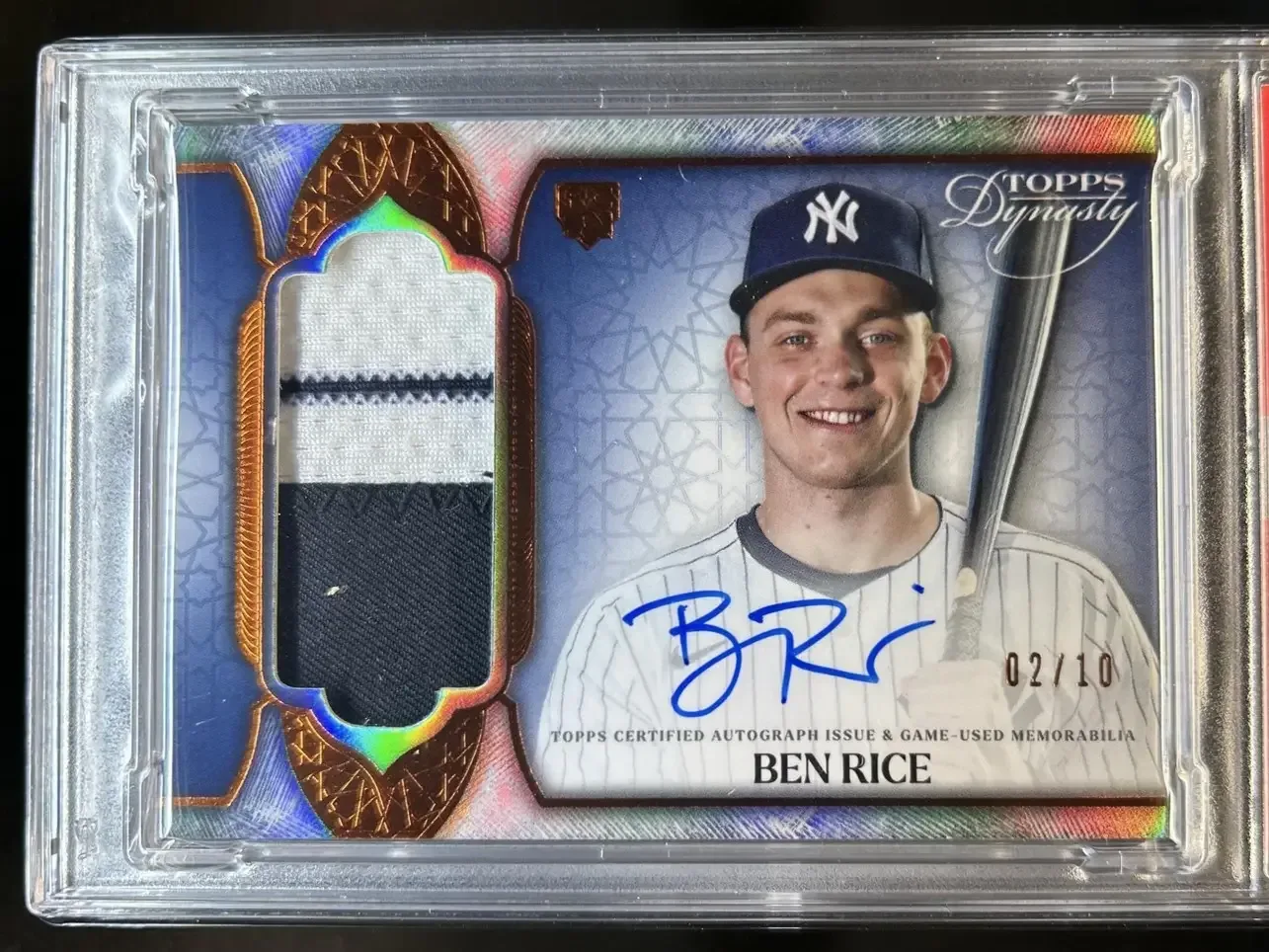
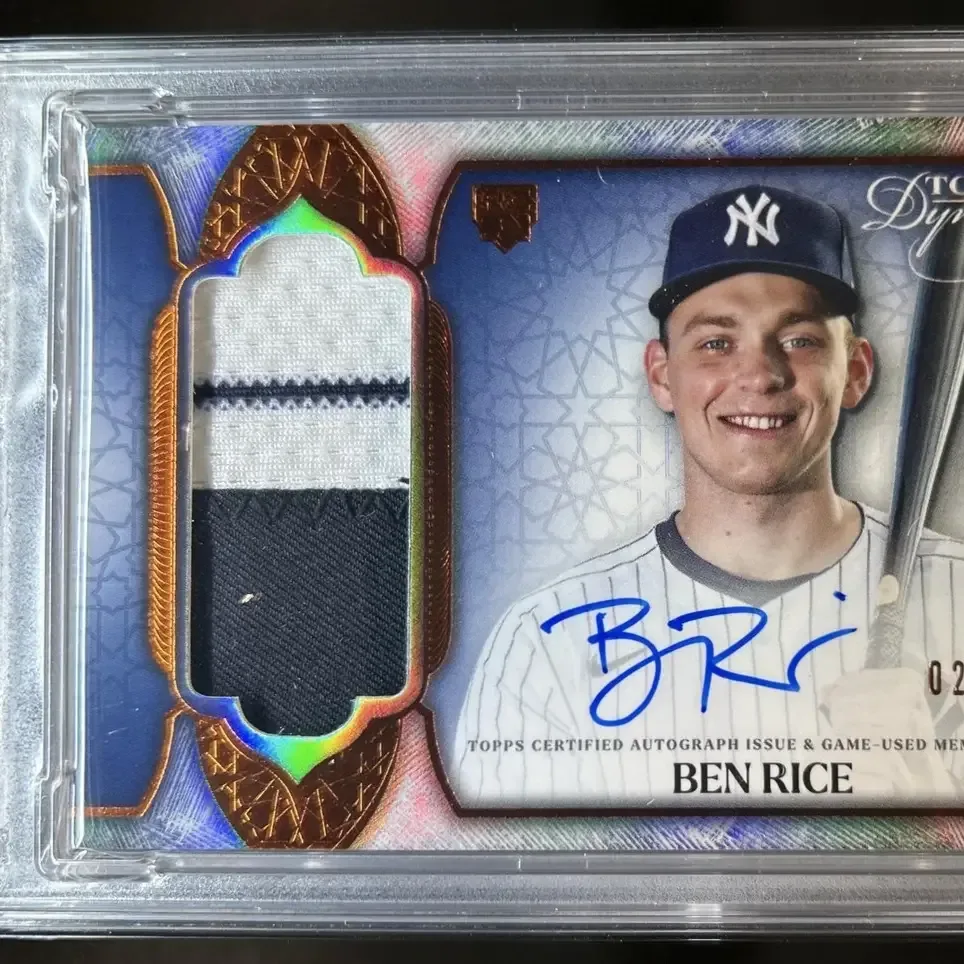
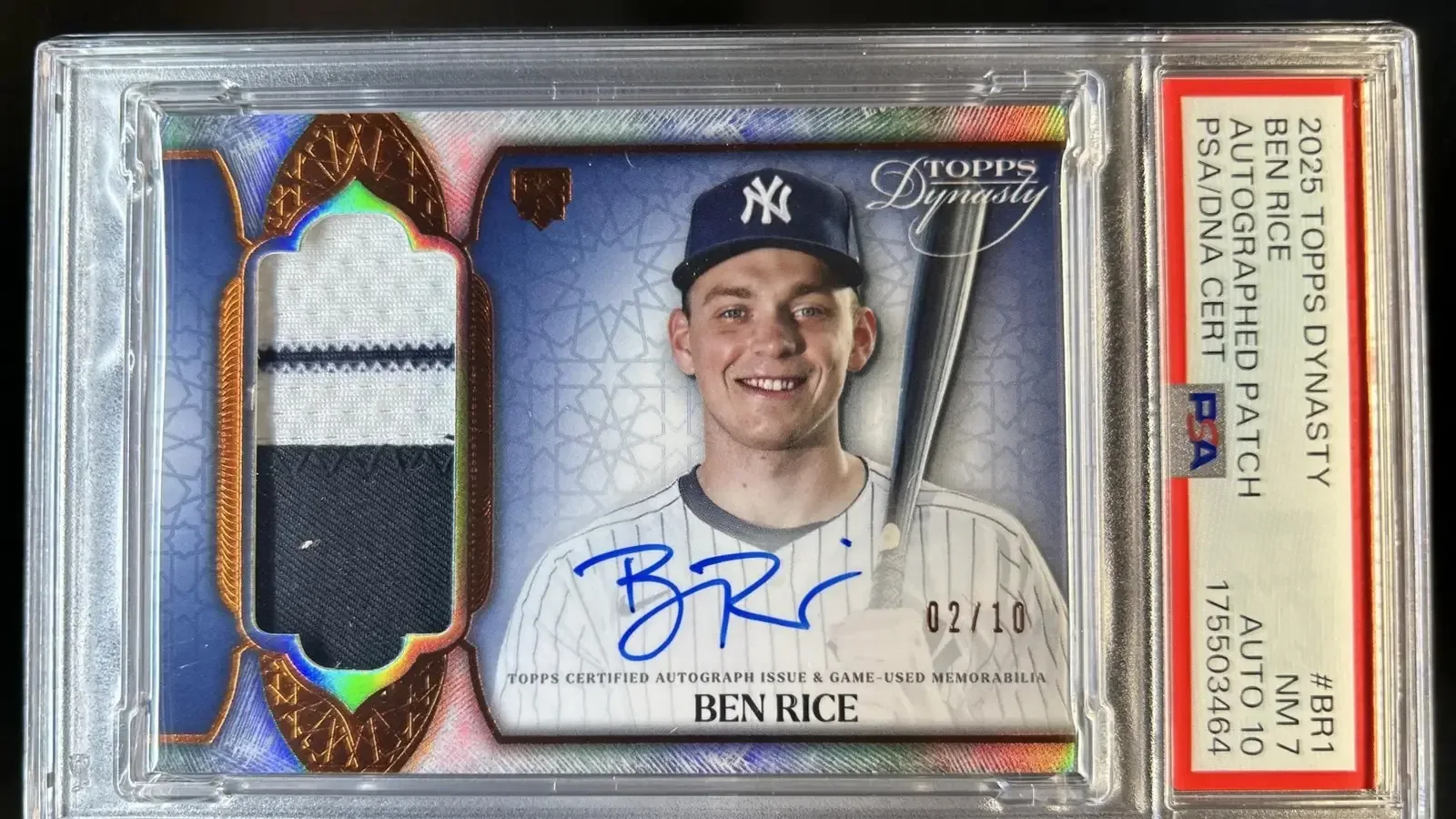
On the night of Rice’s two-homer game against Boston, a 2025 Topps Dynasty signed Rice patch card sold through eBay for $6,700 after drawing 42 bids.
Topps Dynasty is a premium-style product, and this particular card’s appeal is easy to parse from the available details. It pairs an autograph with a patch piece, meaning a section of memorabilia is embedded in the card. Those elements make the card meaningfully different from a standard printed base card: the autograph provides a direct signing component, while the patch gives the item a tactile memorabilia feature.
The card was also limited to an edition of 10. In collecting terms, that means only 10 copies of that specific version were issued. Low numbering does not by itself make a card valuable, but it sharply limits the number of collectors who can own that exact configuration. When a player produces a playoff moment that draws attention, a small supply can turn demand into a competitive auction quickly.
The 42 bids are as notable as the final figure. A single strong bid can produce a surprising result, but repeated bidding better signals that multiple buyers were willing to compete. It still represents one auction rather than a universal price guide, and the $6,700 result should be read as a sale for this specific card at that specific moment—not as a guaranteed value for every Rice autograph or patch card.
Why another card from the same run sold for more
The $6,700 result was not the high-water mark among the two closely related cards described here. Two months earlier, another 2025 Topps Dynasty signed Rice patch-card variation sold for $10,400 on 51 bids. That card also came from an edition of 10, but it used a different Rice image: a serious portrait instead of the smiling image on the later $6,700 copy.
That comparison is a useful reminder that matching serial-number limits do not make cards interchangeable. The two pieces share major fundamentals—same player, signed patch format, same stated print run—but visual presentation can matter to buyers. A portrait choice, the composition of the card, and an individual collector’s preference can all affect bidding. The earlier auction also had nine more bids, though bid totals alone cannot explain the full $3,700 gap.
For collectors, the practical takeaway is to compare exact variants rather than relying solely on a product name or a “/10” designation. Check the image, autograph and memorabilia format, stated numbering, and the auction’s bidding activity. Even cards that look very similar in a search result may be distinct versions with distinct collector appeal.
Rice’s season gives the surge context
Rice’s playoff run has not appeared from nowhere. He batted .264 with 41 homers and 97 RBI during the regular season, taking on an outsized role while former MVP Aaron Judge was injured. Across two full seasons with the Yankees, Rice has 67 home runs.
That combination matters because card attention is often strongest when recent performance and a compelling current narrative overlap. Rice had already built a major power profile over the regular season. The postseason supplied the acceleration: a four-hit night against a historic rival, a grand slam, a series-clinching contribution, and two more homers against Tampa Bay.
Collectors evaluating this moment should separate three related but different things:
- On-field performance: Rice’s regular-season totals and postseason production are the evidence behind the heightened interest.
- Card scarcity: The two auctioned Dynasty variations were each limited to 10 copies, constraining supply for those exact cards.
- Auction outcome: $6,700 and $10,400 are confirmed results for individual cards, not a blanket valuation for Rice’s entire catalog.
Keeping those distinctions clear avoids a common mistake in fast-moving player markets: treating one premium-card auction as if it sets the price for every card featuring the player. A limited signed patch card belongs to a very different tier from ordinary releases, and even within that premium tier, the card’s precise variation can change what bidders are willing to pay.
What to watch next
The immediate question is whether Rice can extend the playoff performance that has put him under a brighter collector spotlight. Four home runs in four games is a remarkable opening burst, but the market’s longer-term direction will depend on both his continued play and the specific cards reaching auction.
There is already evidence of demand for elite Rice material. The $10,400 variation drew 51 bids, while the $6,700 version attracted 42. Those sales show active competition for two low-numbered signed patch cards with different imagery. They also show why collectors should avoid flattening a player’s market into one number.
For a broader example of how product details and collector terms can require careful reading, see this look at a Marvel Comics collector offer and its pre-order terms. The subject is different, but the core habit carries over: identify exactly what is being offered before assigning it value.
Rice has supplied no shortage of reasons for collectors to pay attention. His 41 regular-season homers established the power; his October numbers have amplified the conversation. For now, the auction record is clear: collectors have spent thousands on his rarest signed patch cards, and the latest postseason heroics have ensured that every next sale will be watched closely.