Junior Caminero’s card market has quickly become a case study in how a player’s on-field breakout can focus collector attention on a very small group of premium rookie-year cards. Three of his largest reported insert sales are all 2024 one-of-ones, but they are not interchangeable pieces of cardboard. Each combines scarcity with a different high-end ingredient: a certified autograph, a distinctive premium parallel, or a game-worn connection to a milestone moment.
The sales also arrive after an uneven early stretch in Caminero’s professional story. He began professional baseball in 2021 and made his major-league debut late in 2023. An injury-plagued 2024 slowed the market around him, but 2025 brought a major surge: 45 home runs and 110 RBIs. That followed a prior 30-homer, 94-RBI season. With more than 40 homers in each of the last two seasons cited here, the 2024 rookie cards now occupy a much different place in the conversation than they did when many were originally pulled or first offered.
At the center of the three sales is an important collecting distinction. A one-of-one, often written 1/1, is a card with a stated print run of one for that exact version. It does not mean there is only one Caminero card, one Caminero rookie card, or even one Caminero autograph. It means that particular parallel or configuration is unique within its release. Collectors still weigh the card’s set, visual design, autograph, condition, player image and memorabilia component when deciding what that singular copy is worth.
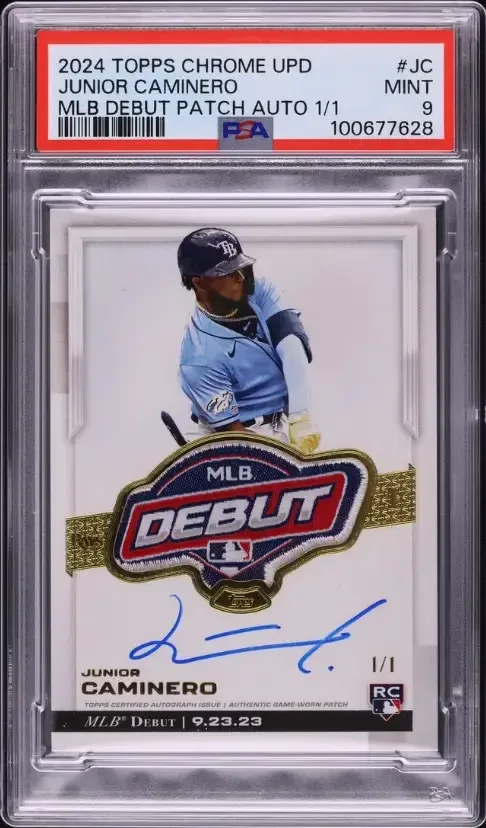
1. 2024 Topps Chrome Update MLB Debut Rookie Patch Autograph — $66,000
The clear leader is Caminero’s 2024 Topps Chrome Update MLB Debut Rookie Patch Autograph, a 1/1 graded PSA Mint 9. It sold for $66,000 in a Fanatics Collect auction that closed on December 19, 2024, after 60 bids. A tracked value associated with the card has since been listed at $144,250.
For more context, explore Marathon’s Symbiosis Update Will Add Team Deathmatch, PvE Space and a Robot Samurai Shell.
That latter figure needs careful reading. A recorded auction result is a documented transaction: one buyer paid a known amount on a known date. A current tracked value is an estimate or market indicator rather than proof that the card has changed hands again at that amount. For collectors assessing a potential purchase or insurance value, those are related data points, but they should not be treated as identical.
The appeal of the Rookie Debut Patch Autograph is easy to identify even before considering Caminero’s production. It joins three attributes that can be powerful on a modern sports card:
- Rookie-year placement: it comes from 2024, the year associated with Caminero’s flagship rookie-card window in this comparison.
- An autograph: the player’s signed card adds a direct, player-specific element beyond the printed design.
- A debut-linked patch: the card incorporates a piece associated with the player’s major-league debut jersey, connecting the collectible to a specific career event.
A patch autograph is a card that includes both a memorabilia swatch and a signature. The “MLB Debut” language carries additional narrative weight because it points to a defined milestone rather than a generic uniform relic. That does not make every patch autograph equally valuable, but it helps explain why this type of card can sit in a different tier from a standard autograph or non-autographed parallel.
Related coverage includes Junior Caminero’s 3 Biggest Insert Sales Are All 2024 One-of-Ones.
The grade is also worth placing in context. PSA Mint 9 indicates a strong graded example, though it is not the company’s top Gem Mint 10 grade. In this case, the debut-patch/autograph combination and 1/1 scarcity appear to be more consequential to the recorded result than the difference between a 9 and a 10. That is not a universal rule; rather, it illustrates how a card’s construction and story can outweigh a single grade point when the item itself is extraordinarily rare.
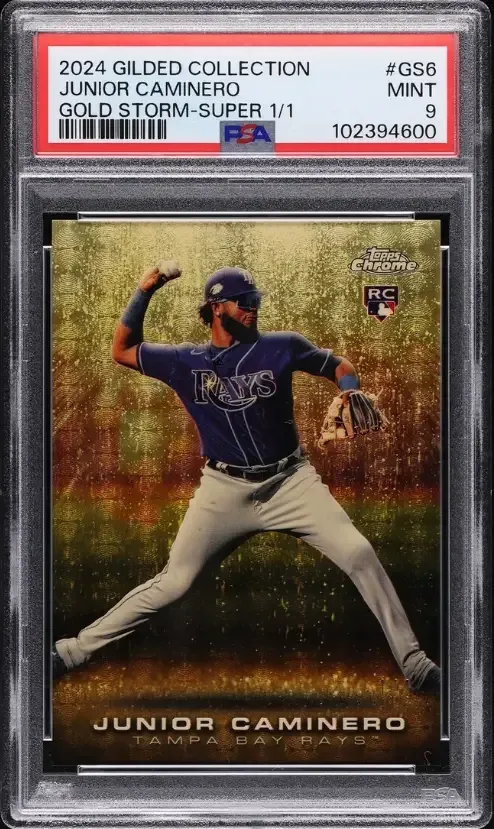
2. 2024 Topps Chrome Gilded Gold Storm Superfractor — $13,800
Second is the 2024 Topps Chrome Gilded Gold Storm Superfractor rookie, another 1/1 and another PSA Mint 9. Unlike the top card, this one is not autographed. It sold for $13,800 through Fanatics Collect on September 13, 2026, drawing 42 bids. The tracked value was also $13,800 shortly after that sale.
The gap between $13,800 and $66,000 says more than “autographs cost extra.” Both cards are one-of-one rookie-year pieces, yet the top entry layers a signature and MLB-debut jersey patch onto its rarity. The Gold Storm card’s auction result shows that a high-end, non-autographed 1/1 can still command a major price when the player has momentum and the product presentation is premium. At the same time, it shows why collectors often separate a visually striking parallel from a card that includes multiple forms of player connection.
The Gold Storm design depicts Caminero in a full throwing motion. For collectors, player imagery can matter, especially when comparing multiple 1/1s. A hitter known for power may be most readily associated with a bat-in-hand photo, but a defensive action shot makes this card visually distinct rather than simply repeating the pose found on another release.
The 42-bid total is notable because bids reveal active auction participation, though they do not reveal every bidder’s maximum willingness to pay or the motivations behind each bid. What the final number does establish is that the card reached $13,800 in a competitive auction setting. The matching tracked value immediately after the sale is unsurprising: when a transaction is recent, there may be little subsequent information available to justify a different estimate.
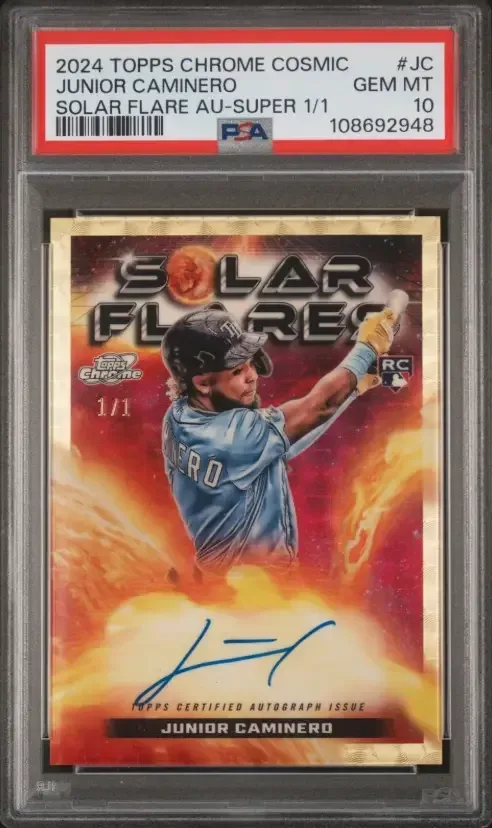
3. 2024 Topps Cosmic Chrome Solar Flare Superfractor Autograph — $12,500
Third on the reported list is the 2024 Topps Cosmic Chrome Solar Flare Superfractor Autograph, a 1/1 that received a PSA Gem Mint 10 grade. It sold for $12,500 through an eBay best-offer transaction finalized on August 22, 2026. Its tracked value about a month later was listed at $13,300.
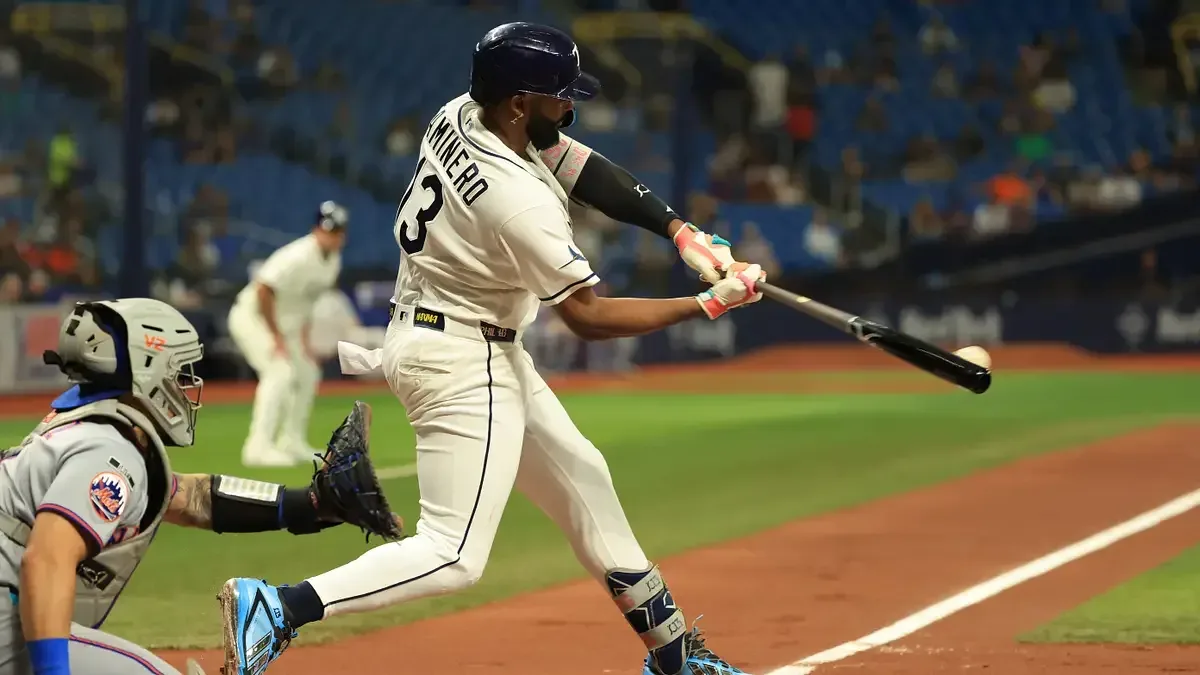
Visually, the card is built around a waist-up image of Caminero at the finish of his swing, surrounded by solar-flare artwork and signed in navy-blue ink. Cosmic Chrome’s stylized presentation differentiates it sharply from more traditional baseball-card photography. For collectors drawn to modern inserts and parallels, that design identity can be a feature rather than decoration: it makes the card immediately recognizable within a large ecosystem of 2024 releases.
This is also the only card in the three-card group carrying the cited PSA Gem Mint 10 grade. Gem Mint 10 is PSA’s top grade and generally indicates a card that meets its highest condition standard. The comparison with the $13,800 PSA 9 Gold Storm is useful, but it should not be overread. The two cards are different products with different imagery, designs and sale formats. A $1,300 difference between their reported sale prices cannot isolate the monetary effect of the grade alone.
Sale format matters as well. An auction publishes a closing result after bidders compete. A best-offer sale confirms that seller and buyer agreed on a price, but it does not provide the same public bidding path. Neither method is inherently better. They are simply different mechanisms, and collectors comparing sales should note the distinction before treating the outcomes as direct equivalents.
What these three sales say about Caminero’s market
The three cards share a common foundation: all are 2024 one-of-ones tied to a player whose offensive output has made him one of baseball’s prominent young names. Beyond that, each occupies a different niche. The Cosmic Chrome Solar Flare is a Gem Mint 10 autographed art-forward parallel. The Gilded Gold Storm is a PSA 9 non-auto premium rookie parallel. The Chrome Update Rookie Patch Autograph is a PSA 9 milestone-based memorabilia autograph with the highest reported sale by a wide margin.
That range is the practical takeaway for collectors. “One-of-one” is a scarcity statement, not a complete valuation model. A collector considering Caminero cards should identify what kind of card they actually want: a signature, a patch, a specific set design, a top grade, or a documented connection to his debut. Those priorities lead to different cards and can lead to sharply different price levels even when every option carries a 1/1 stamp.
It is also sensible to separate enthusiasm from certainty. The $66,000 sale and subsequent $144,250 tracked value suggest substantial attention around Caminero’s elite rookie-year pieces, but no single tracked value guarantees a future sale. Markets for unique cards can be especially difficult to measure because there is no second copy available to trade on a predictable schedule. The next sale may happen soon, years later, or not at all; when it does, the player’s performance, the buyer pool and the card’s presentation can all affect the result.
For anyone cataloging a Caminero collection, preserving the basic details is particularly important: the exact 2024 product name, parallel name, serial numbering, whether the card is autographed, whether it has a memorabilia component, its grade and the date and format of any comparable sale. Those details prevent a common mistake in modern collecting—grouping every low-numbered rookie card together as if they carry the same market meaning.
In Caminero’s case, the market’s current hierarchy is clear from these reported transactions. The MLB Debut Rookie Patch Autograph sits at the top because it combines singular scarcity with a signature and a debut-jersey story. The Gold Storm and Solar Flare cards demonstrate that collectors also place serious value on premium non-base inserts, whether the draw is a high-end parallel, an on-card signature, a Gem Mint 10 grade, or simply the appeal of owning the sole copy.