The 2026 World Series offers baseball card collectors two distinctly different kinds of rooting interest. The Milwaukee Brewers bring the cleaner championship narrative: a 103-win season, a club seeking its first title, familiar stars, a Cy Young contender and a group of emerging prospects. The Tampa Bay Rays bring a more contrarian case. Their roster includes Junior Caminero, but it also offers collectors several players whose cards receive markedly less attention than Milwaukee’s headline names.
That contrast matters because a World Series can concentrate attention on a few plays, a few players and a few card types all at once. It does not automatically make every card on the winning roster more valuable, and it certainly does not erase the importance of scarcity, condition and prior demand. But the series can give collectors new information in public, highly visible moments. A decisive pitching outing, a walk-off hit or an MVP performance may change which player becomes the focal point of that attention.
For collectors deciding which result would be more compelling, Milwaukee represents the high-ceiling star case. Tampa Bay is the value-and-discovery case. Neither case is a guarantee of future sale prices; the available sales instead show where each market stood going into the series and where the biggest pressure points may be.
Why a championship matters to card markets
Sports-card demand often has layers. A player can have a strong market because of prospect reputation, rookie-year excitement, established production, a memorable postseason moment or a scarce card that already has committed buyers. A title can add to that story, but it does not create the entire story by itself.
That distinction is especially important in a comparison between these clubs. Milwaukee already has multiple players with established hobby attention. Tampa Bay’s possible appeal is not merely that a Rays victory might lift the team’s biggest cards; it is that more of the roster may be entering the spotlight from a lower starting point.
Collectors should also separate a player’s on-field outcome from the exact card being considered. A Superfractor is the one-of-one version of a Chrome card, making it a uniquely scarce item rather than a broad measure of the player’s entire market. A debut patch is likewise a singular, patch-based rookie offering. Those cards can set dramatic records, but they do not necessarily indicate what a base card, an ungraded card or a different parallel will sell for. Comps, shorthand for comparable sales, are most useful when the cards being compared are genuinely alike in year, set, serial numbering, grade and autograph status.
The Milwaukee case: a title would add to established demand
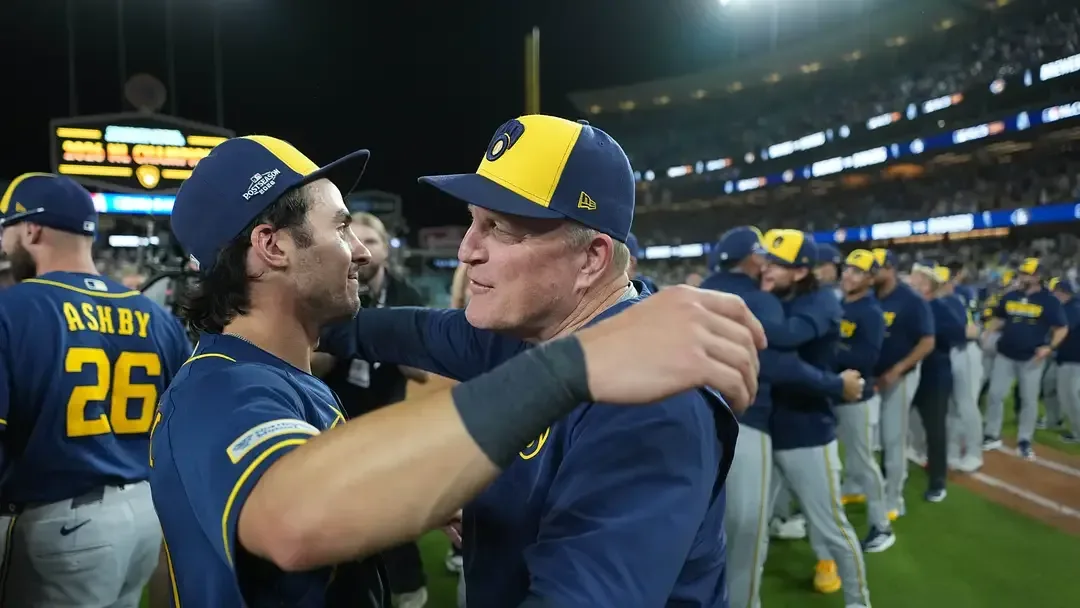
The Brewers reached the World Series after winning 103 regular-season games and defeating the Los Angeles Dodgers in the National League Championship Series. It is Milwaukee’s second World Series appearance, and a championship would be the first in franchise history. That gives a potential title unusually clear historical weight, while the roster supplies several different paths for collectors.
Jacob Misiorowski is the headline ceiling play
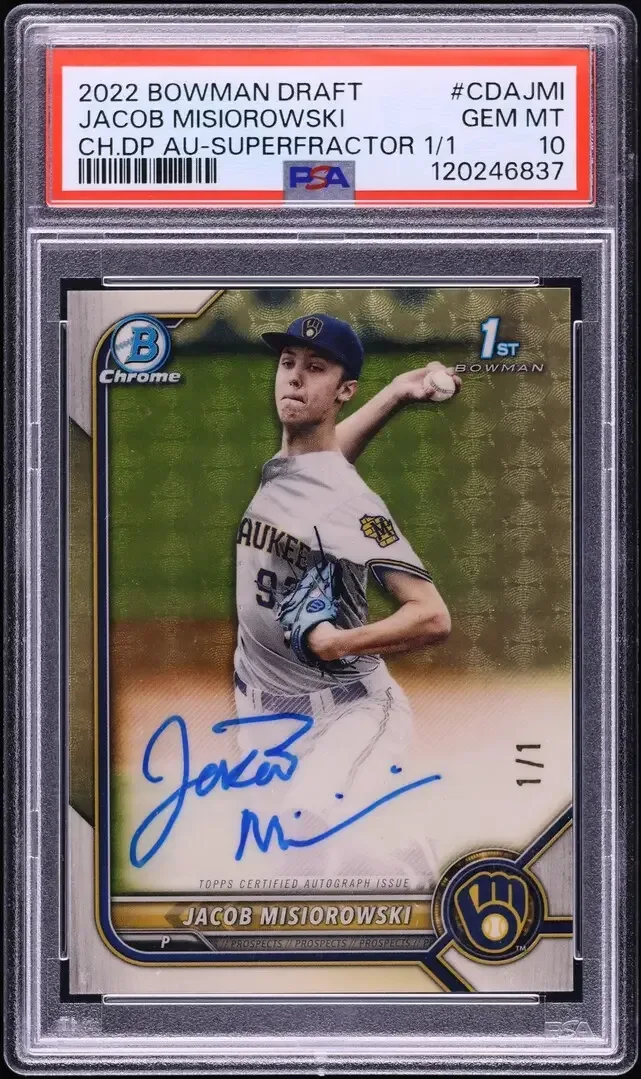
Jacob Misiorowski is the most obvious Milwaukee card-market focal point. The 24-year-old remains a rookie in the card world, is positioned as an NL Cy Young favorite and has a top reported sale of $52,800. Two of his 10 biggest sales arrived after the NLCS began, evidence that the postseason has already brought his higher-end cards more attention.
Related coverage includes Rays or Brewers? The World Series Card Market Cases.
His 2022 Bowman Draft Chrome Superfractor Autograph is a natural centerpiece because it combines a prospect-era issue, autograph and one-of-one scarcity. Yet the potentially most watched Misiorowski item is still ahead: his debut patch is expected in 2026 Topps Chrome Update. A Milwaukee title could make that eventual card one of the event’s defining hobby storylines.
There is an enormous benchmark in this particular niche. Paul Skenes’ debut patch reached $1.11 million, the stated record for the most expensive debut patch. Misiorowski challenging that mark would require a great deal to align, so it is best read as a high-end possibility rather than an expectation. The relevant point for collectors is simpler: a rookie pitcher with existing demand, an awards case and a championship chance has a rare catalyst stack.
For a broader discussion of why game-used patch-card details can be crucial, see what collectors still need to know about game-used patch cards. The player, set, patch provenance and eventual market supply can all matter as much as the big headline around a release.
Jackson Chourio combines youth, performance and a coherent team identity
Jackson Chourio offers a different kind of case. Still 22, he was among the most collected players in the 2024 rookie class, and he posted 4.9 WAR in 2026. His postseason already has a defining memory: a walk-off hit against San Diego Padres closer Mason Miller.
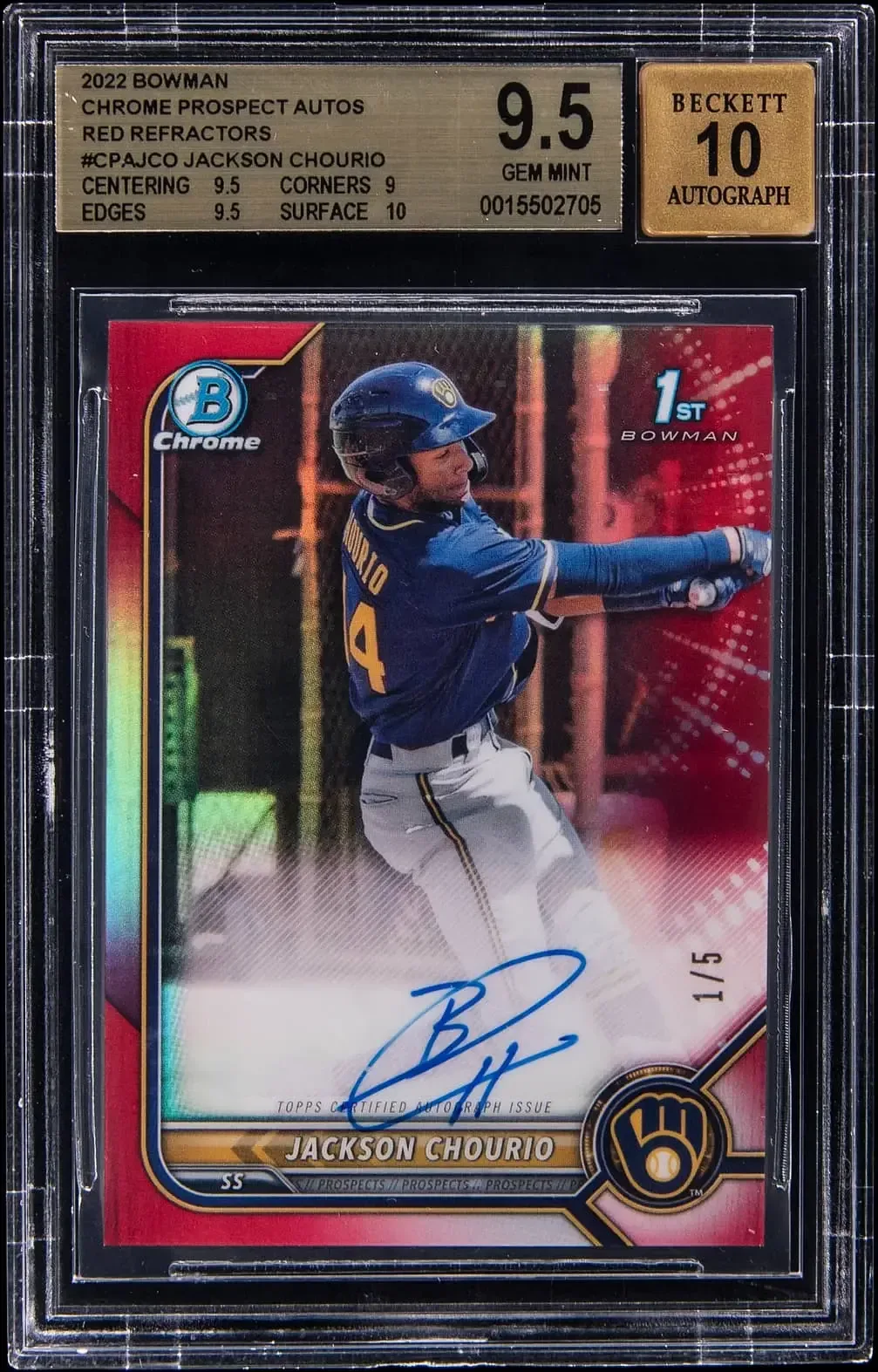
His sales show movement in both accessible and elite forms. A 2022 Bowman Chrome Prospect Autograph in PSA 10 sold for $500 at the start of the season and later sold for $875 on October 12. Then, on October 17, a 2022 Bowman Chrome Prospect Autograph Red parallel numbered to five, graded BGS 9.5 with an Auto 10, sold for $47,580—his second-highest sale.
A numbered-to-five Red autograph is not a substitute comp for the PSA 10 base prospect autograph. The two cards occupy very different scarcity and grading tiers. Together, though, the results illustrate demand across more than one level of Chourio’s market. His profile has another practical advantage for collectors who value visual continuity: his prospect and rookie cards picture him as a Brewer.
Christian Yelich gives Milwaukee an established-star lane
Christian Yelich’s card history is more complex but also deeper. He debuted with Miami in 2013 and remained there through 2017 before becoming a Brewer. He won NL MVP in his first Milwaukee season and has been with the organization for nearly a decade, though cards from the beginning of his career will naturally not match the Brewers-only visual identity available in Chourio’s catalog.
The available numbers nevertheless point to renewed interest. A 2010 Bowman Draft Chrome Base in PSA 10 has doubled in value since June. Yelich’s top sale remains a $111,000 result from May 2020 for a 2010 Bowman Chrome Draft Prospect Autograph Superfractor in PSA 9. That is a useful reminder that a player’s highest historic sale may precede the present postseason by years. A World Series would add a major accomplishment, but collectors should avoid treating an old peak as a current market floor.
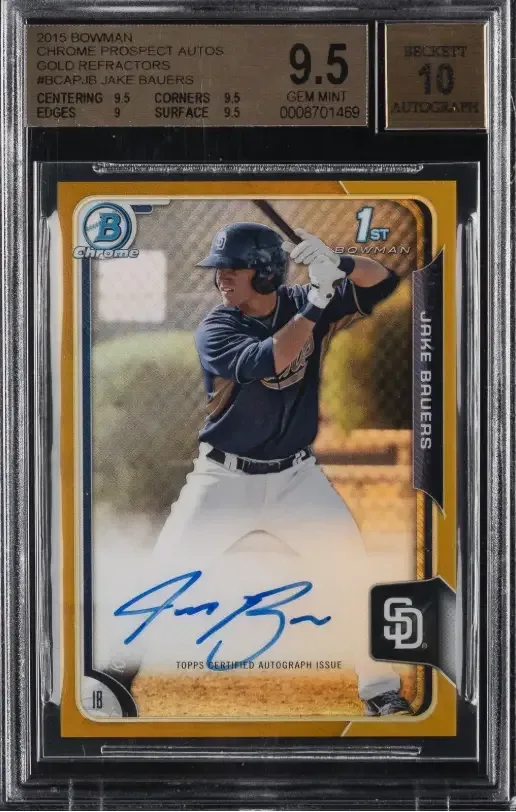
William Contreras, Brice Turang and NLCS MVP Jake Bauers provide additional Brewers routes. Bauers is particularly notable in the direct value comparison with Tampa Bay’s Jonathan Aranda: Bauers’ latest base Chrome rookie sale was $35, versus $15 for Aranda. It is only one pair of sales, not a full market index, but it captures Milwaukee’s greater current attention around several roster pieces.
Pratt and Lara illustrate the prospect-market question
Milwaukee’s World Series roster also includes rookies Cooper Pratt, starting at shortstop, and outfielder Luis Lara, who is platooning. Neither has appeared on rookie cards yet, and both are expected to eventually have debut patches. That means their markets are presently rooted in prospect cards rather than a complete rookie-card catalog.
Those prospect markets are already active. Lara’s 2023 Bowman Chrome Prospects Superfractor in PSA 9 sold for $5,063 on October 17. Pratt’s 2024 Bowman Chrome Prospect Autograph Red /5 in PSA 10 sold for $7,500 in June. These are extremely scarce, high-grade examples; they establish that serious buyers exist, not that every prospect card is priced at the same level. The prospect angle is inherently incomplete until the players’ rookie cards and later releases arrive.
The Tampa Bay case: more room below the spotlight
The Rays earned their World Series berth by beating the Cleveland Guardians, returning to the sport’s largest stage for the first time since 2020. They now face the club with baseball’s best regular-season record, which puts Tampa Bay in the underdog role. From a collecting perspective, that is precisely what makes the Rays intriguing. The potential move in attention is greater when a player begins with less of it.
Junior Caminero is Tampa Bay’s central star
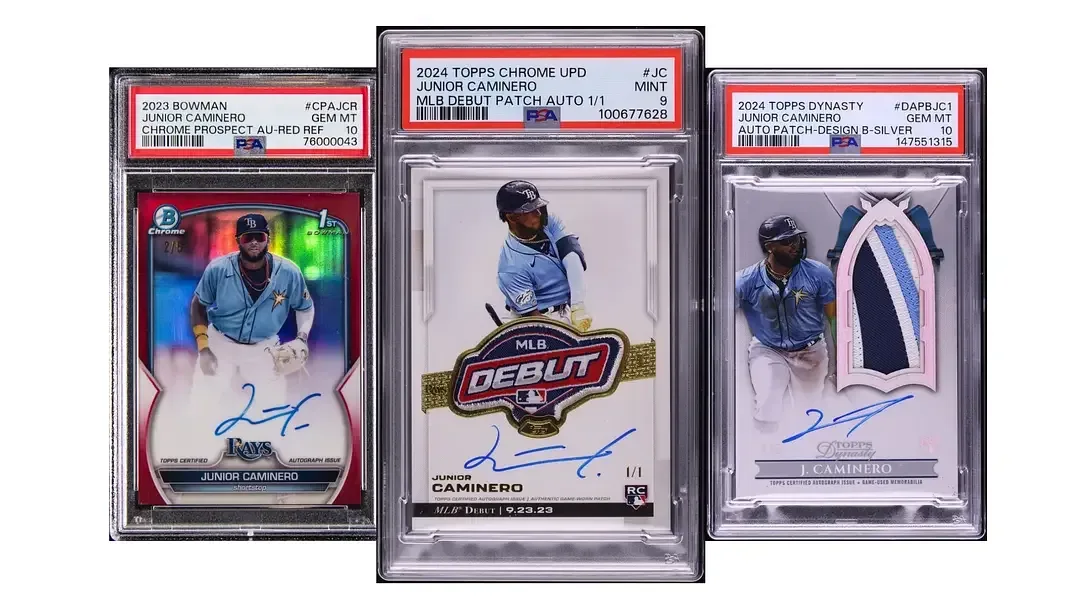
Junior Caminero is the Rays’ clearest blue-chip name. The power-hitting third baseman also had an impressive World Baseball Classic for the Dominican Republic, batting .350 with three home runs and seven RBI. His largest recorded card sale is $66,000 for a debut patch on December 19, 2024.
Chourio makes the cleanest comparison because both players had 2024 rookie seasons. A 2024 Topps Chrome refractor rookie autograph of Chourio sold for $78,000 in February 2025, $12,000 above Caminero’s top $66,000 result. Both results occurred before the 2025 season, so neither is a direct reading of the current World Series market. Still, the gap helps frame the debate: Caminero has elite-card demand, but Chourio has had more high-end sales.
Caminero has recorded three sales above $30,000, with one occurring in 2026. Chourio has nine such sales in total, including three in 2026. The implication is not that Caminero lacks a market. Instead, it suggests Tampa Bay’s biggest name may have more space for a championship narrative to broaden high-end interest. Whether that happens depends on the series and on which individual moments remain memorable after it.
Drew Rasmussen shows how rapidly a scarce card can move
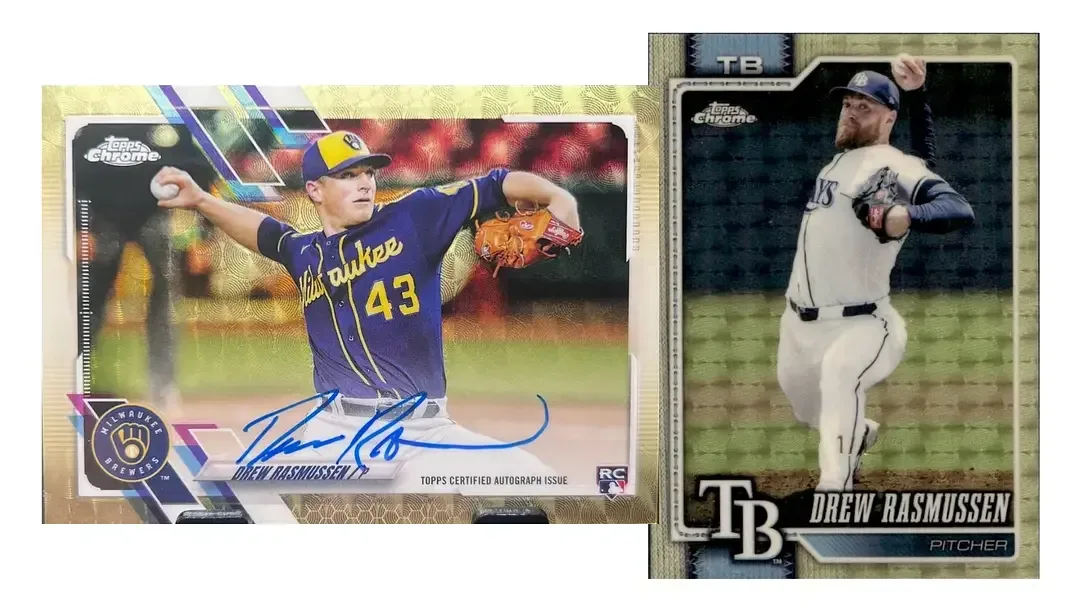
Drew Rasmussen supplies the Rays’ most striking short-window example. His 2021 Chrome rookie autograph Superfractor sold for $799 on August 1, 2026, then for $1,699 on October 17. That is an increase of more than 110% in a little over two months. A separate 2026 Superfractor sold for $1,025 on September 29.
The sales are notable, but they should be interpreted carefully. A one-of-one has no perfectly interchangeable counterpart, so the $799-to-$1,699 change is a real sequence of sales rather than a precise percentage measure for every Rasmussen card. It does, however, demonstrate that postseason attention can move a rare card sharply when a new buyer values it differently. A major World Series start could keep the focus on Rasmussen; a title alone would not necessarily do so if another Ray owns the series’ pivotal moments.
The lower-priced Rays names are the contrarian appeal
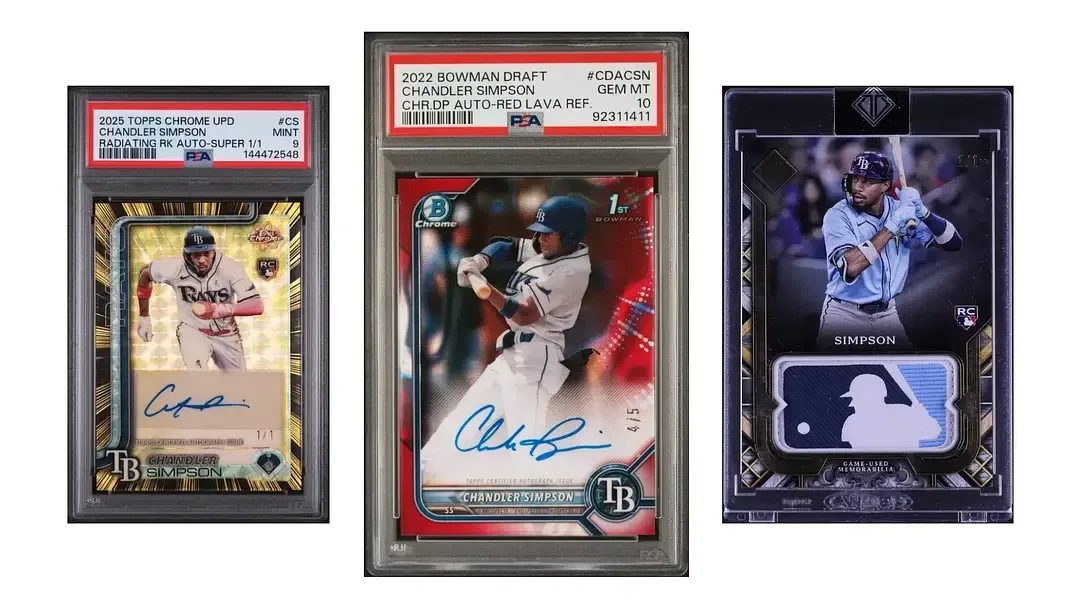
Jonathan Aranda, Chandler Simpson and Richie Palacios are the heart of the Tampa Bay argument for collectors who would rather investigate overlooked contributors than chase the established headliners. Aranda’s most recent base Chrome rookie sale of $15 sits well below Bauers’ $35. The cards are not interchangeable investments, but the gap identifies how much lower the entry point can be for a Rays player.
Palacios has provided on-field support for that argument. He is batting .364 in the playoffs with eight hits, fourth-most on the Rays, despite having nearly half the at-bats of the three teammates ahead of him in hits. Those numbers make him a player whose visibility could rise if Tampa Bay remains competitive or wins. Simpson has also been singled out as a Rays player with possible upside, including demand around rare rookie pieces such as a one-of-one Radiating rookie and rookie Logoman cards.
The practical lesson is not to buy a name solely because it is cheaper than a counterpart. Lower price can reflect lower demand, more supply, fewer established collectors or a combination of factors. For collectors who enjoy tracking postseason contributors, though, Tampa Bay offers more names where a compelling October performance could introduce a player to buyers who previously were not watching.
What collectors should actually watch during the series
- Individual moments over team association alone: A title is powerful, but the player with the defining play may draw the most immediate attention.
- Card-level differences: Do not use a Superfractor, debut patch or /5 autograph as a shortcut valuation for a base rookie.
- Timing of the sale: Chourio’s $78,000 and Caminero’s $66,000 top comparative examples came before the 2025 season, while other cited sales occurred during 2026 postseason interest. Context changes how useful each comp is.
- Grading labels: PSA 10, BGS 9.5 and an Auto 10 describe separate evaluations. A grade adds important context but does not make differently graded copies direct equivalents.
- Release status: Misiorowski’s anticipated debut patch and the future debut patches for Pratt and Lara are not yet released. Interest in a coming card is not the same as a completed sale.
Rooting for Milwaukee means rooting for the possibility of an already robust star ecosystem receiving a historic franchise-level achievement. Rooting for Tampa Bay means rooting for a more disruptive outcome, one that could elevate Caminero and give Rasmussen, Aranda, Simpson or Palacios a larger audience. For card collectors, the most interesting result may be the one that pairs the trophy with an unmistakable individual performance. That is where the World Series stops being only a team story and becomes a card-market story.