A deep postseason run can rearrange a baseball-card market in a hurry, but it rarely does so evenly. The Milwaukee Brewers’ sweep of the Dodgers has created a timely case study: Jake Bauers is drawing fresh attention through comparatively attainable prospect-era autographs, William Contreras remains the established star with a proven high-end record, and Jackson Chourio retains the fan-favorite, grail-card profile despite a more uneven postseason batting average.
The broader takeaway for collectors is not that every Brewers card should suddenly be treated alike. The available sales and performance details point to three distinct collecting stories. Bauers is the player whose market activity appears most directly tied to the moment. Contreras has credentials and a prior marquee sale supporting a steadier foundation. Chourio already occupies the premium end of the modern Brewers conversation, where rare rookie cards can command dramatically different money from more widely available issues.
That distinction matters, particularly when postseason excitement encourages buyers to treat a team surge as if it automatically raises every card at the same rate. Baseball cards are tied to players, specific releases, scarcity, autograph status, condition and the timing of each transaction—not simply the result of one series.
Jake Bauers’ postseason has revived interest in his Bowman trail
Bauers’ path to Milwaukee gives his card catalog a long prospect history. San Diego selected him 208th overall in the 2013 draft, following a high-school championship played at Dodger Stadium. He spent 18 months in the Padres organization before a trade sent him to Tampa Bay, and he made his professional debut on June 7, 2018. Five years and four teams later, Milwaukee has become the club tied to his current playoff breakout.
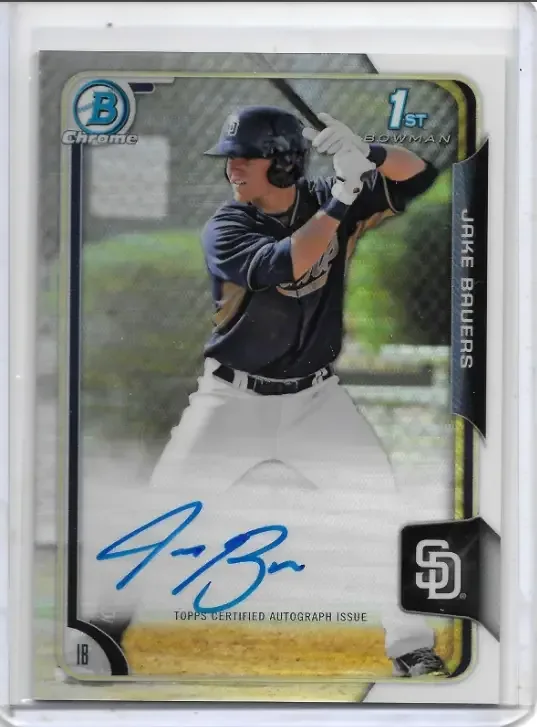
That history helps explain why 2015 Padres-era cards are central to the current discussion. The cards were made well before the present Brewers run, yet they represent the earliest part of his licensed prospect-card identity. In collecting language, a player’s first-year card generally refers to a card from the first year associated with that player in a given product line or prospect cycle. It does not automatically mean “rookie card,” and collectors should read listings carefully rather than assuming the terms are interchangeable.
After the October 15 Brewers sweep, 1,430 Bauers cards reportedly sold. Of that total, 257 were Bowman cards, including 90 of his 2015 San Diego Padres first-year cards. That is a useful signal of attention, especially because it identifies a concrete product family buyers are pursuing rather than merely presenting a vague claim that interest is rising.
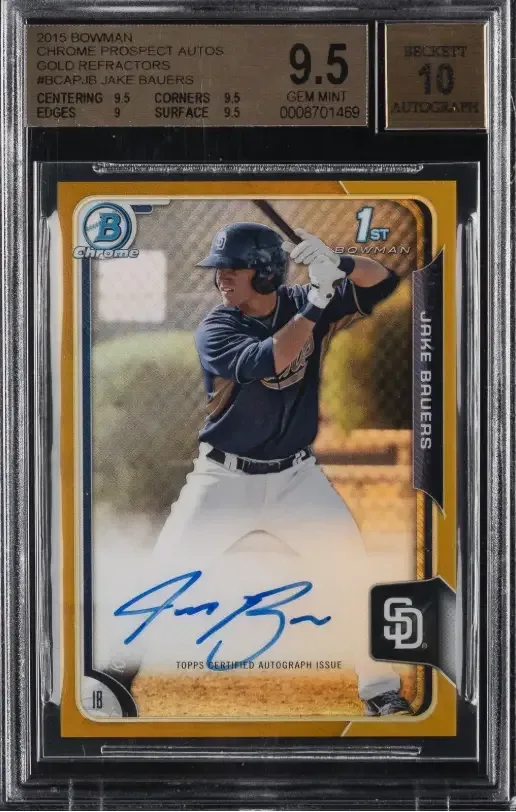
One high-end sale illustrates where condition and scarcity can push a Bauers prospect card: a 2015 Bowman Chrome Prospect Autos Gold #BCAP-JB, graded BGS 9.5, sold for $399 on October 15, 2026. A separate 2015 Bowman Chrome first autograph Refractor, numbered 6 of 499, sold for $99.99 that same day.
Those examples should not be read as a single price guide. The Gold parallel, the limited serial number on the Refractor, the autograph and the assigned grade all shape value. Serial numbering is the printed limitation of a card—for example, “6/499” means that particular copy is number six in a run capped at 499. A parallel is a version of a card distinguished from the standard edition by a different finish, color or treatment. The details are not decorative: collectors often place a major premium on a low-numbered parallel compared with a standard card of the same player.
The BGS 9.5 on the Gold autograph is also consequential. Third-party grading evaluates a card’s physical condition and encapsulates it in a tamper-evident holder. A grade does not change the card’s underlying scarcity or guarantee future demand, but high grades can matter substantially on prospect cards, where collectors may compare centering, corners, edges and surface condition closely.
For collectors who want exposure to the Bauers story without moving immediately into low-numbered graded cards, raw autographs were still described as available for $100 or less. Raw means the card has not been encapsulated and assigned a grade by a third-party grading company. That can lower the entry cost, but it transfers more responsibility to the buyer. Condition, autograph presentation, authenticity of the listing and the exact version of the card all deserve attention. A raw autograph at a lower price is not necessarily directly comparable with a graded Gold parallel or a numbered Refractor.
Why the Bauers market needs careful reading
Short-window sales volume measures activity, not permanence. A playoff performance can bring new collectors into a player’s listings while also prompting existing owners to sell into heightened attention. The reported 1,430-card total therefore says that Bauers has become a live market topic; it does not by itself establish a lasting price level for every issue.
His NLCS contributions—clutch hits and an ability to wear down pitchers—provide the on-field catalyst. Yet the practical collecting choice remains specific: decide whether the appeal is the 2015 first-year connection, a signed card, a numbered card, a graded example, or simply a lower-cost card marking the moment. Those are different goals, with different supply and risk profiles.
William Contreras offers the established-star lane
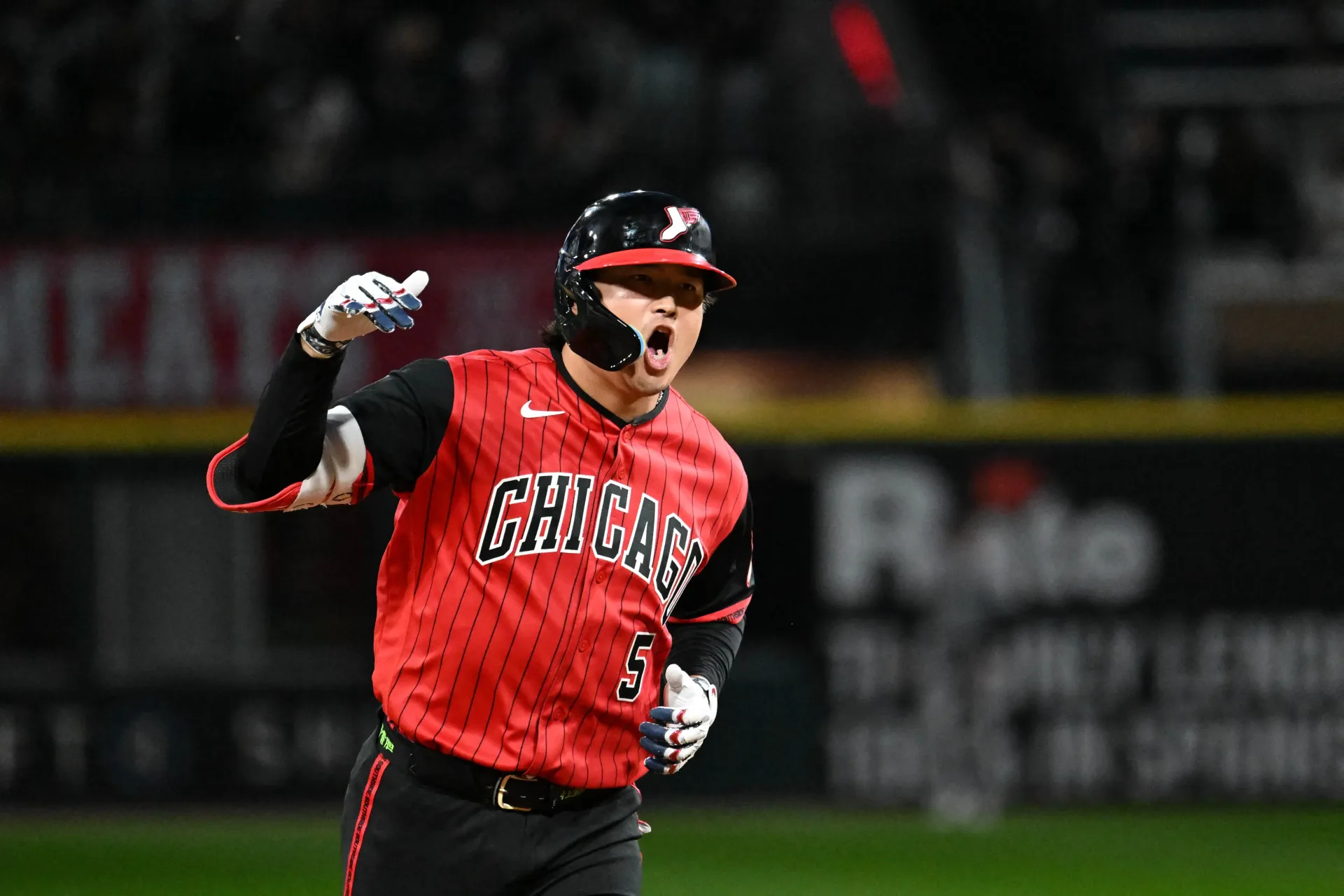
Contreras enters the World Series as a far different market proposition. He is batting an NL-leading .367 and has the résumé cited by collectors looking beyond a single hot stretch: a World Series ring, a World Baseball Classic gold medal, three MLB All-Star selections, two Silver Slugger awards and an All-MLB First Team designation.
That list does not settle future card values, and it is too early to label any active player’s career in Hall of Fame terms. It does, however, show why Contreras has a more established collecting case than a player suddenly lifted by one postseason. For a catcher in particular, a portfolio of honors and sustained recognition can give collectors several reasons to follow his cards at once.
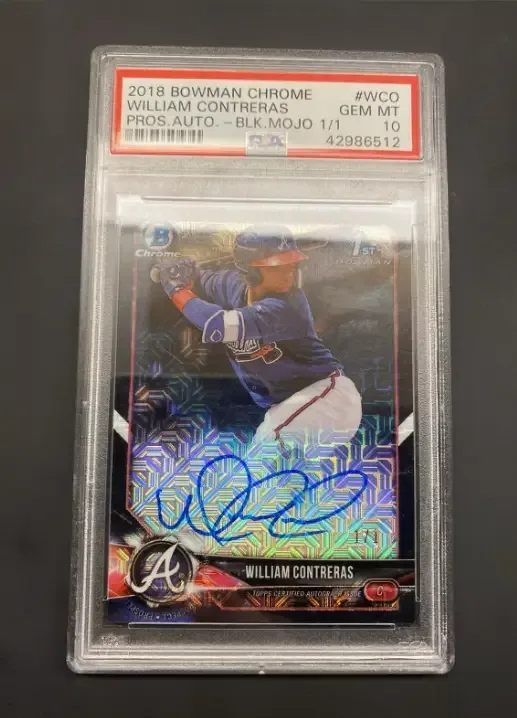
His highest cited sale came after his championship season with Atlanta: a 2018 Bowman Chrome William Contreras Auto Black Mojo 1/1, graded PSA 10, sold for $5,750 on November 6, 2022. The notation 1/1 means it is a one-of-one card—the only copy of that particular parallel. “Black Mojo” identifies the parallel style, while PSA 10 denotes a top grade from the named grading company. Combined with an autograph, that package places the card firmly in the ultra-scarce end of the player’s market.
The $5,750 sale is important context, but it is not a blanket valuation for Contreras cards. One-of-one autograph sales are often headline results precisely because there is no identical second copy for a clean side-by-side comparison. A buyer considering a more common Contreras card should treat that record as evidence of demand for a premium artifact, not as a multiplier that can simply be applied to every base card, parallel or unsigned issue.
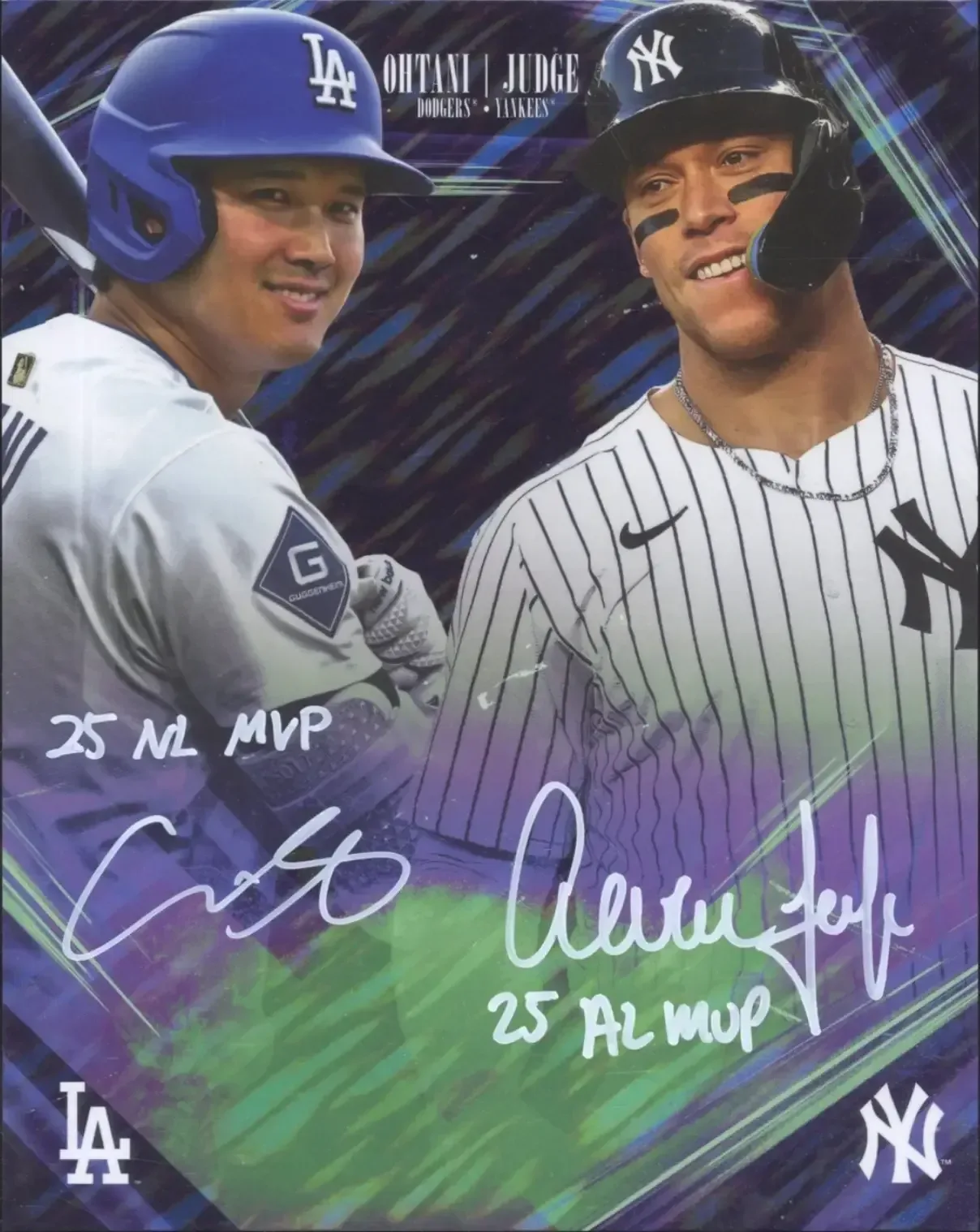
Collectors interested in how autographs change the character of a baseball-card collection can also see the broader appeal in Aaron Judge’s inscribed baseball cards, where the signature itself becomes part of the item’s story. Contreras’ Black Mojo sale is a different kind of premium—one driven by a one-of-one parallel, grade and autograph—but the same principle applies: the exact card configuration is crucial.
Jackson Chourio remains Milwaukee’s big-ticket card name
Chourio’s postseason line supplies a reminder that collectors often value impact beyond batting average. He leads Milwaukee with 11 RBIs and hit a leadoff home run against Blake Snell in Game 3 of the NLCS. Those moments carry obvious appeal during a playoff run even if his overall average is described as mediocre by comparison.
His market was not built from this October alone. Chourio falls outside the earlier Bowman-focused prospect era associated with Bauers, but he has recorded more than 50 five-figure card sales since 2022. That is a notably different market tier: established demand for scarce Chourio cards existed before the current World Series buildup.
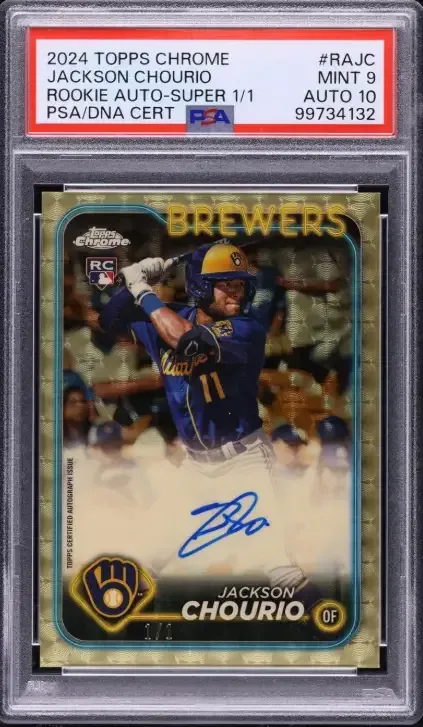
The standout result is his 2024 Topps Chrome Superfractor rookie autograph, graded DNA 10 and PSA 9, which sold for $78,000 on February 23, 2025. A Superfractor is a highly coveted, one-of-one Topps Chrome parallel. The paired labels here describe two different assessments: DNA 10 relates to the autograph, while PSA 9 is the grade assigned to the card itself. The distinction is worth understanding. A card can receive a different assessment for its physical condition than the signature receives for its quality or authenticity.
That $78,000 result demonstrates Chourio’s ceiling for an exceptional modern rookie card. It does not mean a buyer should expect routine Chourio cards to behave like a Superfractor. At the top end, rarity compounds with rookie status, a signature and grading. Remove one or more of those elements and the comparison becomes less precise.
Other Brewers have strengthened the team story, not necessarily a card thesis
Milwaukee’s run has not been limited to its three most visible collecting names. Arron Ashby has posted a 0.00 ERA in six appearances, striking out 11 and earning two saves. ERA, or earned run average, measures earned runs allowed per nine innings; a 0.00 figure means no earned runs have been charged to the pitcher in that sample.
Rookie shortstop Cooper Pratt is batting .310 with nine hits in three games, while David Hamilton has scored five runs and collected five hits in 11 at-bats, including a home run. Their production helps explain why Milwaukee’s postseason has felt like a team effort rather than a one-player showcase.
For card collectors, though, strong October statistics are the beginning of research rather than a command to buy. The supplied sales evidence identifies specific Bauers, Contreras and Chourio cards; it does not establish comparable market records for Ashby, Pratt or Hamilton. The sensible move is to separate a player’s compelling on-field story from verified evidence about particular cards.
What to check before buying into a postseason run
- Identify the exact card: Confirm the year, product, player, parallel, autograph status, serial number and grade. Similar-looking listings can represent very different levels of scarcity.
- Compare like with like: A raw card should not be measured against a graded card as if condition were irrelevant. Nor should a common parallel be valued from a one-of-one sale.
- Use recent sales as context, not certainty: Bauers’ reported spike is meaningful, but a small period of heightened activity can change quickly as postseason attention moves.
- Choose the collecting lane deliberately: Bauers offers prospect-era and comparatively accessible autograph options; Contreras offers a decorated-star narrative; Chourio represents the premium modern rookie and rarity chase.
- Keep the team result separate from the card: A World Series run can boost visibility, but card value still depends on supply, condition and the particular issue a collector wants to own.
The Brewers’ October success has created an unusually clear snapshot of how one roster can support multiple hobby narratives at once. Bauers is the immediate momentum play with attention concentrated around 2015 Bowman material. Contreras is the proven catcher whose rarest cards already have meaningful sales history. Chourio remains the established high-ceiling name, with a six-figure-adjacent benchmark far beyond the rest of the team’s cited results. Collectors watching Milwaukee should follow the individual card, not just the postseason headline.