An autograph establishes a direct, physical link between a player and a trading card. An inscription—the extra words written alongside the signature—can make that link feel much more specific. It may mark an achievement, echo a nickname or commemorate a particular card-company promotion. For Aaron Judge collectors, those additions have produced a distinct corner of the modern baseball-card market.
Judge arrived as a major collecting figure during his 2017 rookie season, when he appeared as the cover player for both 2017 Topps Chrome and Topps Update. But his signing history runs further back than his MLB debut. Early prospect-era cards show a player willing to add information beyond his name, while later releases lean into the identity he built with the New York Yankees and, more recently, his place among baseball’s biggest current stars.
That progression matters. A plain autograph can be scarce, serial-numbered or connected to a premium product. An inscribed autograph adds a second layer of story. It does not automatically guarantee a card’s value, but it gives collectors a clear reason to distinguish one signed copy from another.
What makes an inscription different?
In trading-card terms, an autograph card is a card signed by the player. A short print is produced in lower quantities than standard cards, while a 1/1, or one-of-one, is the only copy of that particular card version. An inscription can appear on any of these formats, but the combination of a recognizable phrase, a limited print run and a major player is especially compelling.
For more context, explore Littlelands Sets November 16 Steam Early Access Debut as Expanded Demo Adds Combat and Customization.
The appeal is not solely financial. Baseball has always had room for player nicknames, franchise shorthand and milestone language. A few handwritten words can locate a card within that tradition. Judge’s inscriptions generally fall into three useful categories: personal branding, Yankees history and career résumé.
The dual-MVP one-of-one: “25 AL MVP”
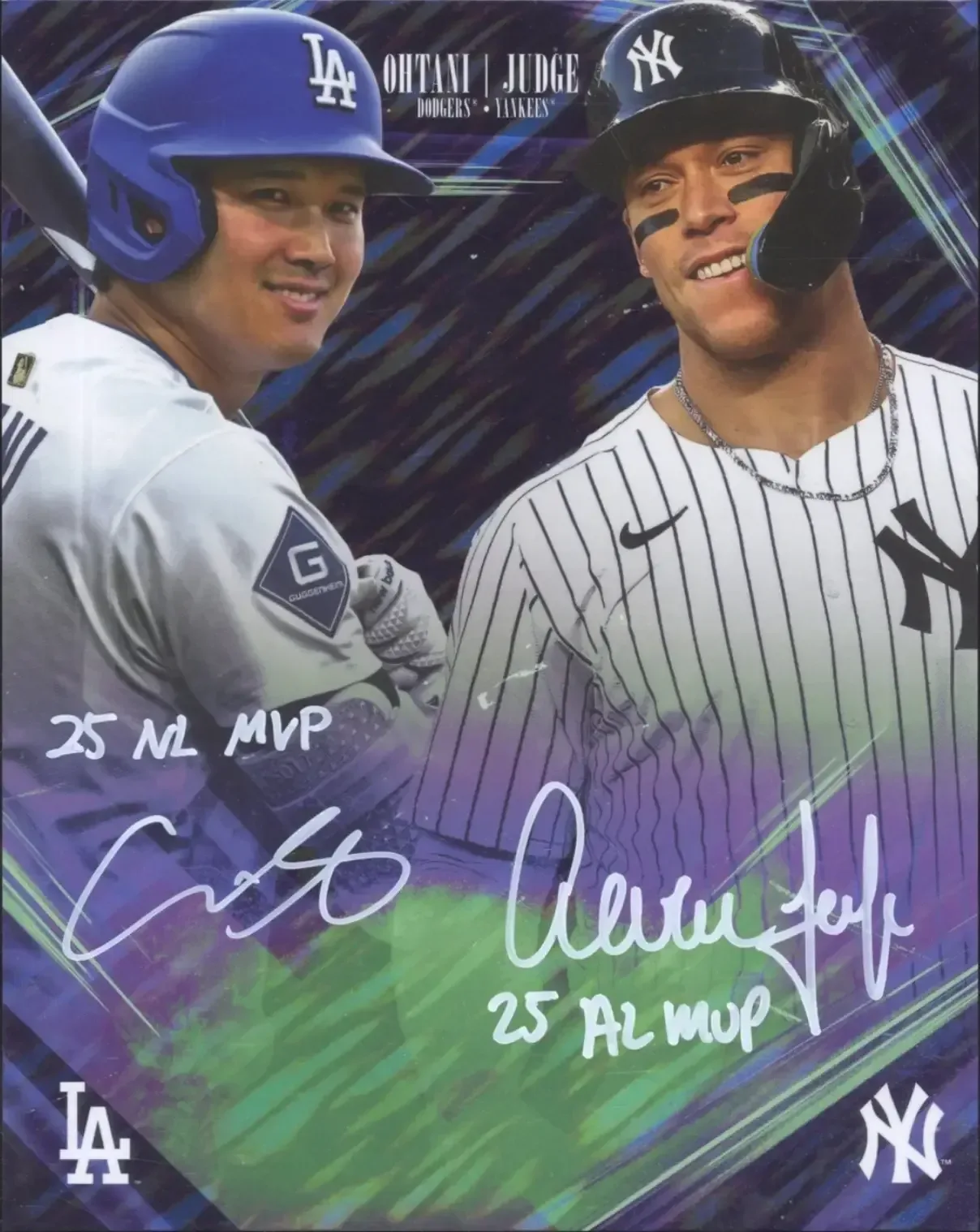
The most expensive example in this group is a 2026 Fanatics Emanate dual-autograph card pairing Judge with Shohei Ohtani. It is a 1/1, features the two reigning MVPs, and includes Judge’s “25 AL MVP” inscription. Those pieces of context are doing substantial work at once: star power, dual signatures, a unique print run and a timely accolade.
The card sold at an eBay auction in September 2026 for $25,100. That result should be read as a sale for one unusually loaded card rather than a simple price guide for all Judge autographs. One-of-ones are inherently difficult to compare because there is no identical second copy. Still, this sale offers a clean example of why inscriptions can be important to high-end buyers: the writing does not just decorate the card, it frames the exact moment the card represents.
Related coverage includes Aaron Judge’s Most Notable Inscribed Baseball Cards.
Judge and Ohtani may appear together on other signed cards during their careers, but a one-of-one created while both were reigning MVPs has a narrowly defined place in modern baseball-card history. For collectors, that specificity is the point.
“Bronx Bombers” on a 2017 rookie autograph
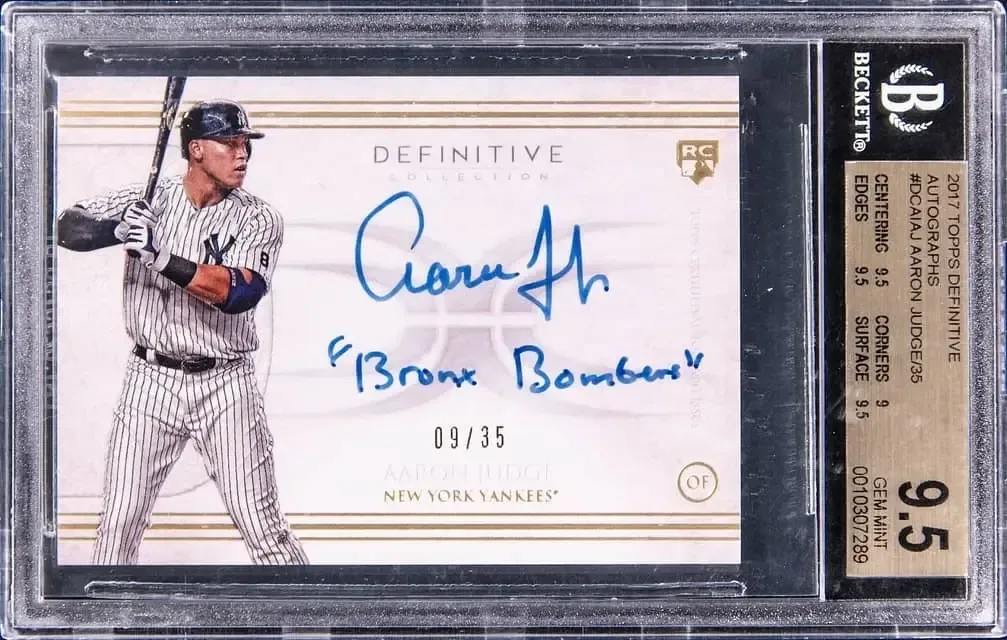
Judge’s “Bronx Bombers” inscription on a 2017 Topps Definitive Autographs Rookie Card is rooted in the team context that made his rookie season so memorable. The Yankees’ wave of young talent—including Judge, Gary Sánchez, Greg Bird and Luis Severino—was often called the “Baby Bombers.” Judge’s inscription reaches beyond that particular group to invoke the far older “Bronx Bombers” identity associated with Yankees power hitting.
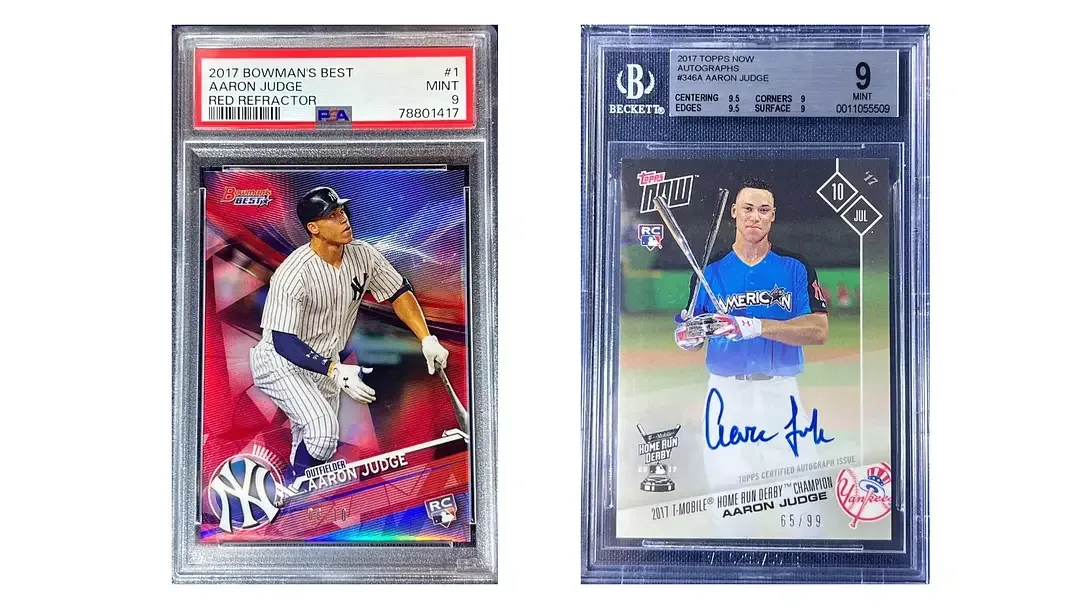
That makes the phrase more meaningful than a generic slogan. Judge is listed behind Babe Ruth, Mickey Mantle and Lou Gehrig on the Yankees’ franchise home-run leaderboard, so the inscription sits naturally alongside a long-running lineage of sluggers. A Beckett 9.5-graded copy sold for $6,500 in June 2025.
Grading refers to an independent assessment of a card’s physical condition, generally examining areas such as centering, corners, edges and surface. The 9.5 grade is relevant because condition can materially affect demand for a premium modern card. But the grade is only one part of this card’s identity. Its rookie status, Definitive branding, Judge autograph and “Bronx Bombers” wording all help explain why it stands apart from an ordinary signed card.
Why “All Rise” carries more weight
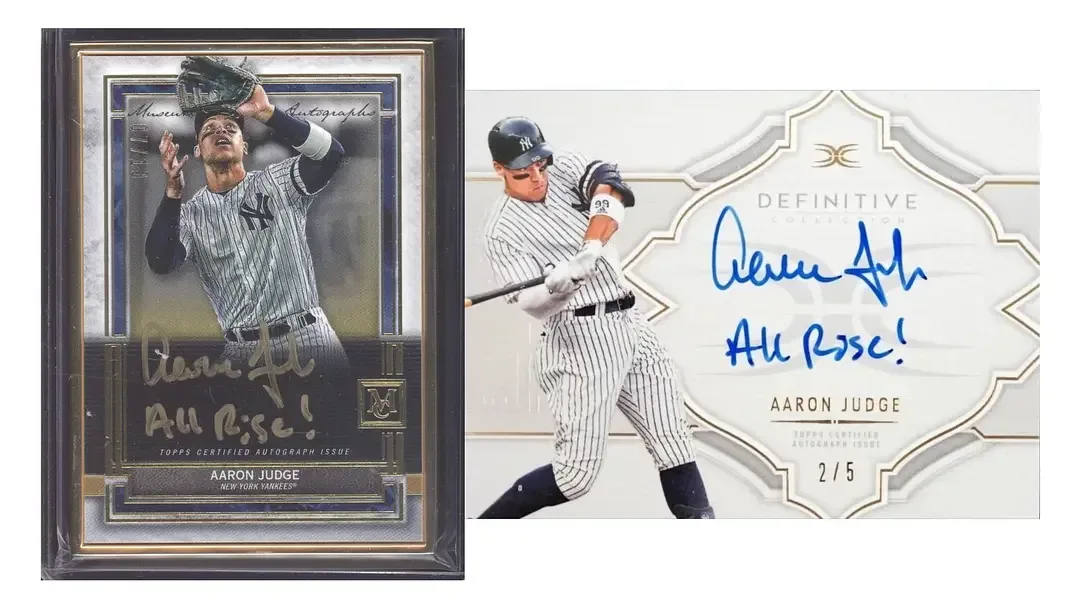
“All Rise” is arguably Judge’s most immediately recognizable card inscription. It appears on 2020 Topps Museum and Topps Definitive autograph cards, and it functions as a natural extension of No. 99’s public identity. The phrase has been used as a call for fans when Judge comes to bat, but it also has a charitable connection: Judge named his youth-empowerment organization the ALL RISE Foundation.
That broader association is what separates “All Rise” from a disposable catchphrase. On a card, it is short enough to be visually bold while still pointing to an established part of Judge’s persona. It also works across product lines. A collector who prefers the design and presentation of Topps Museum can pursue one version, while another who wants the premium positioning commonly associated with Definitive can pursue another.
For someone building a Judge autograph collection, that flexibility is practical. Not every meaningful inscription exists on a single, inaccessible one-of-one. “All Rise” provides a theme that can be pursued across multiple 2020 products without losing its connection to the player.
Prospect cards that read like a résumé
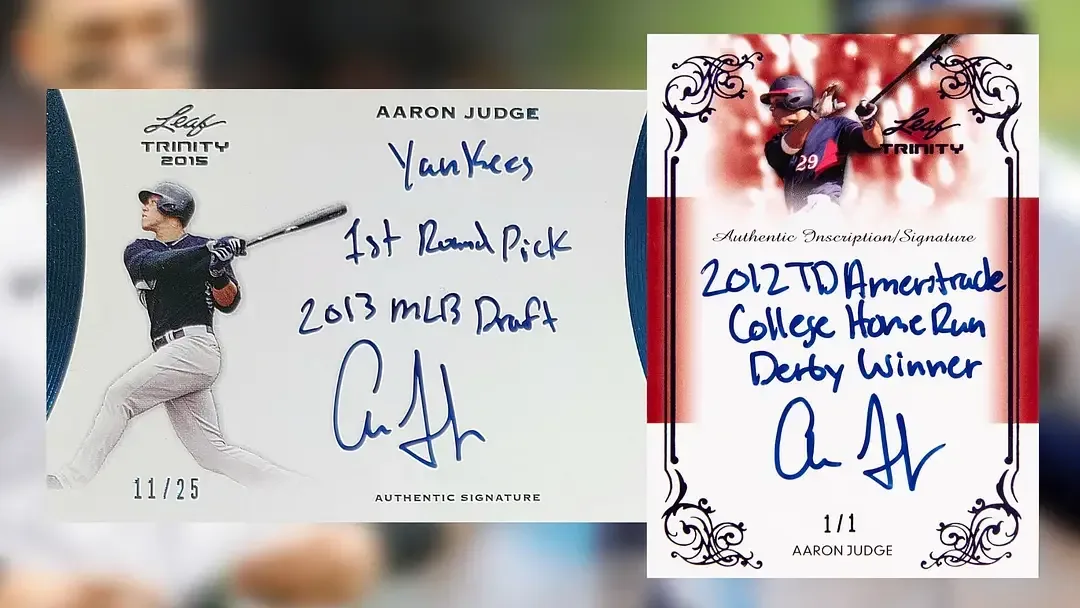
Judge’s 2013 and 2015 Leaf Trinity cards capture a different stage of his career. Rather than relying on an already-famous Yankees slogan, these prospect-era releases use inscription space for biographical accomplishments. The cards reference elements such as his 2012 TD Ameritrade College Home Run Derby win and his first-round selection by the Yankees.
There is an appealing contrast here. Later Judge inscriptions are often concise pieces of branding: “All Rise,” “Bronx Bombers,” an MVP notation. The Leaf Trinity examples are closer to a snapshot of ascent. They preserve achievements that mattered before Judge had established himself as one of the Yankees’ leading home-run hitters.
That is why prospect inscriptions can be especially revealing to collectors. The value is not merely that the card is early. It is that the wording reflects what a player’s story looked like before the biggest professional milestones had arrived. Judge’s rookie-year MLB Home Run Derby win and the accomplishments that followed changed the scale of his career, but these cards retain the language of an earlier chapter.
A company celebration: “Happy Birthday Topps”
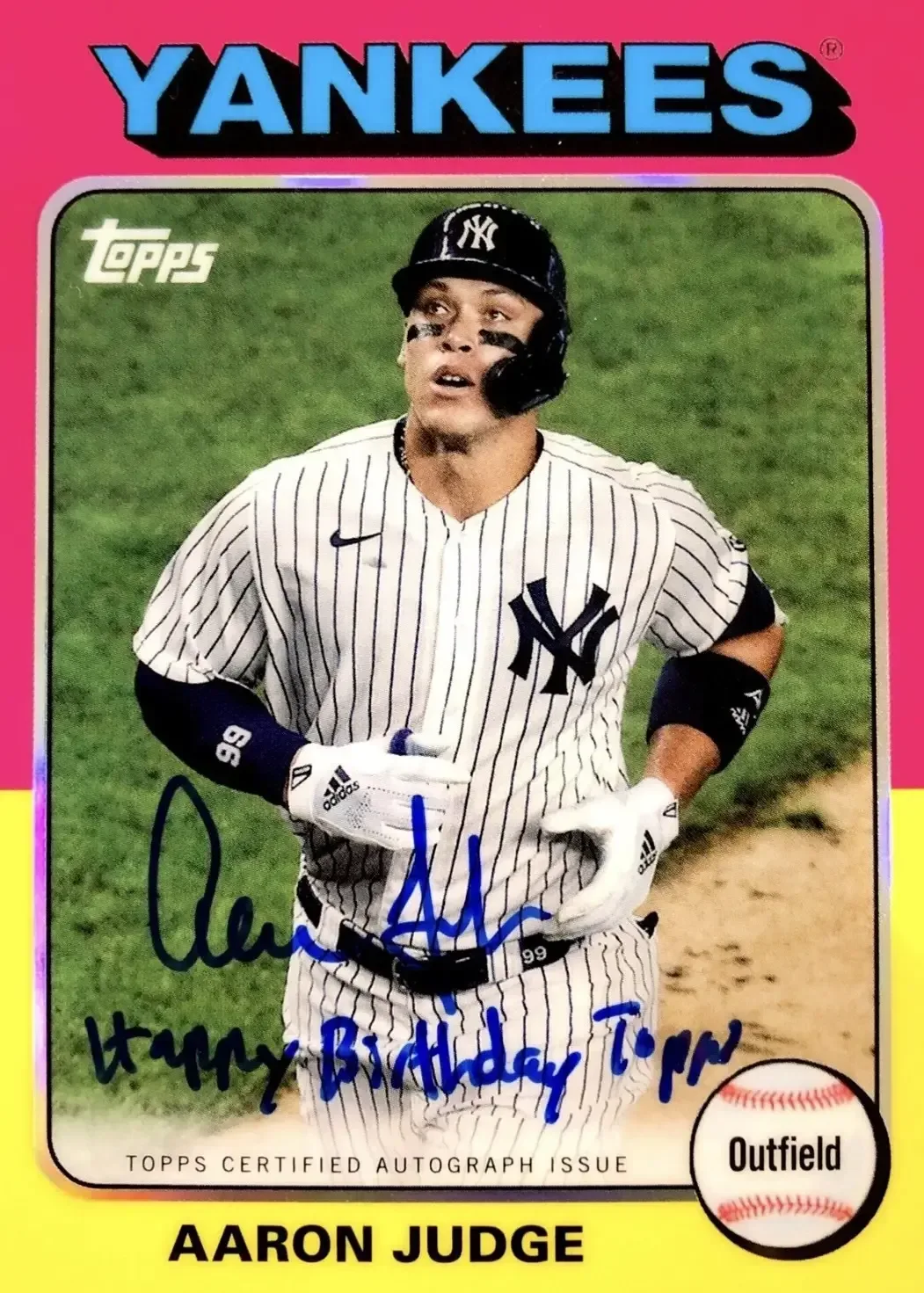
Not every inscription needs to be centered on the athlete. The 2021 Topps Tribute card bearing “Happy Birthday Topps” came from a celebratory autograph program in which numerous baseball names added the same birthday message. Judge was joined in that initiative by players including Frank Thomas, Juan Soto and Don Mattingly.
For collectors, this kind of release illustrates another form of context. The inscription is not a Judge-specific nickname or achievement, but it identifies a coordinated program and its purpose. That can matter to set builders who want a representative card from the full tribute rather than only a Judge-focused chase card.
It also shows why a collector should read an inscription literally before assigning extra significance to it. “Happy Birthday Topps” is meaningful because of the release’s shared concept, not because it marks a unique personal milestone in Judge’s career. Understanding that difference helps buyers organize a collection around the stories they actually want to tell.
How to collect Judge inscriptions with a clear plan
The best starting point is to decide which kind of Judge story matters most. A collector interested in Yankees identity may focus on “Bronx Bombers.” Someone seeking his most durable public slogan may choose “All Rise.” Prospect-card collectors may favor Leaf Trinity’s résumé-style writing, while high-end collectors may view the Ohtani dual 1/1 as a modern centerpiece.
- Separate the autograph from the inscription. Confirm that the extra text is actually handwritten on the card and not part of the printed design.
- Identify the exact release. Product name, year, serial numbering and whether the card is a rookie or prospect issue all affect how it fits into a collection.
- Use single sales carefully. The $25,100 Ohtani/Judge 1/1 sale and the $6,500 Definitive result are specific transactions, not blanket values for every Judge card bearing similar wording.
- Let the theme guide the purchase. Inscription collecting is often strongest when it has a purpose: Yankees lore, major awards, early-career milestones or a particular product set.
Judge’s card career mirrors the rise of his baseball career: early prospect confidence, a breakout rookie season, Yankee mythology and marquee status beside the game’s other elite names. The extra handwriting on these cards makes that arc easy to see. An inscription is only a few additional characters, but on the right card it can turn a signature into a compact piece of sports history.