Topps Holiday began in 2016 as a seasonal baseball-card product built around festive visual gimmicks, including hidden elves, image variations and short prints. It has a low-cost, high-card-count mega-box identity, but its best pulls demonstrate that “affordable product” does not mean every card carries affordable stakes.
Across the leading recorded sale from each Topps Holiday release from 2016 through 2026, the pattern is clear: low-numbered autographs, one-of-one cards and relic cards command the strongest results. Shohei Ohtani is the overwhelming constant, taking the annual top-sale spot in five of the 11 releases covered here. Yet there are meaningful exceptions, from a Ronald Acuña Jr. pre-rookie one-of-one to Paul Skenes’ rookie patch autograph—and, in the newest set, an early $750 sale for an autographed faux-relic Mrs. Claus card.
These are not price-guide promises or a checklist of the cards every collector should chase. They are individual recorded sales, often separated by years, and individual cards can differ dramatically in grade, serial number, relic type, autograph format and timing. A current market value or an active asking price should not be treated as the same thing as a completed transaction.
The annual top Topps Holiday sales
2016: Bryce Harper Metallic Snowflake Relic Autograph — $870
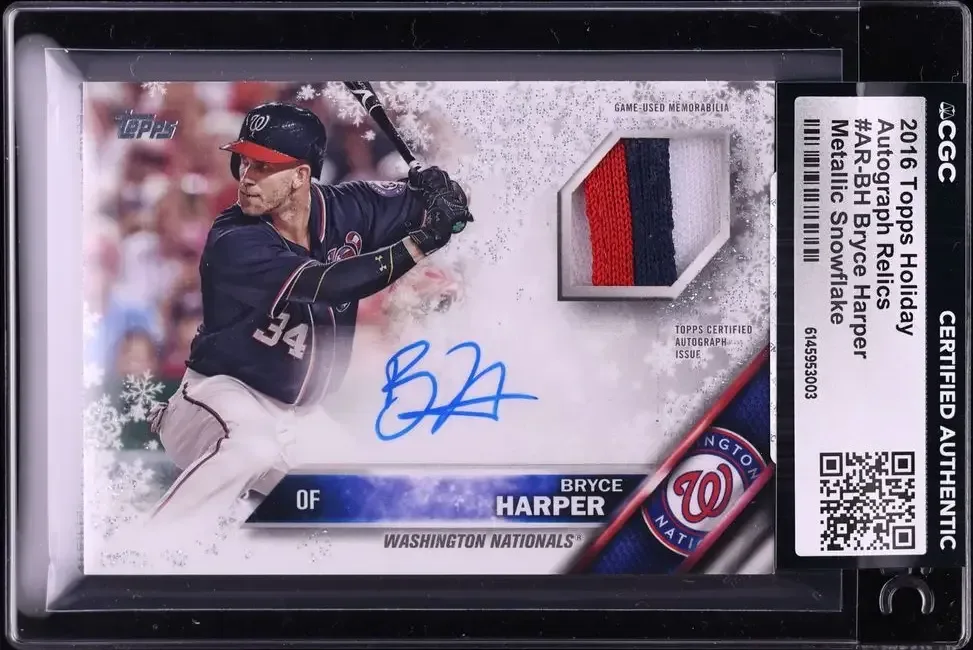
The inaugural Topps Holiday release’s leading sale belongs to Bryce Harper. His Metallic Snowflake Relic Autograph, certified authentic by CGC, sold for $870 on April 19, 2026, after 19 bids in a Fanatics Collect auction. A listed current value is $789.
The card shows Harper from the waist up and includes a tri-color relic. Its autograph is rendered as initials rather than a full signature, an understandable design compromise given the available signing space. As a debut-year premium hit, it establishes the product’s basic formula: the Holiday theme is the wrapper, while autograph-and-relic scarcity is the value engine.
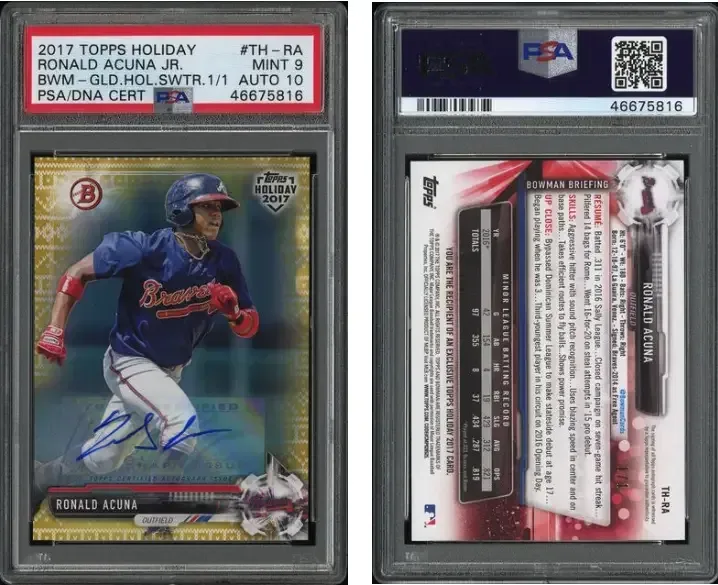
2017: Ronald Acuña Jr. one-of-one autograph — $3,901
The top 2017 result is a Ronald Acuña Jr. one-of-one autograph from before his rookie year. It sold for $3,901 on July 9, 2020. The PSA Mint 9 card received a 10 autograph grade and uses an image associated with Acuña Jr.’s Bowman 1st card, showing him running the bases.
Its gold ugly-sweater pattern and the one-of-one stamp on the reverse make the Holiday connection unmistakable. The card has only one recorded sale in the supplied market history, which is a major limitation when trying to infer its present-day level. It is listed for $60,000 on Fanatics Collect, while a listed value is $2,223.16. Neither figure substitutes for another completed sale; an asking price is simply what a seller wants, while a valuation is an estimate derived from available data.
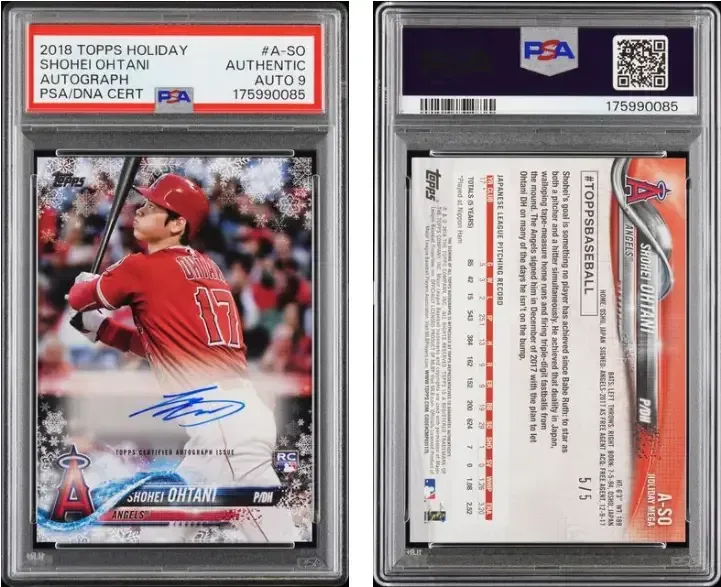
2018: Shohei Ohtani rookie autograph, numbered 5/5 — $10,980
Ohtani’s 2018 rookie autograph is the highest annual result in this group at $10,980, sold at auction on October 8, 2026. The card is numbered 5/5, authenticated and carries a 10 autograph grade. Its listed value is $10,370.
At a glance, the design resembles a base card with an autograph added. The crucial difference is the tiny print run: 5/5 means this was the fifth and final card in a five-card serial-numbered run. Ohtani’s status in the run is not merely a player-name premium; this particular copy combines rookie-year relevance, a direct signature and exceptionally limited numbering.
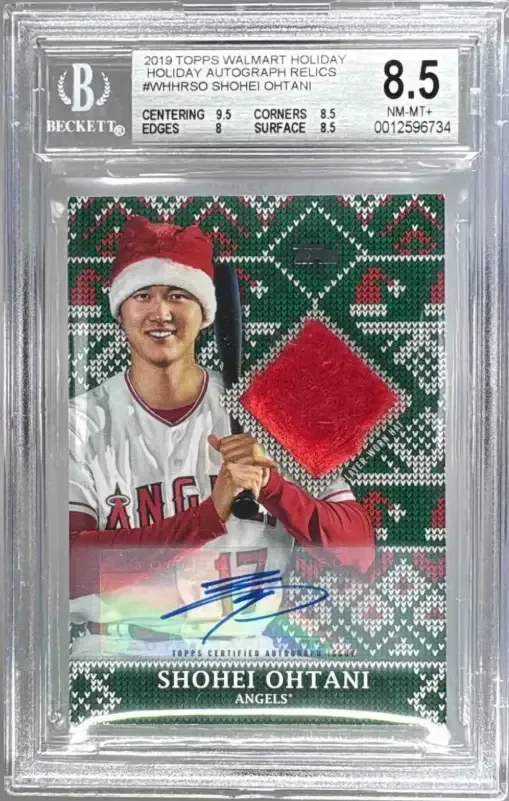
2019: Shohei Ohtani Santa Hat relic autograph — $4,391
Ohtani again leads in 2019 with a Santa Hat relic autograph that sold at auction for $4,391 on March 8, 2026. The BGS NM-MT+ 8.5 card pictures him holding a bat while wearing a Santa hat, with a fuzzy element rising out of a diamond-shaped window. Its listed value is $7,350.
This is described as a faux relic, an important distinction for collectors. A faux relic is a manufactured design element intended to evoke memorabilia rather than a conventional swatch of player-used material. That does not prevent demand—especially when paired with an autograph and an unusual presentation—but collectors evaluating it should understand precisely what the card is and is not offering.
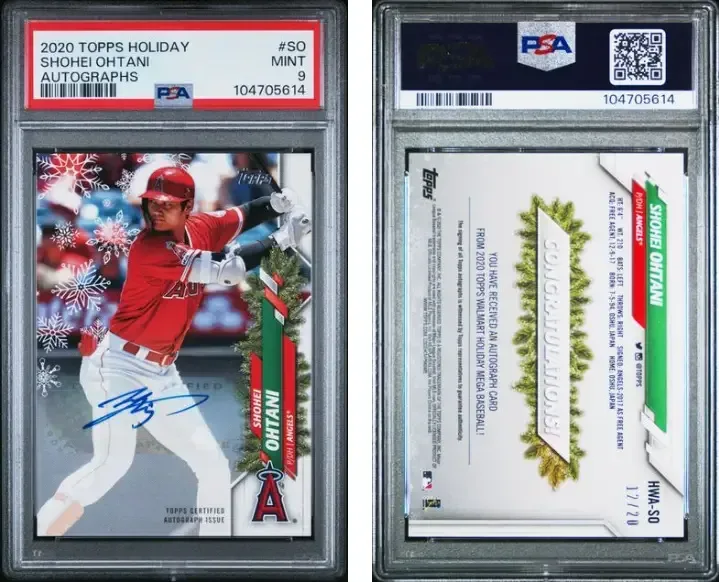
2020: Shohei Ohtani autograph, numbered 17/20 — $3,900
A 2020 Ohtani sticker autograph numbered 17/20 sold through a best offer for $3,900 on May 30, 2026. It is graded PSA Mint 9 and has a listed value of $4,916.
A sticker autograph means the player signed an adhesive label that was later placed on the finished card, rather than signing directly on the card stock. Some collectors prefer on-card signatures, but the sale illustrates that limited production and player demand can remain decisive. In this case, the autograph is placed near the center of the card and the serial number confirms a 20-card run.
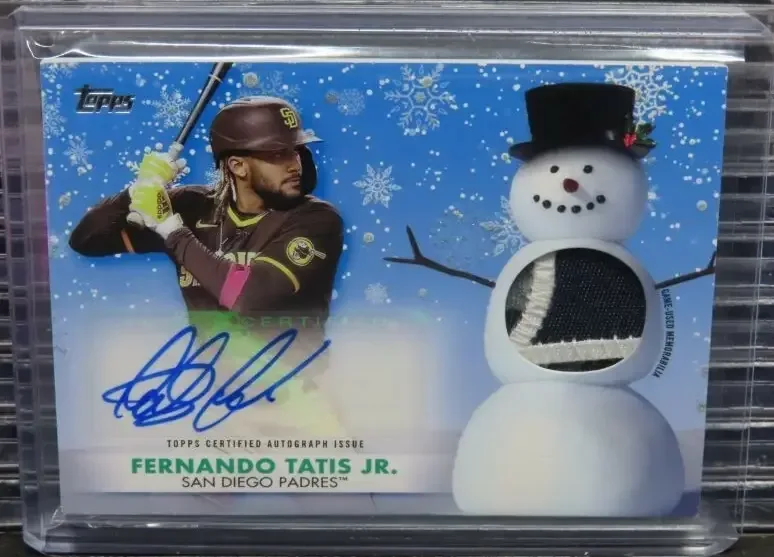
2021: Fernando Tatis Jr. one-of-one relic autograph — $915
Fernando Tatis Jr. breaks up Ohtani’s streak with a raw, horizontal one-of-one relic autograph that sold at auction for $915 on December 26, 2021. The card depicts Tatis in his batting stance, places the sticker autograph below him and reveals a tri-color, game-used relic through a snowman element.
“Raw” means the card had not been encapsulated and assigned a numerical condition grade by a third-party grading company at the time of sale. That status can affect buyer confidence and comparability. The game-used description is also a meaningful detail: unlike player-worn material, it identifies the relic as having been used in an actual game. Even so, the one recorded sale is from 2021, so it should be read as a historical result rather than a current market quote.
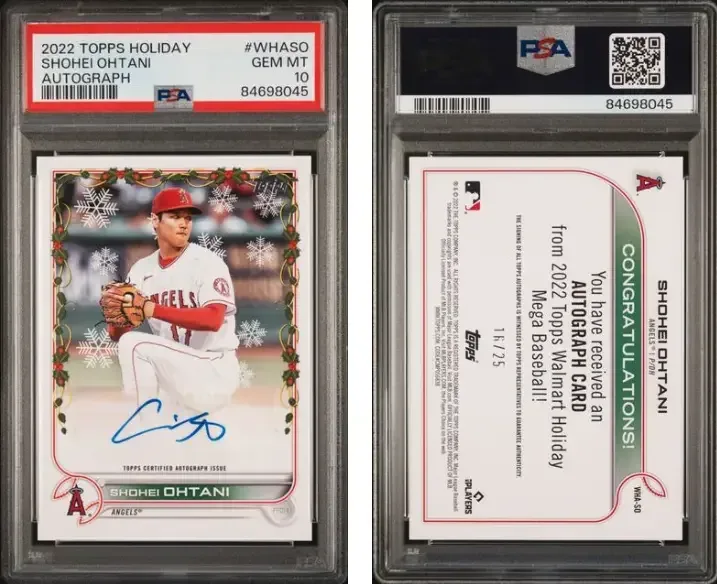
2022: Shohei Ohtani autograph, numbered 16/25 — $5,388
A PSA Gem Mint 10 Ohtani autograph numbered 16/25 leads the 2022 product. It sold via eBay auction for $5,388 on August 9, 2026, attracting 48 bids, and has a listed value of $5,631.
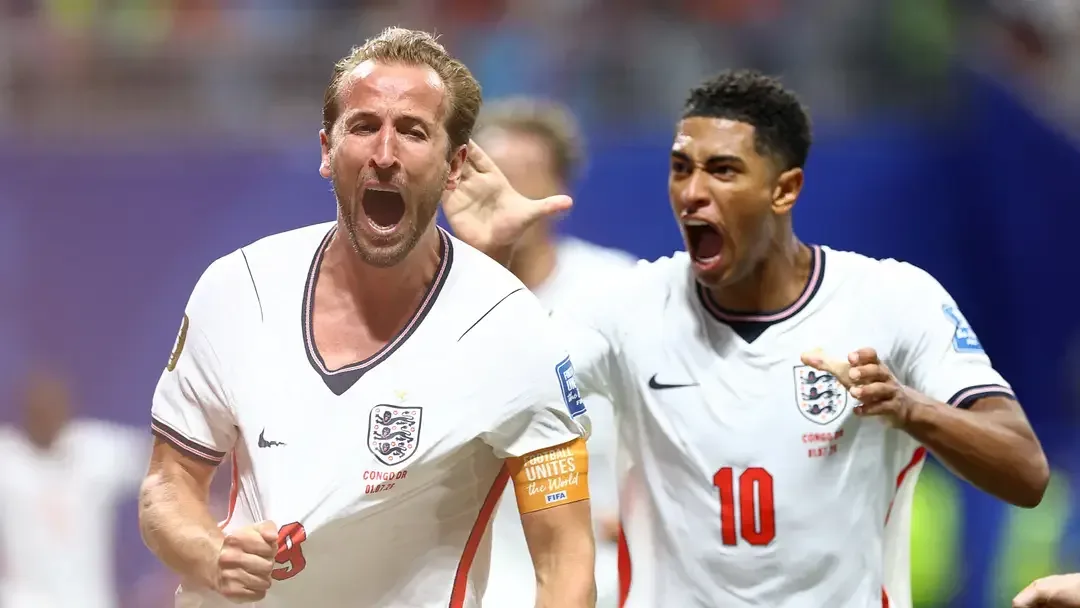
This one offers a pitching image, with Ohtani in mid-windup. A Gem Mint 10 is a condition assessment from PSA, while the serial number denotes scarcity. Together with the autograph, those attributes help explain why a Holiday design can carry a four-figure result. For collectors comparing sports-card markets more broadly, the same combination of star power, condition and limited supply also shapes attention around major soccer cards, as seen in this look at key Harry Kane cards.
2023: Shohei Ohtani Gold Metallic one-of-one relic — $3,999
The 2023 annual leader is another Ohtani one-of-one, though this time it is not autographed. His Gold Metallic relic card, featuring a tri-color patch and a post-swing image, sold at auction for $3,999 on April 27, 2026. Its listed value is $5,219.
It is a useful corrective to the idea that an autograph is always necessary for a flagship sale. A one-of-one is unique within its stated issue, and the patch presentation can be enough to create competition. The comparison with the signed cards above also shows why collectors should avoid reducing a card’s appeal to a single trait: rarity, player, memorabilia, grade and visual presentation all interact.
2024: Paul Skenes Gold Glitter one-of-one rookie patch autograph — $5,843.80
Paul Skenes leads the 2024 set with a Gold Glitter one-of-one rookie patch autograph. Graded BGS 8.5 with a 10 autograph grade, it sold for $5,843.80 through Goldin on November 7, 2025, following 58 bids. Its listed value is $7,155.
The horizontal card includes a large patch that appears to come from a Pirates uniform. The material is player-worn rather than game-worn, meaning Skenes wore it but it was not identified as having been used in a game. That is not a trivial labeling difference. A collector assessing relic cards should read the memorabilia designation carefully instead of assuming all uniform patches carry the same provenance.
2025: Roki Sasaki rookie Superfractor — $7,500
Topps added Chrome cards to Holiday in 2025, and the release’s leading sale is Roki Sasaki’s rookie Superfractor. The PSA Gem Mint 10 card sold through a best offer for $7,500 on August 1, 2026, with a listed value of $8,457.
There is no autograph, but the Superfractor’s gold vinyl swirl finish is among the hobby’s most recognizable parallel treatments. Sasaki is shown in his windup on the vertical card. The result reinforces the 2023 Ohtani lesson: a desirable rookie, a unique parallel and top condition can drive a premium without a signature.
2026: Mrs. Claus faux-relic autograph — $750 so far
Less than a week after the 2026 Topps Holiday product arrived, the highest sale reported so far is not a baseball player at all. An autographed Mrs. Claus faux-relic card sold at a fixed eBay price of $750 on October 24, 2026.
The card shows a woman dressed as Mrs. Claus holding a tray of cookies. A star-shaped window exposes an element labeled “Holiday Memorabilia,” while the autograph appears above the character name. This is a very early snapshot, not a settled verdict on the 2026 checklist. New products can change quickly as more cards are opened and sold, so this result is best understood as a novelty-driven opening-week marker.
What the sale list actually says about Topps Holiday
Topps Holiday’s strongest sales do not turn the whole product into a rare premium release. Instead, they show how a mass-friendly seasonal set can contain a small number of high-interest chase cards. The repeated ingredients are straightforward: Ohtani’s five annual-leading results, low serial numbers, one-of-ones, rookie designations, autographs, relics and high grades.
There is also no single formula. The 2018 Ohtani is a /5 rookie autograph; the 2019 card leans into a deliberately playful faux-relic presentation; the 2023 Ohtani and 2025 Sasaki prove unsigned cards can lead their years; and the 2026 Mrs. Claus sale shows that a thematic character hit can briefly outrun baseball players when a set is brand new.
For buyers, the practical takeaway is to separate the card’s label from its evidence. Check whether a result was auction or fixed price, whether it was a best offer, whether it was graded, what the grade applies to, whether an autograph is on-card or a sticker, and whether a relic is game-used, player-worn or faux. Finally, distinguish a recorded sale from a current valuation and from a seller’s asking price. Those are three different measurements—and the gap between them can be enormous.