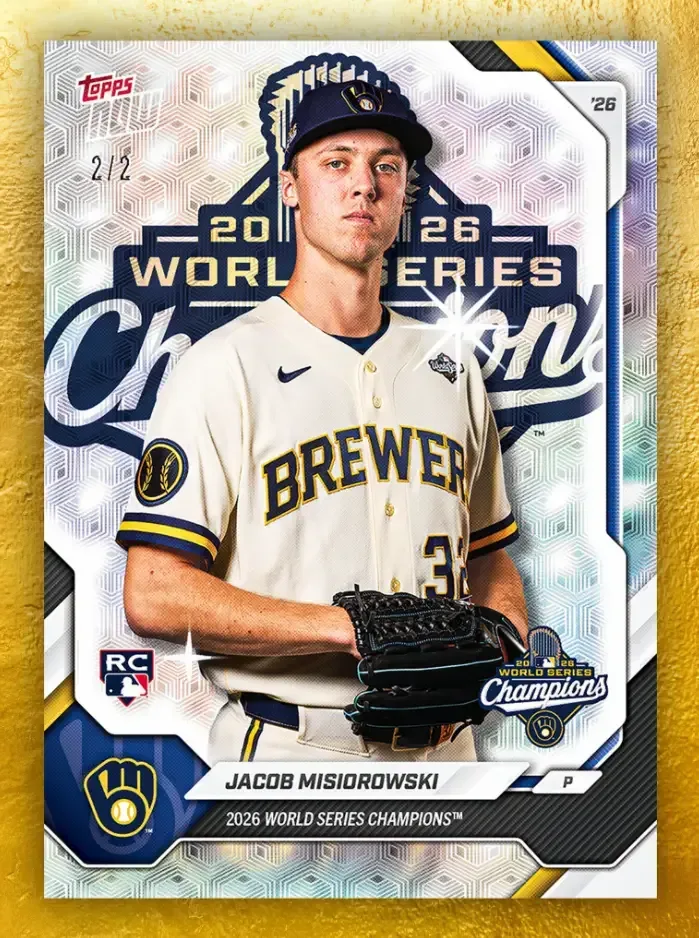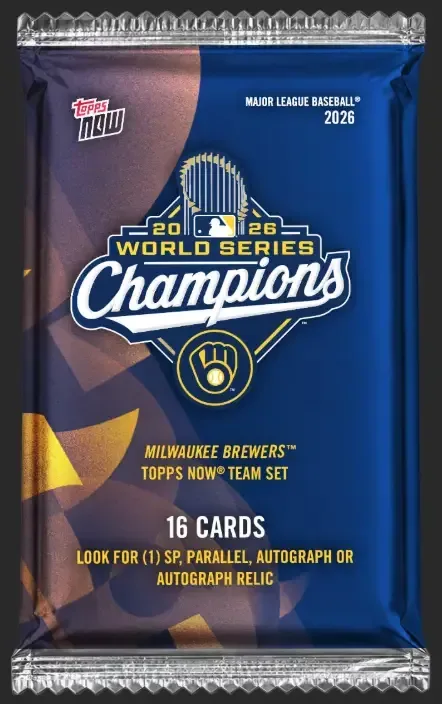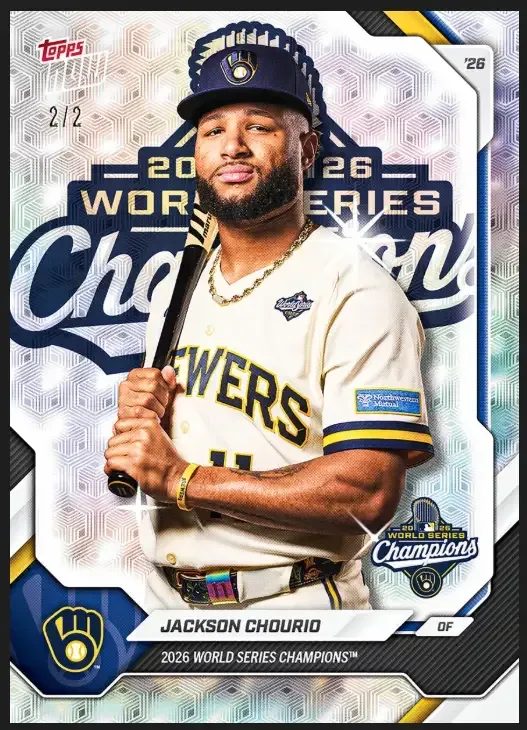
Topps has built an unusually literal bridge between a championship team and its collectors with its Milwaukee Brewers World Series Topps Now release. The 15-card set commemorates the Brewers’ first World Series championship in franchise history, but its most unusual insert is not simply a scarce card with a low serial number. It is a Diamond Parallel Companion Card numbered to two, with one copy going to the player pictured and only the other placed into the collector distribution.
That distinction matters. A card numbered 1/2 or 2/2 normally signals that two copies exist in the same collectible ecosystem. Here, each player received one of the two cards on the night of the World Series win, displayed in a framed, jewel-studded holder with a necklace chain. The matching copy is the one collectors can pursue through the Brewers team set. The product information specifies that the necklaces themselves are not included with collector cards.
The presentation is intentionally louder than a conventional serial-numbered parallel: part sports-card insert, part championship keepsake, and part wearable-display prop. But for collectors, the important practical point is simpler. For any given Companion Card subject, just one copy is being made available through packs. That does not change the printed 1-of-2 or 2-of-2 designation, yet it does create a sharp divide between total production and publicly attainable supply.
Why a two-card parallel can function like a one-card chase
A parallel is an alternate version of a card, generally differentiated from the base issue by its design treatment, finish, color, serial numbering, or a combination of those details. In this case, the Diamond Parallel Companion Card is numbered to two. The companion concept is the twist: one card is attached to the player’s celebration experience, while the other is intended for the pack-opening side of the hobby.
Collectors should be careful with the shorthand that this makes the public card “a one-of-one.” It is not technically a 1/1, because two copies were produced and serial-numbered as such. Still, it is fair to describe it as a publicly available one-of-one opportunity: only one example of that particular two-card pairing can be pulled by buyers. The other resides with the player who received it.
That is a meaningful difference for anyone assessing scarcity. Total print run answers, “How many were made?” Public allocation answers, “How many could a collector reasonably acquire from this product?” In the Companion Card case, the answer to the latter is one per player. The player-held counterpart could theoretically surface in the future, but no such outcome is promised or implied by the release. Treating the two cards as interchangeable would overlook the point of the program.
The Brewers release also turns the serial number into part of the story. A collector who lands a 2/2, for example, is not merely holding the second of two copies; they are holding the counterpart to a 1/2 presented during the championship celebration. Conversely, the player-held card is not a pack pull. That linked provenance is the feature Topps is emphasizing.
What comes in the Brewers World Series team set
The product is built around a 15-card base team set. Each pack includes those 15 base cards, plus one guaranteed additional hit: a numbered parallel, image variation, autograph, or autograph relic. “Guaranteed” here applies to receiving one card from those listed categories, not to receiving any particular player, parallel, autograph, relic, or Diamond Companion Card.
The base checklist consists of:
- Jacob Misiorowski
- Aaron Ashby
- Robert Gasser
- Abner Uribe
- Trevor Megill
- William Contreras
- Cooper Pratt
- Brice Turang
- Jake Bauers
- David Hamilton
- Jackson Chourio
- Sal Frelick
- Luis Lara
- Garrett Mitchell
- Christian Yelich
Topps lists image variations for Misiorowski, Contreras, Chourio, Frelick, Mitchell, and Yelich. An image variation is a card that departs from the standard base-card photo, giving collectors a visual alternative rather than merely a different color or foil treatment. The same six players are listed as autograph subjects.
For team collectors, that structure makes the product more than a single-card lottery. Every pack delivers the complete core checklist, while the additional card creates the variable portion of the break. For player collectors, the listed image variation and autograph subjects identify where the release’s higher-end chase is concentrated. And for collectors specifically following the championship, the base set captures a broader roster than the autograph and variation checklists.
Redemptions add bigger formats and event material
Two triple-autograph cards are listed as prospective pulls, both distributed as redemptions: the 2026 Stars Triple Autograph featuring Jacob Misiorowski, Jackson Chourio, and Christian Yelich; and the Through The Years triple autograph featuring Robin Yount, Paul Molitor, and Yelich.
A redemption is not the finished card in the pack. Instead, the collector receives a redemption card or code to submit for the promised item. In this release, that is relevant because the most elaborate autograph formats are not necessarily physically packed out as completed cards. Collectors pursuing them should understand that a redemption is a claim process, rather than an instant reveal of the final signed card.
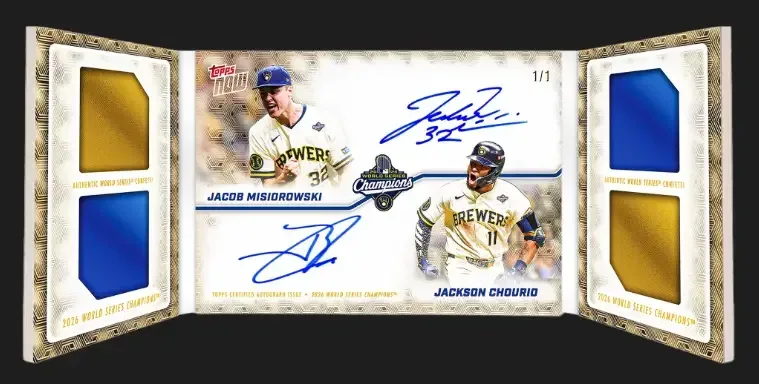
The release also includes a World Series Confetti Dual-Autograph Relic Booklet, again as a redemption, pairing Misiorowski and Chourio. The booklet is described as containing pieces of actual confetti from the event. A relic card incorporates a physical material into the card; here, the stated material is championship-event confetti. A booklet is a larger folding card format, typically designed to accommodate signatures, relic windows, or both across multiple panels.
Those cards give the product two different kinds of connection to the title: signatures from players associated with the set, and physical material tied to the celebration. The Diamond Companion Cards take a third route, linking one collectible copy to a separate presentation copy issued directly to a player. Each approach is about proximity to the moment, but they are materially different items and should not be conflated.
The limited Topps Now ordering window
Like other Topps Now offerings, this was a time-limited release rather than an evergreen product. The Brewers World Series team set went on sale on October 28 and was scheduled to remain available through November 4, 2026. That selling period is important context for the release, though it does not itself establish how many sets were ultimately ordered or how difficult any individual insert will be to pull.
Topps Now is designed around a specific event and a short ordering cycle. In this case, the event is the Brewers’ first World Series title, while the product layers a standard 15-card team checklist with variations, autograph possibilities, relics, redemptions, and the player-companion Diamond cards. It is a compact release, but not a simple base-set purchase for anyone opening packs rather than keeping a sealed team set.
The timing also places the card program in the immediate glow of a championship, when demand can be driven by several overlapping groups: Brewers fans, player collectors, autograph collectors, relic collectors, and people chasing a single exceptionally limited parallel. That crossover is increasingly familiar in sports-event culture; other major showcases turn on guest appearances and star associations as much as the core event itself, as seen in the evolving conversation around a Super Bowl LXI guest spot. Here, Topps has made the player-to-collector link a physical part of the card’s premise.
What collectors can reasonably take from the checklist
The most useful way to approach the Brewers release is to separate confirmed contents from chase speculation. Confirmed: each pack contains the 15-card base set and one additional card from the stated categories. Confirmed: the Diamond Parallel Companion Cards are numbered to two, with one counterpart presented to the relevant player and one available in packs. Confirmed: selected cards, including the two triple autos and the confetti dual-auto relic booklet, are redemptions.
Not established by the product details: pull odds, final order quantity, the number of each parallel made beyond the stated Diamond numbering, or any future market value. A numbered card is scarce, but scarcity alone does not supply a resale price or guarantee a particular level of demand. Likewise, the special player presentation gives the Companion Card narrative significance, but does not turn a pack purchase into a predictable route to that card.
For someone building a Brewers championship binder, the base checklist offers a defined target of 15 players. For collectors who prefer a particular player, the variation and autograph lists provide a clearer focus. For those drawn to event-linked memorabilia, the confetti booklet is the relevant target. And for serial-number collectors, the central hook is the Diamond Companion concept: one two-copy parallel shared, in a very deliberate sense, between the athlete and the collector who finds its partner.
That design makes the set’s rarest angle easy to explain without overstating it. The Companion Card is not a conventional 1/1. It is a numbered-to-two card whose other half was distributed outside packs to the player. For a Brewers World Series release built around a first franchise championship, that is a distinctive way to make one collector’s pull feel connected to the celebration rather than merely adjacent to it.