Tarik Skubal’s card market has already produced a revealing high-end scoreboard: his five biggest reported sales are all five-figure transactions, and the two highest are separate examples of the same extremely limited Gold Logoman redemption. With Skubal reportedly agreeing to a nine-year, $450 million deal with the New York Mets on November 22, attention will inevitably turn toward what a Mets-era card might mean for collectors. For now, the available sales history points to a market built on far more than a change of uniform.
The strongest prices have clustered around three familiar premium-card ingredients: tiny print runs, authenticated signatures, and memorabilia tied to a major award season. Skubal was drafted in 2018, received a Bowman 1st card in 2020, and had his first rookie cards in 2021. His rise after his first Cy Young Award in 2024 gave collectors several different lanes to pursue, from early prospect autographs to later award-themed patch redemptions.
The figures below cover cards featuring Skubal alone and are reported sales tracked by Card Ladder. That scope matters. A player’s overall card history can look different if it includes multi-player cards, unverified listings, or cards that did not actually complete a sale. It also means these results are a snapshot of the top documented transactions, not a price guide for every Skubal card.
The five biggest reported Tarik Skubal card sales
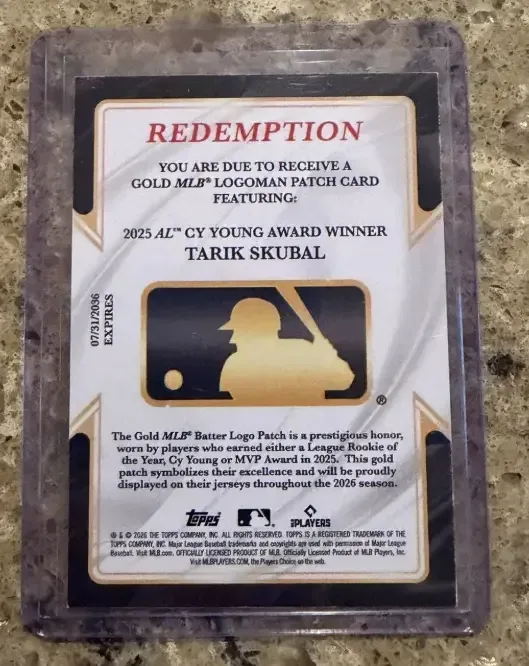
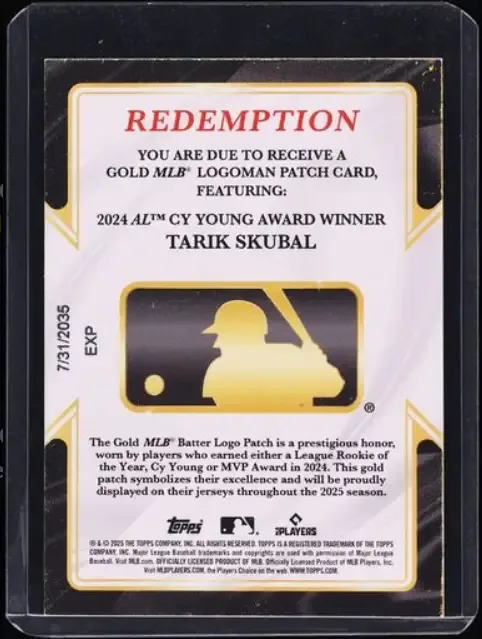
- 2025 Topps Chrome Gold Logoman Redemption, numbered to four — $18,600. A separate redemption example sold through Fanatics Collect on August 28, 2026, after 19 bids.
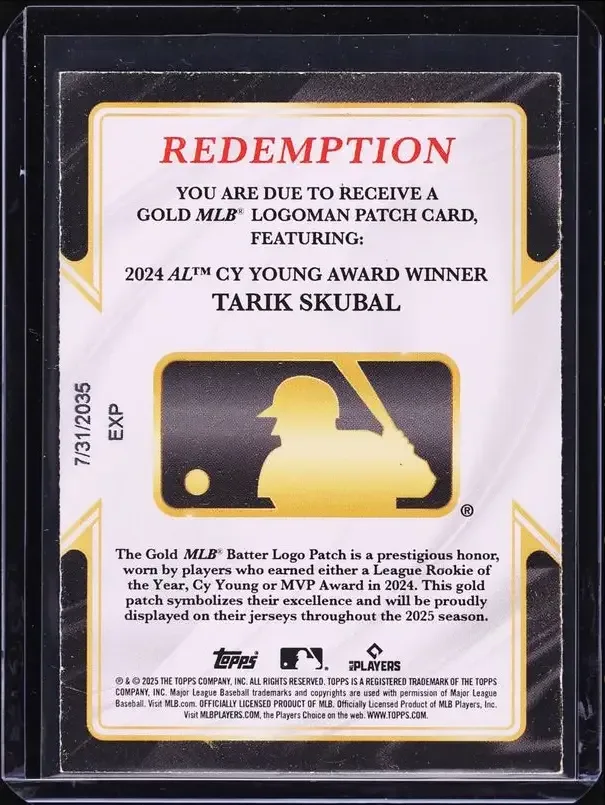
- 2025 Topps Chrome Gold Logoman Redemption, numbered to four — $18,300. Another copy of the same redemption sold through Fanatics Collect on January 22, 2026, after 58 bids.
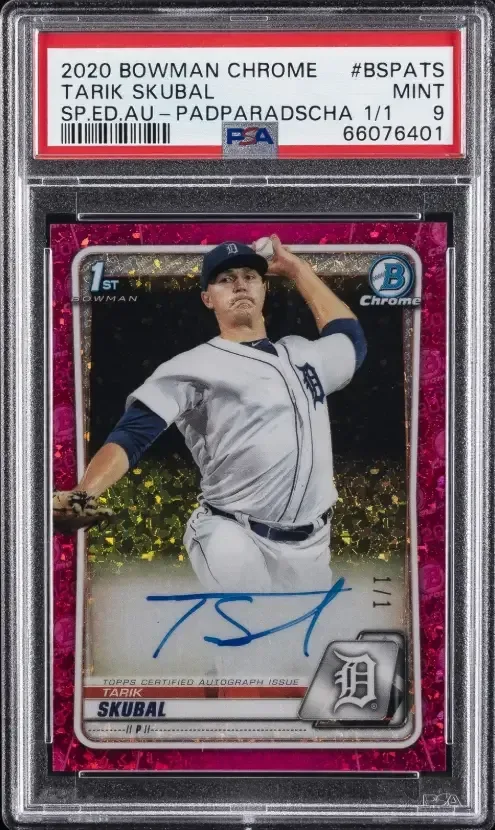
- 2020 Bowman Chrome 1st Padparadscha one-of-one autograph, PSA GEM MT 10 — $18,000. Listed for $25,000 on eBay, it sold via an accepted best offer on September 15, 2026.
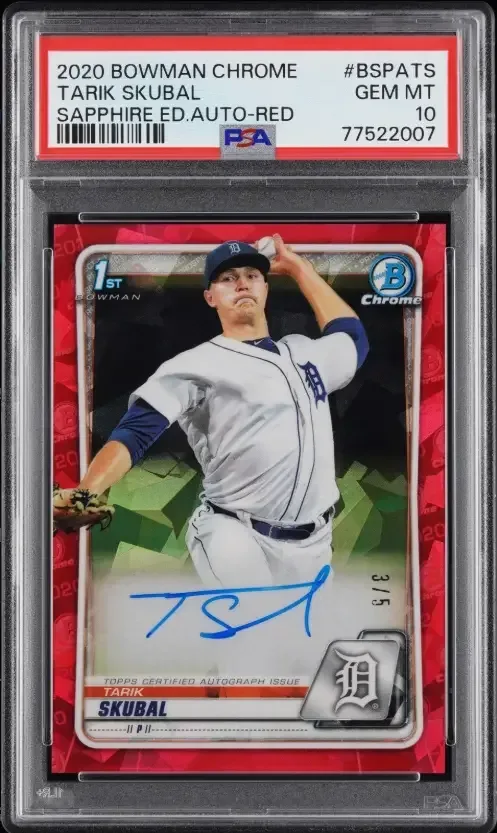
- 2020 Bowman Chrome 1st Red Refractor autograph, numbered 3/5, PSA GEM MT 10 — $15,100.99. This auction sale ended August 19, 2026.
- 2026 Topps Chrome Gold Logoman Cy Young Award Redemption — $12,600. The auction concluded August 2, 2026.
The top two are not a duplicate entry
The $18,600 and $18,300 results are for the same type of card, rather than one sale being counted twice. Both are 2025 Topps Chrome Gold Logoman redemptions tied to Skubal’s 2024 Cy Young season and numbered to only four. The physical differences visible on the redemption cards indicate that they are distinct copies.
That distinction is particularly important when reading high-end sales tables. A serial number such as “/4” means the manufacturer designated four examples of that card, but it does not mean all four will reach the market at once—or at all. When two copies do sell, their results can help establish a rough range, although they are never perfectly interchangeable. Timing, buyer competition, presentation, and the specifics of each individual redemption can all affect a completed price.
Here, the two results land only $300 apart despite occurring roughly seven months apart. The earlier sale drew 58 bids and the later one drew 19, a useful reminder that bid totals do not automatically translate to the final number. The winning bid is the decisive transaction figure; the number of bids merely offers a little context about how the auction got there.
Card Ladder’s listed value for the $18,300 sale was $29,762.44 at the time referenced, well above its recorded sale price. That should not be read as a guaranteed resale value. A platform’s current-value figure is an estimate, while a completed sale documents what one buyer paid at one moment. For collectors tracking the market, the cleanest approach is to keep those two ideas separate: a comp is a historical transaction, whereas a valuation is an interpretation of available market data.
Why the Gold Logoman redemptions carry so much weight
A redemption is a claim card rather than the final collectible itself. The buyer receives the redemption card and redeems it for the promised item, assuming the process is fulfilled under the issuer’s terms. In this case, the high-value appeal is the eventual Gold Logoman patch card connected to Skubal’s Cy Young recognition, not simply the paper redemption card on its own.
Related coverage includes Tarik Skubal’s Five Biggest Card Sales Before Mets Debut.
The 2025 Topps Chrome version is numbered to four and uses a gold patch from Skubal’s 2024 Cy Young season. The other Topps Chrome redemption, from 2026, is tied to a patch worn during the 2025 season while Skubal was the reigning Cy Young Award winner. The latter was the fifth-largest sale at $12,600, with a listed value of more than $17,000 at the time cited.
These are distinct offerings with different years and award-season connections, so the $12,600 result should not be treated as another sale of the 2025 card that occupies the first two positions. Still, the pattern is clear: Cy Young-related Logoman material is the center of Skubal’s current high-end market.
For collectors, the practical takeaway is that a patch card’s value often depends on several layers of scarcity and context. The serial number matters, but so does the type of memorabilia, whether it has a particularly meaningful player or award association, and whether the card is a completed product or a redemption awaiting fulfillment. Those distinctions should be checked before comparing prices across listings.
Early Bowman Chrome autographs remain the other major lane
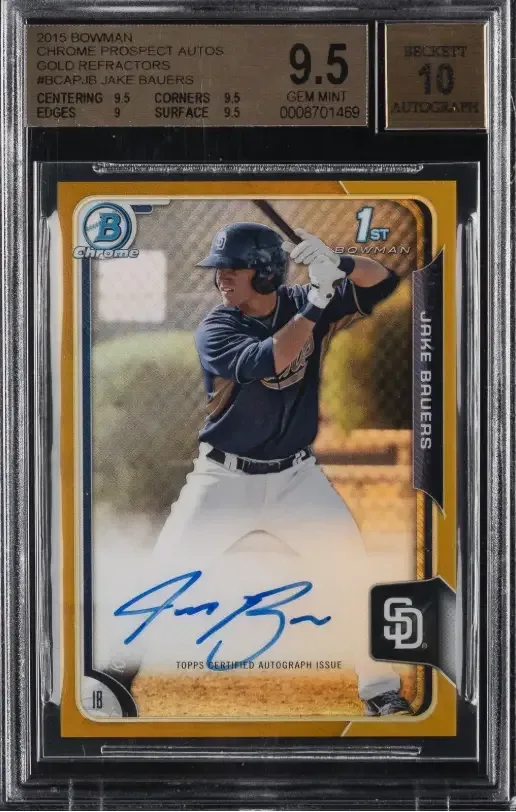
Skubal’s two highest-selling non-redemption cards in the reported top five both come from 2020 Bowman Chrome 1st autograph issues. That makes sense within the structure of modern baseball-card collecting: an early Bowman 1st is a key prospect-era marker, while an autograph creates an additional premium. The color parallel and print run then determine how narrow the supply becomes.
The third-place result was a 2020 Bowman Chrome 1st Padparadscha one-of-one autograph graded PSA GEM MT 10, which sold for $18,000. The seller initially listed it at $25,000, then accepted an offer on eBay on September 15, 2026. It was later listed by Card Ladder at $17,700.
A one-of-one, often written as 1/1, indicates a single manufacturer-designated copy of that exact parallel. The scarcity is obvious, but one-of-one prices can be difficult to generalize from because there is no identical card available for a direct side-by-side comparison. Collectors instead may look at adjacent evidence: other Skubal prospect autographs, similarly scarce parallel colors, grade, and the player’s broader market.
The fourth-place card supplies one such adjacent data point. Skubal’s 2020 Bowman Chrome 1st Red Refractor autograph, numbered 3/5, sold for $15,100.99 at auction on August 19, 2026. It also carried a PSA GEM MT 10 grade and was subsequently listed at $15,290, very near the recorded sale.
A refractor is a parallel card with a distinctive reflective finish; “Red Refractor” identifies the color variant in this case. The key market fact is the stated production number: only five copies. The red version sold for less than the Padparadscha one-of-one, but the gap is modest relative to the difference in stated scarcity. That does not establish a universal rule about which parallel collectors should prefer. It does show that Skubal’s best early signed cards have reached a similar tier to the headline award-patch redemptions.
What “PSA GEM MT 10” adds to the comparison
Both 2020 Bowman Chrome autograph cards in this list were graded PSA GEM MT 10. Grading is a third-party assessment of a card’s physical condition, and GEM MT 10 is the top numerical grade on the commonly used PSA scale. It is not the same thing as an authentication of the player’s career value or a promise that the card will appreciate. Rather, it gives buyers a standardized condition label that can make comparisons easier, especially for modern chrome cards where surface, corners, centering, and edges are closely scrutinized.
That standardization helps explain why it is risky to compare the $18,000 one-of-one directly with an ungraded copy of another card, or to assume every red autograph numbered to five should command the same amount. Parallel, grade, autograph, player demand, and the mechanics of the sale all belong in the comparison.
A Mets card market is still a future question
The reported Mets agreement naturally creates a new collecting storyline, but it does not yet create a comparable set of Mets-uniform sales. With a potential lockout ahead, it remains uncertain when a product featuring Skubal in a Mets uniform will arrive. It is therefore too early to assign a price expectation to a first Mets autograph or to assume it would eclipse his earlier cards.
There is also a broader collecting wrinkle: a player’s cards in an original-team uniform can retain particular appeal because they document the prospect and breakout stages of a career. That does not make later-team cards unimportant. A Mets release could introduce new designs, signatures, patches, serial-numbered parallels, and a different set of buyers. But the five biggest results so far indicate that Skubal’s market already has established pillars: early Bowman Chrome autographs and award-linked, tightly numbered Logoman redemptions.
Collectors watching the next phase should focus on completed sales rather than asking prices, verify whether a listing is a redemption or a delivered card, and avoid treating automated valuations as fixed cash values. The same discipline applies across the hobby, whether the subject is a premium baseball parallel or the expanding crossover between games and cardboard, such as official GTA 6 Panini trading cards.
For Skubal, the present leaderboard is unusually concentrated at the top: two nearly identical $18,000-plus redemption sales, a $18,000 one-of-one prospect autograph, a $15,100.99 red autograph, and one more Cy Young-linked redemption at $12,600. That is a compact but meaningful record of where the hobby has placed its highest stakes so far.