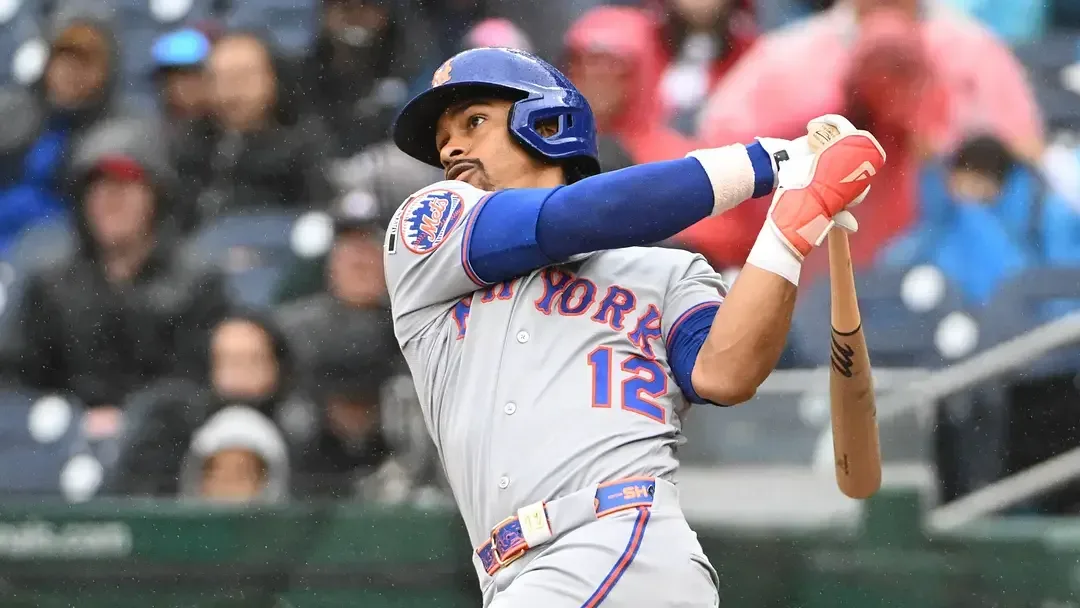
Francisco Lindor’s Roberto Clemente Award adds a meaningful off-field milestone to a career that has already supplied collectors with an unusually strong run of cards. The New York Mets shortstop is the fifth player in club history to receive Major League Baseball’s honor for character and philanthropy, following Gary Carter, Al Leiter, Carlos Delgado and Curtis Granderson.
The award also carries a personal connection: Lindor, like Roberto Clemente, is from Puerto Rico. For card collectors, though, the immediate question is a more familiar one: which pieces sit at the top of the Lindor market? The answer is dominated by a single early issue, 2011 Bowman Chrome, with a rookie-year 2015 Topps Chrome card providing the only break in that run.
The five biggest recorded sales highlighted here are all signed, graded cards with extremely limited production. That matters. A player can have a huge number of cards in circulation while only a small group combines an early-career designation, an autograph, a serial number and a top grade. Lindor’s results show how dramatically those ingredients—and the particular moment a card sells—can affect the final figure.
Why Lindor’s 2011 Bowman Chrome cards matter
Lindor was drafted by Cleveland in 2011, made his major-league debut in 2015, earned four All-Star selections and reached the 2016 World Series with Cleveland. He was traded to the Mets in 2021 and later signed an extension with New York. That chronology places the 2011 Bowman Chrome cards at the beginning of his professional story, well before his debut and his later move to New York.
In card terminology, a refractor is a parallel version designed with a reflective finish. Color parallels generally denote separate, lower-numbered print runs. The orange Lindor card in this group is numbered to 25, while the red versions are numbered to five. A Superfractor is the singular, one-of-one parallel in this group, distinguished by its swirling pattern.
Every card in the top five is also autographed. Two grades appear on the labels: the card’s condition grade and, where noted, an autograph grade. A BGS Gem Mint 9.5 describes the assessed condition of the card itself, while a 10 autograph grade addresses the signature’s presentation. These labels help explain why the sales discussed below should not be treated as automatic benchmarks for every copy of the same issue. A different grade, an unsigned version, or even another serial number from the same five-card run can produce a sharply different result.
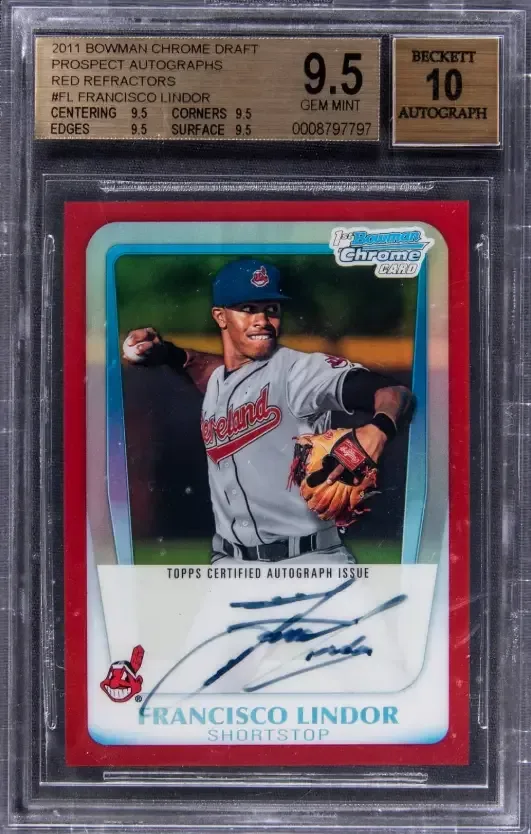
No. 5: 2011 Bowman Chrome Draft Prospect Red Refractor Autograph #2/5
The fifth-largest recorded sale is a 2011 Bowman Chrome Draft Prospect Red Refractor Autograph serial-numbered 2/5. It received a BGS Gem Mint 9.5 card grade and a 10 autograph grade. The image shows Lindor in a throwing pose, framed by the red treatment that signals the five-copy print run.
This particular copy is notable because its signature is not the cleaner-looking blue ink found on some of Lindor’s other cards. The autograph appears streaky, yet the scarcity and grade still supported a $12,000 sale on February 8, 2023. The auction drew 32 bids.
Related coverage includes Francisco Lindor’s Five Biggest Card Sales After Roberto Clemente Award.
That is a useful collecting reminder: eye appeal matters, especially with autographs, but it is only one variable. The earliest Bowman Chrome autograph, a red parallel limited to five, and a high grade form a very powerful combination. A streaky signature may influence a buyer’s preference, but it does not erase the card’s basic rarity.
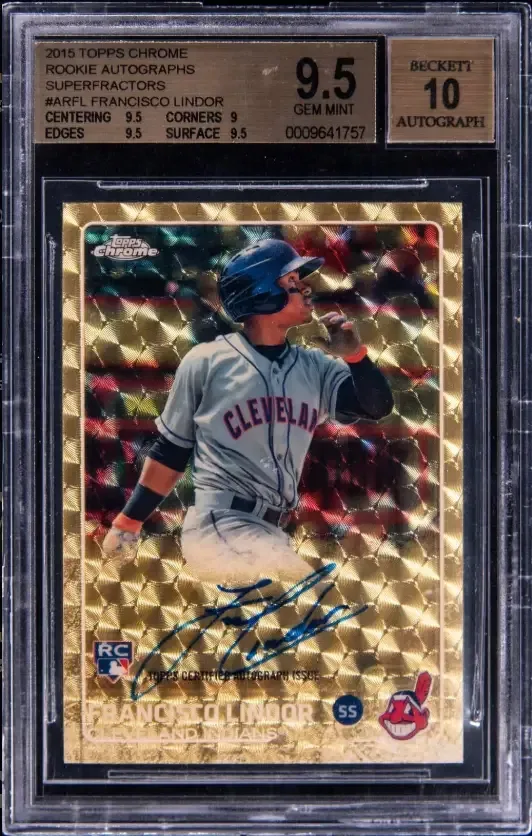
No. 4: 2015 Topps Chrome Rookie Autograph Superfractor
The lone card outside the 2011 Bowman Chrome group is Lindor’s 2015 Topps Chrome Rookie Autograph Superfractor. It is a one-of-one from his rookie season, graded BGS Gem Mint 9.5 with a 10 autograph grade. The card depicts a young Lindor after a swing, looking skyward, and uses the Superfractor’s recognizable swirling finish alongside a blue-ink signature.
It sold for $14,030 on September 26, 2024, after 64 bids. A current value listed for the card is $18,330, but that figure should be read differently from a completed transaction. A recorded sale documents what a buyer paid at a specific time; a value estimate is an attempt to summarize the market and may change without a fresh sale.
The distinction is especially important with one-of-one cards. There is no identical copy that regularly trades to establish a smooth price history. As a result, a one-of-one’s next public sale can depend heavily on who is bidding, the venue, timing, the card’s grade and broader collector attention around the player.
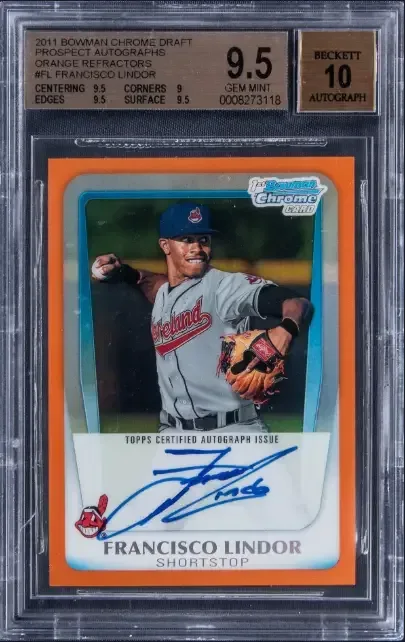
No. 3: 2011 Bowman Chrome Prospect Autograph Orange Refractor #4/25
Third is the 2011 Bowman Chrome Prospect Autograph Orange Refractor, numbered 4/25. Like the other leading entries, it carries a BGS Gem Mint 9.5 card grade and a 10 autograph grade. The composition again captures Lindor throwing, with substantial white space cutting across the lower portion of the design, while the autograph is in blue ink.
This copy sold for $20,400 on April 7, 2021, only months after Lindor’s trade to the Mets and days after that season’s Opening Day. Its listed current value is $7,986. Those two numbers are not evidence that every orange copy is worth one fixed amount; rather, they demonstrate the gap that can emerge between a prior auction result and a later market estimate.
For collectors assessing any scarce parallel, serial numbering tells only part of the story. Numbered to 25 is far less scarce than numbered to five or one, but it is still a very limited issue. The early date, the Bowman Chrome “1st” status, the autograph, the high grading result and Lindor’s career profile all contribute to its appeal. The April 2021 sale also occurred amid intense attention following his move to New York, an example of how player news can coincide with changing demand.
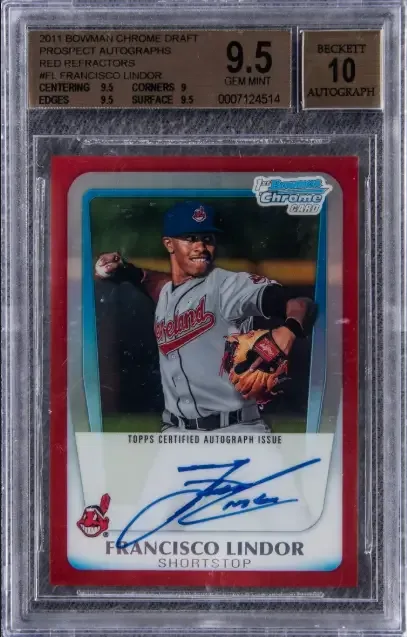
No. 2: 2011 Bowman Chrome Draft Prospect Red Refractor Autograph #4/5
At No. 2 is what might initially look like the same card as the No. 5 entry: another 2011 Bowman Chrome Draft Prospect Red Refractor Autograph from the five-copy run. It is not the same physical card. This is serial-numbered 4/5, while the other is 2/5. It also carries a BGS Gem Mint 9.5 card grade and a 10 autograph grade.
The contrast between the two red copies is a striking detail. The 4/5 has a cleaner blue-ink autograph, whereas the 2/5 signature appears darker and streakier. More importantly, their recorded sales occurred at different moments. The 4/5 sold for $73,200 on March 21, 2021, shortly after Lindor’s Mets trade and just before Opening Day. Its listed current value is $12,750.
That enormous spread is a case study in why collectors should resist treating one past auction as a permanent price tag. Both cards are from the same tiny print run, both have the same stated grade, and both are early autographs. Yet the 4/5 result stands far above the later $12,000 sale of the 2/5. Differences in timing, bidder competition, signature appearance and the circumstances surrounding a player can all affect an auction. Scarcity is vital, but it does not make prices move in a straight line.
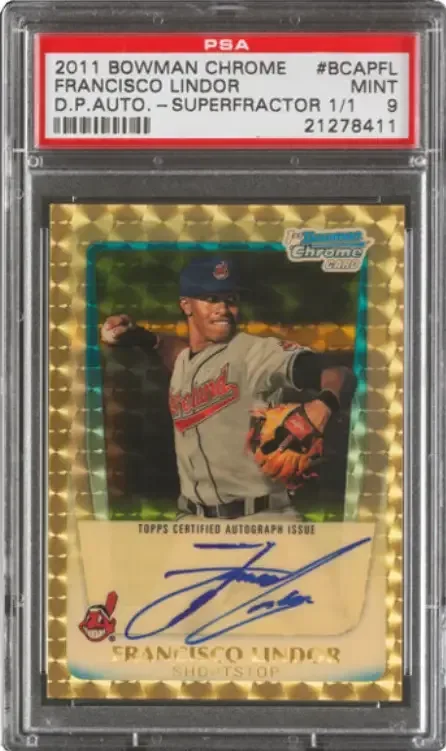
No. 1: 2011 Bowman Chrome Draft Prospect Autograph Superfractor
Lindor’s highest recorded sale belongs to the 2011 Bowman Chrome Draft Prospect Autograph Superfractor, a one-of-one. It is graded BGS Gem Mint 9.5 with a 10 autograph grade. In a card market built on tiers of rarity, it occupies the clearest possible top tier: the signed first-year Bowman Chrome Superfractor has no direct duplicate.
The card has sold publicly twice. It realized $102,000 on May 6, 2020, during the COVID-era collecting boom. It later sold for $26,400 on April 21, 2023. The earlier result remains the high-water mark among the five cards, and the later sale underscores the same central lesson seen with the red and orange parallels: historical sale results are records, not guarantees.
A one-of-one can be both the most prestigious card in a player’s catalogue and the hardest to value precisely. There are no comparable sales of an identical item because there cannot be. Instead, collectors tend to weigh related signals: the player’s standing, the card’s place in the product hierarchy, the autograph, the condition grade, its visual appeal and the appetite of the limited pool of buyers who can pursue it when it becomes available.
What the five sales say about the Lindor market
The ranking is less a simple list of expensive cards than a snapshot of how prospect-card hierarchy works. Four of the five entries are 2011 Bowman Chrome signed parallels. The fifth is a rookie-year Topps Chrome one-of-one. In other words, the market’s strongest signals cluster around Lindor’s earliest premium autograph cards rather than around standard base issues.
- Earliest-card appeal: The 2011 Bowman Chrome “1st” cards precede Lindor’s major-league debut and connect directly to his draft year.
- Low serial numbers: The featured orange, red and Superfractor editions are limited to 25, five and one copy, respectively.
- Autographs: Each leading example is signed, giving collectors both a visual and a personal element beyond the printed design.
- Condition: The cited examples all earned a BGS Gem Mint 9.5 card grade, with 10 autograph grades noted.
- Timing: The sales range from 2020 through 2024, including periods around the pandemic-era boom and Lindor’s move to the Mets.
Lindor’s newest accolade provides another reason for collectors to revisit this part of his catalogue, but it does not change the practical basics of buying scarce cards. Verify the exact serial number, identify whether a figure is an actual completed sale or a value estimate, and compare grading details rather than assuming every copy is interchangeable. The No. 2 and No. 5 red refractors make that last point particularly well: they share the same printed run and stated card grade, yet their sales histories differ enormously.
For baseball fans tracking the wider World Series moment, there is also another baseball-related story on the Game 4 national anthem. Lindor’s own card hierarchy, meanwhile, remains remarkably clear: the 2011 Bowman Chrome Superfractor autograph is the summit, while the red, orange and rookie Superfractor cards fill out a high-end portfolio shaped by rarity, grading and timing.