LeBron James’ 24th NBA season is being marked with a piece of memorabilia built for the modern high-end card market: a dedicated patch placed on each of his game-used jerseys, with patches later intended for one-of-one trading cards.
The program was revealed on October 20, ahead of James opening the 2026-27 season with the Philadelphia 76ers. It ties a highly visible on-uniform emblem to a milestone no NBA player has previously reached. James began the season after 23 NBA campaigns, having entered the league as the No. 1 overall pick in 2003. Vince Carter previously held the league mark at 22 seasons.
That makes the central appeal easy to understand. These will not merely be LeBron James patch cards, and they will not merely be cards containing material described as game-used. Their intended identity is far more specific: cards made with patches worn during the season that moved James alone to 24 NBA seasons.
For collectors, though, the most consequential information has not yet been disclosed. There is no stated number of one-of-one cards planned, no named trading-card product for their release, and no indication of how individual patches will be assigned to particular games or cards. Those omissions make it premature to put a dependable value on the eventual cards, even with James’ stature and the milestone attached.
A milestone patch rather than an ordinary jersey swatch
The patch itself is designed around the event it commemorates. It features a silhouette associated with James’ pregame chalk toss in front of a crest-like form. “NBA Seasons” appears above a prominent 24, while red, white and blue provide the palette. The colors also align with Philadelphia’s team look.
In collectible terms, the design matters because it gives the eventual card a clear visual and historical anchor. A conventional relic card may contain a piece of jersey without immediately explaining why that particular uniform matters. This patch does the explanatory work on its face: it signals a specific career marker and a specific season.
Game-used is an important term here. It means the jersey material is represented as having been used in an actual game, rather than simply being player-worn for a photo opportunity or manufactured as commemorative material. The available details establish that the patches are on James’ game-used jerseys this season. They do not, however, lay out the chain of custody for individual pieces or say whether cards will identify the game from which a given patch came. Those are different levels of provenance, and collectors should not assume the latter from the former.
The project also converts a season-long uniform program into a future supply of memorabilia. Rather than one special patch creating one collectible, the plan is for multiple patches to become separate one-of-one cards. That is a meaningful distinction from an item that is unique across an athlete’s entire card catalog.
Related coverage includes LeBron James’ 24th NBA Season Will Be Marked by Game-Used Patch Cards.
What “one-of-one” will and will not mean here
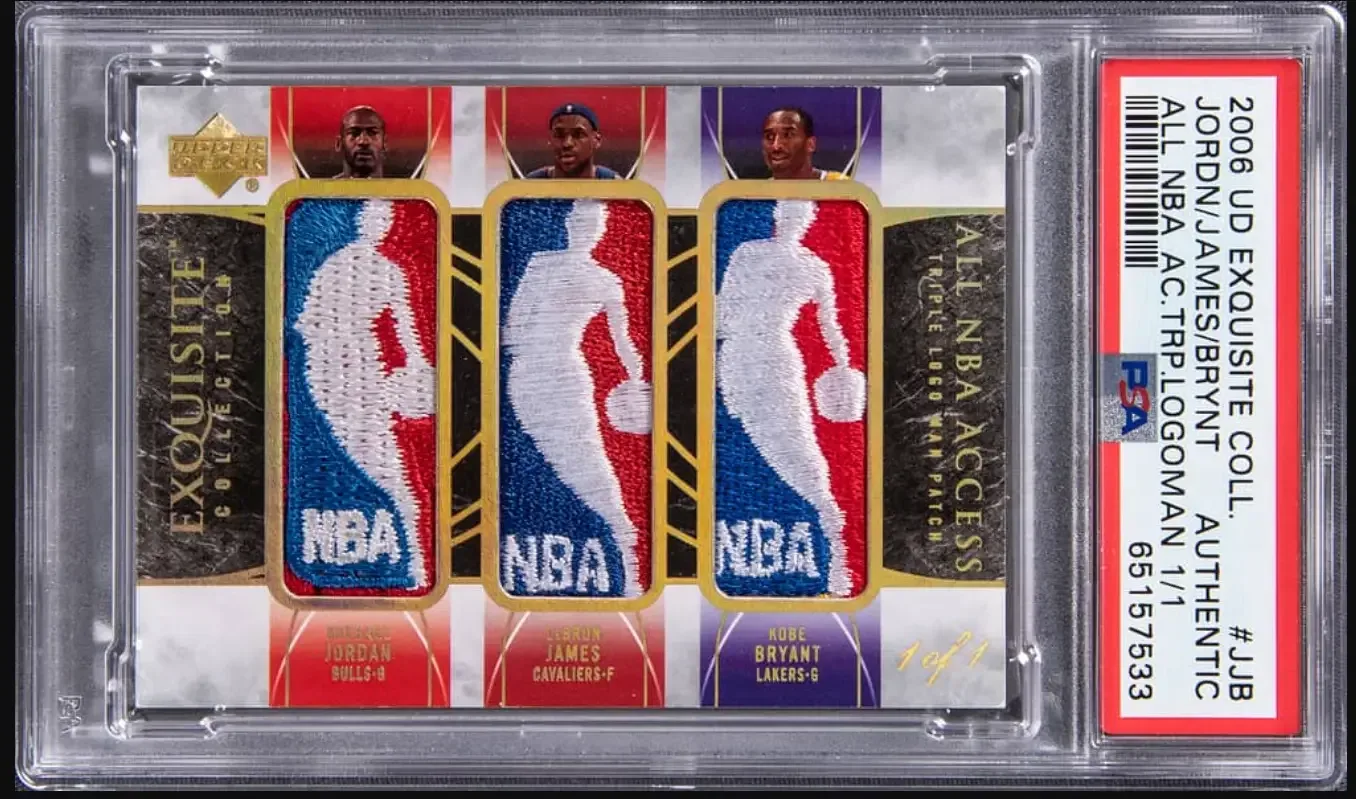
In trading-card language, a one-of-one, often written as 1/1, is a card with a stated print run of one for its particular version. It is a scarcity designation, not an automatic statement that no comparable card exists.
That distinction is especially important with this project. Multiple 1/1s are planned. Each card may be the only copy of its exact card configuration, but it will be part of a wider group of James 24th-season patch one-of-ones. The eventual population is unknown. Until it is known, collectors cannot tell whether the program will yield a small handful of landmark cards or a much broader run of parallel-looking centerpieces.
That does not erase their appeal. Every card would still combine James, game-used material, a dedicated milestone patch and a 1/1 serial status. But it changes how rarity should be described. “A 1/1” is accurate; “the only 24th-season LeBron patch card” would not be supported by the information available.
This is one reason collectors are likely to care about variables beyond the patch itself. The card’s product, autograph status, design, patch size, visual quality and any stated game association could all differentiate one copy from another. None of those specifics has been confirmed for this release so far. A large, striking patch window and an autograph, for example, would not be interchangeable in collector perception with a smaller patch presentation—but those are evaluation points for later, not announced features to presume now.
Why debut-patch sales are a useful comparison—and an imperfect one
The concept arrives after the success of MLB Debut Patches, introduced in 2023. That initiative created a strong market for cards built around a player’s debut-game patch, including cards of less prominent players that have sold for thousands of dollars. The lesson is not that every game-used patch card reaches the same level. It is that a clearly defined, authenticated career moment can give a physical card component unusual meaning.
Recent rookie patch results demonstrate the scale at the top end of that market. Cooper Flagg’s Rookie Debut Patch card sold for more than $8 million. Comparable cards for Dylan Harper and Kon Knueppel sold for $2.88 million and $2.34 million, respectively.
Those sales are compelling reference points, but they should not be treated as direct price forecasts for the James cards. Rookie Debut Patch cards are tied to each player’s debut and are described as the only such cards for that player. James’ 24th-season initiative, by contrast, is explicitly expected to result in multiple one-of-ones. The defining scarcity structure is different.
There is also an active high-profile comparison in a different format: an Aaron Judge and Shohei Ohtani MVP dual patch autograph card had reached $650,000 after 41 bids, with extended bidding set to begin the following day. A dual patch autograph combines two elite athletes, patch material and signatures, so it is not a like-for-like James comp either. Still, it illustrates the continued attention paid to premium cards where a major sports accomplishment, limited memorabilia and top-tier player recognition meet.
The value question has more than one answer
It is tempting to ask what a LeBron James game-used 24th-season patch 1/1 will be worth. At this stage, the responsible answer is that no precise figure can be established. The uncertainty is not a minor footnote; it is the story’s biggest market variable.
First is supply. The number of eventual cards has not been announced. A market cannot meaningfully assess how rare the program is until it knows how many patches are used and how many cards result.
Second is release context. The product that contains the cards has not been specified. Product placement can affect both who encounters a card and the collecting framework around it.
Third is card construction. It has not been confirmed whether the cards will be autographed, how much patch material they will contain, or whether they will carry any particular game attribution. These details can determine whether collectors see individual cards as broadly comparable or clearly tiered.
Finally, there is the historical context of the season itself. James’ longevity already gives the patch a firm narrative, and he has also shared an NBA court with his son, LeBron James Jr., known as Bronny, as the league’s first father-son duo to play in the same game. But the present information does not establish whether 2026-27 will be James’ final season. Any added premium based on that possibility remains speculation, not a confirmed part of the card’s story.
What collectors can responsibly watch for next
The announcement establishes the core premise but leaves the checklist unresolved. The next useful details will be practical ones, not just promotional ones:
- Total card count: How many distinct 24th-season patch 1/1s will exist?
- Product identity: Which release or releases will contain them?
- Patch treatment: Will every card use a full patch, and how varied will the pieces be?
- Autographs and serial details: Are signatures part of the cards, and how is each version designated?
- Provenance language: Will cards connect their patch material to identified games or simply to the season’s game-used jerseys?
Until those answers arrive, the strongest claim is also the simplest: this is a game-used patch program attached to an NBA longevity record. It has the kind of built-in narrative that premium memorabilia cards need, but the final hierarchy among the cards will depend on particulars that remain unannounced.
For a separate example of how sports memory can persist through games as well as physical collectibles, the OpenSWOS rebuild of Sensible World of Soccer 96/97 shows another route by which a sporting era can be preserved and revisited.
James’ record gives this patch a rare advantage: it does not need a hypothetical future achievement to make sense. The number 24 already represents something no other NBA career has reached. Whether that historical significance translates into a single runaway sale or a collection of differently valued 1/1s will depend on the details still to come.