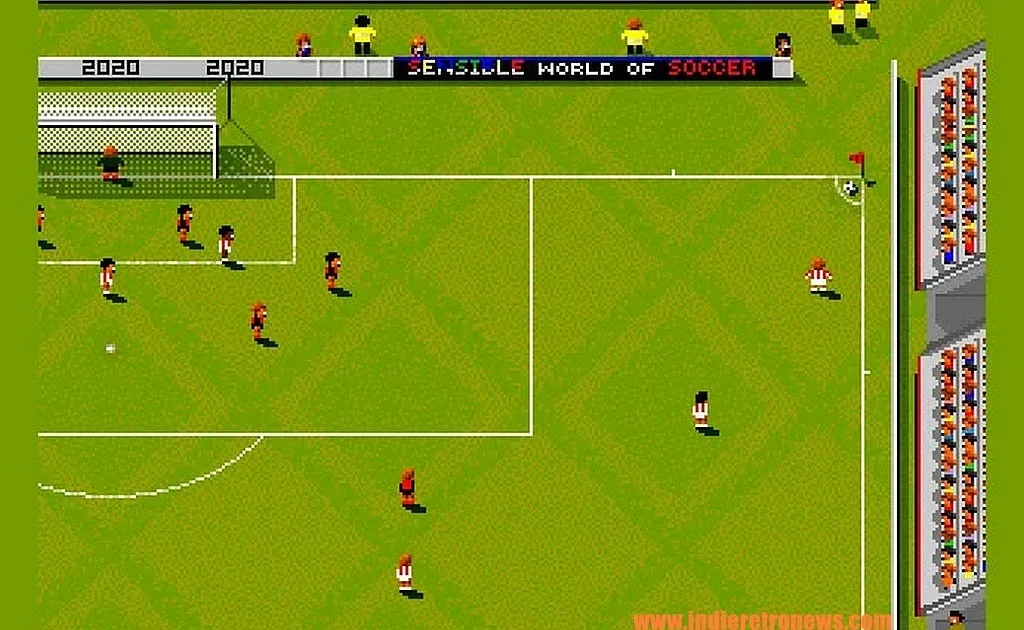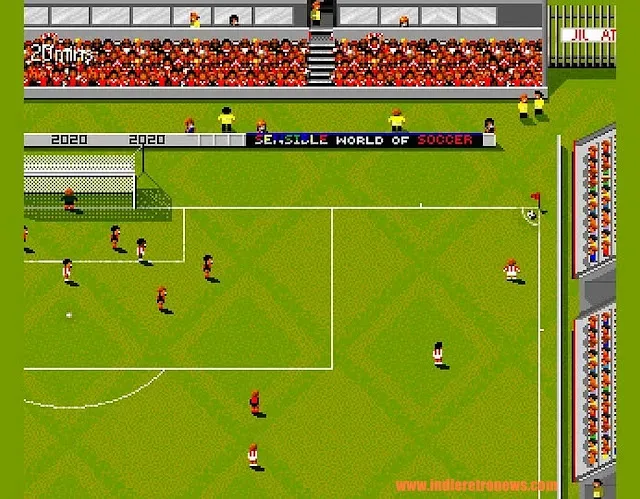
OpenSWOS is bringing Sensible World of Soccer 96/97 back to AGA-capable Amiga hardware with a ground-up C-language rewrite, a true 256-colour display target, and support for the modes that made the football favourite so enduring. The project is free, but it is not a turnkey download of the commercial game: users need to build it from their own legally owned game files before placing the completed drawer on an Amiga system.
That distinction is central to what OpenSWOS is trying to accomplish. This is not simply a setting that flips an existing release into a more colourful screen mode. The original release included an AGA version on its disks, but that version did not run in a true 256-colour mode. OpenSWOS rebuilds the game architecture in C, allowing the pitch and backgrounds to use that expanded colour palette while preserving the broad structure of the 96/97 experience.
What OpenSWOS changes
The headline upgrade is visual. A 256-colour palette gives the game more room for colour variation across the playing surface and surrounding backgrounds. In practical terms, a palette is the set of colours a game can draw from at a given time. More available colours do not automatically change the game’s rules, animation design, or underlying football systems, but they can allow artists and developers to represent gradients, grass tones, stadium details, and background elements with fewer compromises.
That matters particularly for an Amiga version built around AGA. AGA, short for Advanced Graphics Architecture, is the graphics chipset associated with later Amiga machines including the A1200 and A4000. It offered capabilities beyond earlier Amiga configurations, but merely having an AGA-labelled version of a game did not necessarily mean every possible display feature was used. OpenSWOS directly addresses that gap by targeting a full 256-colour presentation for its pitch and background work.
For more context, explore Poison Ivy Series Is in the Works at HBO, With The Penguin’s Lauren LeFranc Producing.
The project’s rewrite is also significant beyond the immediate visual upgrade. Reconstructing the program in C changes the codebase that supports the game. C is a programming language commonly used where direct control and performance matter, including older hardware. Here, the reported aim is not only to refresh the visuals but to create a foundation that can accommodate future additions. That should be read as potential rather than a promise of a defined feature roadmap: the available details establish that the rewrite opens a path for further work, not which features will necessarily arrive or when.
For players, the immediate appeal is a familiar package with a different technical presentation. OpenSWOS includes friendlies, full seasons, custom tournaments, and the signature 20-year career mode. Those options are important because they make the project more than a visual demo or a short exhibition-mode curiosity. The career mode remains the long-form component, while friendlies and tournaments provide quicker ways to return to the game’s football action.
The original AGA question, answered
One understandable question is why a new AGA-oriented version is useful when the original game already booted an AGA version from disk. The short answer is colour depth. The original AGA version was not itself a true 256-colour implementation. OpenSWOS is intended to provide that fuller palette while running as a native AGA release.
Related coverage includes OpenSWOS Brings a True 256-Colour Sensible World of Soccer 96/97 Experience to Amiga AGA.
“Native” is worth clarifying here. It means the software is built to run directly in the intended Amiga environment rather than being presented solely through a separate modern port layer. That does not make emulation unsupported. On the contrary, the project supports both original-style hardware and modern emulator setups. But native operation is meaningful for enthusiasts who want software that launches from Amiga Workbench and is designed around AGA-class machines.
The result is a project situated between preservation and development. It retains the familiar game modes and relies on legitimately owned original materials, while its code reconstruction and revised graphical target give it a technical identity of its own. That is a different proposition from running untouched disks, and it is also different from replacing the game with a wholly new football title.
Hardware and emulator requirements
OpenSWOS requires an AGA-capable Amiga, with the A1200 and A4000 cited as suitable examples, plus a 68020 processor or better. The 68020 is a member of Motorola’s 68k processor family, the hardware line closely associated with these Amiga systems. The requirement matters because it defines the baseline: this is aimed at later AGA-equipped Amigas rather than every machine in the wider Amiga family.
A stock A1200 is reported to handle matches at roughly 42 to 50 frames per second. Frame rate describes how many individual images are shown per second; a higher and steadier figure generally makes motion appear smoother. The stated range is useful because it sets expectations without claiming a locked result under every possible configuration. It indicates that the game is intended to be playable on unexpanded baseline hardware, rather than requiring users to assume that an accelerator or a more elaborate period-correct setup is mandatory.
Those who do not have original hardware can use WinUAE or FS-UAE, both of which are supported. An emulator is software that recreates the target machine’s environment on a current computer. This offers a practical entry point for players who want to explore the project’s AGA presentation without acquiring, maintaining, or configuring vintage hardware. It also means the experience is not restricted to a single physical setup, even though the finished build is designed around Amiga operation.
What users need to build it
OpenSWOS’s free status should not be confused with an included copy of Sensible World of Soccer 96/97. The build process uses a companion setup tool on a modern PC or Mac. Users supply data from games they legally own, then move the resulting SWOS drawer to the Amiga and launch it through Workbench.
The required materials are specific:
- Two original SWOS 96/97 .adf disk images.
- The PC retail version available through GOG.
- A modern PC or Mac to run the companion setup tool.
- An AGA-capable Amiga with a 68020 or better, or a supported WinUAE or FS-UAE configuration.
An .adf file is an Amiga Disk File image: a digital representation of an Amiga floppy disk. In this process, those images and the PC retail files are inputs rather than optional extras. The setup tool compiles the needed data into the final installation. “Compile” normally refers to turning source-oriented material into executable software, though in this case the practical takeaway is straightforward: the tool prepares a playable OpenSWOS installation using the specified owned assets.
Afterward, the completed SWOS drawer is transferred to the Amiga. A drawer is Amiga terminology for a folder or directory. Launching from Workbench means the finished game fits into the Amiga desktop environment rather than requiring users to treat the project solely as a disk-boot novelty.
This approach has a practical advantage for a reconstruction project: it does not present the original commercial game data as freely redistributed content. It also creates a higher entry barrier than downloading a self-contained freeware game. Prospective users should therefore check their files and preferred hardware or emulator route before assuming that the setup will be instant.
SWOS 2020 pitch compatibility
OpenSWOS also has a bridge to the modern community surrounding SWOS 2020. Owners of that release can port its custom pitches into OpenSWOS. A custom pitch is a modified or additional playing-field presentation, and the compatibility gives players a way to carry those assets into this retro-focused build.
That crossover is notable because it connects a newer community resource with an Amiga-targeted version of a much older football game. It does not mean OpenSWOS includes SWOS 2020, nor does it remove the separate ownership requirements for either product. Instead, it provides an option for players who already own SWOS 2020 and want to use its custom-pitch work in the rebuilt Amiga experience.
Why the rewrite matters beyond colour
It would be easy to reduce OpenSWOS to a “more colours” project, especially because the 256-colour display is the most visible change. That undersells the technical point. A ground-up rewrite changes how a program can be maintained and extended. The C-based architecture is described as opening the door to future features, which is an important capability for a community-minded revival even without a published list of additions.
There is also a preservation angle. Vintage games can remain playable in their original form, but maintaining compatibility, improving presentation within period hardware constraints, and allowing new work to build on a comprehensible codebase are separate goals. OpenSWOS appears to sit in that space: it preserves the core mode selection and system requirements of the classic while making a targeted improvement that the original AGA version did not deliver.
For football-game fans, the decision comes down to priorities. Players who want the original release exactly as it was may prefer their existing disks or emulated setup. Players interested in the same foundational game modes with a true 256-colour AGA presentation, Workbench launching, emulator support, and a route for custom SWOS 2020 pitches have a distinct reason to look at OpenSWOS. The need for owned source files is a meaningful condition, but it also makes clear that the project is a rebuild workflow rather than a substitute for obtaining the original game legitimately.
OpenSWOS therefore offers a focused modernization of Sensible World of Soccer 96/97: not a replacement for its identity, but a rebuilt native AGA route intended to make that identity look richer on the machines—and emulated machines—it was made for.