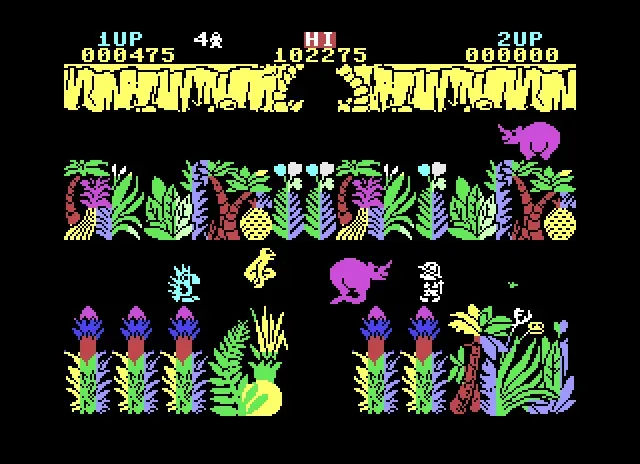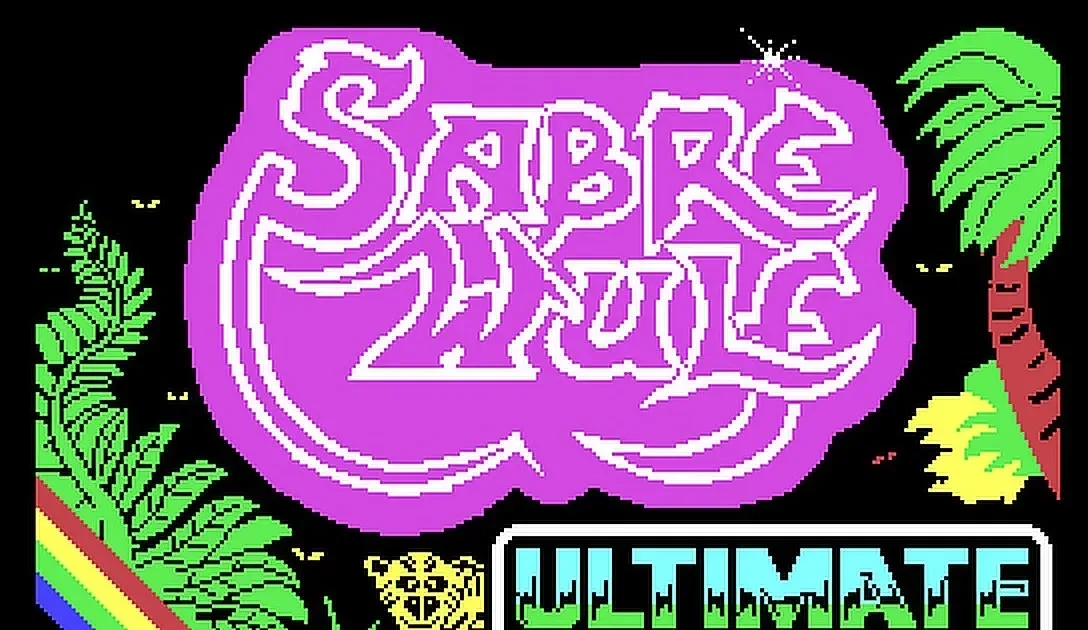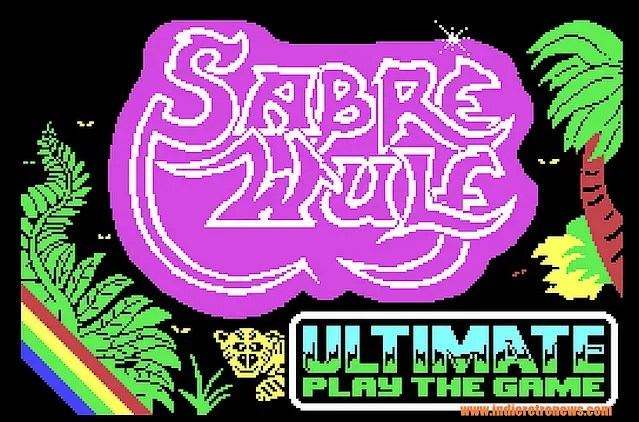
Sabre Wulf Remastered has been released for Commodore 64, bringing Ultimate Play The Game’s 1984 ZX Spectrum adventure to the machine in a newly modernised form. The project is coded by Sveinacious-G, with music by Greg Duddle, and credits the original design to Tim and Chris Stamper.
The key idea is preservation rather than reinvention. Its makers say that the creatures, core mechanics and even the original Spectrum version’s precise item-spawn rates have been retained. At the same time, the version is built on a new engine intended to make much fuller use of Commodore 64 sprite and audio hardware.
That makes this less a loose reinterpretation of Sabre Wulf and more a platform-specific reconstruction: the original game’s rules are meant to stay recognizable, while the C64 presentation and performance are given room to operate on their own terms.
It is also important not to confuse this release with another project carrying a similar description. This is an independent passion project and is separate from the forthcoming Genesis Project remaster.
A familiar jungle built around the original rules
The original Sabre Wulf is noted for an interconnected game map and for enemies that can continue to matter when they are no longer visible on-screen. Those design choices are significant because they make a small-screen adventure feel like a continuous place rather than a chain of isolated rooms.
An interconnected map means the game world is made of adjoining areas that lead into one another. Progress depends on learning where routes connect, remembering useful landmarks and making decisions about where to go next. In a game of this type, a room is not merely a combat arena; it is one part of a broader geography.
Off-screen enemy tracking refers to the game keeping track of enemies beyond the immediate display. In practical terms, that can make movement through the world feel less predictable: leaving an enemy behind does not necessarily mean it has ceased to be relevant. It is a technical and design detail that supports the sense that creatures inhabit the same wider map as the player.
The remaster’s stated commitment to preserve every creature and gameplay mechanic matters for anyone interested in the original’s structure. Changing enemy behavior, room logic or collectible timing would alter the texture of the adventure, even if its visual theme and player character remained the same. Keeping those elements intact suggests that the project treats the Spectrum release’s behavior as a central part of its identity.
Modern engine, C64-specific performance goals
Underneath that retained design is a completely modernised engine. The project targets a stable 50 frames per second on PAL systems and 60 frames per second on NTSC systems.
PAL and NTSC are regional television standards historically associated with different refresh rates. Here, the practical point is straightforward: the performance target changes with the regional machine standard, with PAL aiming for 50 FPS and NTSC aiming for 60 FPS. Frame rate describes how frequently the game image is updated each second; a stable target is intended to keep movement and animation consistent.
For a remake of an early home-computer game, performance is not simply a technical footnote. The pace of player input, enemy movement and transitions between the game’s connected areas shapes how the original rules feel in practice. A rebuilt engine can therefore improve fluidity without requiring new mechanics or a redesign of the game’s map.
The project also takes advantage of the C64’s custom sprite and sound capabilities. A sprite is a separately handled graphic object, commonly used for characters and other moving elements. Using the platform’s dedicated capabilities gives this version a C64-focused visual implementation rather than treating the machine as a passive destination for Spectrum assets.
That distinction is at the centre of the remaster’s appeal. The goal is not presented as replacing the Spectrum original, but as allowing its design to be expressed through the technical character of another classic computer. Readers following other modern releases on older hardware may also be interested in how current games are still finding audiences across platforms, as seen in a recent PC demo release built around an unusually specific concept.
Music with a direct C64 connection
Greg Duddle’s music is described as drawing from Firebird’s official 1985 Commodore 64 port, including its music and character optimisations. That gives the audio approach a particular historical anchor within the game’s C64 lineage rather than positioning it as wholly new scoring detached from prior versions.
Audio is a major part of the machine-specific identity here. The Commodore 64 is being used not only to display a revised version of the game but also to frame it through its own sound capabilities and an earlier C64 adaptation. The result, on paper, is a project concerned with continuity at multiple levels: Spectrum rules are retained, while C64-specific presentation is developed with reference to the official 1985 port.
Three visual options, including Spectrum colours
Visually, Sabre Wulf Remastered adjusts the artwork for the Commodore 64 palette. The default presentation is described as rich and deeply saturated, giving the game a color treatment tailored to the system rather than attempting to make it look exactly like the Spectrum release at all times.
A second option, called dusky, offers a more subdued atmosphere. The inclusion of a distinct alternate setting is useful because it acknowledges that color treatment is not a purely objective upgrade. One player may prefer the stronger saturation of the default mode, while another may want a less intense image.
There is also a dedicated ZX Spectrum color option. This setting is intended for people who want to reproduce the appearance of the 1984 original as closely as possible. It may appear somewhat muted on standard hardware, but the project notes that users with advanced systems such as the Commodore 64 Ultimate can use it to recreate the original look more accurately.
The three choices reveal a careful division between fidelity and adaptation. The default C64 palette treatment emphasizes the host system’s own visual identity. Dusky mode changes the atmosphere without changing the stated underlying game blueprint. Spectrum color mode, meanwhile, favors visual remembrance of the earlier version, even where that is not necessarily the most vivid match for ordinary C64 display conditions.
What this remaster is—and is not
The available details define a fairly clear set of expectations. This release is not described as a new sequel, a redesign of the map, or a version with altered creature behavior and revised item timing. Its central promise is that the Spectrum game’s blueprint remains in place.
Its changes instead concern the engine, performance targets, sprite use, audio and color presentation. That approach can be especially meaningful for retro game preservation because a game’s identity is more than its title, main character or broad objective. Timing, enemy persistence, map connections and item behavior are all part of how players remember a game working.
At the same time, “faithful” does not mean visually identical. The C64 palette work, alternate dusky option and Spectrum color mode explicitly allow different ways to view the game. The project therefore makes room for both a C64-forward rendition and a closer visual callback to the 1984 release.
Credits and project details
- Code: Sveinacious-G
- Music: Greg Duddle
- Original design: Tim and Chris Stamper
- Tools: TRSE, short for Turbo Rascal Syntax error, “;” expected but “BEGIN”
- Original copyright: 1984 A. C. G / Ultimate Play The Game
The project also states that no generative AI was used in its content. For Commodore 64 and Spectrum enthusiasts, the notable takeaway is a version that seeks to preserve the old game’s exact behavioral foundation while giving it a more fluid, C64-native technical presentation.