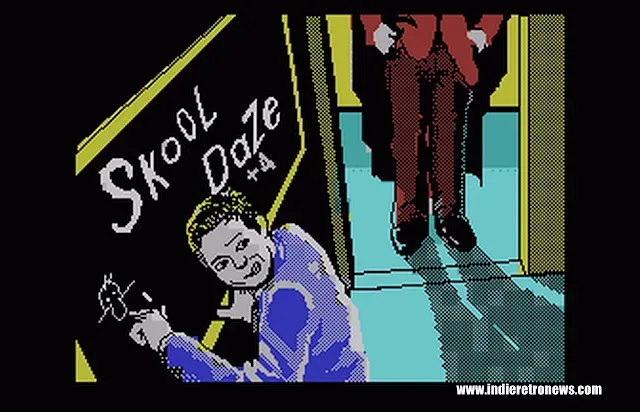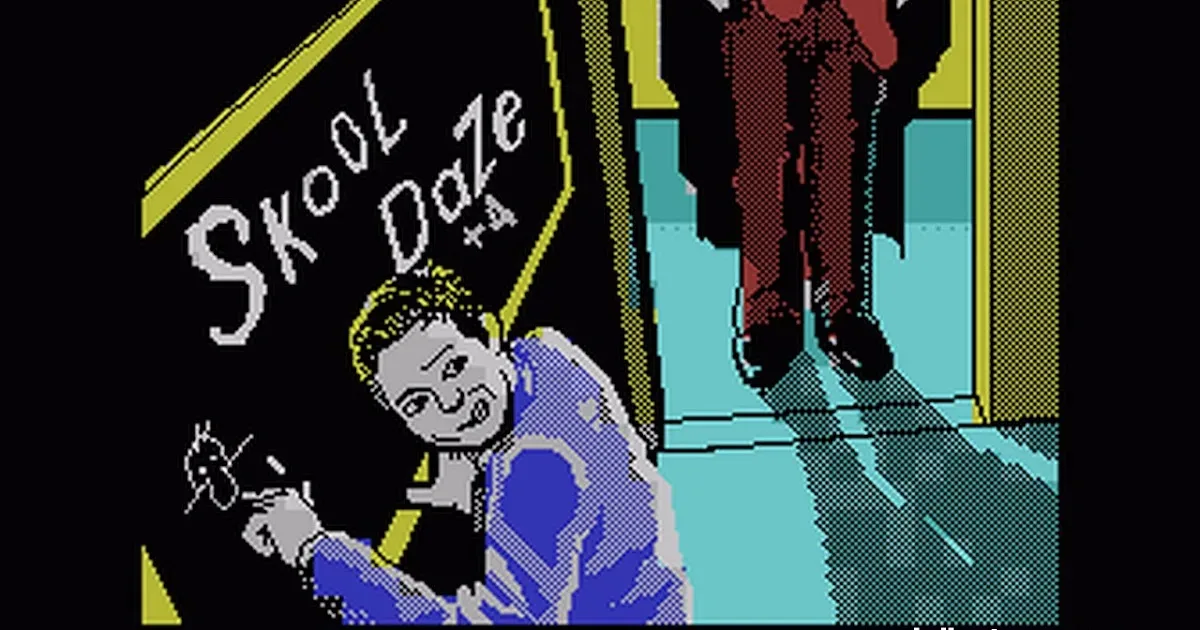
Skool Daze has received an unofficial Commodore Plus/4 adaptation from Proky and Csabo, bringing the school-set mischief game to another classic home computer. The version is described as a refreshed take on the original formula, with revised graphics, an updated musical score and new sound effects intended to modernize the presentation without abandoning the game’s central appeal: trying to cause just enough trouble to get what you want without spending the entire day in punishment.
That premise remains wonderfully direct. Players control Eric, a student whose report card is bad enough to inspire an extreme solution: get into the staff room safe and change it. The route there is not presented as a straightforward sequence of levels. Instead, Eric moves through a school populated by a headmaster, teachers and fellow pupils under computer control. Lessons continue, staff react, classmates occupy the building, and the player has to make decisions amid that ongoing activity.
It is a setting built for low-level mayhem. Eric has a catapult, an environment full of potential disruption, and a very real reason to avoid the adults running the place. Causing a disturbance can be tempting, but punishment lines accumulate if faculty catch up with him. The result is a game of timing and attention management as much as simple mischief.
A classic premise on a different Commodore
Skool Daze first appeared from Microsphere on the ZX Spectrum and later reached the Commodore 64. Its arrival on the Commodore Plus/4 comes decades after those releases, making this an unofficial platform debut rather than a newly conceived sequel or remake.
The Plus/4 is significant here because a port to a distinct machine is not merely a matter of placing the same program on different media. The adaptation’s developers have elected to refresh the audiovisual side of the game, with new art, music and sound effects specifically highlighted. That makes the project more than a bare historical conversion in intent, even as the underlying school-day structure and Eric’s goal remain recognizable.
For players interested in current projects around older computers, it sits comfortably alongside the kind of continuing homebrew and preservation-minded work represented by recent Amstrad CPC 6128 development. Different machines, different games, but the broader point is the same: vintage hardware continues to gain new software attention long after its original commercial era.
What “sandbox” means in Skool Daze
Skool Daze is frequently regarded as an early open-world sandbox pioneer. In modern game discussions, those words can suggest enormous maps, lengthy upgrade systems, or extensive quest logs. They mean something much more compact here.
Open-world, in this context, refers to the freedom to move around the school and pursue objectives within a shared space rather than progressing through a rigid chain of isolated stages. Sandbox refers to the emergent nature of play: the school’s inhabitants are computer-controlled and continue to behave within the game world, so the player’s actions unfold amid systems and reactions rather than against a single static puzzle screen.
Related coverage includes Skool Daze Brings Classroom Chaos to Commodore Plus/4.
That distinction matters because Eric is not simply asked to reach a finish line. He needs to negotiate the rhythms of school life. Attending lessons, evading angry teachers, setting off trouble and working toward the staff room safe all compete for attention. The school is both the game’s map and its mechanism for creating pressure.
The stakes are deliberately small-scale, but that is part of the charm. Altering a report card is a sharply defined objective, and the tension comes from the fact that the player must pursue it in a place designed to monitor and discipline them. A catapult may be useful for creating chaos, but it can also draw the sort of attention Eric is trying to avoid.
Why the computer-controlled cast matters
The adaptation’s description emphasizes a school where the headmaster, teachers and other students are controlled dynamically by the computer. That feature is fundamental to why Skool Daze is remembered as more than a simple classroom-themed action game.
A fixed obstacle always behaves the same way. A simulated cast can produce a sense that the building has its own routine and that the player is intruding on it. Teachers are not just decoration; they are part of the danger attached to breaking the rules. Students are not merely background art; their presence contributes to the school’s activity and chaos. The headmaster represents another layer of authority in a game whose entire goal depends on slipping around authority.
For practical play, this means observation and timing are as important as boldness. A disruptive move may create an opening, but it may also result in punishment. Going to class may seem like a delay when the larger aim is the safe, yet maintaining a low profile can be valuable when the faculty is watching. The game’s comedy comes from treating ordinary school routines as the backdrop to a miniature heist.
Refreshed presentation, familiar misbehavior
The new Plus/4 edition is said to include completely refreshed graphics alongside its updated music and lively sound effects. Those elements should help distinguish the adaptation visually and aurally while the game preserves its established scenario and character. No broader feature list, technical specifications or distribution details have been provided, so it is best to avoid assuming changes beyond the stated audiovisual refresh and the Plus/4 conversion itself.
That restraint is useful when considering retro adaptations. A new port can serve several audiences at once: Plus/4 owners who want a version for their own hardware, longtime Skool Daze fans curious about its presentation on another Commodore machine, and players interested in an important early example of system-driven game design. The evidence here supports all three possibilities, even if individual expectations will differ.
For anyone approaching it for the first time, the basic loop is easy to understand. Eric wants access to the staff room safe so he can fix his report card. He must navigate the school, account for its active population, attend lessons when necessary, avoid the consequences of being caught and decide when a burst of catapult-assisted disorder is worth the risk. The goal is not simply to make trouble; it is to make enough of the right trouble at the right moment.
A school game with unusually durable ideas
Skool Daze’s enduring reputation rests on how much personality its school setting can generate. The environment gives actions consequences that are immediately legible: teachers disapprove, the headmaster is a serious problem, lessons impose a schedule, and punishment lines are the price of misjudgment. Its systems are grounded in a familiar institution, then bent toward comic rebellion.
The Plus/4 version preserves that premise while giving it a newly refreshed coat of paint and sound. It is an unofficial return for a game rooted in 1980s home-computer culture, but it is also a reminder that a small, contained setting can still support flexible and memorable play. Eric may only be trying to improve one terrible report card. In the process, though, the entire school becomes his unpredictable playground.