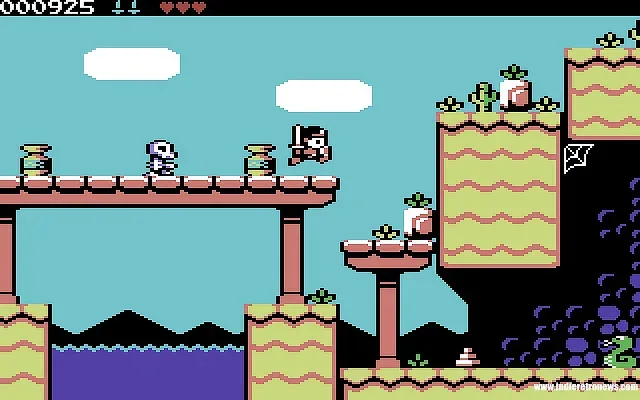

Blade of Victory is a fantasy action-platformer for the Commodore 64 that puts a pleasantly demanding wrinkle on its sword-swinging adventure: slaying monsters is only part of the job. Coins collected during the journey can be spent with merchants concealed within levels, and the choice between buying survival tools now or preserving funds for later is positioned as a central part of the challenge.
Developed by Donut 80, the game sends its hero after the Evil Warlock, whose defeat is the stated route to restoring peace to the land. The road is divided across eight distinct regions, including deserts, caverns, lakes and castles. That gives the adventure a broad fantasy itinerary without losing the focused structure of a platformer: make it through hazardous terrain, deal with enemies, look for secrets, and prepare for the next major encounter.
Eight regions, eight bosses, one warlock waiting at the end
The regional lineup establishes a useful sense of escalation. Deserts, shadowy caverns, dangerous lakes and tall castles imply environments with their own visual identities and navigation pressures, even though specific level mechanics have not been detailed. What is clear is that exploration matters: every stage contains secrets, so simply heading for the finish is not necessarily the whole assignment.
Each stretch of the campaign also feeds into a boss confrontation. Blade of Victory has eight unique bosses on the route to its final battle with the Evil Warlock. “Unique” is important here: it suggests the game is built around a series of distinct obstacles rather than repeatedly asking players to outlast one recycled heavyweight with a different backdrop.
For more context, explore 1933 Babe Ruth Yankees Cap With Decades of Documented Provenance Heads to Auction.
That boss-led pacing should make the player’s economy decisions more consequential. A boss is typically a pressure point in an action-platformer—the moment where positioning, attack timing and remaining health are tested at once. In Blade of Victory, the resources taken into that fight may depend on whether the player previously found a merchant and chose to make a purchase.
Sword attacks are not the only answer
The hero’s blade is the principal means of combat, but enemy stomps are also part of the toolkit. A stomp, in platformer terms, is an attack performed by landing on an opponent from above. It is often a positional option rather than a simple substitute for a weapon: getting above a foe requires a safe jump, a suitable opening and enough room to land without colliding with another danger.
That dual approach matters given the game’s enemy roster. Players will face skeletons, armoured knights, ghosts and unusual winged creatures. The supplied details do not specify which attacks or movement patterns belong to each type, so it would be premature to map out counters. But the combination of sword work and stomping means players are asked to pay attention to where opponents are, not merely whether they are in front of the protagonist.
For a game built around regional hazards and secrets, that is a promising fit. A sword can clear a path at ground level; a stomp can turn a jump into an offensive decision. The difference between the two adds a small but meaningful layer to encounters, particularly when a player must keep moving through a level rather than stop and trade blows.
The merchant system gives coins a purpose
Coins are not described as score-only pickups. In Blade of Victory, they are also currency for travelling merchants hidden inside levels. Those merchants can exchange gold for three known categories of item:
- Extra lives, which offer additional chances after failure.
- Health-boosting hearts, which improve the player’s ability to withstand damage.
- Diamonds that multiply score, which enhance score gains rather than directly increasing survival.
This is resource management: making choices with limited supplies where one useful purchase can rule out another. It does not mean the game has been described as a complex shop simulator, nor are item costs or merchant locations known. It does mean coins carry a decision attached to them, and that is a considerably different role from a collectible that disappears into an abstract tally.
Extra lives and health hearts have obvious practical value. A life provides recovery after a loss, while a health increase can help keep a run intact before that loss happens. Diamonds create a different kind of temptation. A score multiplier can be attractive to players who are pursuing points, but it may involve passing on a purchase with immediate defensive value. The game’s stated emphasis on managing gold suggests that trade-off is deliberate.
What to consider before spending
Without prices, maps or detailed enemy behaviour, there is no responsible universal buying order. Still, the structure described for Blade of Victory points to a few practical principles for players learning its systems:
- Explore carefully before committing to a route. Merchants are tucked away in levels, and stages include secrets. Leaving a section too quickly could mean missing a chance to convert coins into help.
- Value survival when a difficult encounter is approaching. With eight bosses in the campaign, a health or life purchase may matter more than a score benefit when progress is on the line.
- Do not assume every coin should be spent immediately. The game explicitly frames the choice to save or spend as important. Holding gold can preserve flexibility for a later merchant or a more urgent need.
- Separate a score run from a completion-minded run. Diamonds are score multipliers, while lives and hearts are survival purchases. Players may reasonably prioritize them differently depending on their goal.
These are not hidden-item locations or a boss guide—none have been provided—but they describe the likely decision-making loop. Search a stage, gather coins, assess current risk, find a merchant, then decide whether the immediate advantage is worth reducing the reserve for later.
Why the C64 setting is central to the appeal
Blade of Victory is specifically presented for C64 owners, not as a generic fantasy game that happens to use retro-styled graphics. Its design pitch leans into a compact, direct action-platforming formula: varied regions, monsters, secrets, bosses and a constrained economy. The machine is therefore part of the game’s identity, while the play loop is about balancing movement, combat and spending.
There is a useful distinction between exploration and simply searching every pixel. Here, exploration is supported by concrete incentives: hidden merchants and stage secrets. A player is not only looking around out of curiosity; they may be trying to find the means to improve their odds. Likewise, combat is not just an obstacle before the next jump. Damage, lost lives and the need to rebuild resources can affect the choices available later.
The result is a game premise with multiple pressures operating together. The path is dangerous because of terrain and enemies. The bosses set major tests along the way. Currency offers potential relief, but only after a player makes the right call about how to use it. That is a sturdy foundation for old-school action design, where a run can turn on both a well-timed stomp and a decision made at a merchant.
Players interested in the newly detailed C64 adventure can find the available game coverage at this Blade of Victory overview. The confirmed pitch is clear: take up a sword, cross eight regions, uncover what the stages hide, keep an eye on the coin total, and work toward the Evil Warlock’s final defeat.