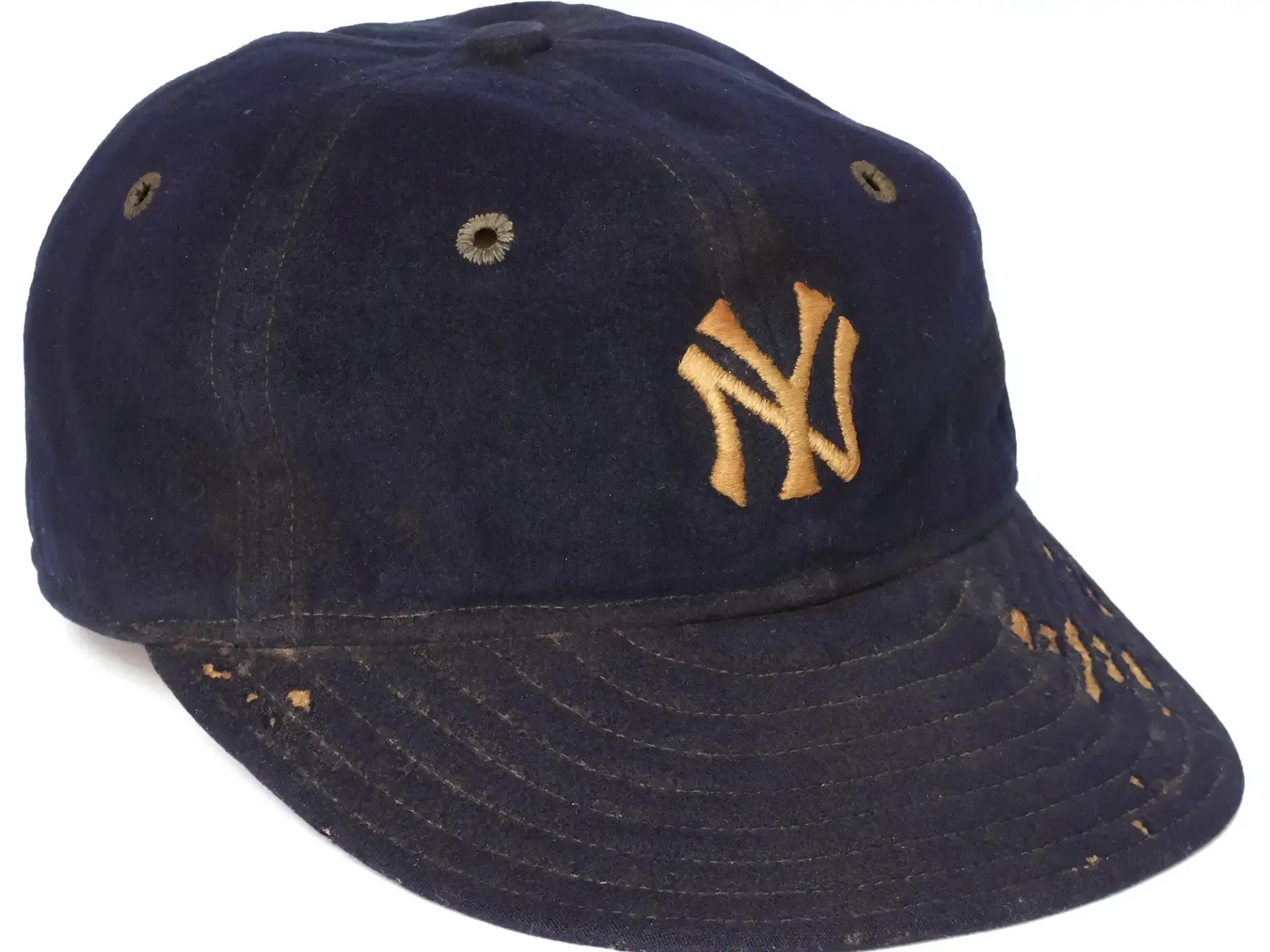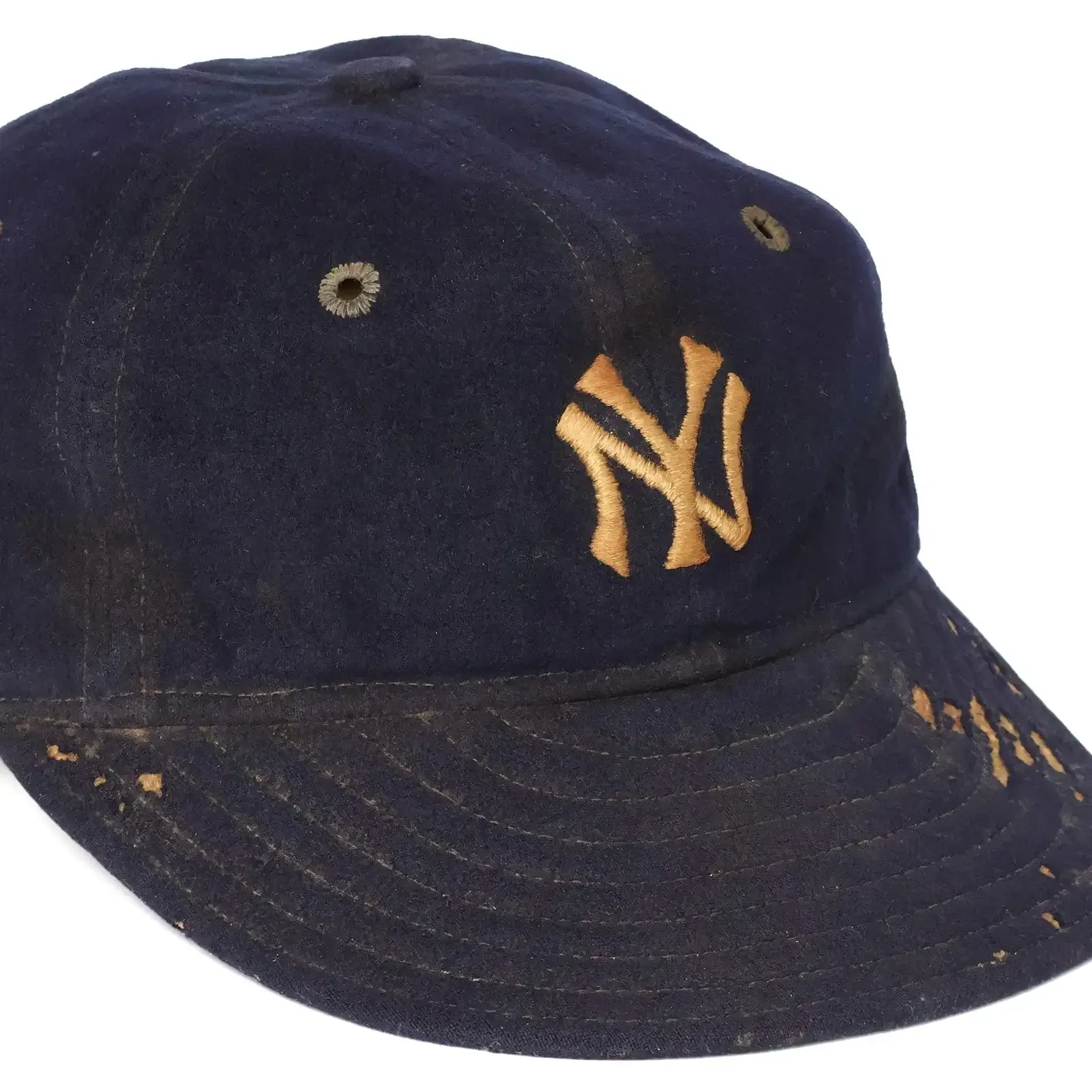
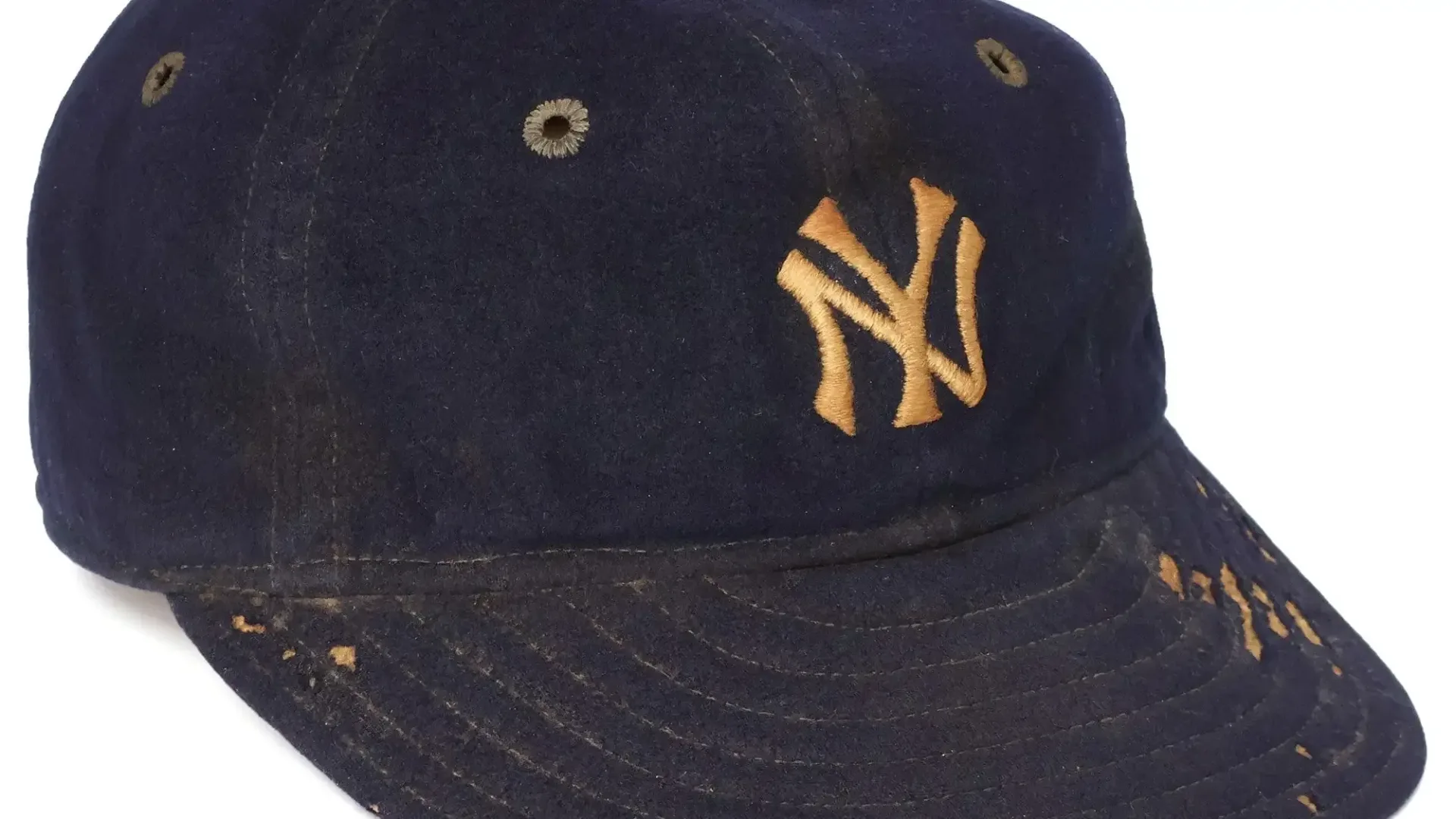
A Babe Ruth New York Yankees cap dating to the 1933 season is headed to auction with an unusually detailed ownership story attached. The navy Spalding cap is described as game-worn, bears an interior player identification reading “Ruth G.H.”, and has remained outside public auction until now.
The item is being offered by Love of the Game Auctions in its Fall Auction, which runs through Dec. 12. Its significance is not solely that it is linked to Ruth, but that its route from a Yankees clubhouse-era uniform supply to a private collection is supported by several layers of documentation.
A 1933 Yankees cap that took an unexpected detour
The cap’s known path begins in 1934, when Yankees business manager Ed Barrow loaned uniforms from the club’s 1933 season to the Mamaroneck Dodgers. The Dodgers were a semipro club playing in New York’s Westchester County Senior League.
Samuel Schaadt, a Mamaroneck first baseman and school teacher, received an especially memorable set of equipment during that season: Lou Gehrig’s uniform and Ruth’s cap. After the season, Schaadt returned the Gehrig uniform but retained the Ruth cap as a personal souvenir.
That distinction matters. The cap was not described as an item directly given away by Ruth, nor is it presented as a generic period Yankees cap later connected to him. Its claimed chain begins with 1933 Yankees equipment being loaned for the following year’s semipro use, then identifies Schaadt as the person who wore and retained this particular cap.
Schaadt kept it for the remainder of his life. After his death in 1976, the cap passed to his wife. In 1990, Schaadt’s daughter sold it directly to a private collector, together with a signed letter documenting its history. It stayed in that collector’s holdings for more than 30 years and, notably, had not previously been placed in a public auction.
What provenance means here
Provenance is the documented history of an object’s ownership and custody. In sports memorabilia, it is often one of the most important factors separating an intriguing old artifact from a collectible with a defensible historical identity.
For this cap, the offered support includes the 1990 letter from Schaadt’s daughter, contemporary newspaper accounts concerning the Mamaroneck Dodgers’ use of Yankees uniforms in 1934, and a letter of authenticity from MEARS. The newspaper material is particularly useful as contextual corroboration: it supports the underlying circumstance that makes Schaadt’s possession of Yankees gear plausible.
Related coverage includes 1933 Babe Ruth Yankees Cap With 90-Year Private Provenance Heads to Auction.
These records do slightly different jobs:
- The family letter addresses the cap’s passage from Schaadt’s household into private collecting hands.
- Contemporary newspaper accounts support the 1934 arrangement involving the Mamaroneck team and Yankees uniforms.
- The MEARS letter of authenticity represents an authentication opinion accompanying the item.
None of those categories should be treated as interchangeable. Authentication generally concerns whether an item is what it is represented to be, while provenance concerns the item’s ownership and historical trail. Contextual reporting can confirm that an event or arrangement took place without, by itself, identifying one exact cap. Together, however, the materials form a more informative package than a loose object with an undocumented Ruth attribution.
The physical details collectors will scrutinize
The cap is identified as a Spalding six-panel navy felt Yankees cap, a style said to be consistent with examples worn in the early 1930s. Inside are the embroidered “Ruth G.H.” identification and a partially visible Spalding stamp.
It also shows extensive use. The auction description notes wear to the sweatband as well as felt loss along the bill. For a game-used textile item of this age, condition is not a simple pass-or-fail matter. Heavy wear can reduce visual neatness, but it can also be compatible with a long-used object—provided that the item’s materials, construction, markings and documentation support its claimed history.
That is why prospective bidders tend to consider the full evidence set rather than isolating one detail. A clean-looking artifact is not automatically better documented, and a worn one is not automatically authentic. The key question is whether the physical object and the paper trail tell a coherent story.
Why the interior marking is important
The “Ruth G.H.” embroidery is the most direct player-specific feature described in the listing. Player identifications can be powerful evidence because they connect an object to a named user rather than merely to a team or era. Yet an identification is best understood as one component of the case, not the whole case. Collectors will want it considered alongside the cap’s period-appropriate form, its wear, the Spalding branding and the ownership history.
The partially visible manufacturer stamp adds another tangible detail. Spalding’s role is not, by itself, proof of Ruth use; it helps place the cap within the expected equipment context. The identification, construction and documents are what turn that period context into a specific attribution.
Why the 1934 Mamaroneck connection changes the story
The Mamaroneck Dodgers chapter gives the cap a narrative that is more complicated than the usual “star wore it, then it was saved” sequence. The cap reportedly moved from Yankees inventory into a semipro environment, where Schaadt wore it during the 1934 season. That means the object’s visible use may reflect more than one chapter of its life.
It also explains why a player of Schaadt’s background could possess a Ruth cap for decades. Without the uniform-loan arrangement, a cap’s appearance in the hands of a semipro first baseman and teacher might invite obvious questions. With the arrangement supported by period accounts and family documentation, the chain becomes easier to examine on its own terms.
For collectors, this is a reminder that the strongest stories are not always the shortest ones. A complicated path is not a weakness if it is explained and documented. In fact, a specific, evidence-backed account of how an item left its original setting can be more valuable than a vague claim that it came from “an old collection.”
What makes this an unusual Ruth offering
Ruth memorabilia has long been a major field within sports collecting, but the auction characterizes surviving examples of this type of cap as limited. This one has an added distinction: it has stayed with private collectors for roughly nine decades and has not been offered publicly before.
First public appearances can draw interest because the market has not already established an auction record or repeatedly circulated the same object through catalog listings. That does not guarantee an outcome, and no estimate or final price has been provided here. It does mean bidders will be evaluating an item with a newly public profile, rather than one whose auction history is already familiar.
The offering also illustrates a broader collecting principle: scarcity alone is not the entire appeal. A rare artifact with a murky origin may remain difficult to assess. Here, the scarcity claim is paired with a traceable family history, contextual reporting, an authentication letter and physical details that can be independently reviewed by interested buyers.
Practical takeaways for memorabilia bidders
This is a high-profile example, but the habits it highlights apply across historical sports artifacts, signed items, uniforms and equipment.
- Read every document for what it actually establishes. A letter from a family member, a period news account and an authentication letter carry different forms of information. Strong due diligence means separating direct knowledge from corroborating context.
- Match the claim to the physical object. In this case, details such as the felt construction, six-panel form, Spalding marking and interior embroidery are relevant to the stated identification.
- Do not confuse age-related wear with a complete answer. Wear may be consistent with use, but it should be evaluated with the item’s construction and ownership history.
- Value continuity of custody. A clear route from an original keeper to family, then to a known collector, is easier to assess than a long undocumented gap.
- Keep the auction record with the object. If acquired, catalog descriptions, letters and any associated paperwork are part of the collectible’s story and should remain together.
Documentation also matters in collecting categories far removed from baseball equipment. Whether the item is a century-old cap or a modern limited edition, the central questions remain familiar: what is it, where did it come from, and what evidence travels with it? That same attention to the object and its accompanying material shapes interest in items such as The Marvel Art of Peach Momoko Kickstarter collection, even though the format and era could hardly be more different.
The auction window
Love of the Game Auctions’ Fall Auction is scheduled to close Dec. 12. The Ruth cap arrives with a distinctive combination of player identification, period-consistent construction, substantial use and a specific ownership narrative running from the Yankees’ 1933 equipment through the Mamaroneck Dodgers’ 1934 season, Schaadt’s family and a long-term private collection.
For the eventual buyer, the cap is not just a recognizable Yankees artifact. Its appeal rests in the surviving evidence around it: an object whose history can be followed through an unexpected local-baseball detour before returning to public view decades later.