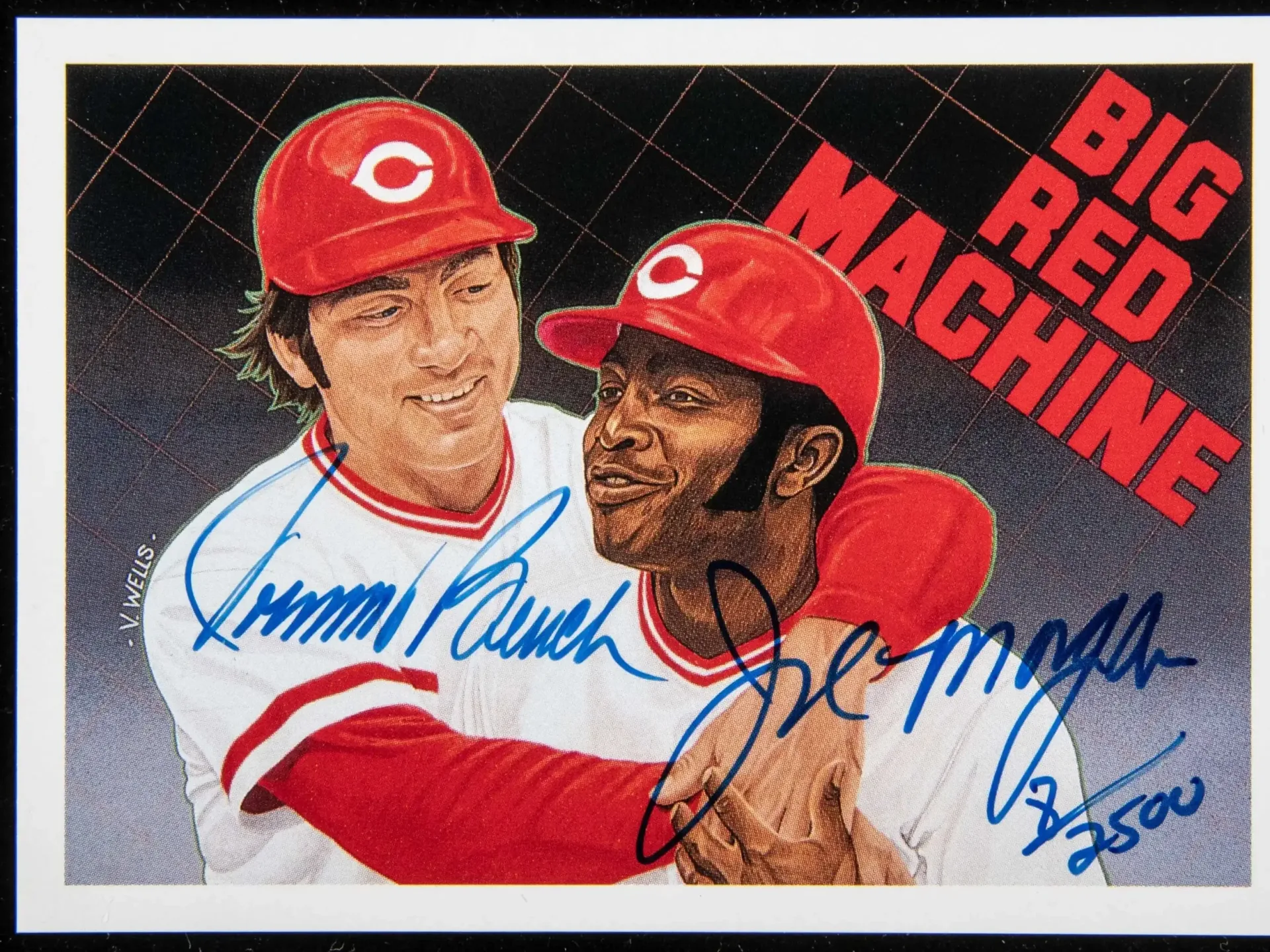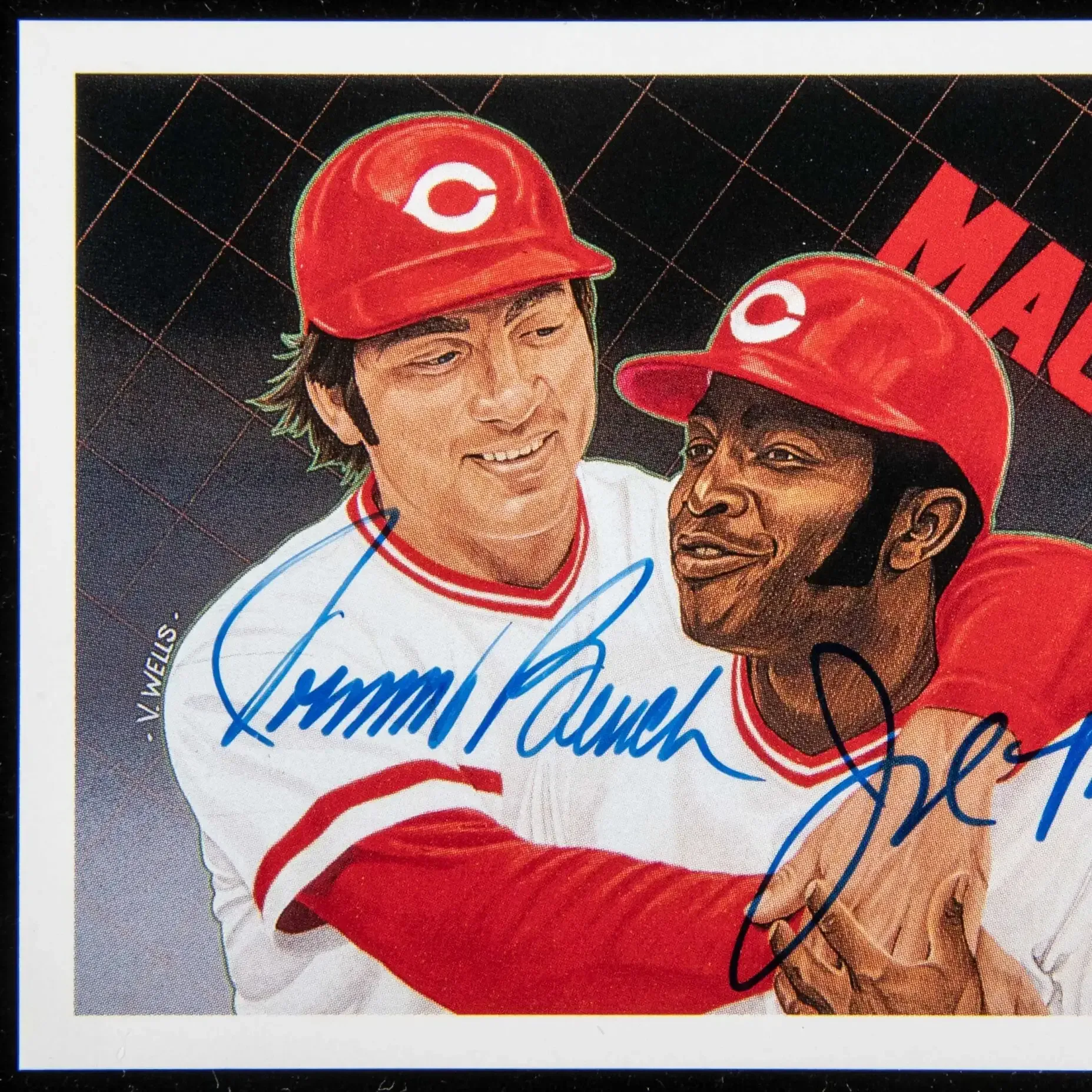
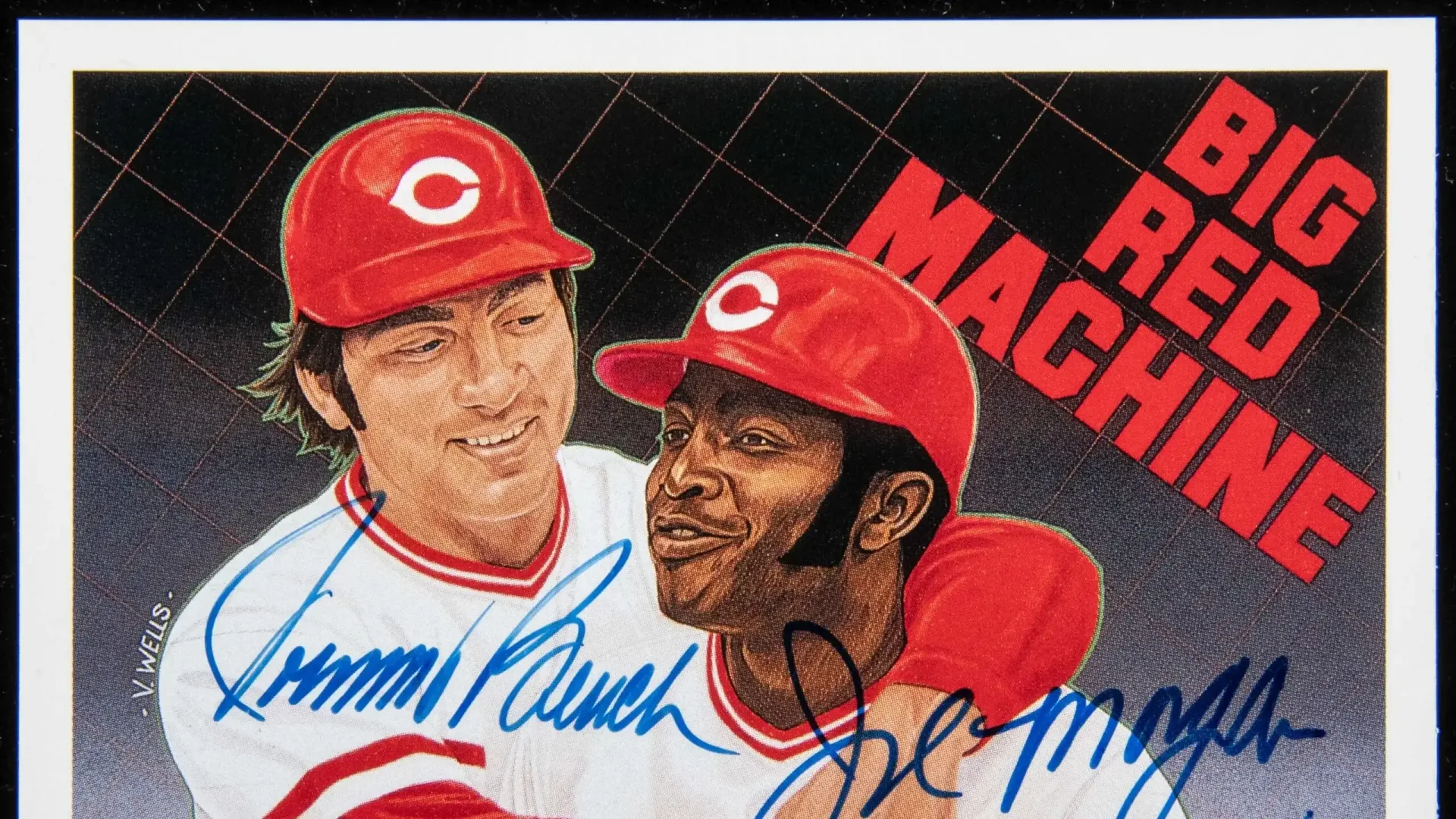
Joe Morgan’s place at the heart of Cincinnati’s 1970s “Big Red Machine” was reflected in a group of auction results that put the Hall of Famer’s biggest career mementos well into five figures. His 1975 Reds World Championship ring sold for $94,000, his 1976 ring realized $88,125, and the two National League MVP awards from those same seasons brought $94,000 and $96,937.
The pieces were part of the Joe Morgan Collection offered in a live auction held November 14 at the Louisville Slugger Museum & Factory in Louisville, Kentucky. Bidders traveled to the event to compete for items linked to a player whose influence reaches beyond a single category of memorabilia: Morgan was a 10-time All-Star, a two-time MVP, a five-time National League Gold Glove winner, a World Series champion twice over, a Hall of Famer, and later a prominent broadcaster.
For collectors, the results illustrate why player-owned awards and championship artifacts occupy a different lane from ordinary sports collectibles. A ring or MVP trophy does not merely reference an achievement. It is a direct physical record of one, tied to a specific season, a specific player, and a particularly famous stretch of Reds history.
The four biggest Morgan results were all tied to 1975 and 1976
Morgan joined Cincinnati in a 1971 trade after beginning his major-league career with the Houston Colt 45s/Astros in the 1960s. He had already made two National League All-Star teams before coming to the Reds, but his Cincinnati tenure established the career résumé now most closely associated with his name.
For more context, explore Future Says Camp Flog Gnaw’s ‘Throw Away’ Singalong Changed His Life Again.
With the Reds, Morgan made eight All-Star teams, earned five NL Gold Gloves and won NL MVP honors twice. The club won World Series championships in 1975 and 1976. That alignment of individual awards and team titles is central to the auction’s standout lots: each of the top four Morgan prices comes from the back-to-back championship period.
- 1975 Reds World Championship ring: $94,000
- 1976 Reds World Championship ring: $88,125
- 1975 NL MVP award: $94,000
- 1976 NL MVP award: $96,937
The 1976 MVP award was the highest-priced Morgan item reported, edging both the 1975 MVP and the 1975 championship ring. It is a useful reminder that auction demand is not governed by one simple hierarchy. Championship rings are highly personal symbols of team success, while MVP awards represent individual recognition. Here, both forms of career hardware had exceptional appeal.
The small difference among those four prices also suggests that bidders placed value on the story they tell together. The 1975 and 1976 seasons were not isolated highlights; they formed a consecutive run in which Morgan’s individual honors coincided with Cincinnati championships. Collectors often respond strongly when an item can be understood immediately within a larger, recognizable sporting narrative.
Related coverage includes Joe Morgan Rings, MVP Awards Command Major Prices in Louisville Auction.
More than rings and awards: trophies, a bat and Hall of Fame hardware
Several additional Morgan lots reached substantial results. His 1976 World Series presentational trophy sold for $67,503, while the corresponding 1975 presentational trophy brought $52,875. A Hall of Fame induction ring realized $30,550.
Those pieces chart the longer arc of Morgan’s life in baseball. The World Series trophies point to the Reds’ championship teams. The Hall of Fame ring connects to his election in 1990, after his playing career had ended. Morgan died in 2020 at age 77, and the collection’s offering gave buyers an opportunity to pursue objects that span his on-field peak and later institutional recognition.
A 1975 World Series professional-model bat sold for $21,150. “Professional model” is an auction-catalog term identifying a bat made to a major-league style or specification; by itself, it should not be treated as a claim that the bat was used in a particular game unless that specific use is documented. The reported lot description does tie the bat to the 1975 World Series, making its period association especially meaningful alongside Morgan’s championship ring and trophy from that year.
Another notable item, described as Joe Morgan’s “Sultan of Swat” Babe Ruth Crown, realized $26,437. The auction results identify the item and its price, but do not provide further background on the crown’s presentation or origin. That gap matters for collectors reading a results list: a memorable title can add intrigue, but the strongest conclusions should remain limited to what the item description actually establishes.
Why provenance is the crucial word in career collections
Provenance means an object’s documented history of ownership and custody. In sports memorabilia, it is often one of the most important factors separating an appealing vintage object from a player-owned artifact with a clear personal connection. The Morgan offering was built around memorabilia from Morgan’s collection, which gives the lots a direct association with the player.
That association does not eliminate the need for careful reading. Buyers considering sports artifacts should distinguish among several different claims:
- Player-owned: An item that belonged to the athlete.
- Player-issued or player-awarded: An item presented to the athlete, such as a ring, trophy or award.
- Professional model: An item made in a style used by professionals; this is not necessarily proof of game use.
- Game-used: An item attributed to actual use in competition, a claim that ideally comes with supporting documentation or authentication.
These distinctions are practical rather than academic. Two objects may look similar in a display case, yet carry dramatically different historical claims. Morgan’s MVP awards and World Series rings are powerful precisely because their relationship to his career achievements is inherent: they were recognitions awarded to him. A professional-model bat can be highly desirable as well, but the language used to describe it should be read with precision.
The broader sale also included a 1924 “Insurance City” Babe Ruth professional-model bat labeled PSA/DNA GU 9, which was the auction’s top-selling item at $158,625. The “GU” abbreviation commonly appears in catalog language as shorthand for game use, while the number is part of the listed PSA/DNA grade. The reported result establishes that this particular bat carried that designation; it does not, on its own, explain the grading criteria behind the 9. For prospective buyers, the key lesson is to review the specific certification and the item’s accompanying documentation rather than relying on a label alone.
Babe Ruth, Hank Aaron and a 1903 ticket also commanded attention
Morgan’s collection was a central draw, but the highest price across the sale belonged to the Ruth bat. Other vintage baseball artifacts also made their mark. A 1903 World Series ticket sold for $99,875, matching the price paid for a 1973 Hank Aaron Atlanta Braves professional-model road jersey. A 1920 Babe Ruth “Headin Home” promotional broadside reached $29,962.
A broadside is a printed sheet designed for public display or promotion. Unlike a baseball card, it is not necessarily a standardized collectible made for distribution in packs or sets. Its attraction can lie in its age, design, subject and survival. Likewise, an early World Series ticket offers a very different kind of baseball connection than a bat or uniform: it is a surviving admission artifact tied to a historic event.
Together, the varied results show that baseball collecting is not one uniform market. A championship ring, an MVP award, a game-related bat, an early ticket, a promotional print and a jersey appeal for different reasons. Some bidders seek direct player provenance. Others prioritize historical age, visual display, rarity, or an association with an iconic figure. The strongest auctions can bring those interests into the same room.
Morgan’s legacy gives the lots context beyond the price tags
Morgan’s career helps explain the intensity around the sale. He was known as the “Little General,” a nickname that captured both his stature and leadership on teams that became synonymous with 1970s baseball excellence. After retiring as a player, he remained closely connected to the sport as a television announcer and through service connected to the Baseball Assistance Team and the Hall of Fame.
“Joe was a champion of the game of baseball in so many ways,” Theresa Morgan said, noting that the family kept certain sentimental belongings while choosing to share other memorabilia with fans.
That choice defines the emotional dimension of a career collection auction. The objects were once personal possessions, but their sale transfers stewardship to new owners. For collectors, that can mean an opportunity to preserve and display a tangible link to a favorite player. For families, it can mean selecting which items remain private and which can begin a new chapter in public collecting culture.
The prices achieved by Morgan’s rings, MVP awards and presentational trophies confirm the enduring appeal of career-defining artifacts. They also offer a clear collecting principle: where an object joins a celebrated player to a specific, consequential moment in sports history, the item’s importance is often more easily understood—and more fiercely contested—than memorabilia with only a broad team or era association.